Funding Your Vision: Everything You Need to Know About Commercial Project Financing

Summary
Master commercial project financing: Unlock non-recourse loans, SPVs, cash flow waterfalls & global funding for your build.
What Is Commercial Project Financing (And Why It Matters for Large-Scale Deals)

Commercial project financing is a sophisticated funding method designed specifically for massive, capital-intensive projects—infrastructure, energy, real estate development, telecommunications, and mining—where repayment comes primarily from the project's own cash flows, rather than from the borrower's personal or corporate balance sheet. Unlike traditional corporate lending, which relies on the historical creditworthiness and existing assets of a company, project finance is forward-looking. It treats the project as a standalone economic unit, evaluating its viability based on future revenue streams and the strength of its contractual arrangements.
In the modern global economy, the scale of infrastructure and development needs has outpaced the ability of single corporations to fund them through traditional debt. Whether it is a multi-billion dollar solar farm, a cross-country pipeline, or a massive mixed-use urban development, these projects require a specialized financial architecture that can manage immense risk while providing the necessary leverage. This is where commercial project financing becomes indispensable.
Here's a quick breakdown of what that means in practice:
| Feature | What It Means for You |
|---|---|
| Repayment source | The project's future revenue (e.g., tolls, power sales, rents) pays back the loan |
| Liability | Limited or no recourse to the sponsor's other assets, protecting the parent company |
| Structure | Usually involves a Special Purpose Vehicle (SPV) to isolate assets and liabilities |
| Best for | Infrastructure, energy, real estate, telecom, mining, and large industrial plants |
| Key requirement | Predictable, contracted cash flows (e.g., off-take agreements, long-term leases) |
This approach unlocks funding for projects that are too capital-intensive for a traditional business loan. Instead of asking "Is the borrower creditworthy?", lenders ask "Will this project generate enough cash to repay the debt?" This shift in perspective allows developers to take on projects that are significantly larger than their own balance sheets would otherwise permit. However, this also means that the due diligence process is far more rigorous, focusing on technical feasibility, market demand, and legal protections.
Getting this right is not simple. In recent years, construction loan requirements have grown stricter, lender appetite has narrowed due to macroeconomic volatility, and many deals fall apart during underwriting—often because borrowers don't know what lenders are actually looking for. A project that looks great on paper can fail if the "bankability" of its contracts isn't established early on.
This guide breaks it all down in plain language, so you know exactly what to expect and how to position your project for success. We will explore the legal structures, the risk mitigation strategies, and the specific criteria that institutional lenders use to evaluate these high-stakes deals.
I'm Daniel Lopez, a loan officer at BrightBridge Realty Capital with hands-on experience guiding borrowers through complex commercial project financing structures across both residential and commercial deals. My focus is on helping investors and developers cut through the confusion, avoid costly mistakes, and close deals with confidence. I have seen firsthand how a well-structured project can secure funding even in tight credit markets, provided the fundamentals are sound.
Commercial project financing word roundup:
The Mechanics of Commercial Project Financing

To understand commercial project financing, you have to stop thinking about the "company" and start thinking about the "project" as its own living, breathing entity. In traditional corporate finance, a bank looks at your company’s balance sheet, its history, and its various lines of business. If the project fails, the bank can come after the whole company, seizing other assets or forcing a liquidation. This "full recourse" model is often too risky for developers tackling massive, multi-year builds.
In project finance, we "ring-fence" the project. This is done by creating a Special Purpose Vehicle (SPV)—a legal entity (usually an LLC or LP) created specifically to own and operate that one project. The SPV has no other business activities, no other assets, and no other liabilities. This structure allows for off-balance sheet financing, meaning the debt doesn't sit on the parent company's books, which can help the parent company maintain its own credit rating and borrowing capacity for other ventures.
The beauty of this is risk isolation. If you’re a developer in New York, NY, working on a massive new industrial facility, you don't want a hiccup in that one project to bankrupt your entire real estate empire. By using an SPV, the project’s risks are contained. If the project fails to generate revenue, the lender's recourse is limited to the assets held within that SPV. For a deep dive into these mechanisms, check out Project Finance Explained: Definition and Mechanism or read more info about Commercial Project Financing on our blog.
Types of Commercial Project Financing Structures
When we structure these deals, we’re essentially building a "capital stack." This stack determines who gets paid first, who takes the most risk, and how the project is governed. Here’s how the money usually breaks down:
- Non-recourse or Limited Recourse Debt: This is the "holy grail" for borrowers. In a non-recourse loan, the lender’s only claim if things go south is the project assets and cash flows. They can’t come after your personal home or other business assets. Limited recourse may involve some guarantees during the construction phase, which then "drop off" once the project reaches operational stability.
- Senior Debt: This is the first layer of the cake. It has the highest priority for repayment and usually covers 60% to 75% of the project cost. Because it is the safest position, it carries the lowest interest rates but comes with the strictest covenants.
- Subordinated Debt (Mezzanine): This sits between the senior debt and equity. It’s riskier for the lender because they only get paid after the senior debt holders. Consequently, it comes with higher interest rates and sometimes "equity kickers" (the right to convert debt into ownership).
- Preferred Equity: This is a hybrid. It’s equity, but it gets paid back before the common equity (the sponsor’s money). It provides a way for developers to fill a funding gap without giving up full control of the project.
Navigating Commercial Project Financing Risks
Lenders aren't just giving money away; they are professional risk managers. In commercial project financing, we look at four major risk categories, each of which must be mitigated through contracts or insurance:
- Construction Risk: Will the project be built on time and on budget? Delays can be catastrophic because they postpone the start of revenue generation. This is why lenders love "turnkey" EPC (Engineering, Procurement, and Construction) contracts where the contractor assumes the risk of cost overruns.
- Operational Risk: Once it's built, will it actually work? If it’s a power plant, will it generate the megawatts promised? Lenders often require an experienced Operations and Maintenance (O&M) provider to be under contract before funding.
- Financial Risk: This involves interest rate fluctuations, inflation, or currency risks if the project is international. Hedging strategies, such as interest rate swaps, are common requirements in the loan agreement.
- Volume/Market Risk: Will people actually use the project? For a toll road, will enough cars drive on it? For a warehouse, will tenants pay the expected rent? This is often the hardest risk to mitigate, which is why long-term "off-take" agreements are so highly valued.
Key Structures: Non-Recourse Loans and the Cash Flow Waterfall
Understanding the difference between how a project is funded versus how a corporation is funded is crucial for your strategy. In project finance, the project is the borrower, and its assets are the only collateral. This requires a much higher level of transparency and a much more rigid structure for how money moves through the system.
| Factor | Corporate Finance | Project Finance |
|---|---|---|
| Borrower | Existing Company with multiple assets | Newly formed SPV with one asset |
| Primary Security | All company assets and future earnings | Project assets, contracts, and cash flow |
| Recourse | Full recourse to the parent company | Limited or non-recourse to the sponsor |
| Debt-to-Equity | Often lower (1:1) to maintain credit | Often higher (3:1 or 4:1) due to contract security |
| Due Diligence | Focus on historical financial statements | Focus on future projections and contracts |
For more details on debt options, see more info about Commercial Real Estate Loans.
Understanding the Cash Flow Waterfall
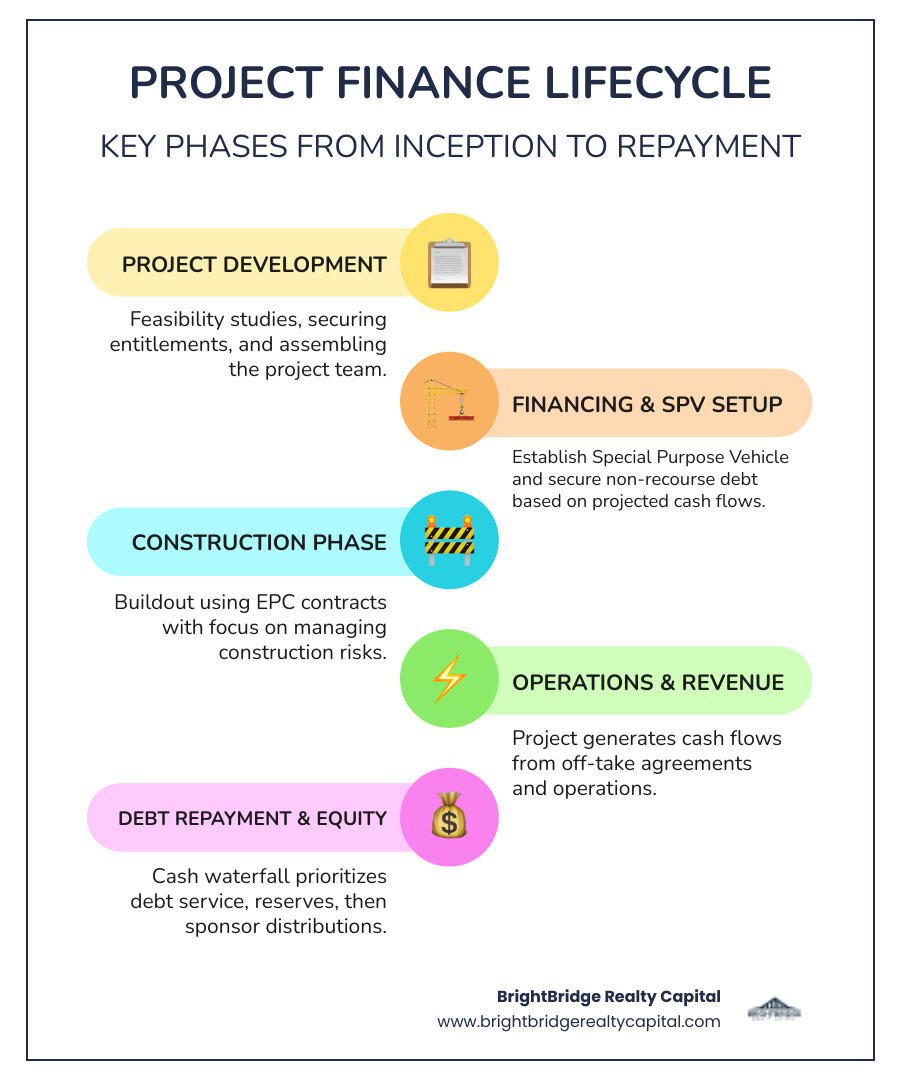
In commercial project financing, the "Cash Flow Waterfall" is the legal document that tells the project’s money where to go. It is a strict hierarchy that ensures the most critical obligations are met before any profit is distributed to the owners. This waterfall is usually managed by a third-party trustee to ensure compliance.
- Operating Expenses (Opex): First, you pay the people keeping the lights on. This includes staff salaries, utilities, insurance premiums, and routine maintenance. If you don't pay these, the project stops working, and no revenue is generated.
- Debt Service: Next, you pay the lenders. This includes interest payments and scheduled principal repayments. In many deals, this is the largest single line item in the waterfall.
- Reserve Accounts: Then, you fill up the "rainy day" funds. Lenders typically require a Debt Service Reserve Account (DSRA), which holds 6 to 12 months of debt payments in case of a temporary revenue dip. There may also be a Maintenance Reserve Account (MRA) for major future repairs.
- Subordinated Debt: If there is mezzanine financing, those lenders are paid after the senior debt and reserves are satisfied.
- Sponsor Dividends: Finally, if there is money left over after all obligations and reserves are met, the equity investors (the sponsors) get a distribution. This is the "incentive" that drives the project.
The Role of the Special Purpose Vehicle (SPV)
The SPV is the legal "shield" of the project. It is designed to be bankruptcy-remote, meaning that if the parent company (the sponsor) goes bankrupt, the project can keep running because it’s a separate legal entity with its own assets and contracts. Conversely, if the project fails, the SPV structure prevents the project's creditors from seizing the parent company's assets. This isolation is what makes non-recourse lending possible and allows multiple partners to collaborate on a single project without merging their entire businesses.
Essential Components of Commercial Project Financing Deals
A project is only as strong as the contracts that support it. Lenders look for "bankability"—basically, a high degree of certainty that the project will succeed regardless of market fluctuations. Because the lender has no recourse to the sponsor, they must be absolutely sure that the project's contractual framework is airtight.
Critical Documentation and Agreements
You’ll need a mountain of paperwork, but these are the heavy hitters that define the project's viability:
- EPC Contracts: A "full wrap" EPC (Engineering, Procurement, and Construction) contract is the gold standard. In this arrangement, a single contractor takes responsibility for the whole build at a fixed price and a guaranteed completion date. If they are late or over budget, they pay liquidated damages to cover the project's lost revenue.
- Off-take Agreements: This is a contract with a buyer who agrees to purchase the project’s output (like electricity, natural gas, or manufactured goods) for a long period, often 15 to 25 years. This "guaranteed revenue" is what allows lenders to feel comfortable providing large amounts of debt.
- Operations and Maintenance (O&M) Agreements: These contracts ensure that the project will be professionally managed once construction is complete. Lenders want to see a reputable firm with a track record of operating similar facilities.
- Loan Agreements and Intercreditor Deeds: These define the relationship between different lenders. If there are multiple banks involved, the Intercreditor Deed ensures everyone knows their place in the waterfall and who has the right to make decisions in a default scenario.
- Collateral Assignment: This gives the lender the right to "step into the shoes" of the borrower. If the borrower defaults, the lender can take over the project’s contracts, finish construction, and operate the facility to recover their investment.
Ensuring Bankability through Long-Term Contracts
Revenue certainty is the heartbeat of commercial project financing. If you are building a solar farm, a Power Purchase Agreement (PPA) with a creditworthy utility is essential. It guarantees that someone will buy your power at a set price for 20 years, shielding the project from volatile electricity market prices. Similarly, in real estate, a long-term lease with a credit-rated tenant (like a government agency or a Fortune 500 company) provides the same level of security. Without these long-term contracts, the risk is often too high for traditional project finance, and the project may have to rely on more expensive, shorter-term corporate debt. For more on the scope of these deals, visit Project Financing Overview and Industry Scope.
Global and Government Funding Sources
While we at BrightBridge focus on direct, fast-closing private solutions for domestic projects, many massive international or high-impact projects leverage government-backed institutions. These entities often provide "patient capital" or risk mitigation that private banks cannot offer on their own.
Leveraging Multilateral Development Banks (MDBs)
MDBs like the World Bank, the International Finance Corporation (IFC), or the African Development Bank extend nearly $50 billion in loans and grants annually for social and economic development. They often step in when private lenders find a project too risky due to its location or the novelty of the technology. Their involvement often acts as a "seal of approval," encouraging private commercial banks to join the lending syndicate.
U.S. Government Agencies for International Projects
For U.S.-based companies looking to export their expertise or build infrastructure abroad, several agencies offer specialized support:
- EXIM Bank: The Export-Import Bank of the United States provides "limited recourse" project finance, looking to future cash flows rather than foreign government guarantees. They are particularly active in the energy and satellite sectors, helping U.S. companies compete globally.
- U.S. International Development Finance Corporation (DFC): The DFC is the U.S. government’s development finance institution. It partners with the private sector to solve critical challenges in the developing world, providing debt financing, equity investments, and political risk insurance. This insurance is vital for projects in regions where the risk of expropriation or political violence is high.
- USTDA and MCC: The U.S. Trade and Development Agency (USTDA) and the Millennium Challenge Corporation (MCC) provide technical assistance, feasibility studies, and grant funding to help "de-risk" a project before it ever breaks ground. By funding the early-stage engineering and environmental studies, they make projects more attractive to commercial lenders.
The Role of Export Credit Agencies (ECAs)
In addition to the U.S. agencies, almost every developed nation has an ECA (like Euler Hermes in Germany or SACE in Italy). These agencies provide guarantees to commercial banks, promising to pay back the loan if the project fails due to specific risks. This allows commercial lenders to offer lower interest rates and longer repayment terms, which are essential for the thin margins of large-scale infrastructure.
Securing Approval: Eligibility and Sponsor Requirements
Lenders are "rich" in loan requests but "poor" in high-quality, bankable projects. To stand out in a crowded market, you need to think like a marketer and a risk manager simultaneously. You aren't just asking for money; you are selling a vision that is backed by hard math, legal certainty, and a proven track record.
Lender Underwriting Criteria
In today’s market, institutional lenders have become more conservative. They are looking for "margin of safety" in every metric. Here are the benchmarks we look for at BrightBridge and across the industry:
- Loan-to-Cost (LTC) Ratios: While 75% was once common, many institutional lenders are now shrinking loan sizes to 65% LTC for larger projects ($50 million+). This means the sponsor must bring more "skin in the game" in the form of cash equity.
- Debt Service Coverage Ratio (DSCR): This is the most critical metric. We want to see a DSCR of 1.5x ideally, though some highly stable projects (like those with government off-takers) may go down to 1.3x. This means the project generates 50% more cash than is needed to pay the debt, providing a buffer for unexpected expenses.
- Debt Yield: This measures the project's return regardless of the loan's interest rate. An ideal debt yield at loan exit is 10% or above. It tells the lender how quickly they could recover their money if they had to take over the project.
- Shovel-Ready Status: Is the project "entitled"? Does it have all the municipal approvals, environmental permits, and zoning clearances? Lenders rarely fund projects that are still in the speculative phase. You must demonstrate that construction can begin almost immediately after the loan closes.
For more on how to structure these, see more info about Real Estate Development Financing.
Common Red Flags and Pitfalls
Avoid these mistakes to keep your deal from falling apart during the intensive due diligence phase:
- Unentitled Land: If you don't own the land or don't have the permits, most lenders will pass. Land carry loans are different from project finance; project finance requires a clear path to revenue.
- Inexperienced Teams: If you haven't built a project of this scale before, you need to partner with someone who has. Lenders look at the "Sponsor's Track Record" as a primary indicator of success. If you are a first-time developer, consider a joint venture with an established firm.
- Lack of Liquidity: For smaller deals, lenders often want to see the borrower have a net worth equal to the loan amount and 10-15% liquidity. This ensures that if there is a minor cost overrun, the sponsor can cover it without the project stalling.
- Unsubstantiated Projections: Don't just "reverse engineer" your numbers to make the DSCR look good. Use real market data, third-party feasibility studies, and conservative growth estimates. Lenders will hire their own consultants to verify your numbers, and any discrepancy can kill your credibility.
Frequently Asked Questions about Commercial Project Financing
How does project financing differ from traditional corporate loans?
Traditional corporate loans rely on the entire company's ability to pay, using the company's existing assets and diverse revenue streams as collateral. If one part of the company fails, the others can cover the debt. Commercial project financing relies almost exclusively on the project's future cash flow, using the project's assets (held within the SPV) as collateral. It is a "stand-alone" credit decision.
What is a non-recourse loan in commercial project finance?
A non-recourse loan is a type of loan where the lender's only source of repayment is the project's assets and revenue. If the project fails, the lender cannot pursue the borrower's personal assets, their home, or their other business interests. Because this is riskier for the lender, they typically limit Loan-to-Value (LTV) ratios to 60% and require much more extensive due diligence and higher interest rates than recourse loans.
Which industries most commonly use project financing?
It is most common in capital-intensive industries with long-term lifespans and predictable outputs, such as:
- Energy: Power plants, solar farms, wind farms, and natural gas pipelines.
- Infrastructure: Toll roads, bridges, airports, sea ports, and tunnels.
- Real Estate: Large-scale multifamily complexes, industrial logistics hubs, and mixed-use developments.
- Telecommunications: Fiber-optic networks, data centers, and satellite systems.
- Mining and Natural Resources: Large-scale extraction and processing facilities.
What is a "Take-or-Pay" contract?
A "Take-or-Pay" contract is a common feature in project finance where the buyer (off-taker) agrees to either take the product (e.g., electricity) or pay a penalty that is roughly equal to the purchase price. This ensures the project has the cash flow to pay its debt even if the buyer doesn't actually need the product at that moment.
How long does it take to close a project finance deal?
Because of the complexity of the contracts and the depth of the due diligence, traditional bank-led project finance can take 6 to 12 months to close. However, private lenders like BrightBridge can often move much faster, focusing on the core economics of the deal to provide bridge funding or construction starts in a fraction of that time.
Conclusion
Securing commercial project financing is a marathon, not a sprint. It requires a perfect alignment of legal structure, contracted revenue, and a rock-solid development team. The process is rigorous because the stakes are high; you are essentially asking a lender to become a silent partner in a massive venture where the only guarantee of repayment is the success of the project itself. Whether you are building a new industrial park in New York or a renewable energy plant in the Midwest, the key is to present a "bankable" project that mitigates risk at every turn.
At BrightBridge Realty Capital, we understand that in the world of development, time is the most expensive commodity. While the big institutional banks might take months to move through their various committees and layers of bureaucracy, we specialize in quick, flexible funding for serious investors. We look past the red tape to see the underlying value of your project. Because we are direct lenders, we cut out the intermediaries, offering you competitive rates and a streamlined process that respects your timeline.
We pride ourselves on fast closings, often getting you the capital you need to break ground or secure a site in as little as a week. Our team has the expertise to handle the complexities of SPVs, mezzanine layers, and construction draws, ensuring that your financing is a tool for growth rather than a hurdle to overcome.
Ready to bring your vision to life? Whether you need a construction loan for a new development or are looking for more info about our rental loans to stabilize an existing asset, we are here to help you bridge the gap between your plans and your finished project. Reach out to us today, and let’s get your project funded and moving forward.