The Final Stretch How Construction Completion Financing Works

Summary
Rescue your stalled project! Discover how Construction completion financing provides the lifeline to finish strong and boost value.
Why Construction Projects Need a Financial Lifeline
Construction completion financing is a highly specialized form of rescue capital, meticulously designed to serve as a financial lifeline that bridges the funding gap when a construction project unexpectedly stalls. This isn't just another loan; it's an emergency intervention. It provides the crucial injection of funds precisely when original construction loans are depleted due to unforeseen cost overruns, supply chain disruptions, or a host of other common issues. By stepping in at this critical juncture, it empowers developers to push through the final stages of construction, thereby preserving their initial investment and preventing a catastrophic financial loss.
Key Facts About Construction Completion Financing:
- Purpose: Emergency funding for partially-built projects when original financing falls short, designed to rescue the developer's equity.
- Speed: Closes in 7-14 days with specialized lenders, a stark contrast to the 60-90 days typical for traditional bank loans.
- Focus: Underwriting is based on the project's final value (After-Repair Value or ARV) and the cost to complete, not solely on the borrower's credit history.
- Loan Terms: Typically short-term (12-24 months) with interest-only payments to minimize cash flow strain during the final construction phase.
- Value Impact: Successfully completing a stalled project often increases its market value by 30-50% compared to its 'as-is' distressed state.
- Exit Strategy: A clear exit is planned from the outset, usually through a refinance into permanent financing or a profitable sale upon completion.
The stark reality is that construction is fraught with uncertainty. Industry research consistently shows that a staggering 60% of construction projects exceed their initial budgets. This isn't a sign of poor planning but a reflection of the industry's inherent volatility. When budget overruns occur, developers are often forced to find emergency capital to reach completion. Traditional lenders, who are comfortable funding a project from a clean slate, are notoriously hesitant to finance partially-complete projects, viewing them as damaged goods. This is precisely the scenario where construction completion financing becomes an indispensable lifeline.
Consider this real-world example: a developer was building a 24-unit mixed-use project, a promising venture in a growing neighborhood. The project stalled at 65% completion. The original loan was fully drawn, and unexpected spikes in material costs and labor shortages had exhausted the contingency fund. Facing foreclosure and the loss of millions in invested capital, the developer secured a completion bridge loan. This provided the necessary $1.2 million to finish construction, navigate the final inspections, secure the certificate of occupancy, and ultimately achieve a profitable exit through sale, turning a potential disaster into a success.
The financial mathematics are dramatic and unforgiving. Incomplete projects, when sold under duress, typically fetch only 40-60% of their potential completed value. A strategic completion loan allows a developer to capture that missing 40-60% of equity and transform a project on the brink of failure into a highly profitable venture.
At BrightBridge Realty Capital, we specialize in helping developers navigate the complexities of construction completion financing. Our expertise lies in rescuing stalled projects and maximizing their returns. Understanding your financing options before a crisis hits is the most critical step in protecting your investment and ensuring your vision becomes a reality.
What is Construction Completion Financing and Why is it a Lifeline?

When a construction project stalls due to unexpected costs, contractor issues, or unforeseen delays, it sits unfinished—a silent monument to locked-up capital. Each passing day drains resources through mounting carrying costs like insurance, taxes, and interest payments. Construction completion financing is the specialized rescue capital that breathes life back into these projects. It is specifically structured for developments that are already underway but are facing a critical funding shortfall. Unlike traditional construction loans that fund projects from the ground up, completion financing is a flexible, fast-acting solution designed to bridge the final, most crucial gap and get your project across the finish line.
The primary, most immediate benefit is the critical act of salvaging your initial investment. A partially built structure is more than just an eyesore; it's a rapidly depreciating liability. Letting a project sit incomplete exposes you to the imminent risk of foreclosure from your original lender, which would not only wipe out your hard-earned equity but also severely damage your professional reputation. Completion financing acts as a shield, protecting that foundational investment and unlocking the significant latent value trapped within the unfinished asset. An incomplete building is a financial drain, but a finished one is a valuable, income-producing, or sellable asset. Industry data consistently shows that completing a stalled project can increase its market value by a staggering 30-50%—a monumental leap in potential profit that would otherwise be lost.
The Core Differences: Completion vs. Traditional Loans
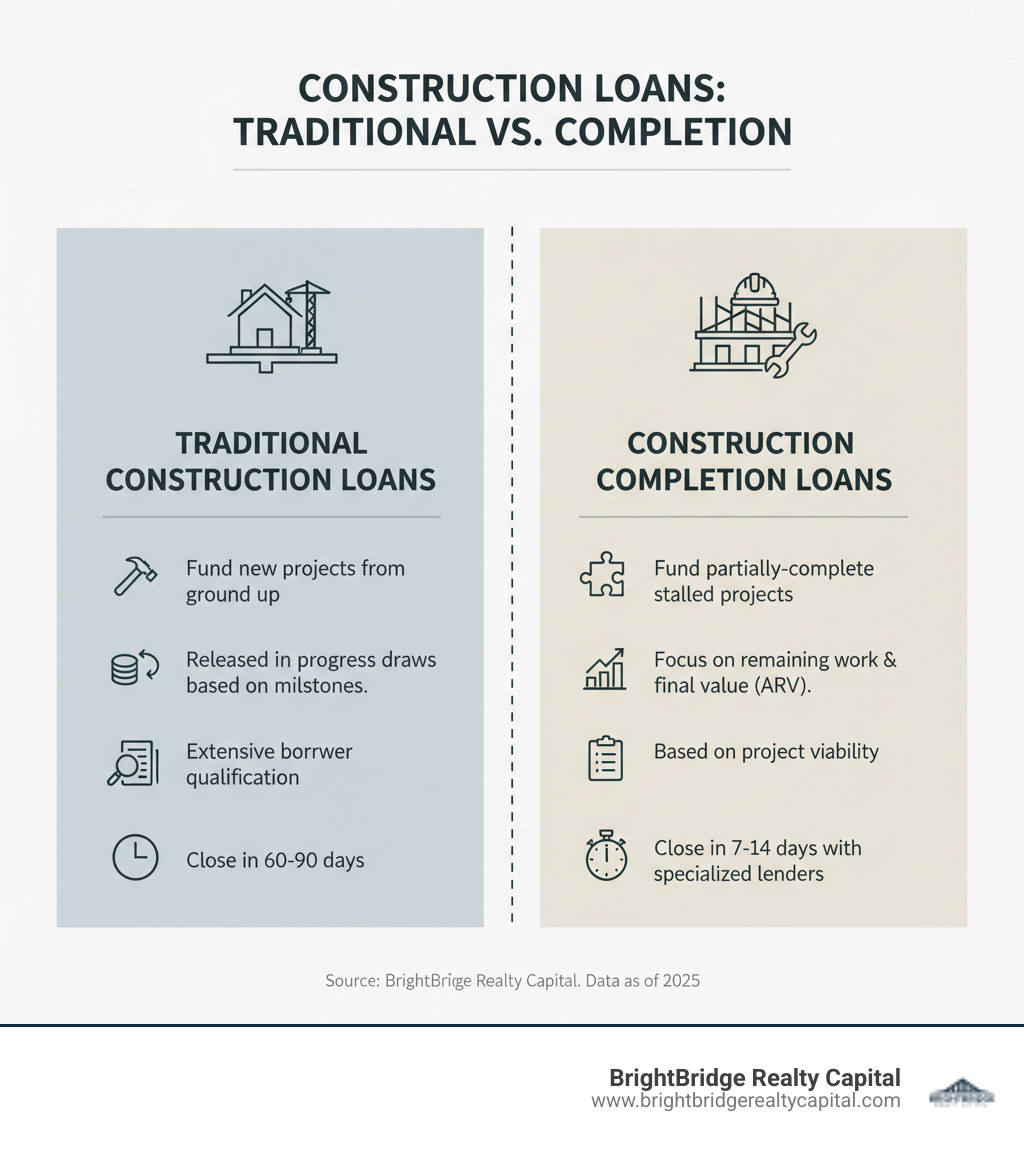
To truly grasp the strategic power of construction completion financing, it’s essential to understand how it fundamentally differs from a standard, ground-up construction loan. The distinction lies not just in timing but in philosophy, underwriting, and execution.
| Feature | Traditional Construction Loan | Construction Completion Loan |
|---|---|---|
| Purpose | Funds new construction from the ground up | Rescues partially-built, stalled projects |
| Timing | Initial project phase, before significant work begins | Mid-project, when funding gap or issue arises |
| Approval Basis | Borrower's financial history, project plans, and budget | Project's viability, "as-completed" value (ARV), cost-to-complete |
| Funding Structure | Progress draws based on pre-set milestones | Often a single disbursement or rapid draws for remaining work |
| Speed to Close | Typically 60-90 days | Often 7-14 days with specialized lenders |
| Risk Perception | Lower, as project is new and controlled from start | Higher, due to existing issues, but mitigated by ARV |
| Lender Focus | Borrower qualifications, detailed budget adherence | Asset-based, project's potential for profitable completion |
Traditional loans are methodical and forward-looking, disbursing funds via progress draws tied to pre-approved construction milestones. Their underwriting process is heavily weighted toward borrower qualifications, including credit scores, personal financial statements, and development history. In contrast, construction completion financing employs a dynamic, asset-based approval approach. The lender's primary focus shifts from the borrower's past to the asset's future. The underwriting centers on three core questions: What is the project's current state? What is the realistic cost to complete the remaining work? And most importantly, what is its anticipated After-Repair Value (ARV)? This intense focus on the asset's potential for a profitable outcome allows for much faster and more flexible decision-making. Specialized lenders can often close these loans in just 7-14 days, providing funding as a lump sum or through rapid draws to immediately restart work. This speed is paramount, as every single day a project sits idle, carrying costs relentlessly eat into your bottom line and erode your potential profit.
Why Projects Stall: Common Triggers for Completion Financing
When a promising construction project grinds to an unexpected halt, it creates a frustrating, costly, and high-stress scenario for any developer. The unfortunate reality is that this is a common problem. Research indicating that 60% of construction projects exceed their initial budget underscores this industry-wide vulnerability. When these challenges inevitably strike, construction completion financing emerges as the critical bridge between a stalled site and a successful, profitable outcome.
Projects rarely stall for a single reason. More often, it's a perfect storm of interconnected issues, including budget exhaustion, crippling cash flow disruptions, contentious contractor disputes, frustrating regulatory delays, and extreme volatility in material and labor markets. At BrightBridge Realty Capital, we have seen these destructive patterns repeatedly and have developed the expertise to diagnose and solve them effectively.
Analyzing the Financial Shortfall
Financial shortfalls are, without a doubt, the most frequent catalyst for a project grinding to a halt. Cost overruns are not just common; they are a pervasive challenge. These overruns can stem from a multitude of sources. For instance, unexpected site conditions, such as discovering poor soil quality, underground rock formations, or environmental contamination, can necessitate expensive remediation and foundation redesigns. Volatile supply chains can cause the price of essential materials like steel, lumber, and copper to skyrocket seemingly overnight, completely shattering a meticulously planned budget. A 15-20% contingency fund, once considered a robust safety net, can be rapidly depleted by a confluence of these setbacks.
Once the initial loan is depleted, the project enters a perilous phase. Carrying costs—including loan interest, insurance premiums, property taxes, and security—begin to accumulate daily, acting like a slow bleed on the project's profitability. This situation is particularly challenging because traditional lenders, who provided the initial financing, often refuse to extend more funds to a troubled project. They view the stall as a sign of unmanageable risk. From our specialized perspective, however, we see a project that's 70-80% complete as an asset with immense potential, needing only a final, strategic push to capture its full value.
Navigating Operational and Regulatory Problems
Money isn't the only obstacle that can derail a project. Permit delays and other regulatory hurdles can halt all progress for weeks or even months, even when contractors and materials are ready. A failed inspection for a critical system like electrical or plumbing can force expensive and time-consuming rework, creating a domino effect of delays throughout the entire project schedule.
Operational nightmares can be just as devastating. The sudden bankruptcy of a general contractor can stop a project overnight, leaving the developer to untangle a web of legal issues, deal with unpaid subcontractors who may file liens, and scramble to find a reputable replacement. Similarly, severe subcontractor performance issues, such as shoddy workmanship, improper installations, or unpermitted work, can necessitate costly tear-outs and repairs, further delaying the project and inflating the budget.
While government resources like the New York State Contractor Financing Program exist to support contractors, they are not designed to solve the immediate, acute cash crisis a developer faces with a stalled project. That's where specialized private lenders who understand these multifaceted challenges become invaluable. At BrightBridge Realty Capital, we have proven systems to rapidly assess stalled projects, accurately determine the true cost to complete, and provide the necessary capital to get your project back on track and moving toward completion.
The Completion Loan Process: From Application to Final Draw

The construction completion financing process is engineered for speed and efficiency because we understand that for a stalled project, time is the most expensive commodity. Mounting carrying costs can erode equity daily, so our focus is simple and direct: can the project be completed profitably? This asset-centric perspective allows us to bypass the bureaucratic hurdles of traditional lending and move with urgency from your initial application to the final draw that secures your certificate of occupancy.
Eligibility and Documentation for Construction Completion Financing
Unlike traditional banks that often get bogged down in a borrower's historical personal credit and global financials, our approach is fundamentally asset-based. We prioritize the intrinsic viability and potential of the project itself. We typically fund projects that are at least 50% complete, as this demonstrates a significant commitment and reduces the overall completion risk. Eligibility hinges on a thorough analysis of the After-Repair Value (ARV)—the projected market value of the project once it is fully completed. This forward-looking valuation must demonstrate that the finished asset will be worth substantially more than the total investment, including the new completion loan. As a general guideline, we lend up to 70% of the ARV and up to 85% of the total project cost, ensuring there is sufficient equity to protect all stakeholders and deliver a profitable outcome.
To facilitate a rapid approval, we focus on project-specific documentation:
- An updated, detailed project budget outlining the specific cost to finish each remaining line item. This is crucial for us to verify the loan amount is sufficient.
- Original and revised construction plans and architectural drawings.
- A summary of your existing loan, including the outstanding balance and lender information.
- Current contractor bids for all remaining work, which validates the cost-to-complete budget.
- A third-party appraisal report providing both an "as-is" value and the projected "as-completed" (ARV) value.
- Your entity documents (LLC operating agreement, etc.) and the builder's financials, license, and insurance to ensure the team is sound.
Our experienced team works collaboratively with you to gather only what is essential, avoiding the endless paperwork drills common with conventional lenders.
The Draw Schedule and Roles of Key Players
Once the loan is approved, funding is not disbursed in a single lump sum. Instead, it is released through a pre-agreed, milestone-based draw schedule. We work with you and your contractor to break down the remaining work into logical phases and assign a cost to each. After your contractor completes a phase (e.g., drywall and painting), an independent inspector hired by the lender visits the site to verify the work is complete and meets quality standards. This verification is a crucial control point that protects all parties and ensures loan proceeds are being used as intended. Once the work is verified, funds for that phase are disbursed. This disbursement is often managed through a title company, which collects lien waivers from the contractors and suppliers before releasing payment, ensuring the property remains free of new claims.
This process is a team effort requiring clear communication and defined roles: the developer manages the overall project and submits draw requests, the contractor executes the construction, the title company ensures clear title and manages payments, and we as the lender provide the capital and oversee the draw process to ensure a smooth path to completion.
Typical Loan Parameters and Exit Strategies
Our construction completion financing loans are structured for flexibility with some common parameters:
- Loan Amounts: $100,000 to $10 million+, tailored to the project's needs.
- Loan Terms: Short-term, typically 12 to 24 months, providing ample time to finish construction and stabilize the asset.
- Payments: Interest-only during the construction period to keep monthly carrying costs low and preserve capital for the project itself.
A clear and viable exit strategy is not an afterthought; it's a core component of the loan approval. The two primary paths are:
- Refinancing: Once construction is complete and the building receives its Certificate of Occupancy, you can stabilize the property (i.e., lease it up to a certain occupancy level) and then refinance the short-term completion loan into a conventional long-term commercial mortgage with a lower interest rate.
- Selling: For build-to-sell projects, the exit is the sale of the completed property. The completion loan provides the necessary time and capital to finish the project to the highest standard and market it effectively, avoiding a low-ball "fire sale" and maximizing your profit. The loan is then paid off from the sale proceeds.
At BrightBridge Realty Capital, we don't just provide a loan; we partner with you to architect a successful outcome. That is the fundamental purpose of construction completion financing.
Navigating Key Risks and Legal Problems
Securing construction completion financing is the pivotal first step in rescuing a stalled project, but navigating the remaining risks is what ensures a successful outcome. A new infusion of capital is only effective when paired with smart legal and strategic planning. Understanding the potential pitfalls—from lien priority battles to final inspection hurdles—and having a solid game plan to address them makes all the difference between simply restarting work and truly finishing with confidence.
Understanding Lien Priority and Its Impact on Your Loan
Mechanic's liens, which are legal claims filed by unpaid contractors, subcontractors, or material suppliers against a property, represent one of the most significant risks in a stalled construction scenario. For a completion loan to be viable, the new lender must be absolutely certain of securing first lien priority. This means that in the event of a default, their loan is the first to be paid back from the sale of the property. The complexity arises because, in many jurisdictions, mechanic's liens can "relate back" to the date when work first commenced on the project. This could potentially allow a subcontractor's later-filed lien to take priority over a new loan, a risk most lenders are unwilling to take. The legal frameworks governing these priorities, such as British Columbia's intricate Builders Lien Act, highlight the need for expert navigation.
At BrightBridge Realty Capital, we mitigate this risk through a multi-pronged approach. This includes conducting exhaustive title searches to identify all existing claims, requiring lien waivers from all contractors and suppliers before disbursing each draw, and using subordination agreements. A subordination agreement is a legal document signed by existing claimants (like an unpaid contractor) that contractually places their claim behind that of the new lender. Finally, we secure a new lender's title insurance policy to protect against any unforeseen title defects or priority disputes. For developers, proactive communication and meticulous payment records are the best defense against liens derailing your project's recovery.
The Certificate of Occupancy (C of O) Finish Line
The Certificate of Occupancy (C of O) is the official document that marks the true finish line. Issued by the local municipal authority, like the New York City Department of Buildings, it certifies that your building is safe, code-compliant, and ready for occupancy. For the purposes of construction completion financing, obtaining the C of O is the critical event that unlocks your exit strategy. Without it, you cannot legally lease the property to tenants or sell it to a buyer, rendering the building a finished but unusable asset. A permanent lender will not refinance a property without a C of O.
To secure a C of O, the project must pass a series of final inspections covering every aspect of the build, from fire suppression and alarm systems to electrical, plumbing, HVAC, and ADA accessibility. It is vital to factor the inspection process into your timeline and budget. Engaging with inspectors from your local building department early and maintaining open communication can help you anticipate requirements and avoid costly, last-minute delays over minor issues. In some cases, a Temporary Certificate of Occupancy (TCO) may be issued, allowing parts of a building to be occupied while minor outstanding work is completed, which can be a useful tool for starting to generate cash flow.
How to Strategically Plan for Delays and Overruns
While completion financing is a powerful rescue tool, the most successful developers focus on prevention to minimize the chances of a stall in the first place. Strategic planning can help you weather the inevitable challenges of construction.
- Build Robust Contingency Reserves: A contingency fund is not a luxury; it's a necessity. Set aside a minimum of 15-20% of your total project budget in a separate, liquid account specifically for unexpected costs. This isn't pessimism; it's the financial realism that defines experienced developers.
- Vet Contractors and Subcontractors Thoroughly: Don't automatically choose the lowest bid. Conduct deep due diligence. Verify licenses and insurance, check for past litigation, and call references. Ask specific questions like, "How did the contractor handle unexpected change orders?" and "How did they manage project delays?"
- Structure Contracts to Align Interests: Ensure your contracts have clear language regarding change orders, payment schedules, and dispute resolution. Consider clauses that incentivize on-time completion and penalize unapproved delays.
- Establish Relationships with Lenders Early: Don't wait for a crisis to find a lender. Building a relationship with a specialized lender like BrightBridge Realty Capital before you need them means we already understand your business and your goals. When an emergency arises, we can act with the speed and trust required to provide capital in as little as 7-14 days, because the foundation of a partnership is already in place.
Frequently Asked Questions about Construction Completion Loans
It's natural to have questions when your project hits a snag and you're navigating the unfamiliar territory of rescue financing. Here are detailed answers to some of the most common inquiries we receive about construction completion financing.
How fast can I get a construction completion loan?
Speed is the single most important feature of this financing. While traditional banks can take 60-90 days or even longer to underwrite and approve a loan, specialized private lenders like BrightBridge Realty Capital are built for urgency. We can often move from initial application to closing and funding within 7-14 business days. We understand that every day a project is stalled, you are incurring significant carrying costs that erode your equity. Our streamlined process is designed to get capital deployed quickly to restart your project and stop the financial bleeding.
Can I get a completion loan if my original lender won't provide more funds?
Yes, absolutely. This is one of the primary reasons construction completion financing exists. It is extremely common for the original lender, typically a conventional bank, to refuse to provide additional funds once a project stalls. From their perspective, the project has deviated from the original plan and now represents a higher risk profile than they are comfortable with. We, on the other hand, specialize in this exact scenario. Our underwriting focuses on the project's future viability and its "after-repair value" (ARV). If our analysis shows a clear and profitable path to completion, we can confidently provide funding even if your original lender has already said no.
What is the most important factor lenders consider for a completion loan?
The single most important factor is the project's economic viability, supported by a clear exit strategy. While many elements are considered, our asset-based underwriting ultimately prioritizes the project's potential to be completed and then sold or refinanced profitably. We conduct a rigorous assessment of these key elements to ensure success:
- A detailed and credible "cost to complete" budget.
- A strong projected "after-repair value" (ARV) supported by a third-party appraisal and current market comparables.
- Favorable market conditions in the project's specific submarket, such as New York, NY, indicating demand for the finished product.
- A well-defined and realistic exit plan (a viable sale or a clear path to refinancing).
This intense focus on the completed asset's value and marketability is what allows us to fund situations that others won't.
How are interest rates and fees for completion loans determined?
Interest rates and fees for construction completion loans are typically higher than those for traditional construction loans or conventional mortgages. This pricing reflects the increased risk the lender undertakes. They are stepping into a project that is already in distress, with existing complexities like budget overruns or contractor disputes. The risk is mitigated by the asset-based underwriting (focusing on the ARV), but it is still present. Rates are often structured as interest-only to keep monthly payments manageable during the final construction phase. While the cost of capital is higher, it's crucial to view it in context: the cost of not securing the loan—risking foreclosure and a total loss of investment—is infinitely higher. The financing is a strategic expense to unlock a much larger profit.
Can a completion loan be used to pay off existing mechanic's liens?
Yes, in many cases, the proceeds from a construction completion loan can be used to satisfy and pay off existing mechanic's liens filed by unpaid contractors or suppliers. In fact, clearing these liens is often a prerequisite for the loan, as the new lender will require a first-priority lien position. The loan would be structured to include a budget for the remaining construction costs plus the amount needed to clear the title of any existing claims, ensuring a clean slate for the final phase of the project.
What happens if I can't execute my exit strategy before the loan term ends?
This is a valid concern and highlights the importance of working with a flexible lending partner. While the goal is always to exit within the initial term (typically 12-24 months), unforeseen delays can happen. Many specialized lenders, including BrightBridge Realty Capital, have options for loan extensions. An extension is typically contingent on the project showing continued progress and the borrower operating in good faith. There may be an extension fee, but it provides the crucial extra time needed to finish the project properly, obtain the C of O, and execute the sale or refinance without being under duress. Open communication with your lender as you approach the maturity date is key.
Conclusion: Crossing the Finish Line with Confidence
Here's the unvarnished truth about real estate development: even the most meticulously planned projects can hit unexpected and formidable roadblocks. In those critical moments, construction completion financing isn't just another loan product on a menu of options—it's the strategic intervention that marks the difference between walking away from your investment in defeat and turning a challenging situation into a profitable success story.
Throughout this comprehensive guide, we've explored the mechanics of how completion financing works, dissected the common reasons why projects stall, and mapped out the process from application to final draw. If there is one key takeaway, it is this: you do not have to face these monumental challenges alone. With the right financing partner—one who brings not just capital, but expertise, speed, and a shared vision—a stalled project does not have to become a failed project.
At BrightBridge Realty Capital, we have witnessed firsthand how quickly the right capital, deployed strategically, can transform a developer's fortunes. While traditional banks might take months to deliberate on a decision—if they are even willing to consider a distressed project at all—we specialize in moving with purpose and speed. Our direct lending model means we can often close a loan within a week, getting funds into your hands when every single day counts. There are no intermediaries, no bureaucratic delays, just straightforward, asset-focused financing designed to get your project completed.
The value you stand to capture is not just substantial; it is transformative. As we've discussed, completing a stalled project can amplify its market value by 30-50%, and in some cases, even more. That isn't merely an abstract percentage on a spreadsheet. It represents your preserved equity, your hard-earned profit, and the integrity of your reputation as a developer who delivers. Construction completion financing is the tool that empowers you to secure all three, turning a narrative of potential failure into a testament of resilience and strategic success.
Whether you're grappling with severe cost overruns in a competitive market like New York, navigating complex contractor issues, or simply ran out of financial runway just short of securing your Certificate of Occupancy, we understand the immense pressure you're under. Our team possesses the deep experience and dedicated resources to evaluate your project's potential with speed and precision, providing the customized, flexible solution you need to regain momentum.
The path from a stalled construction site to a successfully completed asset doesn't have to be a solitary or complicated journey. With competitive rates, flexible terms, and a team that genuinely understands the grit and nuance of real estate development, you can cross that finish line with absolute confidence.
Ready to get your project moving again and reclaim its potential?