The Fastest Ways to Get Your Loan Approved Online Today
Summary
Get fast loan approval with our seamless online loan application. Instant quotes, 24/7 access, and next-day funding for real estate investors!
Why Your Online Loan Application Can Make or Break Your Next Deal
Online loan application processes have completely changed how real estate investors access capital — and speed is everything when a deal is on the table. In the modern real estate market, the difference between securing a high-yield property and losing it to a competitor often comes down to hours, not days. The traditional banking model, with its physical branch visits and manual paperwork, is increasingly becoming a liability for the agile investor.
Here's a quick look at the fastest ways to get approved online today:
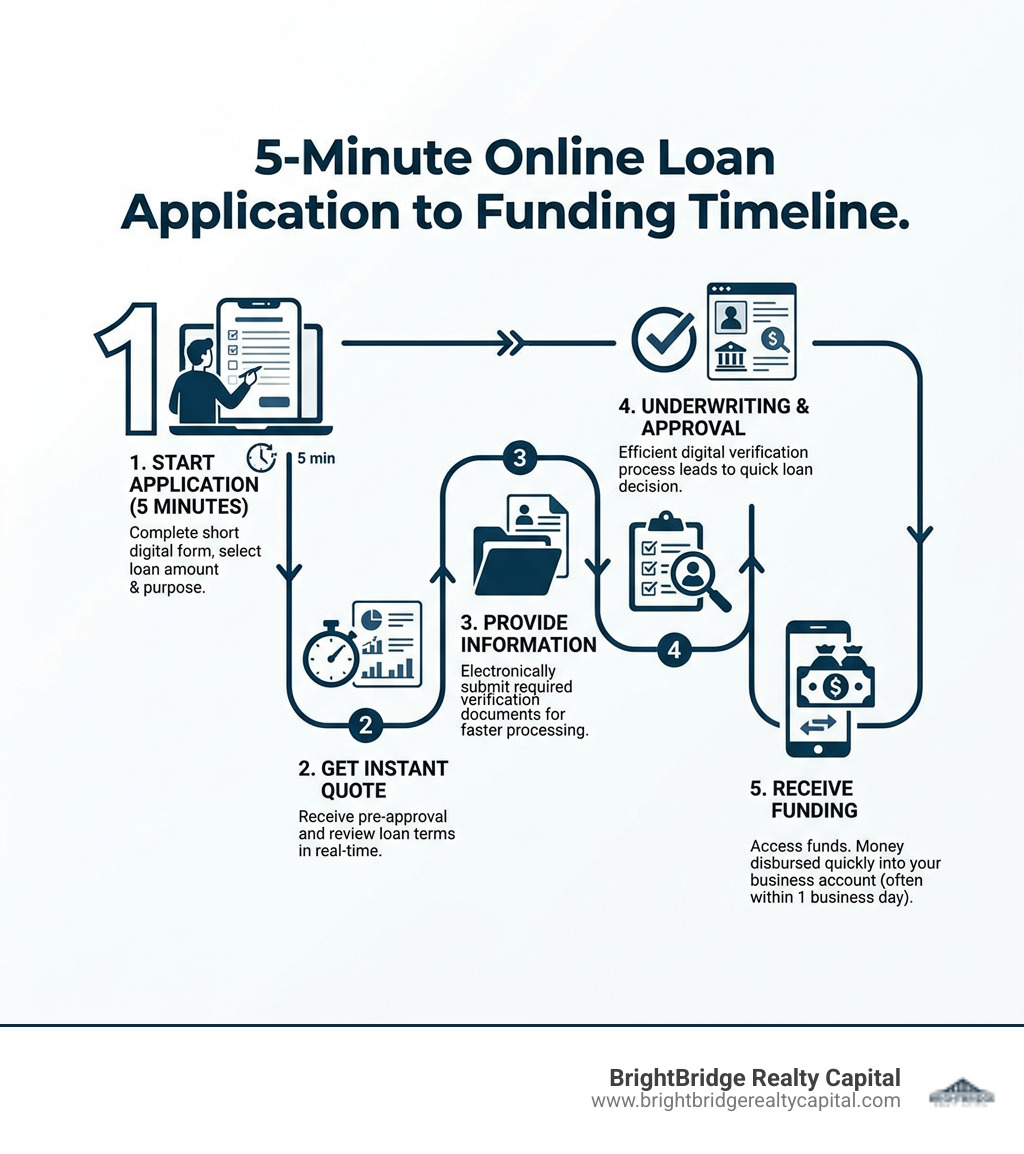
- Choose a lender with a short digital form — many take 5 minutes or less to complete by utilizing smart logic that only asks relevant questions based on your previous answers.
- Use a soft credit inquiry option — check your rate without affecting your credit score, allowing you to shop for the best terms without damaging your financial profile.
- Prepare your documents in advance — have digital copies of your ID, proof of income, bank statements, and SSN/EIN ready for immediate upload to avoid processing bottlenecks.
- Opt for lenders offering next-business-day funding — some even disburse within one hour of closing, which is critical for bridge loans and urgent renovation needs.
- Apply for pre-approval first — it signals readiness to sellers and speeds up the final underwriting process once you have a property under contract.
Gone are the days of scheduling branch visits and waiting weeks for a decision. Today, investors can submit a fully digital application, get a real-time quote, and receive funds directly into their account — sometimes the same day. This digital revolution has democratized access to capital, allowing smaller investors to compete with institutional firms by leveraging the same speed and efficiency.
But not all online lenders are built the same. Rates, terms, approval speed, and flexibility vary widely. Some platforms are merely lead generators that sell your data, while others are direct balance-sheet lenders. Knowing which lenders fit your specific situation — whether you're flipping a property or expanding a rental portfolio — can save you thousands in interest and weeks of frustration.
I'm Daniel Lopez, a loan officer at BrightBridge Realty Capital with hands-on experience guiding investors through the online loan application process for fix-and-flip, bridge, and rental property financing. I have seen firsthand how a streamlined application can empower an investor to scale their business from one property to a dozen in a single year. In this guide, I'll break down exactly what to look for — and what to avoid — so you can close faster and smarter.
Online loan application terms you need:
Understanding the Modern Online Loan Application Process
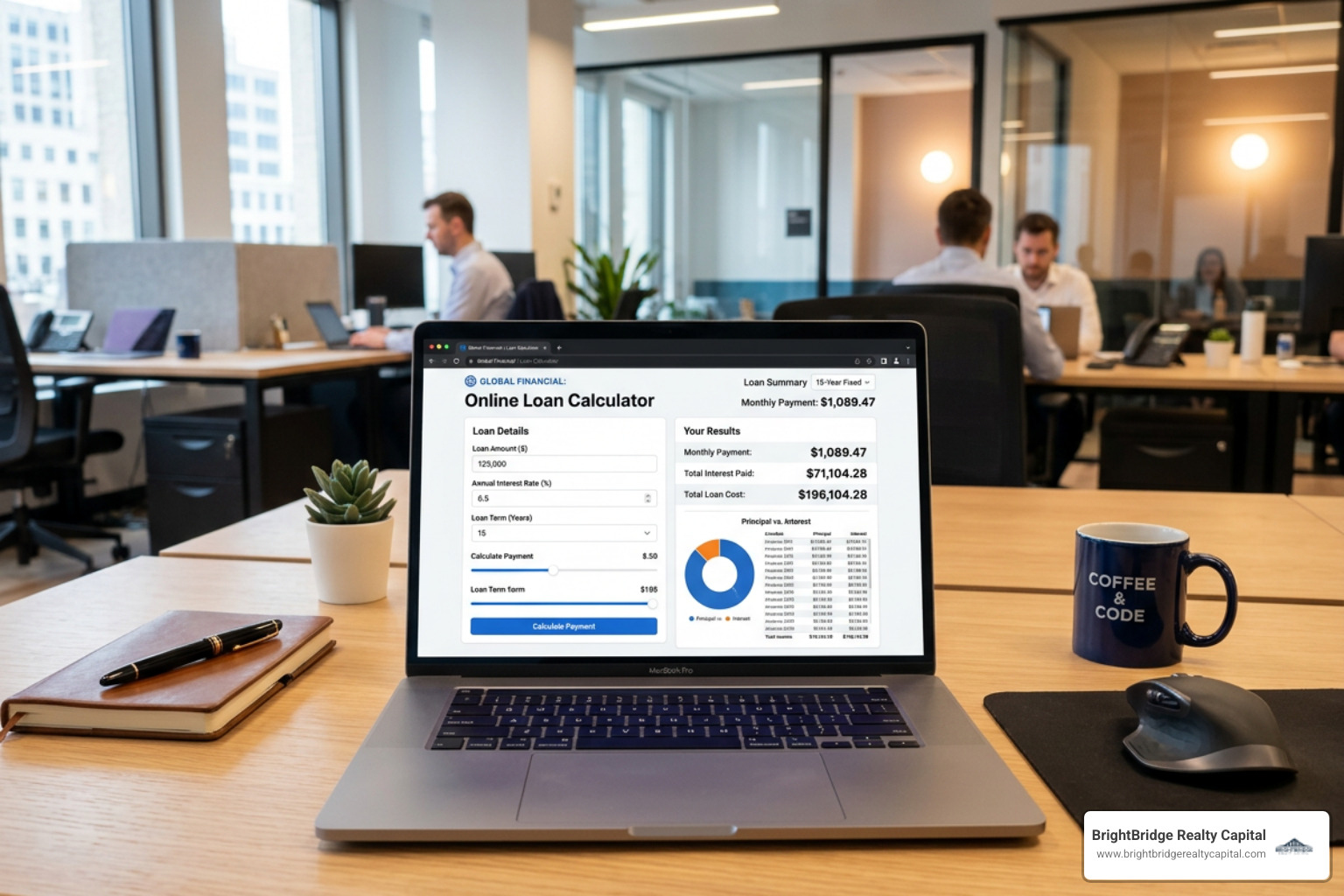
The landscape of borrowing has shifted from mahogany desks and paper stacks to sleek interfaces and instant algorithms. When we talk about a modern online loan application, we aren’t just talking about a digital version of a paper form. We’re talking about a completely re-engineered user experience designed for the 24/7 reality of the real estate market. This evolution is driven by Fintech (Financial Technology) companies that prioritize data-driven decision-making over traditional, often biased, manual reviews.
In the old world, you’d wait for a bank to open at 9:00 AM, hope your loan officer wasn't on vacation, and wait for a physical file to be moved from one department to another. In the digital world, you can submit a Bridge Loan Application Online at 2:00 AM on a Sunday. This availability is crucial for investors in New York NY, where the market moves at lightning speed and waiting until Monday morning could mean losing a prime property to a cash buyer who doesn't need to wait for bank approval.
How Digital Applications Differ from Bank Visits
Traditional bank visits often involve "manual processing," which is a polite way of saying your file sits on someone's desk for three days before they even look at it. Modern online platforms use automated underwriting systems (AUS). These systems use APIs to instantly pull credit data, verify bank balances, and even assess property values through Automated Valuation Models (AVMs). This doesn't mean a robot makes the final call without human oversight, but it does mean your data is verified in real-time, allowing the human underwriter to focus only on the complex aspects of the deal.
With electronic signatures (e-signatures) like DocuSign or HelloSign, the days of driving across town to sign a single missed page are over. You also get real-time status tracking. Instead of calling a loan officer and leaving a voicemail to ask "Where are we?", you simply log into a secure portal and see exactly which stage your application is in—whether it's in 'Initial Review,' 'Underwriting,' or 'Clear to Close.' This transparency reduces the anxiety often associated with large-scale financial transactions.
Funding Speed and Disbursement Timelines
Speed is the ultimate currency in real estate. Research shows that some online lenders can now disburse funds as soon as one hour after loan closing. For most high-quality personal or business installment loans, next-day funding via ACH deposit is the standard. In the world of commercial real estate, where title companies and escrow agents are involved, the digital process streamlines the communication between all parties, ensuring that the 'wire' is sent the moment the ink is dry on the closing documents.
At BrightBridge Realty Capital, we’ve seen how this speed changes the game. While a traditional bank might take 45 to 60 days to close a real estate loan, our digital-first approach allows us to fund investors much faster—often within a single week. The "approval window" has shrunk from weeks to minutes for the initial decision, provided your documentation is ready to go. This efficiency allows investors to turn over their capital more frequently, increasing their annual Return on Investment (ROI).
Types of Online Loans for Real Estate Investors and Their Businesses
Not every online loan application is for a $2,000 personal expense. For the serious investor, the digital lending world offers sophisticated products tailored to specific business needs. Whether you are looking to scale your portfolio or bridge a gap in your cash flow, there is a digital path for you. The variety of products available online today rivals, and often exceeds, what is available at a local credit union or national bank.
For those focused on property, a Real Estate Loan Application can unlock various doors:
- Fix-and-Flip Financing: Short-term capital used to purchase and renovate distressed properties. These loans are often asset-based, meaning the lender cares more about the property's After-Repair Value (ARV) than your personal debt-to-income ratio.
- Bridge Loans: Quick-access funds that "bridge" the gap until long-term financing or a sale is secured. These are perfect for opportunistic buys where you need to close in 10 days or less.
- Rental Property Loans: Long-term financing for buy-and-hold investors looking for steady cash flow. Many online lenders now offer 30-year fixed rates for rental portfolios, often using DSCR (Debt Service Coverage Ratio) to qualify the loan based on the property's income.
- SBA 7(a) Loans: For small business owners, these can range from $25,000 to $5 million, often used for acquiring real estate for their own operations. The online application for SBA loans has become significantly more streamlined in recent years. You can find more details on the U.S. Small Business Administration website.
Eligibility for Fast Online Real Estate Investment Loan Approval
To get that "Instant Approval" notification, you need to meet specific criteria. While every lender is different, the core requirements usually revolve around financial capacity and track record. Online lenders use sophisticated algorithms to weigh these factors differently than traditional banks might.
- Financial Capacity: You’ll need to show proof of funds or liquidity. Lenders want to see that you have the "skin in the game" required to close, covering the down payment and closing costs. Digital lenders often use services like Plaid to verify your bank balances instantly without requiring you to download and upload PDFs.
- Identity & Entity: You’ll need a Social Security Number (SSN) for personal guarantees or an Employer Identification Number (EIN) if you are borrowing through an LLC or Corporation. Most professional investors prefer borrowing through an LLC to limit personal liability.
- Credit History: While some lenders specialize in "bad credit loans," most competitive rates require a solid credit history (typically 660+). However, many online lenders now look at the "whole picture," including the value of the asset you’re buying and your history of successful exits.
- Experience: For real estate specific loans, your track record matters. Have you flipped three houses this year? That experience makes you a much lower risk in the eyes of an automated underwriting system, often leading to lower interest rates and higher leverage (LTV).
Flexible Options for Real Estate Investors and Small Businesses
One of the best features of modern lending is the move toward "soft credit pulls." This allows you to check your rate and see what you qualify for without a "hard hit" appearing on your credit report. This is particularly helpful for investors who may be shopping around for the best terms across multiple platforms simultaneously.
Furthermore, digital lenders are often more welcoming to self-employed individuals. While a traditional bank might scoff at a tax return with heavy deductions that lower your taxable income, online lenders often use bank statement programs to verify "real-world" income. They look at the total deposits over 12 to 24 months to determine your ability to repay, making it much easier for full-time investors and entrepreneurs to qualify for the capital they need to grow.
Requirements and Documentation for Fast Approval
If you want to move fast, you have to be organized. The number one reason an online loan application gets delayed isn't the lender—it's the borrower forgetting to upload a clear copy of their ID or a missing page of a bank statement. In the digital world, an incomplete application is often automatically moved to the back of the queue until the missing data is provided.
Documents Needed for Your Online Loan Application
Think of this as your "digital closing kit." Having these files saved as high-quality PDFs on your desktop or in a secure cloud folder will shave hours, or even days, off your application time. Ensure all documents are complete; for example, if a bank statement says "Page 1 of 6," the lender needs all 6 pages, even if the last page is blank.
- Government ID: A clear, color scan of your driver’s license or passport. Ensure the edges aren't cut off and there is no glare on the photo.
- Bank Statements: Usually the last 2–3 months of your primary business or personal account. These are used to verify the source of your down payment and your overall liquidity.
- Proof of Income: For business owners, this might be a Year-to-Date Profit & Loss (P&L) statement and a Balance Sheet. For individuals, it’s recent paystubs or the last two years of tax returns (W2s or 1040s).
- Entity Documents: If you’re borrowing as an LLC, have your Articles of Organization, Operating Agreement, and EIN Confirmation Letter ready. Lenders need to verify who is authorized to sign on behalf of the company.
- Property Details: For real estate loans, the executed purchase contract, a summary of the renovation budget (the "Scope of Work"), and photos of the property's current condition.
Improving Your Chances for Instant Approval
To ensure the process is as smooth as possible, accuracy is paramount. Even a small typo in your SSN, date of birth, or home address can trigger a manual review flag or an identity mismatch error, slowing everything down. Double-check every entry before hitting the 'Submit' button.
Another pro tip? Use the Get Started or "Check Your Rate" features first. This allows you to get a "Pre-Approval" which acts as a green light for your search. In the competitive New York NY market, having a pre-approval letter in hand when you make an offer on a property is often the difference between winning the deal and being ignored. Sellers want to know that your financing is secure and that you have already passed the initial hurdles of the online loan application process. Furthermore, maintaining a clean digital footprint and ensuring your LinkedIn or business website is up to date can provide "social proof" to lenders who may perform a quick Google search on your business history.
Interest Rates, APR, and Credit Score Impact
Let’s talk numbers. The cost of your loan is determined by two primary figures: the Interest Rate and the APR (Annual Percentage Rate). While the interest rate is the cost of borrowing the principal amount, the APR includes fees like origination, processing, and underwriting charges, giving you the "true" cost of the loan over a year. When comparing online loan application offers, always look at the APR to ensure you are making an apples-to-apples comparison.
In the online space, APRs can vary wildly based on the risk profile of the borrower and the type of collateral. Personal installment loans might range from 5.99% for those with excellent credit to much higher for "no credit check" options. For real estate investors, rates are typically fixed for the duration of the loan (especially for bridge and flip loans), and repayment plans are structured to fit the project—whether that’s a 12-month bridge loan with interest-only payments or a 30-year rental loan with full amortization.
Understanding SCHUFA-Neutral and Soft Inquiries
For our friends and clients dealing with international or specific European contexts, terms like "SCHUFA-neutral" are vital. In the US, we call this a "soft inquiry" or "soft pull." This is a critical distinction in the modern lending era. A soft inquiry allows a lender to view your credit report without it being recorded as a hard inquiry, which means it does not lower your FICO score.
When you start an online loan application to check your rate, most reputable lenders (including us) will perform a soft pull. This allows us to see your credit health and provide an accurate quote. A "hard credit pull" usually only happens once you’ve accepted an offer and we are moving toward final funding. This transparency protects your credit score while you shop for the best deal, allowing you to maintain your creditworthiness for future acquisitions.
Hidden Fees and Loan Terms to Watch Out For
Not all "quick" loans are good loans. You must be vigilant about the fine print, as some lenders hide their true costs in complex fee structures. Watch out for:
- Origination Fees: These are upfront costs taken out of the loan proceeds. They typically range from 1% to 3% of the loan amount.
- Prepayment Penalties: Some lenders charge you a fee if you pay the loan off early. For a fix-and-flip investor, this is a deal-breaker! You want the flexibility to sell the house in four months without a penalty. Always ask for "No Prepayment Penalty" terms for short-term loans.
- Commitment Periods: Ensure you aren't locked into a long-term contract if you only need short-term liquidity. Some business loans have "minimum interest" clauses that require you to pay a certain amount of interest even if you pay the loan back early.
- Repayment Breaks: Some business lenders offer "breaks" or "deferrals" where you can skip a payment during a slow month—know if this is an option before you sign, as it can provide a vital safety net for your cash flow.
Security Measures and Data Privacy in Digital Lending
Whenever you enter your Social Security Number, bank details, or tax returns into a website, you should feel a healthy sense of caution. Security is the backbone of the digital lending industry, and reputable firms invest millions of dollars into protecting borrower data. Without trust, the entire model of the online loan application would collapse.
Protecting Your Personal Information Online
Top-tier lenders use "bank-level" security. This means 256-bit SSL (Secure Sockets Layer) encryption, which is the same standard used by major financial institutions like Chase or Wells Fargo. When you look at your browser’s address bar, you should always see the padlock icon and "https://", signifying a secure, encrypted connection. If a site lacks these, do not enter any personal information.
Reputable lenders will also have a clear, easily accessible Privacy Policy. They should state clearly that they do not sell your personal data to third-party marketing firms. Under the USA PATRIOT Act, lenders are required to verify your identity to prevent money laundering and terrorism financing, but this data must be handled with extreme care. If you are a resident of California, look for the "California Disclosures" (CCPA), which give you extra rights over how your data is used, including the right to request that your data be deleted.
Accessing Support and Credit Counseling
Just because an application is online doesn't mean you're alone in the process. The best platforms offer a hybrid model: digital efficiency combined with human expertise. They provide non-binding assistance and access to expert advisors who can explain complex terms. If you're feeling overwhelmed by debt or unsure about a loan term, seek out free credit counseling from a non-profit organization before committing to a new loan.
Customer testimonials and third-party reviews are a great way to gauge a lender’s reliability. Look for companies with high average ratings (4.7/5 or higher) on platforms like Trustpilot or Google Business. Look for reviews that specifically mention "uncomplicated service," "transparent terms," and "competent support." At BrightBridge Realty Capital, we pride ourselves on being more than just a website; we are a New York-based team of professionals you can actually talk to on the phone. We believe that technology should enhance the human relationship, not replace it.
Frequently Asked Questions about Online Loans
How quickly can I receive funds after approval?
For many personal and business loans, funds are deposited via ACH the next business day. In some specialized cases, such as certain real estate closings or specific installment products, funding can happen as quickly as one hour after the final documents are signed. The timeline often depends on your bank's processing speed and whether the loan is funded via ACH or Wire Transfer.
Will checking my rate affect my credit score?
Initially, no. Most modern lenders use a soft credit inquiry to provide you with a quote. This does not impact your FICO score. A hard inquiry, which can slightly lower your score (usually by 5 points or less), typically only occurs after you move forward with a full application and give explicit consent for the lender to pull your full credit report for final underwriting.
What are the minimum requirements for a real estate investment loan?
While every deal is unique, you generally need a valid government ID, an SSN or EIN, proof of liquidity (bank statements showing enough for a down payment), and some level of experience in real estate. For rental properties, the "Debt Service Coverage Ratio" (DSCR) is often the most important factor. This measures how much rent the property brings in versus the mortgage cost. If the property's income covers the debt, you are much more likely to be approved.
Can I apply for an online loan if I am self-employed?
Yes, absolutely. In fact, online lenders are often more flexible for self-employed borrowers than traditional banks. While banks focus on the "bottom line" of your tax returns after all deductions, online lenders often use "Bank Statement Programs" where they look at your total gross deposits to determine your true cash flow and borrowing power.
Are there any geographic restrictions for online loans?
Most major online lenders operate nationwide, but some products may be restricted in certain states due to local usury laws or licensing requirements. For real estate loans, lenders often have "preferred markets" where they have more data on property values. BrightBridge Realty Capital, for instance, has deep expertise in the New York NY market but serves investors across many other regions as well.
Conclusion
The digital transformation of the lending industry has been a gift to the real estate community. By choosing an online loan application, you are opting for a streamlined process that values your time as much as you do. The shift away from bureaucratic, slow-moving traditional banking allows you to focus on what you do best: finding deals, managing renovations, and growing your wealth.
Fast closings, customized financing, and paperless workflows aren't just "nice to have" anymore—they are the requirements for staying competitive in today's market. Whether you're looking to bridge a gap, flip a home, or build a legacy of rental properties, the right digital partner can provide the financial relief and leverage you need to succeed. As the market continues to evolve, those who embrace these digital tools will be the ones who thrive in the face of competition.
Ready to take the next step in your investment journey and secure the capital you need to win your next deal? Don't let a slow bank hold you back from your goals. Apply for your customized rental property loan today and experience the speed, transparency, and efficiency of modern lending firsthand. Our team is ready to help you navigate the process and get you to the closing table faster than ever before.