Navigating Acquisition Bridge Financing What You Need to Know

Summary
Unlock M&A opportunities with Acquisition bridge financing. Secure deals, speed up acquisitions, and bridge funding gaps effectively.
Why Acquisition Bridge Financing Matters for Today's Real Estate Investors
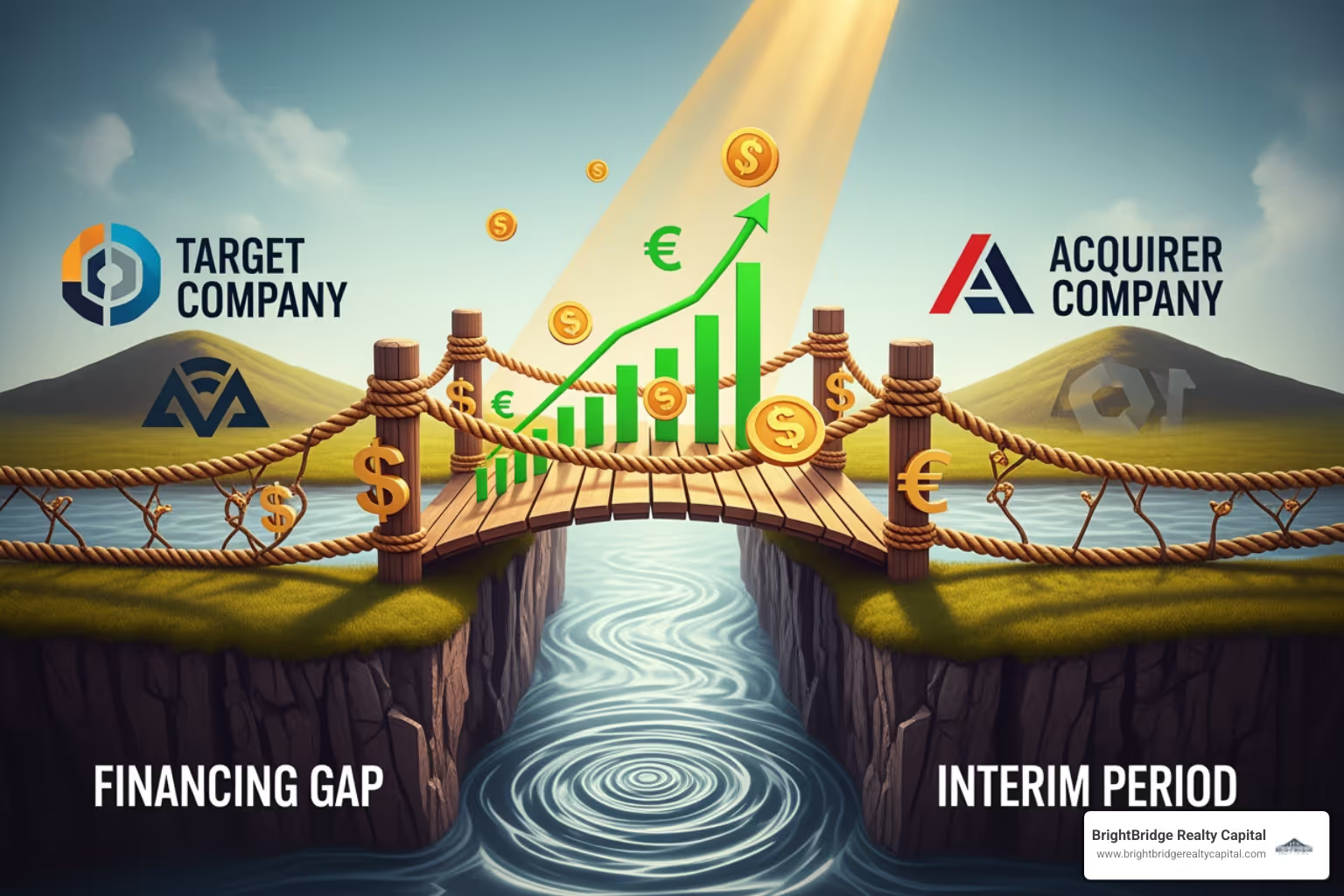
Acquisition bridge financing is a short-term loan that bridges the gap between purchasing a property and securing long-term financing. It provides immediate capital, allowing buyers to close deals quickly without waiting for slow traditional approvals.
Quick Answer: What You Need to Know About Acquisition Bridge Financing
- Purpose: Provides interim capital to close acquisitions when permanent financing isn't ready yet.
- Speed: Funding in as few as 7-45 days, depending on the lender and deal complexity.
- Loan Amount: Typically $100K to $75M+.
- Loan Term: Usually 6-24 months.
- Interest Rates: Higher than traditional loans (often 7.75%-15%+), typically floating (SOFR-based).
- Leverage: Up to 75-85% loan-to-cost (LTC) or 65-80% after-repair value (ARV).
- Exit Strategy: Refinance with permanent debt, sell the asset, or secure new equity.
- Best For: Time-sensitive deals, competitive bidding, distressed properties, and fix-and-flip projects.
In a market where certainty of funds wins bids, bridge loans give buyers a critical competitive edge. They provide the liquidity to act fast on time-sensitive opportunities. However, this speed comes at the cost of higher interest rates and shorter repayment timelines. A clear takeout strategy—a plan to repay the loan—is essential to avoid getting stuck with expensive debt.
I'm Daniel Lopez, a loan officer at BrightBridge Realty Capital. I specialize in structuring acquisition bridge financing that aligns with our clients' timelines and exit strategies, helping them close with confidence and avoid costly pitfalls.
What is Acquisition Bridge Financing and How Does It Work?
Think of acquisition bridge financing as a temporary financial bridge that gets you from identifying an opportunity to closing the deal. When you've found the perfect property or business but your permanent financing isn't ready, a bridge loan fills that gap. It provides immediate capital so you don't lose the deal while waiting for a construction loan, SBA package, or equity partners. The process begins with a borrower presenting a time-sensitive deal to a bridge lender. The lender's underwriting focuses primarily on two things: the value of the underlying asset (the collateral) and the credibility of the exit strategy. If the plan to repay the loan is sound and the asset provides sufficient security, the lender can move much faster than a traditional bank, which would conduct a deep dive into the borrower's global financial history.
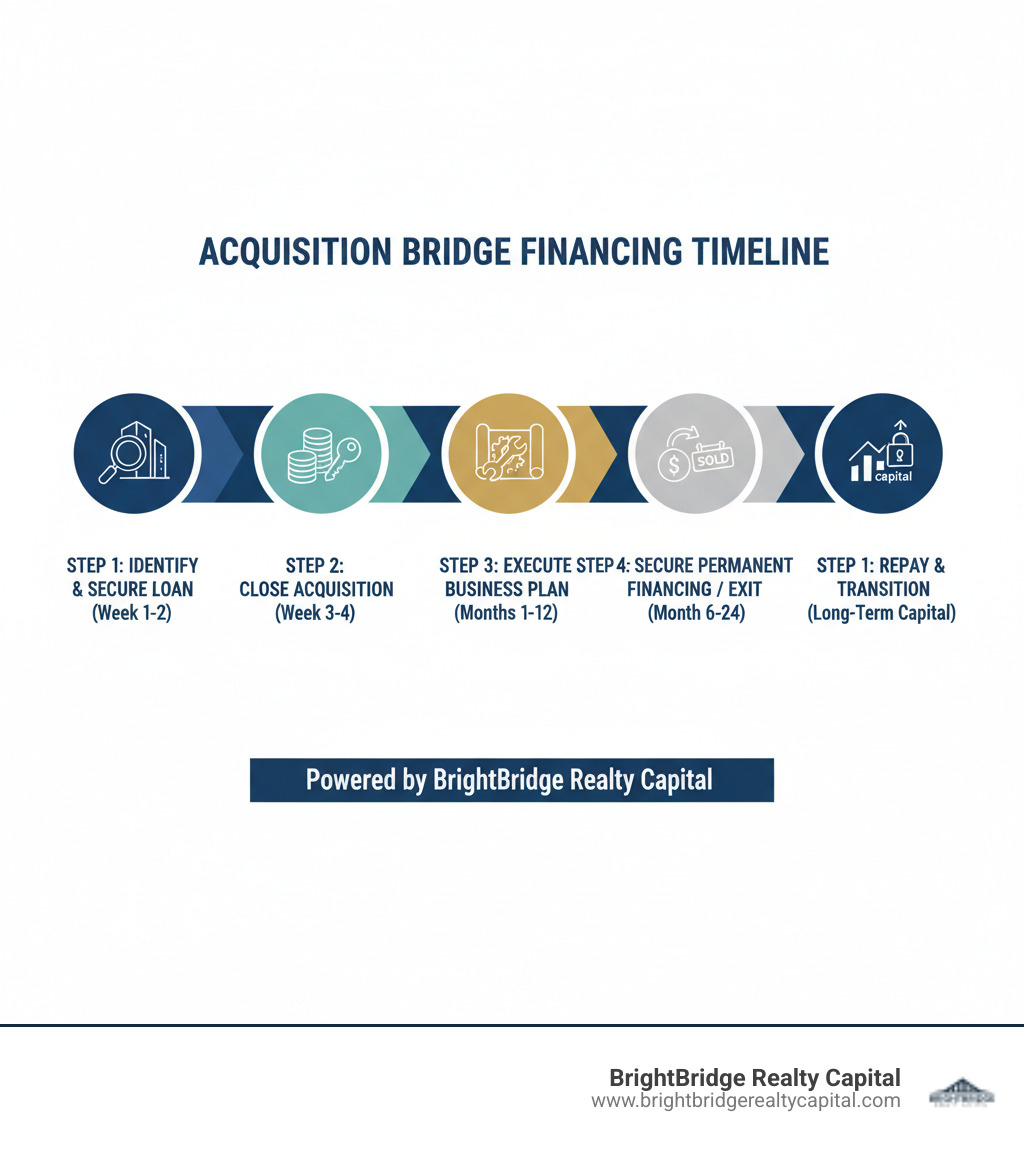
This interim financing is designed for speed and typically lasts 6 to 24 months. Unlike traditional acquisition loans that can take months to approve, bridge loans move fast. Every bridge loan is built around a clear takeout strategy—your plan to repay it. Lenders want you to transition to permanent capital, and the loan structure encourages this.

| Feature | Acquisition Bridge Loans | Traditional Acquisition Loans |
|---|---|---|
| Speed | Very fast (days to weeks) | Slower (weeks to months) |
| Loan Term | Short-term (6-24 months, sometimes up to 3 years) | Long-term (5-30 years) |
| Interest Rates | Higher (often floating, 7.75%-15%+) | Lower (fixed or floating, generally more competitive) |
| Flexibility | Highly flexible, customized for specific situations | Less flexible, standardized terms |
| Approval Process | Streamlined, asset-focused, quicker underwriting | Rigorous, extensive financial review, longer approvals |
| Purpose | Bridge temporary funding gaps, time-sensitive deals | Long-term capital for stable assets/businesses |
| Collateral | Often real estate or business assets | Varies, but can be less stringent for strong borrowers |
| Recourse | Often non-recourse with standard carve-outs | Can be recourse or non-recourse |
The Core Purpose: Speed and Certainty
In today's market, the best deals don't wait. Whether it's a distressed property or a business owner who wants to close in 30 days, acquisition bridge financing provides the speed and certainty to win. While traditional lenders take 60-90 days, bridge loans can close in as few as 7-45 days. This speed is a clear advantage. The flexibility is also a key differentiator; for example, a bridge loan can be structured to include funds for immediate renovations or capital improvements, which a standard acquisition loan might not cover.
Certainty is just as crucial. An offer backed by a bridge loan commitment removes financing contingencies, showing the seller you are a serious, capable buyer. This confidence can be the deciding factor in a competitive bidding situation, even if your offer isn't the highest. Bridge loans give you the power to act decisively when opportunities arise.
The Exit Strategy: Planning Your 'Takeout'
A bridge loan is only as good as its exit strategy. This is your roadmap for repaying the loan before it matures, and it's a non-negotiable part of the process. Lenders will rigorously vet this plan, assessing its feasibility based on market conditions, your track record, and the specifics of the asset. Common takeout strategies include:
- Refinancing with long-term debt: After acquiring and stabilizing a property (e.g., by increasing occupancy or completing renovations), you can qualify for a conventional mortgage with better terms to pay off the bridge loan. The lender will want to see realistic projections for achieving this stabilization.
- Sale of assets: For fix-and-flip investors, the exit is the sale of the improved property. The proceeds repay the loan, and you keep the profit. The lender will analyze comparable sales (comps) to ensure your projected sale price is achievable.
- New equity investment: A business might use a bridge loan to close an acquisition and then bring in private equity or venture capital to repay the debt once operational milestones are met. The lender will want to see letters of intent or strong interest from these future equity partners.
Your plan must be realistic and stress-tested. A failed takeout, known as a "hung bridge," can turn an expensive loan into a financial disaster. With proper planning, however, most bridge loans transition smoothly to permanent financing as intended.
The Strategic Advantages of Using a Bridge Loan for Acquisitions
Acquisition bridge financing is more than a temporary funding solution; it's a strategic tool for today's competitive market. It provides increased purchasing power, allowing you to compete with cash buyers and win deals based on your ability to close quickly.

This creates a significant competitive advantage. A seller with multiple offers will favor the one backed by a bridge loan commitment because it signals you are ready to close without financing contingencies. The flexibility in deal structure is another key benefit, as loans can be customized for unique situations like properties needing renovation or businesses with temporary cash flow issues. Bridge financing opens up growth opportunities that would otherwise be missed due to the slow pace of traditional funding.
Key Use Cases in M&A and Real Estate
Bridge loans are versatile and apply to a wide range of scenarios:
- Sponsor-led buyouts and add-on acquisitions: Private equity firms use bridge loans to execute roll-up strategies quickly. For instance, a PE firm might acquire a platform company and then use a bridge facility to rapidly purchase several smaller, synergistic "add-on" companies before arranging a larger, more complex syndicated loan package to consolidate the debt.
- Divisional carve-outs: Bridge financing covers the awkward interim period when a corporate division is being separated, allowing the deal to close before all operational and financial tangles are resolved. This is crucial when the parent company has a strict deadline for the divestiture.
- Management buy-ins: A new leadership team can use a bridge loan to acquire a business while finalizing their long-term equity and debt financing. This solves a classic chicken-and-egg problem: they need to show the seller they have committed funds before their own equity partners will formally commit capital.
- Distressed properties and time-sensitive investments: Investors can secure properties in foreclosure, at auction, or from a seller needing a rapid sale. These situations often require closing in days or weeks, not months, making traditional financing impossible. A bridge loan provides the necessary speed to capitalize on the steep discount.
- Funding integration costs and earnouts: Bridge financing can cover immediate post-acquisition expenses like IT system upgrades, rebranding, or performance-based payments (earnouts) to the seller without depleting the newly acquired company's working capital.
- Temporary funding before long-term financing: A bridge loan can cover a gap of a few weeks or months between a required closing date and the approval of a traditional loan, such as an SBA loan or a CMBS loan, which have notoriously long underwriting periods.
For a deeper dive into these scenarios, industry experts have outlined additional applications in their analysis of Top 7 Use Cases for Bridge Loans in M&A.
Real-World Example: Facilitating Large-Scale Growth
Bridge loans are sophisticated tools used by major corporations for strategic growth. For example, Utz Quality Foods secured $490 million in bridge financing to acquire Truco Holdco Inc. This allowed them to close a major acquisition swiftly, integrating the new asset while their investment bankers arranged a more permanent, long-term financing structure in the background.
Similarly, Olayan America Corp. used a bridge loan to purchase the iconic Sony Building in Manhattan. In a hyper-competitive market like New York City real estate, the speed afforded by the bridge loan was essential to securing the deal against other well-capitalized bidders. These examples show that acquisition bridge financing is a powerful tool for investors and companies of all sizes to act decisively when opportunity knocks.
Key Features and Terms of Acquisition Bridge Financing
Understanding the features of acquisition bridge financing is crucial. These loans prioritize speed and certainty, and their terms reflect this short-term, expedited nature.

Key terms include:
- Loan-to-Value (LTV) and Loan-to-Cost (LTC): These ratios determine the loan amount relative to the asset's value or cost. Leverage often goes up to 75-85% LTC or 65-80% of the After-Repair Value (ARV).
- Collateral Requirements: Bridge loans are secured by a valuable asset, typically the real estate or business assets being acquired.
- Covenants: These are rules to keep the acquisition on track, such as maintaining minimum liquidity levels or providing financial reports.
- Interest-Only Payments: Most bridge loans are interest-only, preserving cash flow for operational needs post-closing.
- Non-Recourse: Many commercial bridge loans are non-recourse, meaning the lender can only seize the collateral in case of default, protecting your personal assets. However, this protection has exceptions for acts like fraud.
Typical Loan Structure: Rates, Fees, and Duration
The structure of an acquisition bridge loan is designed to encourage a quick transition to long-term financing.
- Loan Tenor: The term is typically 6 to 24 months, with an initial maturity of one year or less. This short timeline keeps the focus on executing the takeout strategy.
- Interest Rates: Rates are higher than traditional loans to compensate for speed and flexibility. They are usually floating, based on benchmarks like SOFR (Secured Overnight Financing Rate), and can range from 7.75% to 15%.
- Step-Up Provisions: The interest rate may increase periodically (e.g., every 3-6 months) to incentivize prompt repayment.
- Fees: Expect an origination fee (1-3% of the loan amount) to cover underwriting costs and an exit fee (0.25%+) when the loan is repaid. Extension fees apply if the term is extended.
Security and Documentation Requirements
Because bridge loans move quickly, lenders require comprehensive documentation to assess the deal efficiently. Key documents include:
- Deal Documents: A signed Sale and Purchase Agreement (SPA) or Letter of Intent (LOI).
- Financial Information: For business acquisitions, a Quality of Earnings (QoE) report is vital. Lenders also require historical financial statements, financial projections, and a detailed financial model showing sources and uses of funds.
- Security Package: This outlines the collateral, such as property deeds, appraisals, and UCC-1 filings that perfect the lender's security interest.
- Borrower Information: Lenders perform Know Your Customer (KYC) due diligence and may require personal guarantees, especially for smaller transactions.
Having this documentation organized and ready is the key to a fast and smooth funding process.
Navigating the Risks and Application Process
While acquisition bridge financing offers tremendous advantages, it comes with risks that require careful management. It's a powerful tool, but you must understand its challenges before committing.

Risks to Consider with Acquisition Bridge Financing
- Higher Costs: Steep interest rates and fees (origination, exit, extension) can quickly erode profits if your exit is delayed. These costs must be factored into your financial model from the beginning.
- Interest Rate Risk: Most bridge loans have floating rates tied to benchmarks like SOFR. If rates rise unexpectedly, your monthly payments will increase, impacting cash flow and profitability.
- Short Timeline: The typical 6-24 month maturity creates significant pressure. Delays in renovations, leasing, or securing permanent financing can lead to serious problems as the maturity date looms.
- Collateral Risk: If you default, the lender can seize the collateral (the property or business assets), resulting in a total loss of your investment and any equity you contributed.
- 'Hung Bridge' Scenario: This is the worst-case scenario where you fail to secure an exit before the loan matures. For example, an investor buys a vacant office building, planning to refinance after leasing it up. If the local market softens and leasing takes a year longer than projected, the bridge loan comes due. The investor is now trapped, facing default, foreclosure, or being forced to accept a punitive extension fee and a much higher interest rate, wiping out any potential profit from the deal. A solid primary and backup exit plan is critical to mitigate this risk.
Eligibility and Key Borrower Requirements
Lenders need to see that you can manage a short-term loan and execute an exit strategy. Key requirements include:
- A Post-Revenue Company: For business acquisitions, the target should be an established, income-generating entity.
- Clean Ownership Structure: A simple, transparent ownership structure is essential for a smooth underwriting process.
- Verifiable Collateral: The asset being acquired must have sufficient, verifiable value and a clear title.
- Operational History and Financial Strength: A strong track record of successful investments, along with adequate net worth and liquidity, is crucial.
- A Clear and Viable Takeout Plan: This is the most important requirement. You must have a realistic, documented plan to repay or refinance the loan.
The Application Process for Acquisition Bridge Financing
The application process is designed for speed but requires thorough preparation.
- Intake and Initial Review: You provide a summary of the deal, including the asset, purchase price, your business plan, and your proposed takeout strategy. We conduct a preliminary assessment to ensure a bridge loan is a good fit and the exit is plausible.
- Due Diligence: We collect and review all necessary documentation, including the purchase agreement, financial statements, and collateral details. This stage often involves ordering third-party reports like a property appraisal, an environmental site assessment (Phase I ESA), and a property condition report. We also perform required Know Your Customer (KYC) checks on the borrower and key principals.
- Underwriting and Term Sheet: Our team analyzes the deal's strengths, weaknesses, opportunities, and threats (SWOT analysis). This is compiled into a credit memo that assesses the deal from the lender's perspective. If approved, we present you with a formal term sheet outlining the proposed loan amount, interest rate, fees, and other key terms.
- Closing and Funding: Once the term sheet is executed, our legal teams draft and finalize all loan agreements and security documents. Funds are typically placed in escrow with a title company and are disbursed once all closing conditions are met, allowing your acquisition to close on time.
This streamlined process allows for closings in as few as 7 business days for straightforward deals, though 21-45 days is more common for complex acquisitions.
Frequently Asked Questions about Acquisition Bridge Loans
Here are answers to some of the most common questions we receive about acquisition bridge financing.
Are bridge loans suitable for startups or early-stage businesses?
Generally, bridge loans are for established, post-revenue companies. However, a startup might qualify under specific conditions, such as having a confirmed next round of funding (e.g., a Series B) that can serve as a clear takeout strategy. The key is having sufficient collateral and a guaranteed path to repayment, as the high costs can be risky for a business without stable cash flow.
What are the most common exit strategies for repaying a bridge loan?
The success of a bridge loan depends on a viable exit strategy. The most common are:
- Refinancing with Traditional Long-Term Financing: The most frequent exit. Once the asset is stabilized, it qualifies for a conventional loan with better terms, which is used to pay off the bridge loan.
- Sale of the Acquired Asset: Common in fix-and-flip real estate, the improved asset is sold, and the proceeds repay the loan.
- Securing New Equity Investment: A business may use a bridge loan as a placeholder until a planned equity raise from investors is finalized.
- Organic Cash Flow Generation: Less common as a sole strategy, but strong cash flow from the acquired business can be used to pay down the debt.
How do bridge loan interest rates compare to traditional long-term financing?
Acquisition bridge loan interest rates are significantly higher than traditional loans. This premium is for the value they provide: speed, flexibility, and the ability to fund deals that traditional lenders can't or won't. The higher rate reflects the lender's increased risk and the administrative costs of deploying capital quickly for a short term. While a conventional loan might be in the single digits, bridge loan rates often range from 7.75% to 15% plus fees.
Conclusion: Bridging Your Way to a Successful Acquisition
Acquisition bridge financing is a strategic tool that allows investors to seize time-sensitive opportunities and move faster than the competition. It provides the speed and certainty needed to win deals in today's market, turning ambitious plans into tangible results.
While bridge loans come with higher costs and short timelines, these are trade-offs for the immense value of immediate capital and deal flexibility. The key to success is a clear and realistic exit strategy, whether it's refinancing, selling the asset, or securing new equity. With a solid plan, a bridge loan becomes a powerful competitive advantage.
At BrightBridge Realty Capital, we understand these dynamics. We specialize in providing fast, flexible acquisition bridge financing custom to your strategy. Our direct lending model eliminates intermediaries, allowing us to close deals in as little as a week and provide the certainty you need when the clock is ticking.
We've seen our clients use bridge loans to transform their portfolios, capitalizing on undervalued properties and making strategic acquisitions for long-term growth. It all starts with decisive action and the right financing partner.
Ready to explore how acquisition bridge financing can accelerate your next acquisition?