Unlock Your Airbnb Potential: Smart Financing Strategies
Summary
Unlock your Airbnb potential! Learn smart airbnb financing strategies, overcome challenges, and boost your approval odds.
The Growing Opportunity in Short-Term Rental Financing
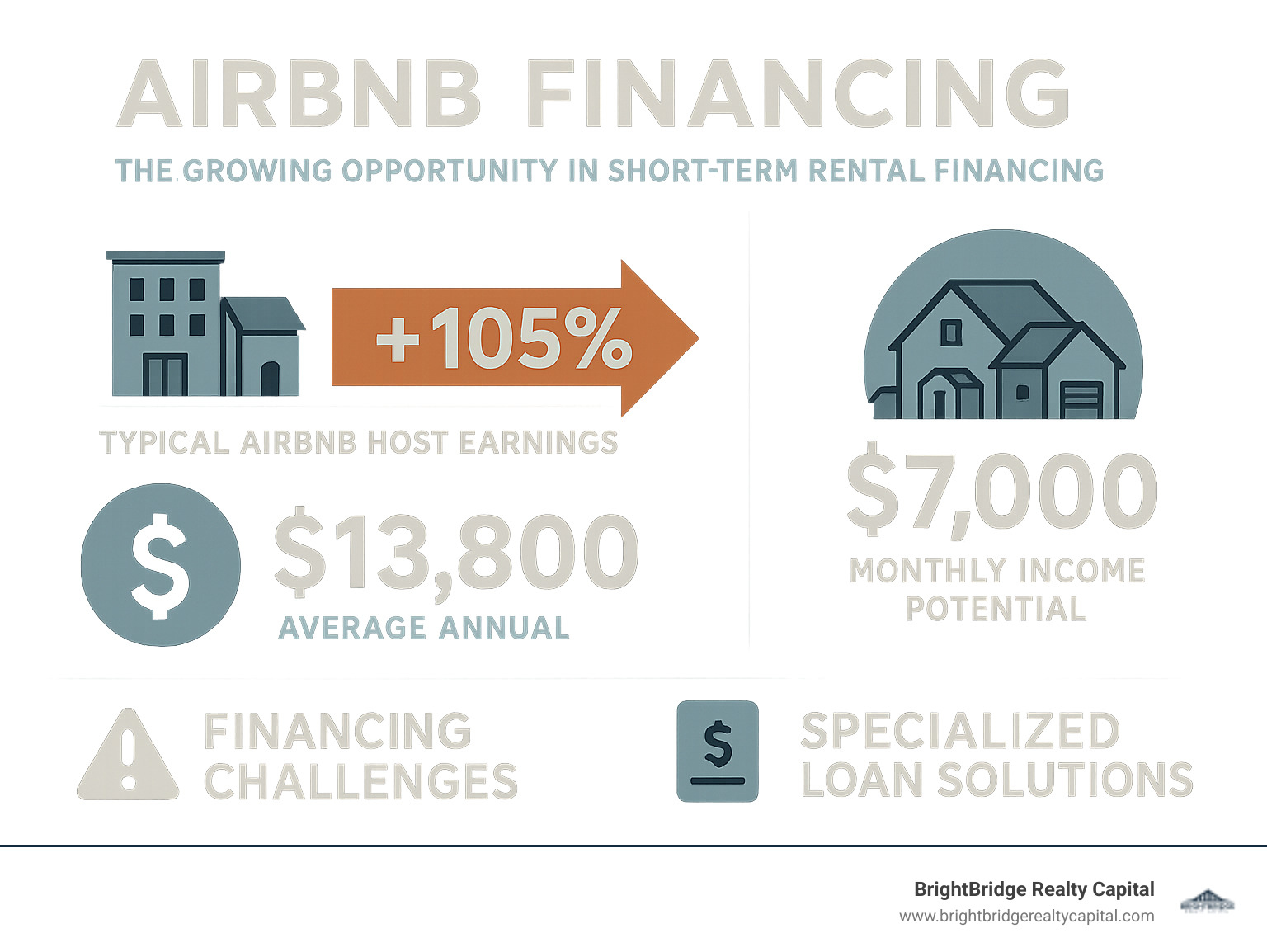
Airbnb financing has become a pivotal topic for real estate investors as the short-term rental (STR) market continues its explosive growth. This isn't just a fleeting trend; it's a fundamental shift in the hospitality and real estate industries. The number of short-term rentals has surged by an astonishing 105% in the last three years, driven by a new generation of travelers seeking unique, flexible, and spacious accommodations. The rise of remote work has further fueled this demand, creating a robust market for month-long stays and “work-from-anywhere” travelers.
The financial incentives are compelling. Typical Airbnb hosts are now bringing in an average of $13,800 annually, which represents an 85% increase from pre-pandemic levels. However, this figure is just the baseline. In high-demand urban centers, popular vacation destinations, and even unique rural locations, savvy investors are generating nearly $7,000 per month from a single well-managed property. This potential for high cash flow has drawn a wave of new and experienced investors to the STR space.
Quick Answer: Airbnb Financing Options
- DSCR Loans - Asset-based loans that qualify you based on the property's income potential, not your personal W-2.
- Conventional Investment Property Loans - Traditional mortgages that require stricter qualifications, including higher down payments (20%+) and personal income verification.
- Cash-Out Refinance - A strategy to unlock the equity in your existing properties to fund a new Airbnb purchase or renovation.
- Bridge Loans - Fast, short-term financing designed to help you acquire a property quickly while you arrange for a permanent loan.
- Fix-and-Flip Loans - Loans that cover both the purchase and renovation costs of a distressed property, perfect for creating a high-value Airbnb from scratch.
But here's the critical challenge that catches many aspiring hosts off guard: traditional mortgages often fall short for Airbnb properties. Conventional lenders, accustomed to the predictability of long-term tenants with 12-month leases, view the STR model as inherently riskier. They struggle with the income volatility, seasonal demand fluctuations, and the unpredictable nature of the global travel market. Mentioning your intent to use a property for short-term rentals can bring a loan application to a grinding halt at a traditional bank.
Fortunately, the financing landscape has evolved to meet this burgeoning demand. A new class of specialized lenders has emerged, offering innovative products designed specifically for the needs of short-term rental investors. These lenders look beyond personal tax returns and focus on what truly matters for an investment property: its ability to generate income.
I'm Daniel Lopez from BrightBridge Realty Capital, where I've spent years helping investors navigate the complexities of Airbnb financing. Through creative loan structures and specialized products, we've funded countless successful STR portfolios. My experience has shown me one undeniable truth: the right financing strategy is the bedrock of your short-term rental success. It can be the difference between a profitable asset and a financial burden.
Basic airbnb financing vocab:
Why Traditional Mortgages Often Fall Short for Airbnb
When you walk into a traditional bank or credit union to apply for a mortgage for an Airbnb property, you might assume the process will be straightforward. If you have a strong credit score, a stable job, and a sizable down payment, you should be a prime candidate. However, the moment you mention the words "short-term rental" or "Airbnb," the entire dynamic of the conversation can shift. Suddenly, the loan officer becomes hesitant, and the underwriting process grows far more complex.
Here's the reality that every STR investor must understand: Airbnb financing isn't just a regular mortgage with a different label. Traditional lenders, whose risk models are built on decades of data from primary residences and long-term rentals, view short-term rentals through a completely different and much more skeptical lens.
The biggest hurdle is income volatility. A long-term rental provides a predictable, fixed income stream documented by a one-year lease. An Airbnb's income, by contrast, can be a rollercoaster. A beach house might earn $8,000 in July but only $1,500 in a chilly January. A property near a major university might be booked solid during graduation and football season but see significant vacancies over the summer. This unpredictability makes it incredibly difficult for a conventional underwriter, who relies on tax returns and pay stubs, to confidently verify your ability to make consistent mortgage payments.
Next is the challenge of occupancy rate uncertainty. A long-term rental is either 100% occupied or 0% vacant. An Airbnb property exists in a state of constant flux. Even the most successful properties in prime locations rarely achieve 100% occupancy year-round. There will always be gaps between bookings, cancellations, and days blocked for maintenance. Lenders are acutely aware of this, and the lack of a guaranteed, year-long tenant lease factors heavily into their risk assessment, often leading them to discount projected income heavily or disregard it altogether.
Furthermore, because an Airbnb property is not your primary home, it is classified as an investment property. This classification automatically triggers stricter lending requirements. From a lender's perspective, if a borrower faces financial hardship, they will almost always prioritize the mortgage on the home they live in, making the investment property loan the first to go into default. This increased risk translates directly into higher interest rates, larger down payment requirements (typically 20-25%), and lower loan-to-value (LTV) ratios for investment properties.
Understanding the Lender's Perspective
To secure financing, you must think like a lender. Lenders are in the business of managing risk, and short-term rentals present a unique and multifaceted risk profile:
- Proving Income: Traditional lenders are trained to analyze W-2s, tax returns (like Schedule E for rental income), and signed lease agreements. They are often unequipped or unwilling to evaluate projected income from a variable source like an Airbnb, especially for a new purchase. They may not accept data from platforms like AirDNA or Mashvisor as sufficient proof.
- Secondary Property Risk: As mentioned, lenders know that in a financial crisis, borrowers will default on their second homes and investment properties long before their primary residence. This makes the loan inherently riskier from the outset.
- Occupancy & Market Unreliability: Real-world occupancy is affected by a host of factors beyond an investor's control: seasonality, increased local competition, economic downturns affecting travel, and even bad reviews. The travel market itself is notoriously volatile.
- Guest Liability and Property Damage: The high turnover of guests increases the risk of property damage, accidents, and potential legal liabilities. A long-term tenant is more likely to care for the property as their own, whereas a stream of short-term guests introduces more wear and tear and potential for misuse.
- Regulatory Risk: Municipalities across the country are constantly changing their rules regarding short-term rentals. A lender faces the risk that a new ordinance could restrict or even ban STR operations in a specific area, instantly jeopardizing the property's ability to generate income and repay the loan.
Key Differences from a Standard Mortgage
Understanding these distinctions highlights why a specialized approach to Airbnb financing is not just beneficial but often necessary:
- Income Verification: Traditional mortgages focus on your personal DTI (Debt-to-Income) ratio based on W-2s and tax returns. Specialized financing, like DSCR loans, focuses on the property's income potential, often ignoring your personal income entirely.
- Down Payment: A primary residence mortgage (FHA or conventional) can require as little as 3-5% down. An Airbnb property typically requires a minimum of 15-25% down, with many lenders requiring 30% for the best terms.
- Interest Rates: Rates are always higher for investment properties compared to primary residences to compensate the lender for the increased risk. The difference can be anywhere from 0.5% to over 1.5%.
- Property Type: Traditional loans are for owner-occupied homes. Specialized loans are explicitly for non-owner-occupied investment properties, including condos, single-family homes, and 2-4 unit multi-family buildings. Some lenders even have programs for larger commercial properties intended for STR use.
- Credit Score: While you might get a conventional loan with a 620 score, most investment property loans and specialized financing products require a score of 680 or higher, with the best programs reserved for those with 740+.
- Appraisal Process: Appraisers for conventional loans primarily use the sales comparison approach. For an Airbnb, an income-based approach is more relevant but harder to execute, often requiring a more sophisticated commercial appraisal or a residential appraiser with specific STR experience.
The good news is that the market has responded. The rise of sophisticated, data-driven lenders has created a new ecosystem of financing that understands and embraces the STR model. These lenders have built their underwriting processes around property performance, opening the door for thousands of investors who don't fit the rigid mold of a traditional bank.
Exploring Your Airbnb Financing Options
You have a surprisingly diverse array of Airbnb financing options at your disposal, extending far beyond the limitations of your local bank. The key to building a successful short-term rental portfolio is to understand this landscape and match the right loan product to your specific investment strategy, timeline, and financial situation. At BrightBridge Realty Capital, we specialize in guiding investors through this process, offering a suite of financing solutions tailored for the modern STR market.
Conventional and Government-Backed Loans
Let's begin with the most familiar territory: conventional mortgages backed by Fannie Mae and Freddie Mac. While challenging, securing a conventional loan for an Airbnb is not impossible, but you must approach it correctly. The property will be underwritten as a standard investment property, which means preparing for a higher level of scrutiny.
Expect to make a down payment of at least 20-25%. While some lenders may offer 15% down, putting down 20% allows you to avoid private mortgage insurance (PMI) and generally secures better terms. You'll also need a solid credit score, typically 680 or higher, and a debt-to-income (DTI) ratio below 45-50%. A major hurdle is how lenders treat rental income. For a new purchase, they generally won't use projected short-term rental income to help you qualify. They want to see signed, long-term leases, which is antithetical to the Airbnb model.
This is where house hacking emerges as a powerful strategy. This involves purchasing a multi-unit property (a duplex, triplex, or fourplex), living in one unit, and renting out the others on Airbnb. Because you occupy one of the units, the property qualifies as your primary residence. This is a game-changer, as it unlocks access to government-backed loans with incredibly favorable terms.
With a house-hacking strategy, you could potentially use:
- FHA Loans: Require only a 3.5% down payment and have more lenient credit requirements. For 3-4 unit properties, the FHA may apply a "self-sufficiency test," requiring the projected rent from the other units to cover the entire mortgage payment.
- VA Loans: Available to eligible veterans, active-duty service members, and surviving spouses, these loans require zero down payment. This is an unparalleled opportunity to enter the market with minimal cash out of pocket.
Given that approximately 16% of all Airbnb rentals worldwide are private rooms within owner-occupied homes, the house-hacking model is a proven and popular entry point into the market. First-time buyers should also explore local home buying assistance programs for potential grants or loans to help with down payments and closing costs.
Specialized Airbnb Financing for Investors
This is where the world of Airbnb financing truly opens up for serious investors. Specialized lenders have built their entire business model around the unique economics of short-term rentals.
DSCR (Debt-Service Coverage Ratio) Loans are the flagship product for STR investors. Instead of scrutinizing your personal pay stubs and tax returns, DSCR loans focus on one simple question: does the property generate enough income to cover its own debt? The lender calculates the DSCR by dividing the property's gross rental income by its total debt service (including principal, interest, taxes, and insurance or PITI). Most lenders look for a ratio of 1.25 or higher, meaning the property's income is 125% of its expenses. To project income, these lenders use sophisticated analysis of market data from sources like AirDNA, Mashvisor, and their own internal data, making them far more accurate than a traditional bank's guesswork. This is the ideal loan for self-employed individuals, investors with complex income, or anyone who wants to scale their portfolio based on asset performance, not personal income.
Bridge Loans provide the critical elements of speed and flexibility. In a competitive real estate market, the ability to make a cash-like offer and close in a matter of days is a significant advantage. Bridge loans are short-term, asset-based loans (typically 12-24 months) that focus on the property's value, not your personal credit. This allows you to acquire a property quickly, whether it's from an auction or a seller who needs a fast close. The plan is then to execute an "exit strategy"—either stabilizing the property with guests and refinancing into a long-term DSCR loan, or selling the property for a profit.
Fix-and-Flip Loans are no longer just for traditional flippers. These loans are perfect for the "BRRRR" (Buy, Rehab, Rent, Refinance, Repeat) strategy adapted for Airbnbs. If you find a distressed property in a great location, a fix-and-flip loan can finance both the purchase price and 100% of the renovation costs. The loan amount is based on the property's After-Repair Value (ARV), allowing you to leverage the future value you're creating. You can use the loan to transform an outdated property into a stylish, in-demand short-term rental, then refinance into a long-term DSCR loan to pull your capital out and move on to the next project.
Using Existing Equity and Creative Strategies
Often, the capital for your next deal is locked away in the equity of your current real estate holdings. These strategies are essential for scaling your portfolio.
- Cash-Out Refinance: This involves replacing your current mortgage on your primary home or another investment property with a new, larger loan, and taking the difference in cash. This tax-free lump sum can be used as a down payment for your Airbnb purchase.
- Home Equity Loan (HEL): This is a second mortgage taken out against your property's equity. You receive a lump sum upfront and make fixed monthly payments over the life of the loan. It's predictable and straightforward.
- Home Equity Line of Credit (HELOC): This functions like a credit card secured by your home. You are given a credit limit and can draw funds as needed, paying interest only on the amount you've borrowed. This offers maximum flexibility for ongoing renovation projects or as a reserve fund.
- Seller Financing: In this creative strategy, you negotiate for the property's seller to act as your lender. You make payments directly to them. This can allow for more flexible terms, a lower down payment, and a faster closing process by bypassing traditional bank underwriting entirely.
- Self-Directed IRA (SDIRA): For those with significant retirement funds, an SDIRA allows you to use your retirement money to purchase investment real estate. The property must be held purely for investment (you cannot use it personally), and all income and expenses must flow through the IRA. This is a complex but powerful strategy for building long-term, tax-advantaged wealth.
Each of these tools has a specific purpose. The most successful investors understand how to combine them, using a bridge loan to acquire a property, a fix-and-flip loan to renovate it, and a DSCR loan to hold it long-term, all while using a HELOC as a liquidity reserve. This strategic approach to Airbnb financing is what separates amateurs from professionals.
How to Boost Your Loan Approval Odds
Securing Airbnb financing is much like pitching a business idea to a venture capitalist. You need to present yourself as a competent, reliable operator and your property as a sound, profitable investment. The difference between a swift approval and a frustrating rejection often hinges on meticulous preparation of both your personal financial profile and your investment's business case. Lenders are ultimately betting on your ability to succeed, so your goal is to eliminate as much perceived risk as possible and build their confidence.
Strengthen Your Financial Profile
Your personal financial health is the foundation of any loan application. Even for asset-based loans like DSCR products, which de-emphasize personal income, lenders still need to see that you are a financially responsible individual who manages debt well and has the resources to handle unforeseen challenges.
1. Polish Your Credit Score: Your credit score is your financial report card, and it's one of the first things a lender will check. For specialized Airbnb financing, aim for a score of 680 or higher, with the best interest rates and terms reserved for borrowers with scores of 740+. Before applying, pull your credit reports from all three bureaus (Equifax, Experian, and TransUnion) to check for errors. To boost your score, focus on paying every bill on time, keeping your credit card utilization below 30% of your limits, and avoiding opening any new lines of credit in the months leading up to your application.
2. Optimize Your Debt-to-Income (DTI) Ratio: While less critical for DSCR loans, your DTI is paramount for conventional mortgages. It's calculated by dividing your total monthly debt payments (mortgage, car loans, student loans, credit card payments) by your gross monthly income. Most lenders want to see a DTI below 45%. You can improve this ratio by aggressively paying down existing loans (especially high-interest credit card debt) or by documenting additional sources of income.
3. Maximize Your Down Payment: A larger down payment is the single most effective way to reduce a lender's risk. For an investment property, putting down 25-30% instead of the minimum 20% demonstrates significant financial strength and personal investment in the project. This "skin in the game" reduces the loan-to-value (LTV) ratio, which almost always results in a lower interest rate and more favorable loan terms, saving you thousands over the life of the loan.
4. Build Up Your Cash Reserves: Lenders need to know you can weather a storm. Short-term rentals can experience unexpected vacancies or require sudden, costly repairs. Lenders will want to see that you have sufficient liquid cash reserves to cover several months of PITI (Principal, Interest, Taxes, and Insurance) payments. The standard is 3-6 months of reserves, but this requirement can increase if you own multiple financed properties. These funds must be in accessible accounts like checking, savings, or a brokerage account—not tied up in retirement funds like a 401(k).
5. Get Organized: Professionalism matters. Before you even speak to a lender, gather all your necessary financial documents. This includes the last two years of tax returns, recent pay stubs, W-2s or 1099s, bank statements for all accounts, and a detailed list of your real estate assets and liabilities. Having this package ready demonstrates that you are a serious, organized borrower and will dramatically speed up the underwriting process.
Build a Bulletproof Investment Case
Beyond your personal finances, you must prove to the lender that the property itself is a winner. This is where you transition from being just a borrower to being a savvy real estate investor.
1. Create a Professional Business Plan: Even if not explicitly required, a detailed business plan is your secret weapon. It shows you've done your homework and are approaching this as a business, not a hobby. Your plan should include:
- Executive Summary: A brief overview of the opportunity.
- Property Analysis: Details about the property, its location, and its unique appeal.
- Market Analysis: Data on local tourism, comparable STRs, and demand drivers.
- Marketing & Management Plan: How you will attract guests and manage operations (self-management vs. professional company).
- Financial Projections: A detailed 3-5 year forecast of income, expenses, and cash flow, with clear assumptions.
2. Provide Data-Driven Income Projections: This is the most critical element for DSCR loans. Do not rely on wishful thinking or the seller's claims. Use third-party data tools like AirDNA, Mashvisor, or AllTheRooms to pull reports for the specific property address. These reports provide data-backed estimates for Average Daily Rate (ADR), occupancy rates by month, and projected revenue. Presenting this objective, third-party data to the lender gives your projections immense credibility.
3. Highlight Your Track Record (or a Professional's): If you have prior experience managing rental properties (long-term or short-term), showcase it. Provide performance data, including occupancy rates, revenue, and guest reviews. If you're a first-time investor, one of the strongest moves you can make is to include a proposal from a reputable local short-term rental management company. This shows the lender that the property will be in experienced hands, significantly mitigating their operational risk.
4. Understand the Appraisal: The property appraisal can be a major hurdle. Many residential appraisers are unfamiliar with valuing a property based on its STR income potential. Be proactive. Provide the appraiser with your business plan, your AirDNA report, and a list of comparable STR properties in the area with their nightly rates and booking links. This helps them understand the income approach to valuation and justify the property's worth as a business.
Beyond the Loan: Budgeting for Your Airbnb Business
Securing your Airbnb financing is a monumental step, but it's the starting line, not the finish line. The true determinant of success in the short-term rental game is rigorous financial management. I have seen countless enthusiastic investors secure a loan and purchase a property, only to be completely blindsided by the sheer volume and scale of the ongoing costs required to operate a successful hospitality business. A profitable Airbnb is not a passive investment; it's an active business that demands a comprehensive budget.
Unlike a traditional long-term rental where your primary expenses are the mortgage, taxes, insurance, and occasional maintenance, an Airbnb property has a much more complex and demanding financial structure. You are not just a landlord; you are a hotelier, a concierge, and a logistics manager, and every aspect of that role comes with a cost.
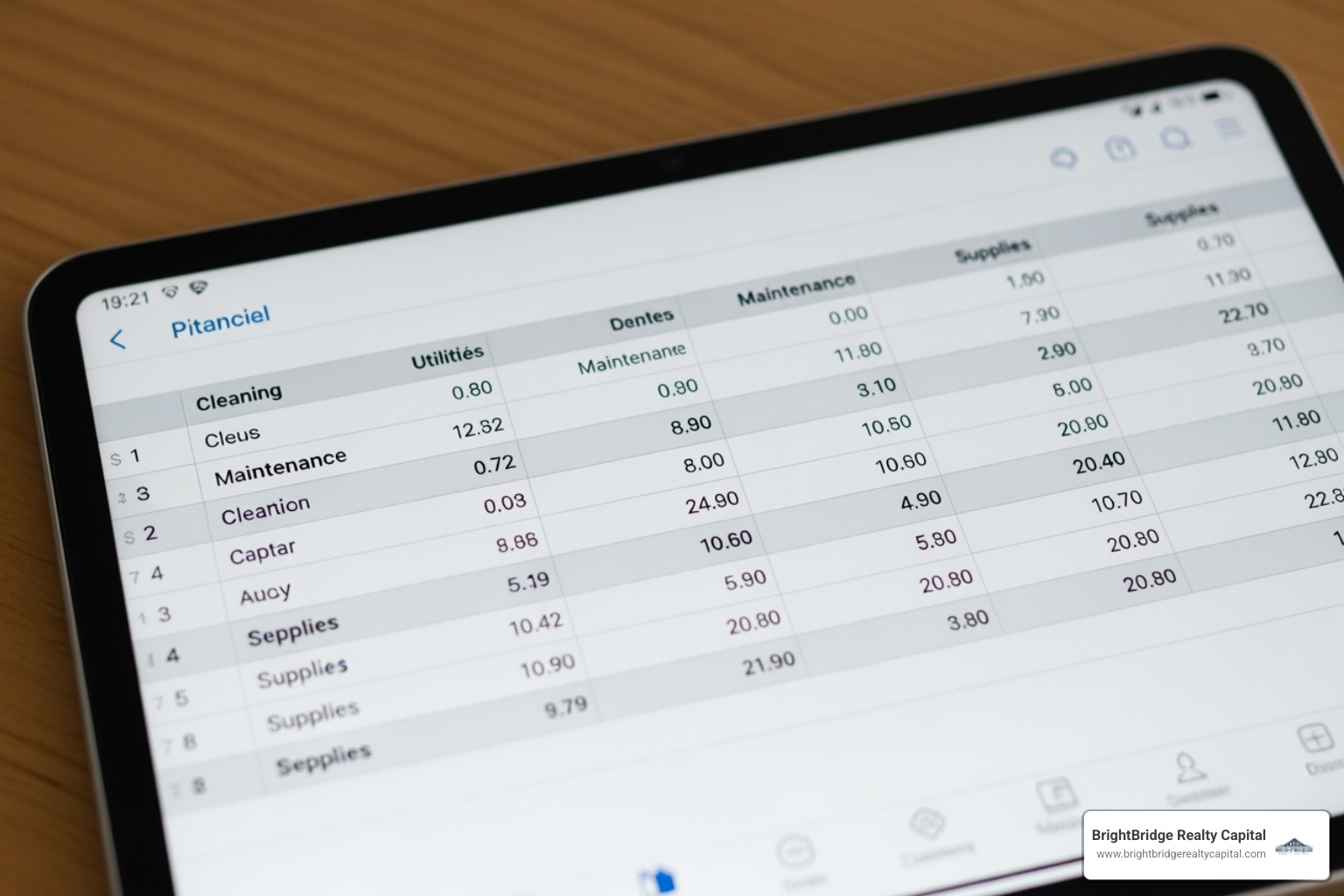
Calculating Your Full Spectrum of Costs
Your monthly mortgage payment (PITI) is just the tip of the iceberg. A realistic and sustainable Airbnb budget must account for a wide range of variable and fixed operating expenses.
1. Initial Setup and Furnishing Costs: This is a significant one-time expense that is often underestimated. You need to fully furnish and equip the property to a high standard. This includes everything from large furniture (beds, sofas, tables) and appliances to every last detail: linens, towels, kitchenware, decor, smart home technology (smart locks, thermostats, noise monitors), and professional photography. Depending on the size and luxury level of the property, this can easily cost $10,000 to $30,000 or more.
2. Recurring Operating Expenses: These are the ongoing monthly costs of doing business.
- Cleaning and Turnover Costs: This is one of your largest variable expenses. Professional cleaning between each guest is non-negotiable for maintaining high ratings. This can cost anywhere from $75 for a small apartment to over $300 for a large house, and it happens after every single booking.
- Consumable Supplies: You are responsible for restocking supplies for every guest, including toiletries (shampoo, soap), paper products (toilet paper, paper towels), coffee, tea, snacks, and cleaning supplies. This can add up to $50-$100 per month or more.
- Platform and Channel Manager Fees: Online travel agencies (OTAs) charge for their services. Airbnb typically charges hosts a 3% fee, while platforms like Vrbo and Booking.com can charge commissions of 8-15%. If you use a channel manager to sync calendars, expect an additional monthly software fee.
- Utilities: You will cover all utilities, including electricity, water, gas, trash service, and—most importantly—high-speed Wi-Fi, which is now considered an essential amenity.
- Landscaping and Maintenance: For single-family homes, costs for lawn care, snow removal, pool service, and pest control are your responsibility.
3. Capital Expenditures (CapEx) and Maintenance: You must budget for both routine maintenance and large-scale replacements. A good rule of thumb is to set aside 1-3% of the property's value annually for these costs. This fund covers everything from fixing a leaky faucet to eventually replacing the roof, HVAC system, or major appliances. This is separate from your emergency fund.
4. Professional Services and Taxes:
- Insurance: A standard homeowner's policy does NOT cover commercial activity. You need a specialized short-term rental insurance policy that covers property damage, liability, and loss of income. This is significantly more expensive than a standard policy.
- Taxes: You must budget for federal and state income tax on your profits, as well as local transient occupancy taxes (TOT) or lodging taxes, which you are required to collect from guests and remit to the city or county.
- Licenses and Permits: Most locations require annual business licenses and short-term rental permits, which can range from under $100 to over $1,000 per year.
The Critical Impact of Local Regulations
Before you even think about applying for Airbnb financing, your absolute first step must be a deep dive into local regulations. This is the single biggest external risk to your investment. Cities across the globe are grappling with the impact of STRs on housing affordability and neighborhood character, and the regulatory landscape is a minefield that can change with little notice.
1. Zoning Laws and Permits: Your property must be in a zone that permits short-term rentals. Check with your local planning or zoning department. Many cities have created complex permit systems, some of which involve lotteries or long waiting lists. Operating without the proper permit can lead to massive fines and a permanent ban.
2. Rental Restrictions: Be aware of common restrictions:
- Primary Residence Requirement: Many cities (like Portland and San Francisco) only allow you to rent out your primary residence, effectively banning non-owner-occupied investment properties.
- Day Limits: Some areas impose a cap on the number of nights you can rent per year. London's famous "90-night rule" is a prime example. Exceeding this can trigger higher taxes or fines.
- Density Caps: Some municipalities limit the number of STRs allowed per block or per building to prevent neighborhoods from turning into de facto hotels.
3. HOA and Condo Association Rules: City and county laws are only one layer. If your property is part of a Homeowners Association (HOA) or a condo building, you must meticulously review their bylaws (CC&Rs). HOAs have the power to restrict or completely prohibit short-term rentals, and their rules supersede city ordinances. Getting on the wrong side of an HOA can lead to fines and legal action.
4. Tax Compliance: The lodging tax landscape is complex. You are responsible for understanding what taxes to collect (state, city, county), how to collect them (some platforms do it automatically, some don't), and how to remit them on time. Tax authorities are increasingly auditing STR operators, and non-compliance can result in severe penalties and back taxes.
Before you sign any loan documents, call your local city hall, planning department, and review all HOA documents. A single overlooked rule can render your entire investment strategy unviable. It is far better to discover a deal-breaking regulation before you buy than after you've closed on the property.
Frequently Asked Questions about Airbnb Financing
As an investor, navigating the world of Airbnb financing can feel overwhelming. There are new loan types, different rules, and a unique set of risks to consider. Here are detailed answers to some of the most common and pressing questions I hear from investors who are considering their first (or next) short-term rental investment.
Can I get a loan for an Airbnb if I have no experience?
Absolutely, yes. This is one of the most significant advantages of the new wave of specialized financing. The beauty of asset-based loans like DSCR loans is that they are primarily underwritten based on the property's income-generating potential, not your personal hosting resume. If you identify a strong property in a high-demand market with verifiable rental data (from sources like AirDNA), the numbers will speak for themselves. The lender is essentially investing in the asset's cash flow, making your personal experience a secondary consideration.
However, while direct experience isn't a strict requirement, demonstrating your preparedness is crucial. This is where a strong business plan becomes your secret weapon. By presenting the lender with thorough market research, detailed financial projections, and a clear operational plan, you show that you understand the business. An even stronger move for a novice investor is to partner with a professional property management company. Including a management agreement in your loan application can significantly boost a lender's confidence, as it proves the asset will be in experienced hands from day one.
How much of a down payment do I need for an Airbnb property?
Because an Airbnb is an investment property, you must be prepared for a larger down payment than you would need for a primary residence. For conventional investment property loans, the standard is 20% to 25% down. For specialized Airbnb financing like DSCR loans, the down payment typically ranges from 20% to 30%. The exact amount will depend on the lender, the loan program, your credit score, and the property's projected cash flow (DSCR ratio).
A larger down payment (25% or more) is always advantageous. It reduces the lender's risk, which often qualifies you for a lower interest rate and better loan terms. This, in turn, improves your monthly cash flow and overall return on investment. Remember that the down payment is just one part of your initial cash outlay; you must also budget for closing costs (typically 2-5% of the purchase price), initial furnishing costs, and having several months of cash reserves.
Can I use projected Airbnb income to qualify for a loan?
This is a critical question that highlights the fundamental difference between lenders. Traditional lenders are extremely skeptical of projected income. They are structured to verify historical, documented income from tax returns and pay stubs. They generally will not use projected STR income to help you qualify for a loan.
This is precisely where DSCR (Debt-Service Coverage Ratio) loans shine. These loans are specifically designed to use the property's projected cash flow to qualify the loan. The lender will use sophisticated data analysis from third-party sources (like AirDNA) or their own proprietary models to create a reliable projection of the property's potential gross rental income. If that projected income is sufficient to cover the mortgage payments by a certain margin (e.g., a DSCR of 1.25x or higher), you can be approved, often without the lender even asking for your personal pay stubs or tax returns. This is a game-changer for self-employed investors or those looking to scale a portfolio based on asset performance.
What kind of insurance do I need for an Airbnb?
A standard homeowner's or landlord insurance policy is dangerously inadequate for a short-term rental. These policies contain a "business activity exclusion" that allows the insurer to deny claims if they discover you are running a business—which an Airbnb is. You need a specialized policy that covers commercial use. Your main options are:
- A rider or endorsement: Some home insurance companies offer an add-on to your existing policy, but coverage is often limited.
- A commercial insurance policy: This is the best and most comprehensive option. Companies like Proper Insurance or Safely offer policies designed specifically for the STR market. They combine homeowner's insurance (for the building), landlord insurance (for the business aspect), and business insurance (for liability and income) into one package. It will cover property damage by guests, liability if a guest is injured, and even loss of business income.
Can I get Airbnb financing for a property held in an LLC?
Yes, and in many cases, it's the preferred method. Most experienced investors purchase properties under a Limited Liability Company (LLC) to protect their personal assets from business-related lawsuits. While traditional banks are often hesitant to lend to a new LLC, most specialized lenders that offer DSCR and bridge loans are very comfortable lending to an LLC. In fact, many require it. The process is straightforward, though you will almost always be required to sign a "personal guarantee," which means you are still personally responsible for the debt if the LLC defaults. This structure provides a crucial layer of liability protection while still allowing you to access excellent financing options.
Conclusion: Fund Your Success in the Short-Term Rental Market
The short-term rental market represents one of the most exciting opportunities in real estate today, offering the potential for significant cash flow and wealth creation. However, success is not guaranteed. It requires a strategic approach that begins with the right financing. As we've seen, traditional mortgages and conventional lenders often create insurmountable hurdles for STR investors due to their rigid underwriting and inability to properly assess the business model. This is why a new generation of specialized financing products, such as DSCR loans, bridge loans, and fix-and-flip loans, have become essential tools for the modern investor.
Securing the right funding is about more than just getting a check; it's about structuring a deal that maximizes your potential for success. By focusing on the property's income potential, preparing a data-driven and professional investment case, and performing meticulous due diligence on costs and regulations, you can confidently secure the capital you need to build a profitable portfolio.
The final key is to partner with a lender who is more than just a source of capital—a partner who understands the unique challenges and opportunities of the Airbnb market. You need a lender who can move quickly, offer flexible solutions, and provide expert guidance.
At BrightBridge Realty Capital, we specialize in financing for real estate investors just like you. We are direct lenders, not brokers, which means a streamlined, transparent process without middlemen. Our focus on asset-based lending allows for fast closings, often in as little as a week, ensuring you never miss out on a time-sensitive opportunity. We are committed to being your long-term partners in building a profitable short-term rental business, providing customized real estate financing solutions nationwide.
Ready to turn your short-term rental ambitions into a tangible, cash-flowing reality? Explore your real estate financing options with us today and discover how the right financing partner can accelerate your journey to success.