Asset-Based Bridge Loans: The Smart Way to Short-Term Financing


Summary
Get fast, flexible asset based bridge loans for real estate. Secure short-term financing leveraging your assets.
Introduction: What is an Asset-Based Bridge Loan?
Asset based bridge loans are short-term financing solutions that use your property or business assets as collateral to secure quick funding—typically for 6 to 24 months—while you transition between deals or wait for permanent financing. Think of it as a financial bridge that gets you from Point A (a time-sensitive opportunity) to Point B (a stabilized, long-term investment) without the delays and roadblocks of traditional lending.
Quick Answer:
- What they are: Short-term loans, generally lasting 6-24 months, that are secured by the value of a real estate asset. The loan's approval hinges on the property's worth, not just the borrower's credit profile.
- Who they're for: Real estate investors, property flippers, developers, and businesses who need to act quickly on an opportunity and cannot afford to wait for a slow, conventional loan process.
- Key benefit: The ability to close in as little as 5-7 days. This speed is possible because underwriting is focused on the asset's value, allowing investors to make competitive, non-contingent offers.
- Typical terms: Interest rates generally fall between 9-15%, with loan-to-value (LTV) ratios up to 80%. Loan amounts can range from as low as $75K for smaller projects to over $50M for large commercial acquisitions.
- Best used for: Rapidly acquiring properties, funding significant renovations or value-add projects, or bridging a gap until long-term, permanent financing can be secured.
Unlike traditional bank loans that scrutinize every detail of your credit history, income statements, and tax returns, asset based bridge loans prioritize the intrinsic value of your collateral. This fundamental difference in focus is what enables faster approvals, significantly fewer documentation requirements, and unparalleled flexibility for time-sensitive real estate opportunities. When a bank asks, "How creditworthy are you?" an asset-based lender asks, "How valuable is the property and what is your plan for it?"
The private credit market, which is the primary source for these loans, has surged to an estimated $1.4 trillion and is on a trajectory to reach $2.3 trillion by 2027. This explosive growth isn't just a market trend; it's a direct response to a growing need. As traditional banks have become more risk-averse and bound by stricter regulations, they've left a significant void in the market for financing transitional or non-stabilized properties. Private lenders have stepped in to fill this gap, providing the essential capital that fuels real estate entrepreneurship.
Bridge loans typically carry terms of 12-24 months with interest rates from 9-15%, which is noticeably higher than conventional financing. However, for an investor competing in a hot market or looking to acquire a distressed property that needs immediate attention, the speed and certainty offered by a bridge loan often justify the higher cost. The ability to secure a deal that would otherwise be lost is a value that can't be measured in basis points alone. Furthermore, most lenders will offer up to 80% loan-to-value (LTV) and, for qualifying deals, may finance 100% of the renovation costs, allowing you to preserve your capital for other ventures.
I'm Daniel Lopez, a loan officer at BrightBridge Realty Capital. In my career, I've structured hundreds of asset based bridge loans for a diverse range of clients—from first-time flippers to seasoned developers managing large portfolios. I've financed fix-and-flip projects, commercial acquisitions, and portfolio expansions across the country. My core philosophy is to demystify the lending process, making complex financing simple and transparent. I work with my clients to build a clear, actionable roadmap that covers everything from the initial application and closing to the final exit strategy, ensuring you're positioned for success at every stage.
Asset-Based Bridge Loans: How They Stand Out
Applying for a traditional bank loan often feels like a financial interrogation. You're buried in endless paperwork, subjected to intense credit checks and income verification, and then forced to endure a long, uncertain waiting period. This exhausting and bureaucratic process can easily cost you a time-sensitive real estate deal, leaving you with nothing but frustration.
Asset based bridge loans operate on a completely different philosophy, and understanding these core differences can fundamentally transform how you approach your next investment.
Traditional banks are governed by a rigid, borrower-centric underwriting model. They live and breathe by your personal financial profile. They demand stellar credit scores (often 740+), low debt-to-income (DTI) ratios, multiple years of tax returns, detailed profit and loss statements, and proof that you could comfortably afford the loan several times over. It's a process designed to minimize the bank's risk by ensuring the borrower is financially flawless, often before they even give serious consideration to the property itself. For self-employed investors or those with complex income structures, this can be an insurmountable hurdle.
With asset based bridge loans, we flip that script entirely. The star of the show isn't your credit report—it's the asset you're using as collateral. Our primary focus is on the property's current value, its potential after-repair value (ARV), and, most importantly, your strategic exit plan. While we do review your credit score (ideally 660 or higher) and real estate experience, these are just components of a much larger, more holistic picture. A lower credit score can often be offset by a high-quality asset and a well-articulated plan.
This shift in focus from borrower to asset changes everything about the lending experience. Because we're evaluating the deal's merits rather than dissecting every detail of your personal financial history, we can move with incredible speed—often closing in just 5-7 days. Compare that to the 45-90 day timeline of a typical conventional loan, and you can see the immense competitive advantage.
Here's a more detailed look at how the two financing options compare:
| Criteria | Asset-Based Bridge Loans | Conventional Bank Loans |
|---|---|---|
| Underwriting Focus | The asset's current and potential value (ARV), and the borrower's exit strategy. | The borrower's personal credit history, income, debt-to-income (DTI) ratio, and personal cash flow. |
| Approval Speed | Extremely fast, with closings often in 5-7 days. | Very slow, typically taking 45-90 days or more. |
| Loan Term | Short-term, usually ranging from 6 to 24 months. | Long-term, with amortization schedules of 5 to 30 years. |
| Interest Rates | Higher (typically 9-15%) to compensate for speed, flexibility, and higher risk. | Lower (prime rate + a small margin), reflecting a lower-risk, highly regulated lending model. |
| Borrower Requirements | Less stringent on credit/income; requires a clear exit strategy and real estate experience is a plus. | Strict requirements for credit score, income verification, DTI, and cash reserves. |
| Flexibility | High. Loans are highly customizable and structured around the specific deal. | Low. Products are standardized with rigid guidelines and little room for negotiation. |
| Documentation | Streamlined. Focuses on property appraisal, scope of work, and entity documents. | Extensive. Requires tax returns, pay stubs, bank statements, P&L statements, and more. |
The numbers tell an important story. Yes, bridge loans come with higher interest rates—typically between 9% and 15%—and shorter terms of 6 to 24 months. But what those numbers fail to capture is the opportunity cost. How much is a missed deal worth? For many investors, the premium paid for a bridge loan is a small investment to secure a highly profitable project that would be impossible to acquire with slow, conventional financing.
The underwriting for bridge loans is streamlined by design. Instead of demanding two years of tax returns, endless bank statements, and detailed income documentation, we concentrate on what truly drives a successful real estate investment: the asset's value and your plan to exit the loan. Whether you intend to sell the property after renovations (a fix-and-flip) or refinance into permanent financing once it's stabilized and generating income, we want to see that roadmap clearly laid out. This is where you demonstrate your vision and expertise.
This asset-centric approach means far less bureaucracy. We aren't trying to force your unique project into a rigid, one-size-fits-all lending box. At BrightBridge Realty Capital, we've built our entire business around this direct, asset-focused model. When you work with us, you're collaborating directly with the lender. There are no middlemen or loan brokers adding unnecessary layers of complexity, fees, and delays. We make swift, informed decisions because we are real estate experts ourselves, and we understand the market from the inside out.
The real-world impact is simple and powerful: when that perfect off-market property hits your desk, you can make a competitive, non-contingent offer and close the deal before anyone else even has their paperwork in order. That is the transformative power of asset based bridge loans.
Why Choose Asset-Based Bridge Loans for Your Next Project?
The real estate market operates on its own timeline, and it doesn't wait for anyone. A fantastic deal can appear and vanish in a matter of hours, not days. This is the precise environment where asset based bridge loans transform from a financing option into your strategic secret weapon, offering a combination of speed and flexibility that traditional banks simply cannot match.

Think about the last time you found a property that checked all your boxes. Perhaps it was an off-market deal from a motivated seller, a distressed property at a deep discount, or an auction where you needed to close within 10 days. With conventional financing, you'd still be on the phone with a loan processor gathering documents while another, more agile investor walks away with the keys. Asset based bridge loans empower you to move at the speed of opportunity, turning possibilities into profitable realities.
The ability to make a non-contingent offer is a game-changer in competitive markets. Sellers prioritize certainty and speed above all else. When you can confidently say "no financing contingency" and promise a closing in 7-10 days, your offer immediately rises to the top of the pile. We have consistently watched our clients win bidding wars not by offering the highest price, but by offering the most reliable and fastest close.
Beyond acquisitions, these loans are exceptionally well-suited for funding property renovations and value-add projects. Are you planning a fix-and-flip? Do you need to reposition a commercial asset by upgrading its facilities and attracting new tenants? An asset based bridge loan can be structured to cover both your purchase price and up to 100% of your rehabilitation costs. This means you are not forced to drain your personal cash reserves to fund the project; instead, you are leveraging the asset's future value to finance its transformation today.
There's another powerful advantage that savvy, experienced investors leverage: unlocking equity from existing assets. Imagine you own a portfolio of rental properties with significant trapped equity. You've identified your next perfect investment, but your capital is tied up. A bridge loan allows you to place a lien on one or more of your existing properties (a process called cross-collateralization) to pull out cash immediately. This strategy means you're not stuck choosing between holding your current assets and growing your portfolio. You can do both simultaneously.
Ideal Scenarios for Using an Asset-Based Bridge Loan
Having worked with hundreds of investors on thousands of deals, I've seen clear patterns emerge. Certain situations consistently call for the unique benefits that asset based bridge loans provide. Recognizing these scenarios will help you identify when this tool is the perfect fit for your strategy.
- Acquiring Unstabilized Properties: This is the most common use case. Traditional lenders require stable occupancy and consistent cash flow. But what about a vacant office building with immense potential or a multi-family property that needs significant renovations before it can be leased? Banks will almost certainly pass. Bridge lenders, however, focus on the after-repair value (ARV) and your business plan to stabilize the asset.
- Value-Add Projects: This is the sweet spot for bridge loans. Whether you're renovating a multi-family building, converting an old warehouse into loft apartments, or repositioning a retail center for a new anchor tenant, these projects require significant capital upfront before they can generate the income that traditional lenders demand. Bridge loans fund this critical transitional period.
- Partner Buyouts: Business partnerships can change, and sometimes a swift resolution is needed. Waiting months for a bank to approve a loan to buy out a partner can jeopardize the entire deal. Bridge loans provide the immediate capital required to execute a clean and timely buyout, allowing the business to move forward without disruption.
- Construction Loan Maturity: If you're nearing the maturity date of a construction loan but your permanent financing isn't quite in place, a bridge loan can be a lifesaver. It prevents costly delays, extension fees, and potential default, keeping your project on track while you finalize your long-term financing solution.
- Bridging to Permanent Financing: The classic use case remains incredibly popular. You use a fast, flexible bridge loan to acquire and stabilize a property. Once the asset is performing well (e.g., fully leased and generating predictable income), you refinance into a lower-interest, long-term loan from a conventional lender. It's a proven two-step process that maximizes your opportunities.
- Portfolio Refinancing for New Investments: For seasoned investors, this is a sophisticated strategy. Instead of refinancing properties one by one, you can use a blanket bridge loan across multiple properties to pull out equity from your entire portfolio. This provides a substantial pool of capital to fund your next wave of acquisitions, allowing for rapid expansion.
Potential Risks and How to Mitigate Them
I believe in straight talk, especially when your capital is on the line. Asset based bridge loans are powerful tools, but they are not a universal solution. Understanding and planning for the risks is just as important as recognizing the opportunities.
- Higher Costs: The most obvious risk is the cost. With interest rates typically running from 9-15% and origination points of 1-2%, these loans are significantly more expensive than conventional financing. You are paying a premium for speed, flexibility, and access to capital for deals that banks won't touch. Mitigation: Your financial modeling must be meticulous. Ensure your projected profit margin can comfortably absorb these higher financing costs. If the numbers are too tight, the deal may not be worth the risk.
- Short-Term Pressure: These are short-term solutions, usually lasting 6-24 months. This isn't a problem if you have a solid plan, but it becomes a critical issue if you don't. Your exit strategy must be crystal clear from day one. Mitigation: Develop not just one, but two or three viable exit strategies. If your primary plan is to sell, what's your backup if the market softens? Could you refinance and hold it as a rental? Having a Plan B and Plan C is non-negotiable.
- Foreclosure Risk: The short repayment term creates real pressure. If your renovation takes longer than expected, materials costs skyrocket, or the market turns against you, you could struggle to repay the loan at maturity. Without a viable exit, you could face foreclosure risk and lose the property and your initial investment. Mitigation: Build a significant contingency into your budget and timeline (at least 10-15%). Work with an experienced team (contractors, agents, property managers) who have a proven track record. If you run into trouble, communicate with your lender early and proactively. At BrightBridge, we'd rather work with you on an extension than foreclose.
- Hidden Fees: Beyond interest and origination points, be aware of other potential costs. Some lenders charge exit fees, extension fees, appraisal fees, legal fees, and servicing fees. Mitigation: Demand a transparent term sheet that clearly outlines every single fee. Ask your lender, "What are all the costs I will incur from application to payoff?" A reputable lender will provide a clear and comprehensive answer. At BrightBridge, we ensure every fee is explained upfront so there are no surprises.
My advice is this: asset based bridge loans work brilliantly when you have a time-sensitive opportunity, a clear path to exit, and the experience to execute your plan. They are a poor choice for passive, long-term holds or for investors who are merely hoping things will work out. Know the difference, and you'll use this powerful tool to build your real estate portfolio successfully.
Qualifying for an Asset-Based Bridge Loan
One of the most common frustrations we hear from real estate investors is the experience of navigating the bureaucratic maze of requirements at traditional banks. The good news is that asset based bridge loans are fundamentally different. The qualification process is more direct, logical, and streamlined, focusing primarily on your property's value and the viability of your business plan.
At BrightBridge Realty Capital, we have engineered our requirements to get you clear answers quickly—often providing a term sheet within 24 hours and closing within days, not weeks or months. Let's walk through exactly what you need to qualify and what to expect.

What Assets Can Be Used as Collateral?
The versatility of asset based bridge loans is one of their greatest strengths, allowing you to leverage a wide range of real estate assets to secure financing.
- Commercial Real Estate: This is a major category we finance. It includes a broad spectrum of properties such as office buildings, retail spaces (from strip malls to standalone storefronts), industrial warehouses, self-storage facilities, and hospitality properties like hotels and motels. We also have experience with more specialized assets like medical facilities, data centers, and mixed-use buildings.
- Residential Investment Properties: We provide financing for non-owner-occupied residential properties. This covers everything from single-family homes (1-4 units) to larger multi-family complexes with five or more units. Whether you're flipping a brownstone in a historic district or acquiring a 100-unit apartment building, we have programs designed for your specific needs.
- Land and Development Projects: In some cases, we can provide financing for land acquisition, particularly if it is entitled and has a clear development plan. These are more specialized loans but can be crucial for ground-up construction projects.
- Cross-Collateralization: For investors with existing portfolios, we can structure loans that are secured by multiple properties. This strategy, known as cross-collateralization, allows you to unlock trapped equity from your stabilized assets to fund new acquisitions or renovations without having to sell anything.
Our focus at BrightBridge is exclusively on real estate. This specialization is our strength; it's where our expertise lies and what allows us to offer the most competitive rates and fastest closings. While some generalist lenders might accept business equipment or accounts receivable, we believe that a deep focus on property-backed loans enables us to serve our real estate investor clients more effectively.
Typical Requirements for Asset-Based Bridge Loans
Unlike traditional banks that demand near-perfect credit and exhaustive documentation, our underwriting focuses on the core elements of the deal: the property's value and your ability to execute your plan.
- Credit Score Requirements: Our guidelines are more flexible. For our residential transition loans (RTLs), we typically look for a minimum credit score around 660. However, for hard money bridge loans, the emphasis shifts even more heavily toward the property's value and potential. A strong asset can often compensate for a less-than-perfect credit history. Your credit matters, but it's rarely the sole deciding factor.
- Real Estate Experience: Experience is always a plus, especially for more complex projects. If you've successfully completed similar projects, it gives us confidence in your ability to manage the process. That said, we are open to working with newer investors who present a solid, well-researched plan and have a strong team (contractor, property manager, etc.) in place.
- Loan-to-Value (LTV) and Loan-to-Cost (LTC): These ratios are key. We typically offer up to 80% LTV on the purchase price. For renovation projects, we often provide up to 85% LTC, which covers a large portion of both your purchase and construction costs. In some cases, we can even finance 100% of your rehab budget. For example, if you buy a property for $300,000 with a $100,000 renovation budget (total cost of $400,000), an 85% LTC loan would provide $340,000, meaning you'd only need to bring $60,000 plus closing costs to the table.
- A Clear Exit Strategy: This is perhaps the most critical element we evaluate. We need to see a clear, realistic, and well-documented plan for how you will repay the loan within the short term. Your exit strategy should include a detailed timeline, budget, and market analysis supporting your plan. Whether you plan to sell or refinance, your assumptions must be grounded in reality.
- Property Appraisal and Scope of Work: We will require a third-party appraisal to establish the property's current market value. For renovation projects, the appraiser will also determine the after-repair value (ARV)—what the property will be worth once your improvements are complete. This ARV is crucial as it underpins the entire loan.
Our entire process is built for efficiency. We're not here to bury you in paperwork. We focus on these key factors to give you a decision quickly, so you can move forward with confidence.
Navigating the Loan Terms, Rates, and Fees
Understanding the numbers is essential for planning your project and ensuring its profitability. Let's break down the financial details of a typical asset based bridge loan.
- Loan Terms: Bridge loans are intentionally short-term. Most of our programs run from 12 to 24 months. For very quick flips, terms can be as short as 3-6 months. For larger, more complex commercial bridge loans, terms can sometimes extend up to five years. We also offer extension options on a case-by-case basis, provided the project is showing progress.
- Interest Rates: Rates are higher than conventional mortgages, typically ranging from 9% to 15%. This premium reflects the increased risk, speed, and flexibility associated with private lending. For commercial properties, rates are often floating and tied to a benchmark like the SOFR (Secured Overnight Financing Rate), which is a transparent, market-based rate that replaced LIBOR.
- Origination Points: These are upfront fees charged when the loan closes, typically ranging from 1% to 2% of the loan amount. As direct lenders, we keep our origination fees competitive because there are no brokers or middlemen taking a cut.
- Other Fees: Be sure to ask about all potential fees. These can include an appraisal fee, legal/documentation fees, and sometimes an exit fee (a small percentage paid when the loan is closed out). We believe in complete transparency and will provide you with a detailed breakdown of every cost before you commit.
- Interest-Only Payments: A significant advantage of most asset based bridge loans is that they feature interest-only payments. This keeps your monthly carrying costs low during the project, freeing up cash flow for renovations and other expenses. You are not required to pay down the principal until you execute your exit strategy.
- No Prepayment Penalties: Many of our programs feature no prepayment penalties. If you finish your project ahead of schedule and want to sell or refinance early, you won't be penalized. This flexibility can save you thousands in interest payments and gives you complete control over your investment timeline.
At BrightBridge Realty Capital, we are committed to total transparency. Before you sign anything, you will receive a clear, easy-to-understand term sheet outlining every rate, fee, and term. No surprises, no hidden charges—just straightforward financing designed to help you achieve your real estate goals.
The Lender's Perspective: Underwriting and Market Trends
From our vantage point as direct lenders at BrightBridge Realty Capital, we've had a front-row seat to the dramatic evolution of the real estate financing world. The old, rigid playbook used by traditional banks is becoming increasingly obsolete. This shift has created incredible opportunities for agile investors who need speed and customized financing solutions.

How the Underwriting Process for Asset-Based Bridge Loans Differs
When you submit an application for an asset based bridge loan with us, the first thing you'll notice is that we're not asking for the same mountain of paperwork that traditional banks demand. There's a very specific reason for that.
Our underwriting process is built around two core pillars: the asset itself and your plan for it. We want to understand the property's current value, its potential after improvements (the ARV), and whether the asset can comfortably support the loan amount. We analyze the local market, recent comparable sales, and the feasibility of your renovation budget. If you're planning renovations, we're especially interested in the after-repair value, as this demonstrates the value you're creating.
Your exit strategy is the other critical piece of the puzzle. We need to see a realistic, data-driven plan for how you'll repay the loan. Are you planning to flip the property? We'll look at comps to verify your projected sale price. Will you refinance into a long-term mortgage? We'll assess whether the property's projected net operating income (NOI) will be sufficient to qualify for permanent financing. These are the questions that matter to us, and we'll work with you to ensure your timeline and projections are sound.
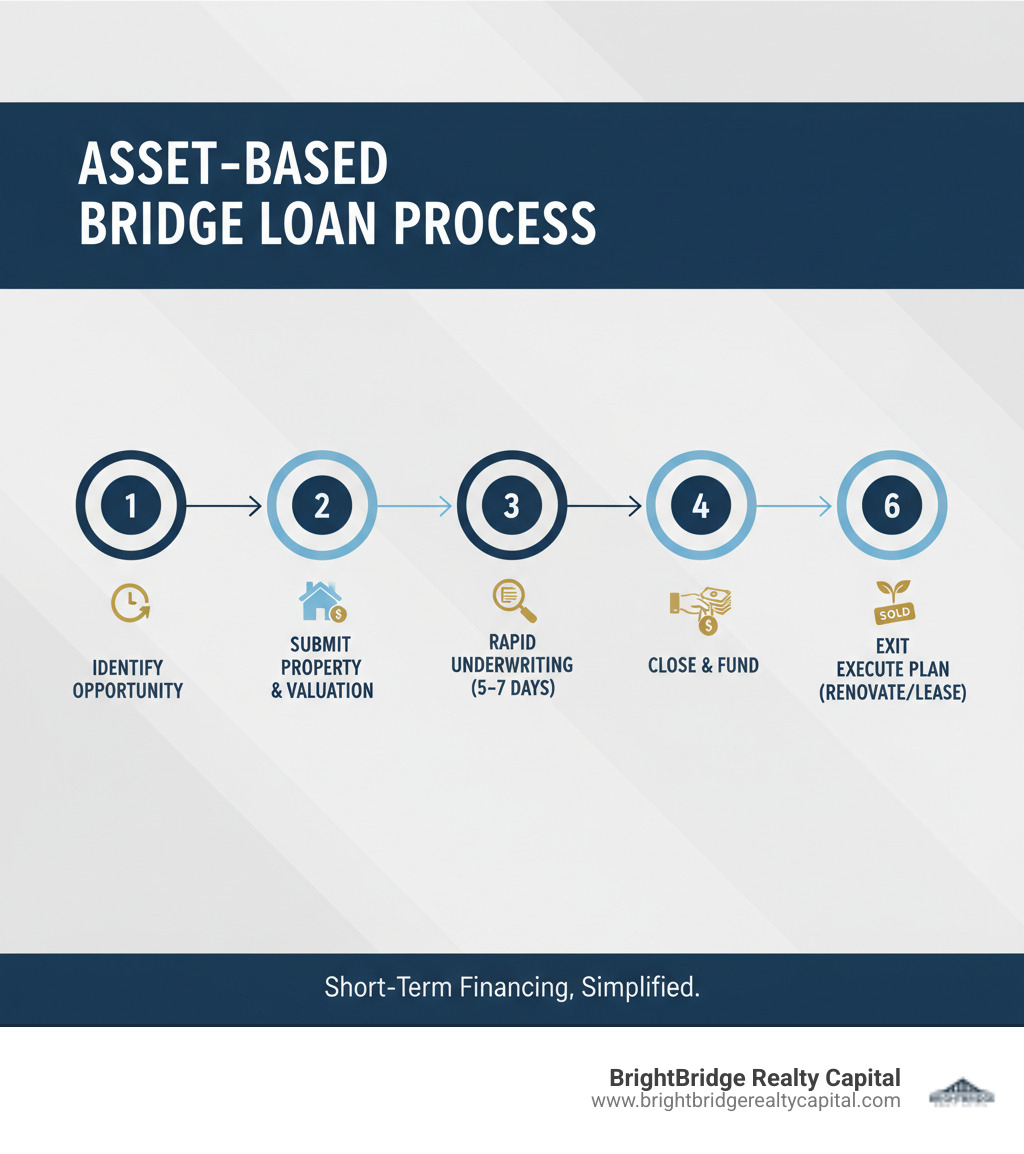
Here’s a simplified look at our typical underwriting timeline:
- Day 1: You submit a loan application with basic property details, purchase price, renovation budget, and your proposed exit strategy. We can often provide a preliminary term sheet within 24 hours.
- Day 2-3: We conduct an in-depth review of the property, your experience, and your business plan. We'll have a direct conversation with you to discuss the project's specifics and ensure our goals are aligned.
- Day 3-5: We order a third-party appraisal to confirm the as-is value and the ARV. Simultaneously, our legal team prepares the loan documents.
- Day 5-7: Once the appraisal is in and title work is clear, we schedule the closing. The loan is funded, and you get the keys to your new project.
This streamlined approach means we can often provide pre-approvals within 24 hours and close loans in as little as 5-7 days. When you're competing for a property in a hot market, that speed is the ultimate competitive advantage.
The Growing Role of Asset-Based Lenders in Private Credit
The financial landscape has shifted seismically, and asset based bridge loans are at the epicenter of this change. The private credit market has exploded to roughly $1.4 trillion and is projected to hit $2.3 trillion by 2027. This isn't just growth; it's a fundamental restructuring of how real estate deals get financed.
What's driving this tectonic shift? A major factor is the retreat of traditional banks from many areas of real estate lending. Following the 2008 financial crisis, regulations like Dodd-Frank, Basel III, and Basel IV imposed stricter capital requirements and compliance burdens on banks. This has made them more risk-averse and has tightened their underwriting standards considerably. As a result, properties that need work, transitional assets, and projects that don't fit a standardized mold are often rejected by bank loan committees.
This is precisely where private lenders like us come in. We have built our business to thrive in the space that banks have vacated. We specialize in the deals they struggle with: properties needing renovation, acquisitions requiring a quick close, and investors who need flexible, customized financing. Because we are not constrained by the same rigid regulatory framework, we can evaluate deals on their individual merits and move with a speed that is impossible for large, bureaucratic institutions.
This growth has also been fueled by investors seeking higher yields. In a world of low returns from traditional fixed-income investments, private credit has become an increasingly attractive asset class. The structural protections built into asset-based private credit—with tangible real estate backing every loan—offer compelling risk-adjusted returns for our capital partners.
The rise of asset-based private credit is still in its early innings, representing a significant opportunity for both lenders and borrowers. As direct lenders, we bring specialized expertise in valuing real estate assets and structuring deals that work for investors. We understand the nuances of different property types, local market dynamics, and the complexities of renovation projects in a way that generalist lenders simply can't. This expertise, combined with our ability to close quickly without layers of bureaucracy, is why more and more investors are turning to private lenders for their bridge financing needs. We are not trying to replace traditional financing; we are filling a crucial gap that banks have left open, providing essential capital when and where it's needed most.
Conclusion: Bridge to Your Next Success
The real estate investment game moves at a relentless pace, and those who hesitate are often left watching opportunities slip through their fingers. Throughout this guide, we've explored how asset based bridge loans provide the critical tools—speed, flexibility, and financial leverage—to not just compete, but to win in today's dynamic market.
These are not your typical bank loans. They are sophisticated, strategic instruments designed for savvy investors who need to act decisively. Whether you are acquiring an unstabilized property that banks won't touch, funding a complex value-add renovation, or simply bridging a gap to permanent financing, the advantages are undeniable:
- Speed: The ability to close in as little as 5-7 days allows you to make non-contingent offers that sellers love.
- Focus on the Asset: Approvals are based on your property's value and potential, not just your personal financial statements.
- Leverage: Higher loan-to-value (LTV) and loan-to-cost (LTC) ratios, including financing for 100% of rehab costs, allow you to preserve your capital and scale your business faster.
- Flexibility: Loan terms are customized to fit your specific project and exit strategy, not a rigid, one-size-fits-all box.
Yes, asset based bridge loans come with higher interest rates and shorter terms than conventional financing. But this cost should be viewed as a strategic investment. When you're competing for a property in a hot market, or when you've found that perfect off-market deal that won't wait, the premium paid for speed and certainty is often a small price for securing a highly profitable opportunity. The most critical factor for success is having a well-researched, realistic exit strategy—whether that's a sale, a refinance, or stabilizing the property for long-term cash flow.
The landscape of real estate financing has fundamentally and permanently changed. With traditional banks pulling back from transitional properties and projects that don't fit their rigid criteria, direct private lenders like us have stepped in to fill the void. We focus on what truly matters: the intrinsic value of your asset and your ability to execute a sound business plan.
At BrightBridge Realty Capital, we have built our reputation on being more than just a source of capital. We are your strategic partners in navigating these transactions. We provide transparent terms, competitive rates, and most importantly, the speed and certainty you need to capitalize on opportunities. We understand the nuances of markets across the country and the unique challenges investors face.
If you are sitting on an opportunity that requires quick, decisive action, or if you are planning your next investment and need a financing partner who understands your vision, we are here to help. Don't let traditional lending roadblocks stand between you and your next successful project. Explore your stabilized bridge loan options and secure funding for your next deal with a team that is fully committed to your success.