Real Estate Bridge Loans: The Short-Term Solution for Your Next Big Move


Summary
Bridge funding real estate: Get fast financing to buy before you sell. Learn pros, cons, and how to qualify.
Why Speed Matters in Real Estate Financing
Bridge funding real estate is a short-term financing solution that helps investors and homeowners quickly secure capital to purchase a new property before selling an existing one—or to fund time-sensitive acquisitions and renovations. In a market where opportunities can vanish in an instant, this ability to act decisively is not just an advantage; it's a necessity. Let's explore the core components of this powerful financial tool:
What It Is: At its heart, a bridge loan is a temporary financing instrument, with terms typically ranging from three to 36 months. It is secured by a real estate asset, meaning the property itself serves as collateral. This structure is what enables the speed and flexibility that define bridge lending, as the loan's security is based on a tangible, valuable asset.
Who Uses It: The applications are broad. Real estate investors are primary users, leveraging bridge loans for fix-and-flips, value-add projects where a property is renovated to increase its income potential, or portfolio expansions that require rapid capital deployment. Homeowners also frequently use them to navigate the common dilemma of buying a new home before their current one has sold, eliminating the need for a stressful double-move or a less competitive contingent offer.
Why It's So Useful: The key benefits are speed, flexibility, and certainty. Closings can often happen in 7-30 days, a stark contrast to the 30-60 day timeline of traditional mortgages. The underwriting process is more adaptable, focusing on asset value over rigid borrower metrics. Crucially, it allows buyers to make offers without financing contingencies, which is a powerful signal to sellers that the buyer is serious and capable of closing quickly.
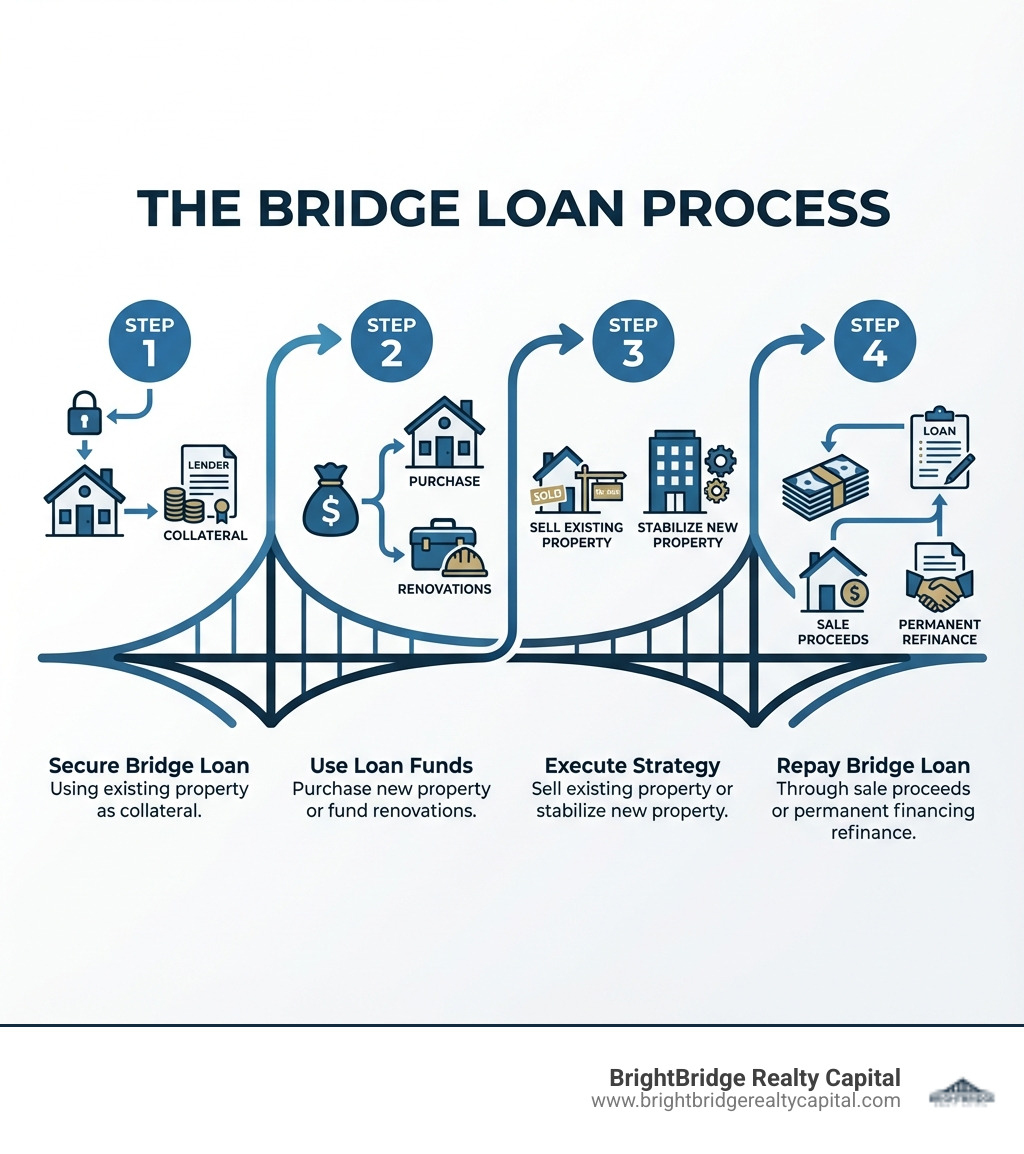
How It Works: The process is straightforward. A borrower secures a bridge loan using an existing property's equity or the new property as collateral. These funds are then used to acquire or renovate the target property. The loan is then repaid—the "exit"—through a planned event, most commonly the sale of the original property or a refinance into a long-term, permanent loan once the property is stabilized or renovated.
The Inherent Trade-Off: This speed and flexibility come at a cost. Bridge loans have higher interest rates and fees compared to their long-term counterparts. This premium is the price for immediate access to capital and the ability to bypass the slower, more bureaucratic processes of conventional lending. Borrowers must weigh this cost against the potential loss of a valuable opportunity.
Timing is everything in real estate. Whether you're a homeowner who found your dream property before your current house sold, or an investor eyeing a distressed multifamily building that won't stay on the market long, the gap between needing capital and having it can cost you the deal. Traditional financing, with its lengthy underwriting and appraisal processes, often takes 30-60 days to close—if you even qualify in today's tight credit environment. That's where bridge loans come in, acting as a dedicated financial vehicle for speed.
Bridge financing is designed for situations where speed, flexibility, and certainty matter more than getting the absolute lowest rate. According to Investopedia, these loans provide "immediate cash flow until permanent financing is secured or an existing obligation is met." They're also known as interim financing, gap financing, or swing loans—and they've become essential tools for investors navigating competitive markets, rising interest rates, and tightening credit conditions. As conventional banks pull back on lending for transitional assets (properties that are not yet fully leased or stabilized), the role of specialized bridge lenders has become even more critical.
As Daniel Lopez, a loan officer at BrightBridge Realty Capital, I've helped countless investors and homeowners leverage bridge funding real estate to close on properties that would have otherwise slipped away. My focus is on making complex loan structures easy to understand and execute, ensuring our clients can move with confidence and precision. Let's break down how bridge loans work, when they make sense, and what you need to know before using one.
Simple Bridge funding real estate glossary:
What Is a Real Estate Bridge Loan?
At its core, a real estate bridge loan is a short-term, temporary financing solution designed to "bridge the gap" between two financial events. Think of it as a financial lifeline that provides immediate cash flow when you need it most, such as when you're buying a new property but haven't yet sold your current one, or when an investment opportunity requires rapid funding. These loans are often called interim financing, swing loans, or gap financing, reflecting their temporary nature and their function as a connector between a capital need and a future capital event.
Unlike traditional mortgages that focus heavily on your personal income, credit history, and debt-to-income ratios, bridge loans are primarily collateral-based and asset-focused. This means the lender places significant emphasis on the value and potential of the real estate itself, rather than solely on the borrower's personal financial strength. For an investor, this means the lender is more interested in the property's projected income after renovation than their W-2 from last year. This asset-centric approach allows for greater speed and flexibility in underwriting, making them ideal for situations where time is of the essence. Our goal with bridge funding real estate is to provide you with the capital you need to seize opportunities without delay.
Defining the "Bridge" in Financing
The "bridge" in bridge financing isn't just a catchy name; it perfectly describes the loan's function. It provides temporary capital, connecting two separate transactions that can't happen simultaneously due to timing or funding constraints. For example, a homeowner might find their dream home listed for a competitive price, but they need the $150,000 of equity from their current home for the down payment. Instead of waiting for their home to sell, which could take months, they can use a bridge loan. The loan "bridges" this gap by providing the $150,000 immediately, allowing them to buy the new home. Once their old home sells, they use the proceeds to pay back the bridge loan. This connection prevents them from missing out on opportunities.
A key benefit of this bridging function is the ability to avoid contingencies. In today's competitive real estate markets, an offer contingent on the sale of another property can be a significant disadvantage, often leading to it being rejected in favor of a cleaner, non-contingent offer. Bridge loans empower you to make a non-contingent, cash-backed offer, giving you a competitive edge and helping you secure a property quickly. As one expert put it, bridge loans make an offer "more competitive in a seller's market by mitigating mortgage contingencies." We see this often with our clients; the ability to act fast can make all the difference between winning a bidding war and losing a deal.
Types of Bridge Financing
While the fundamental concept of a bridge loan remains consistent, its application can vary. Primarily, we focus on debt financing, where the loan is secured by real estate assets. This includes both residential and commercial bridge loans, each tailored to different borrower needs and property types.
Residential Bridge Loans: These are typically used by homeowners who need to purchase a new primary residence before their current home sells. The loan is usually secured by the equity in their existing property, effectively allowing them to 'borrow' their down payment from themselves ahead of time. This is also known as a 'swing loan' and is perfect for navigating tricky moving timelines.
Commercial Bridge Loans: For real estate investors and developers, commercial bridge loans are highly versatile tools. They are used for a wide range of property types, including multifamily, office, retail, industrial, mixed-use, self-storage, student housing, hospitality, and even specialty use properties like medical facilities or data centers. These loans are secured by the commercial real estate asset and are crucial for specific strategies:
- Value-Add Projects: An investor might use a bridge loan to buy an older apartment complex with low rents, fund extensive renovations to the units and common areas, and increase rents to market rates. Once the property is stabilized with higher income, they can refinance into a permanent loan.
- Lease-Up Scenarios: A bridge loan can be used to acquire a newly built but vacant office or retail building. The loan covers costs while the investor works to secure tenants. Once a certain occupancy level is reached, the property qualifies for traditional financing.
- Quick-Close Acquisitions: When a desirable property comes to market and must be closed on in under 30 days, a bridge loan is often the only viable financing option.
All these forms of bridge funding real estate share the common characteristic of being secured loans, meaning collateral (the property itself) is pledged to the lender. This security is what often allows for faster approval and funding compared to unsecured options, as the lender's risk is mitigated by the value of the physical asset.
How Does Bridge Funding Real Estate Work?
Understanding how a bridge loan works is crucial for leveraging its power effectively. The process is designed to be streamlined, helping you move from application to funding as quickly as possible. Generally, it involves an initial application, a swift underwriting process focused on the asset, rapid funding, and a clear repayment strategy, often called an exit plan. This plan, which is arguably the most important part of the application, typically involves the sale of your existing property or the refinancing into a more permanent, long-term loan.

The Step-by-Step Funding Process
The speed of bridge funding real estate is one of its most attractive features. Here's a typical breakdown of how we get you from application to closing:
- Initial Application: You start by submitting a concise application, providing essential details about yourself (or your entity), the property you're selling (if applicable), and the property you intend to acquire or renovate. This initial step is often a simple form that can be completed in minutes.
- Document Submission & Due Diligence: We then request necessary documentation to begin our due diligence. For a commercial project, this might include personal financial statements, a schedule of real estate owned (REO), entity documents (like an LLC operating agreement), a detailed business plan for the asset, historical operating statements, current rent rolls, and a comprehensive renovation budget. For a homeowner, this is simpler, often requiring just mortgage statements and an agreement of sale for the new property.
- Underwriting and Appraisal: Our team quickly underwrites the loan, focusing on the viability of your project and the value of the collateral. An independent, third-party appraisal of the property is a critical step. For value-add projects, the appraiser may be asked to provide both an "as-is" value and an "after-repair value" (ARV), which projects the property's worth once renovations are complete. This ARV is crucial for determining the total loan amount, including the renovation budget.
- Lender Approval & Term Sheet: Once all documentation is reviewed and the appraisal is satisfactory, we move swiftly to approval and issue a term sheet. This document outlines all the proposed terms of the loan for your review and acceptance.
- Closing Process: This is where BrightBridge Realty Capital truly shines. As direct lenders, we fund loans from our own balance sheet, eliminating intermediaries and ensuring a streamlined process. While traditional mortgages can take 30-60 days, many bridge lenders can close in a few weeks. Our specialization and in-house teams mean we often achieve fast closings, sometimes within a week to ten days, depending on the complexity of the deal and the speed of third-party reports.
- Fund Disbursement: Once closing is complete, funds are disbursed. For an acquisition, the funds go directly to the seller. For renovation projects, the acquisition funds are disbursed at closing, and the renovation budget is placed in an escrow account to be drawn down by the borrower as work is completed.
- Repayment (The Exit): The final step is the repayment of the bridge loan. This happens according to your pre-approved exit strategy, typically through the sale of your existing property or by refinancing into a long-term mortgage once your project is complete or the market conditions are favorable.
Understanding Typical Terms: Rates, Fees, and Conditions
Because bridge loans offer speed and flexibility, they come with different terms than traditional financing. It's essential to understand these to make an informed decision:
- Loan Amount: Loan amounts for bridge funding real estate can vary widely, from a few hundred thousand dollars for a residential swing loan to tens of millions for large commercial projects. For example, some commercial bridge loans can range from $5 million to $75 million, with larger amounts considered on a case-by-case basis.
- LTV and LTC Ratios: Lenders typically base the loan amount on the property's Loan-to-Value (LTV) or Loan-to-Cost (LTC) ratios. For homeowners, lenders might offer up to 80% of the combined value of the two properties. For investors, leverage can be up to 75% LTC for core assets. For value-add projects, a lender might offer up to 80% of the purchase price plus 100% of the capital improvement budget, as long as the total loan amount does not exceed a certain percentage (e.g., 75%) of the After-Repair Value (ARV).
- Term Length: Bridge loans are short-term, generally ranging from three months to three years. Some loans may include extension options (e.g., two one-year extensions) for an additional fee, providing a safety net if the exit plan takes longer than expected. They are not meant for permanent financing.
- Interest Rates & Payments: Interest rates for bridge loans are higher than traditional loans, often starting at a few points over the Secured Overnight Financing Rate (SOFR), which replaced LIBOR as the benchmark. Many commercial bridge loans feature Floating (SOFR-based) rates and are structured as interest-only, meaning the borrower only pays the interest each month, not the principal. This keeps monthly payments lower, preserving cash flow for renovations or other expenses.
- Origination & Other Fees: Expect an upfront origination fee, typically 1.00% to 2% of the loan amount, paid to the lender for processing the loan. Other costs include appraisal fees, legal fees for both borrower and lender, title insurance, and processing fees.
- Exit Fees: Some bridge loans include an exit fee, often 0.25% to 1.00% of the loan amount, payable when the loan is repaid. This fee compensates the lender for the short duration of the loan. It's crucial to factor this into your total cost of capital.
- Recourse vs. Non-Recourse: Many commercial bridge loans are non-recourse, meaning the lender's claim in a default is limited to the property itself. However, these loans always include standard "bad boy" carve-outs, which trigger personal liability for actions like fraud, intentional waste, unauthorized transfer of the property, or declaring bankruptcy.
- Prepayment Penalties: To ensure they earn a minimum amount of interest, some lenders include prepayment penalties. This might be structured as a minimum number of months of interest (e.g., 6-12 months) or a declining percentage of the loan balance if paid off within a certain period. However, many bridge loans designed for quick flips have no prepayment penalty to facilitate a fast exit.
Strategic Scenarios: When to Use a Bridge Loan
Bridge loans are powerful tools when traditional financing options are too slow, too rigid, or simply unavailable for your specific needs. They shine brightest in time-sensitive situations where quick access to capital can make or break a deal. Let's explore some detailed scenarios where bridge funding real estate becomes a game-changer.
For Homeowners: Buying Before You Sell
This is one of the most common and relatable uses for a bridge loan. Imagine you've found your absolute dream home – the perfect layout, the ideal neighborhood, the backyard you've always wanted. The only problem? Your current house hasn't sold yet, and you need the equity from it for the down payment on the new property. A bridge loan steps in to cover that gap.
- Securing a Dream Home: It allows you to make an offer on the new property without the contingency of selling your current home, making your offer much more attractive to sellers in a competitive market.
- Relocating for a Job: If a new job requires a quick move, a bridge loan can provide the funds to purchase a new home immediately, avoiding the hassle and expense of temporary housing or renting while you wait for your old home to sell.
- Downsizing or Upsizing: Whether you're moving to a smaller place or need more space for a growing family, a bridge loan lets you transition smoothly without juggling two mortgages for an extended period or rushing the sale of your current home for a lower price.
- Covering a Down Payment: The equity in your current home can be used as collateral for the bridge loan, providing the necessary funds for the down payment and closing costs on your new property.
For Investors: A Value-Add Case Study
For real estate investors, bridge loans are an indispensable part of their toolkit, particularly for projects that require significant capital infusion and a rapid turnaround. Let's walk through a hypothetical value-add project:
An investor identifies a 20-unit apartment building for sale at $2 million. The building is old, with dated units and below-market rents averaging $1,000/month. The investor's plan is to renovate all 20 units, upgrade the common areas, and increase rents to the market rate of $1,500/month. The total renovation budget is $500,000 ($25,000 per unit).
- The Challenge: A traditional bank won't finance this deal because the current income doesn't support the loan amount, and they won't fund the extensive renovation budget.
- The Bridge Loan Solution: The investor secures a bridge loan from a direct lender like BrightBridge Realty Capital.
- Purchase Price: $2,000,000
- Renovation Budget: $500,000
- Total Project Cost: $2,500,000
- The Loan: We provide a loan for 80% of the purchase price ($1.6M) and 100% of the renovation budget ($500k), for a total loan of $2.1M. The investor contributes $400k as a down payment plus closing costs.
- Execution: Over a 12-month period, the investor renovates the units and raises rents. The property's value increases significantly due to the higher net operating income.
- The Exit: With the property now stabilized and valued at $3.5 million, the investor refinances with a traditional long-term mortgage, pays off the $2.1M bridge loan, and recaptures their initial equity plus a profit.
Other Strategic Uses for Bridge Loans
Beyond the common scenarios, savvy investors use bridge loans in several other creative ways:
- 1031 Exchange Timing Issues: In a 1031 exchange, an investor must identify a replacement property within 45 days and close within 180 days. If their ideal replacement property requires a fast closing before their relinquished property has sold, a bridge loan can provide the funds to complete the purchase and meet the strict deadlines.
- Partner Buyouts: In a real estate partnership, one partner may wish to buy out another. A bridge loan can provide the immediate capital needed to purchase the departing partner's equity, allowing the remaining partner to gain full control before securing permanent financing.
- Acquiring Properties at Auction: Real estate auctions often require the winning bidder to pay in cash within a very short timeframe (sometimes 24-72 hours). A bridge loan is one of the few financing methods fast enough to meet these requirements.
Gaining a Competitive Edge with 'Certainty of Execution'
In the world of real estate, "certainty of execution" is a golden phrase. It means that when you make an offer or commit to a project, you have the financial backing to follow through, quickly and reliably. This is where bridge funding real estate truly offers a strategic advantage.
As direct lenders, BrightBridge Realty Capital funds loans from our own balance sheet. This crucial distinction means we don't rely on third-party funding sources or warehouse lines, which can introduce delays and uncertainty. Our in-house underwriting and credit functions ensure a streamlined, transparent, and swift process from application to funding. This direct lending approach provides:
- Eliminating Financing Contingencies: For both homeowners and investors, being able to make an offer without a financing contingency is incredibly powerful. It signals to sellers that you are a serious buyer, ready to close.
- Closing Deals Faster: Our ability to close deals quickly, often within a week, means you can seize opportunities before competitors who are reliant on slower, traditional financing. As one expert noted, "Approvals can happen within days rather than weeks, making them powerful tools for competitive markets where quick closings matter."
- Attractive Leverage: We offer competitive leverage, including up to 80% of the purchase price and 100% of the capital improvement budget for commercial projects, giving you the financial muscle to execute your vision.
Weighing Your Options: Pros, Cons, and Considerations
Like any financial tool, bridge funding real estate comes with its own set of advantages and disadvantages. It's not a one-size-fits-all solution. The key is to weigh these factors against your specific situation, conduct a thorough risk assessment, and ensure you have a solid, realistic exit strategy before committing.
The Major Advantages: Speed and Flexibility
The primary reasons borrowers turn to bridge loans are their unparalleled speed and flexibility, which are critical in a fast-moving market.
- Fast Funding and Quick Closing: This is the hallmark of bridge loans. While a traditional bank loan can take weeks or months to navigate committees and bureaucracy, a direct bridge lender can often underwrite and fund a loan in a matter of days or a few weeks. This rapid turnaround is invaluable for time-sensitive transactions, like auctions or competing against all-cash offers.
- Flexible Underwriting: Bridge lenders are often more adaptable in their evaluation process. They focus heavily on the asset's value and the project's viability. For example, a self-employed investor with fluctuating income might be rejected by a conventional bank's automated underwriting system. A bridge lender, however, can look past that, see the value in the deal and the borrower's experience, and approve the loan.
- Easier Qualification for Transitional Assets: Traditional lenders prefer stabilized properties with a proven history of cash flow. Bridge lenders specialize in "transitional" assets—properties that are vacant, in need of renovation, or not yet generating income. They are comfortable with the story behind the property and the plan to create value.
- Focus on Asset Value Over Credit Score: While credit is still a factor, it's not the sole determinant. A borrower with a lower-than-perfect credit score but significant equity in a property or a well-conceived business plan can still qualify. The lender sees the potential and the security in the real estate itself, not just the borrower's FICO score.
Potential Risks and Drawbacks to Consider
While the advantages are compelling, it's crucial to be aware of the potential downsides and costs.
- Higher Interest Rates: Bridge loans carry higher interest rates than conventional mortgages, often starting several percentage points above the prime rate. This is the premium for speed and risk. For example, on a $1 million loan, a 4% rate difference translates to an additional $40,000 in interest costs over a year. You must be confident that the opportunity's profit potential justifies this higher cost of capital.
- Upfront Fees and Total Cost: In addition to interest, you'll encounter various fees, including origination fees (1-2% of the loan amount), appraisal fees, legal fees, and sometimes exit fees. These can add up, creating a "cash crunch" if not properly budgeted. It's vital to analyze the Annual Percentage Rate (APR), which includes these fees, to understand the true cost of the loan.
- Short Repayment Window: The short term (typically 3 months to 3 years) means you need a clear and executable exit strategy. If your property doesn't sell as quickly as anticipated, or if the refinance market tightens, you could face significant pressure as the loan's maturity date approaches.
- Risk of Default: If you fail to repay the loan on time, the property used as collateral is at risk of foreclosure. This is why a solid exit plan isn't just a good idea—it's essential. You must have contingency plans in place. What if the sale falls through? What if the appraisal for the refinance comes in low?
- Managing Two Property Payments Simultaneously: For homeowners buying before selling, you might be responsible for payments on both your existing mortgage and the new bridge loan for a period. This requires careful financial planning and sufficient cash reserves to handle the temporary increase in monthly obligations.
Bridge Loans vs. Traditional Financing
To help you decide if bridge funding real estate is right for you, here's a quick comparison with traditional financing options:
| Feature | Bridge Loan | Traditional Mortgage (Conventional) |
|---|---|---|
| Term Length | Short-term, typically 3 months to 3 years | Long-term, typically 10-30 years |
| Interest Rate | Higher, often floating (SOFR-based) | Lower, often fixed |
| Closing Speed | Very fast, days to a few weeks | Slower, typically 30-60 days |
| Qualification | Asset-focused, project viability, exit plan | Borrower-focused (income, credit, DTI) |
| Property Condition | Accepts transitional, unstabilized properties | Requires stable, cash-flowing properties |
| Payment Structure | Often interest-only | Principal and Interest (P&I) amortized |
| Best Use Case | Time-sensitive acquisitions, value-add projects, buying before selling | Long-term ownership, stabilized properties, primary residences |
How to Qualify and Secure Your Bridge Loan
Qualifying for bridge funding real estate can be an easier and faster process than for traditional loans, primarily because lenders often prioritize the viability and value of the underlying real estate asset. However, being prepared is key to a smooth and successful funding experience. There are still key borrower requirements and lender expectations you'll need to meet.
Qualifying for Bridge Funding Real Estate: What Lenders Look For
Lenders assess several factors to determine your eligibility and the terms of your bridge loan. A strong application addresses all of these points comprehensively.
- Credit Score: While bridge loan lenders are more flexible than traditional banks, a good credit score is still beneficial as it indicates financial responsibility. According to Experian, a minimum credit score of 700 is often cited, though some lenders may prefer 740 or higher. A major issue like a recent bankruptcy or foreclosure can be a hurdle, but a lower score due to high credit utilization might be overlooked if the deal is strong.
- Equity and Capital: For homeowners, significant equity (often 20% or more) in your current property is usually required, as this serves as the collateral. For investors, lenders want to see that you have sufficient liquidity or "skin in the game"—the cash to cover the down payment, closing costs, and interest reserves for the loan term.
- Debt-to-income ratio (DTI): While less rigid than with conventional loans, your DTI still matters. It indicates your ability to manage additional loan payments, especially if you're a homeowner carrying two mortgages temporarily. Some lenders may look for a DTI below 50%.
- Investor Track Record: For commercial investors, a proven track record in real estate investment, development, or property management can significantly strengthen your application. A portfolio showing successful past projects demonstrates that you have the experience to execute your business plan. New investors can overcome a lack of experience by partnering with a seasoned professional or hiring a highly qualified property management team.
- Property Cash Flow & Potential (for CRE): For commercial properties, lenders analyze the existing cash flow (if any) and your projections for future cash flow post-repositioning. They will stress-test your assumptions to ensure the property can service the debt and that the value-add plan is realistic.
- A Viable Business Plan & Exit Strategy: This is the roadmap for the loan. It must be clear, detailed, and realistic. Lenders want to see a well-researched plan that includes a detailed renovation budget, a project timeline with clear milestones, a market analysis with comparable sales or rents to support your projections, and, most importantly, a primary and secondary exit strategy. How, specifically, will you repay the loan? Name the banks you plan to approach for a refinance or list the brokers you will use to sell the property.
Key Considerations Before You Commit
Before you sign on the dotted line, do your homework and ensure a bridge loan aligns with your financial goals and risk tolerance.
- Calculate the True Total Cost: Don't just look at the interest rate. Create a spreadsheet and factor in all fees – origination, exit, legal, appraisal, and potential extension fees – to understand the true cost of the loan. Compare this total cost against your projected profit to ensure the deal still makes sense.
- Stress-Test Your Exit Strategy: This is the most critical consideration. What happens if your primary exit strategy fails? If you plan to sell, what if the market softens and it takes three months longer than expected? If you plan to refinance, what if interest rates rise and you can't qualify for the loan you need? Have a backup plan, such as additional cash reserves to cover payments or a willingness to accept a lower sale price.
- Choose the Right Lender: Not all lenders are created equal. A direct lender like BrightBridge Realty Capital uses its own funds, offering more speed and certainty. A broker, on the other hand, acts as an intermediary, which can add time and cost. Research your lender's reputation, ask for case studies of similar deals they've funded, and ensure they are transparent about all terms and fees.
- Understand All Loan Terms: Read the fine print carefully. Clarify the exact term length, how the interest rate adjusts (for floating-rate loans), the specifics of any prepayment penalties, and any reporting requirements or covenants you must adhere to during the loan term.
- Prepare Your Application Package in Advance: To facilitate a fast closing, have your documents ready. This includes personal and business tax returns, financial statements, a schedule of real estate owned, bank statements, entity documents, and a fully developed business plan. Being organized shows the lender you are a serious and capable borrower.
Frequently Asked Questions about Real Estate Bridge Loans
Navigating the world of specialty financing can bring up many questions. Here are detailed answers to some of the most common inquiries we receive about bridge funding real estate.
How fast can you get a bridge loan?
Bridge loans are known for speed, which is their primary advantage. While a traditional mortgage can take 30-60 days or more to close, many bridge lenders can close in a few weeks. At a direct lender like BrightBridge Realty Capital, where underwriting and funding are handled in-house, we can often fund a loan in as little as 7-10 business days, provided the borrower is organized and third-party reports like the appraisal and title search don't face unexpected delays. The speed is contingent on the deal's complexity and the borrower's preparedness.
Are bridge loans only for real estate investors?
No, while they are a very popular tool for professional investors, homeowners frequently use bridge loans. The most common residential scenario is to purchase a new primary residence before their current one is sold. This allows the homeowner to avoid moving twice, make a stronger, non-contingent offer in a competitive market, and have a more relaxed timeline for selling their existing home. These are often called "swing loans."
What happens if I can't repay the bridge loan on time?
This is the most significant risk associated with bridge financing. If you can't sell your property or refinance before the loan term ends, you will be in default. The consequences can be severe, starting with significant late fees and penalty interest rates, which can dramatically increase your loan balance. Ultimately, the lender can begin foreclosure proceedings to seize the property used as collateral to recoup their investment. This is why having a solid, realistic, and even conservative exit strategy—with a backup plan—is the most critical part of using a bridge loan successfully.
What is the difference between a bridge loan and a hard money loan?
The terms are often used interchangeably, but there can be a subtle difference. Historically, "hard money" was associated with loans from private individuals or small, unregulated groups, often at very high rates and based almost exclusively on the property's liquidation value. "Bridge loans" are typically offered by more institutional, organized private lenders. While still asset-based, bridge lenders often take a more holistic view, considering the borrower's experience and business plan, and may offer more structured and slightly more competitive terms than traditional hard money lenders.
Can I get a bridge loan with bad credit?
It's possible, but it depends on the reason for the bad credit and the strength of the deal. Bridge lenders are more flexible on credit than conventional banks. If your credit score is low due to minor issues but you have significant equity, a strong track record, and a great business plan, many lenders will still consider your application. However, major red flags like a recent bankruptcy, foreclosure, or a history of financial fraud will make it very difficult to secure a loan from any reputable lender.
Can I use a bridge loan for ground-up construction?
Typically, no. Bridge loans are designed for existing properties—either for acquisition, renovation (value-add), or to bridge a timing gap. Ground-up construction is a different risk profile and is usually financed with a dedicated construction loan. A construction loan is disbursed in stages (draws) as construction milestones are met, whereas a bridge loan for renovation typically funds the acquisition upfront and places the renovation budget in escrow.
Conclusion: Bridging Your Way to Success
Bridge funding real estate offers a unique blend of speed, flexibility, and strategic advantage that traditional financing simply cannot match. In a world where real estate opportunities are fleeting and competition is fierce, the ability to act with certainty and swiftness is paramount. Whether you're a homeowner eager to secure your next residence without a sales contingency, or a real estate investor eyeing a value-add opportunity that demands rapid capital, bridge loans provide the essential interim financial solution to make your next big move possible.
We've explored how these loans function as a vital link between transactions, enabling you to act quickly in competitive markets and seize opportunities that slower-moving buyers must pass up. We've detailed their versatility for both residential and commercial applications, from the simple 'buy before you sell' scenario to funding complex fix-and-flip or property repositioning projects. The "certainty of execution" offered by direct lenders like BrightBridge Realty Capital, who fund from their own balance sheet, removes critical layers of uncertainty and delay, ensuring that once you commit, the funding is delivered swiftly and seamlessly.
However, with great power comes great responsibility. The advantages of speed and flexibility are balanced by higher costs and a shorter repayment window. This makes having a clear, well-thought-out, and stress-tested exit plan not just advisable, but absolutely essential. Understanding the full scope of the terms, performing due diligence on market risks, and honestly evaluating your financial stability are the key steps to ensuring your bridge loan is a pathway to profit and success, not a bridge to nowhere.
Before you proceed, ask yourself: Is my opportunity time-sensitive? Is the potential profit or benefit greater than the higher cost of the loan? Do I have a clear and realistic plan to repay this loan within its term? If the answer to these questions is a confident 'yes,' then a bridge loan may be the perfect strategic tool for your arsenal. For investors needing fast, direct, and flexible financing to seize their next opportunity, exploring a customized lending solution is the next logical step. We are here to help you steer the complexities of bridge funding real estate with expert advice and custom solutions.