Beyond the Basics: Getting a Commercial Equity Line of Credit for Your Investment Property

Summary
Unlock your commercial equity line of credit investment property potential: qualify, compare rates, and fund growth with expert tips.
What Is a Commercial Equity Line of Credit for Investment Property?

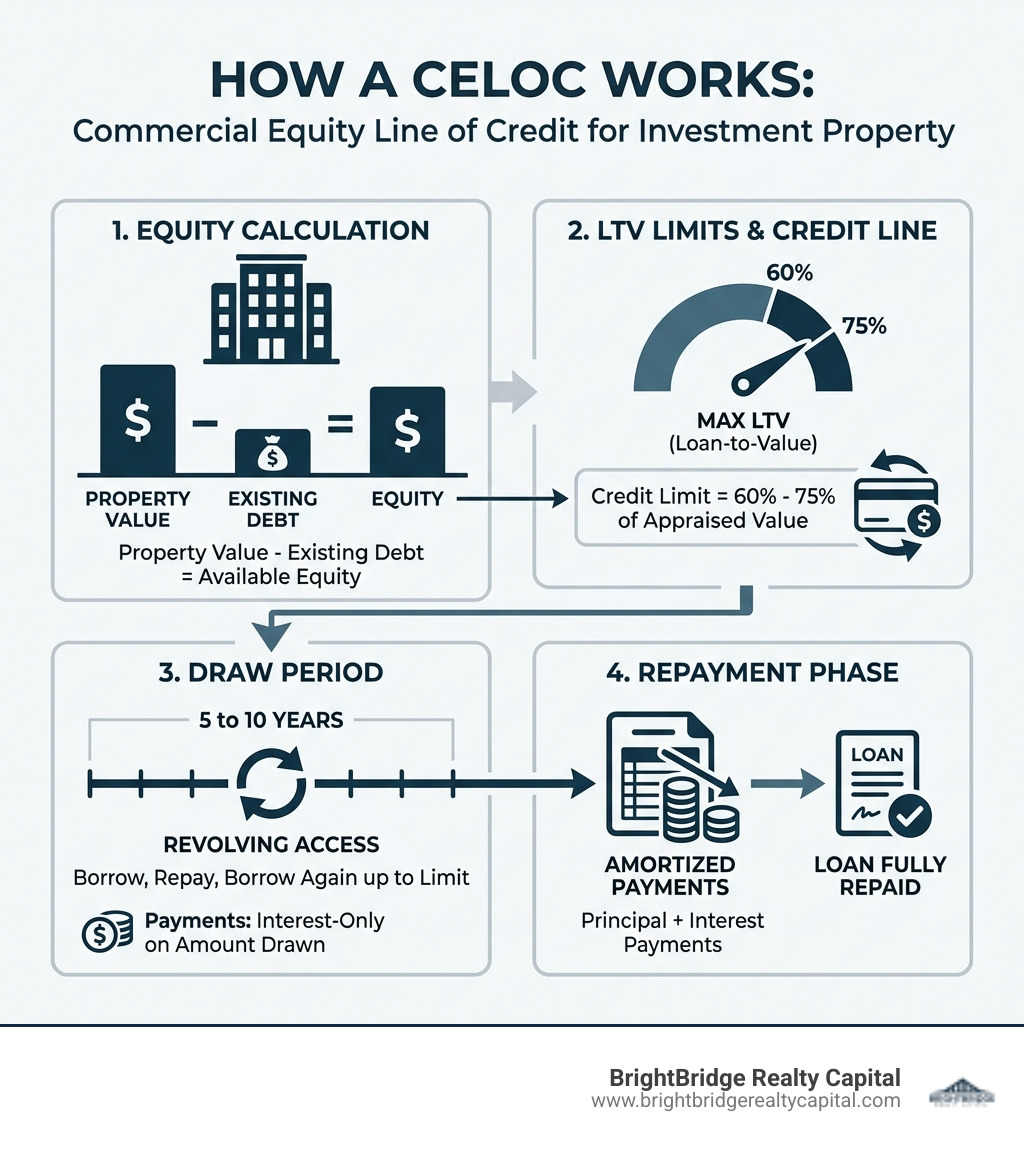
A commercial equity line of credit investment property loan — often called a CELOC — is a revolving credit line secured by the equity in a commercial or investment property you already own. Think of it like a credit card backed by real estate: you borrow what you need, repay it, and borrow again — up to your approved limit.
In today's volatile real estate market, liquidity is the ultimate competitive advantage. Whether you are managing a portfolio of multifamily units or a single industrial warehouse, having "dry powder" ready to deploy can mean the difference between securing a distressed asset at a discount or missing out to a cash buyer. A CELOC provides that liquidity without the permanence of a traditional mortgage or the high costs of hard money.
Here's what you need to know at a glance:
| Feature | Typical Terms |
|---|---|
| How it works | Revolving credit line secured by commercial property equity |
| Credit limit (LTV) | 60% to 75% of appraised property value |
| Interest | Variable, charged only on what you draw |
| Draw period | Usually 5 to 10 years |
| Repayment | Interest-only during draw period, then amortized |
| Eligible properties | Office, retail, multi-family, warehouse, mixed-use, industrial |
| Who it's for | Investors and business owners with equity in commercial real estate |
This financing tool is powerful for real estate investors who need fast, flexible access to capital — without selling assets or going through a full refinance every time an opportunity comes up. Unlike a standard term loan, where you pay interest on the full amount from day one, a CELOC allows you to keep your interest expenses low by only paying for the capital you are actively using.
But it works differently from a standard home equity line, and lenders apply stricter criteria to investment and commercial properties. Knowing those differences before you apply can save you time, money, and frustration. Commercial lenders are less interested in your personal debt-to-income ratio and far more focused on the property's ability to generate net operating income (NOI).
I'm Daniel Lopez, a loan officer at BrightBridge Realty Capital with experience structuring commercial equity line of credit investment property deals across a wide range of asset types and deal sizes. In this guide, I'll walk you through exactly how CELOCs work, how to qualify, and how to use them strategically to grow your portfolio.
Handy commercial equity line of credit investment property terms:
Understanding the Commercial Equity Line of Credit (CELOC)
At its core, a commercial equity line of credit investment property is a flexible financing vehicle. Unlike a traditional mortgage where you receive a lump sum of cash on day one and start paying interest on the whole amount immediately, a CELOC sits there waiting for you. It is a standby source of capital that provides peace of mind in an unpredictable economy.
We often describe it as a "revolving" credit facility. This means as you pay down the balance, those funds become available to borrow again. It’s an asset-backed loan, meaning the lender uses your property as collateral. If you’re looking for more info about commercial real estate loans, you’ll find that while most are "one and done" transactions, the CELOC is a long-term relationship tool. It evolves with your business needs, allowing you to draw funds for a renovation, pay it back once the property is stabilized, and then draw again to fund the down payment on your next acquisition.
One of the biggest perks? Interest-only payments. During the initial phase (the draw period), most lenders only require you to pay interest on the money you’ve actually spent. If your line is $500,000 but you’ve only drawn $50,000 to fix a leaky roof, you only pay interest on that $50k. It’s efficient, smart, and keeps your monthly overhead low while you're in the middle of a project. This cash flow flexibility is vital for investors who may be dealing with seasonal vacancies or unexpected maintenance costs.
CELOC vs. HELOC: Key Differences for Investors
If you’ve ever had a Home Equity Line of Credit (HELOC) on your primary residence, you might think you know the drill. However, when we move into investment properties, the rules of the game change significantly. The underwriting shifts from a consumer-protection focus to a business-risk focus.
The primary difference lies in occupancy and risk. Lenders view a property you live in as a lower risk—people generally do everything they can to keep the roof over their own heads. An investment property, however, is a business asset. If the market turns south, an investor might be more willing to walk away from a warehouse than their family home. This perceived risk is why you won't find 90% LTV options in the commercial world.
Because of this, home-equity-line-of-credit-on-investment-properties usually come with:
- Lower Loan-to-Value (LTV) ratios: You can typically only borrow up to 70-75% of the value, compared to 85-90% for a primary home. This ensures the lender has a significant equity cushion if the market dips.
- Higher Interest Rates: Expect to pay a premium—often 1% to 2% higher than a standard HELOC. This reflects the increased risk of commercial lending.
- Stricter Underwriting: Lenders will scrutinize your rent rolls and property cash flow just as much as your personal credit score. They want to see that the property itself can support the debt, even if your personal income were to disappear.
Calculating Equity for a Commercial Equity Line of Credit Investment Property
Before you apply, you need to know how much "meat is on the bone." Equity is the difference between what your property is worth today and what you owe on it. In the commercial world, value is often determined by the income the property produces (the Income Approach) rather than just what the building next door sold for (the Sales Comparison Approach).
The formula is simple: Current Market Value - Outstanding Debt = Equity.
However, lenders don't let you borrow 100% of that equity. They use an LTV cap to ensure they have a safety buffer. For example, if your office building in New York NY is worth $1,000,000 and you owe $400,000, you have $600,000 in equity. If the lender allows a 70% LTV, your maximum total debt is $700,000. Subtract your existing $400,000 mortgage, and your CELOC limit would be $300,000.
| Requirement | Primary Residence HELOC | Investment Property CELOC |
|---|---|---|
| Typical Max LTV | 85% - 90% | 60% - 75% |
| Min. Credit Score | 660 - 680 | 700 - 720 |
| Appraisal Type | Standard Residential | Full Commercial/Income-Based |
| Income Verification | W2/Personal Tax Returns | Rent Rolls, P&L, Business Returns |
| Cash Reserves | 0 - 3 Months | 6+ Months of Payments |
Qualifying for a Commercial Equity Line of Credit Investment Property
Qualifying for a commercial equity line of credit investment property is a bit like an obstacle course—it requires preparation and a solid "financial fitness" level. Lenders aren't just looking at you; they are looking at the property’s ability to pay for itself. This is a fundamental shift for residential investors moving into the commercial space.
The Debt Service Coverage Ratio (DSCR) is the star of the show here. This ratio measures the property’s annual net operating income (NOI) against its annual debt obligations. Most lenders want to see a DSCR of at least 1.25x. This means for every $1.00 of debt payment, the property generates $1.25 in profit. If your property is barely breaking even, getting a CELOC will be an uphill battle. Lenders use this margin to ensure that even if expenses rise or occupancy drops slightly, the loan can still be serviced.
We also look at cash reserves. Real estate is unpredictable. A tenant might move out, or a boiler might explode. Lenders want to see that you have enough liquid cash (often six months' worth of debt service) sitting in a bank account to handle these hiccups without defaulting on the loan. This "liquidity requirement" ensures that the investor isn't living hand-to-mouth. For more details on the nuances of these requirements, check out our guide on investment-property-equity-line-of-credit.
Eligible Assets for a Commercial Equity Line of Credit Investment Property

What kind of buildings can you use as collateral? The list is broader than you might think, though each asset type carries a different risk profile in the eyes of a bank. Lenders often categorize these into "Core," "Value-Add," and "Opportunistic" assets.
- Multifamily (5+ Units): Generally considered the "gold standard" because residential housing is always in demand. Even in economic downturns, people need a place to live.
- Retail Spaces: Think strip malls or standalone shops. Lenders will look closely at the strength of your tenants (e.g., is it a national grocery chain or a local hobby shop?). They will also examine lease expiration dates to ensure the income is stable for the duration of the draw period.
- Warehouses and Industrial: These are currently very popular due to the rise of e-commerce. Properties with high ceilings and loading docks are particularly attractive to lenders right now.
- Mixed-Use: Properties that have retail on the bottom and apartments on top. These are common in urban centers like New York NY and offer diversified income streams.
- Self-Storage Facilities: These often have high margins and low overhead, making them attractive collateral. They are also considered "recession-resistant."
- Office Buildings: Post-pandemic, these are scrutinized more heavily. Lenders prefer medical offices or buildings with long-term government or corporate leases over general-purpose office space.
Lender Criteria and Required Documentation
If you hate paperwork, I have some bad news: commercial lenders love it. Because a commercial equity line of credit investment property involves higher dollar amounts and more complexity, the "file" is usually thick. You are essentially presenting a business case for why your property is a safe bet.
You will typically need:
- Three years of tax returns (both personal and business) to show a history of financial stability.
- Current Rent Rolls: A list of tenants, their lease terms, and how much they pay. Lenders look for "tenant concentration" risk here.
- Operating Statements (P&L): Showing the property's income and expenses for the last two years. They will look for "normalized" expenses, stripping out one-time capital expenditures.
- Personal Financial Statement (PFS): A snapshot of everything you own and everything you owe, including other real estate holdings.
- Property Appraisal: A fresh valuation from a lender-approved appraiser. This will include a detailed analysis of market rents and comparable sales.
- Environmental Reports: For many commercial properties, a Phase I Environmental Site Assessment (ESA) is required to ensure there is no soil or groundwater contamination.
For those who need to move faster or have complex tax situations, some private lenders offer a no-doc-equity-line, though these typically come with lower LTVs and higher interest rates to offset the lender's risk. These are ideal for investors who have high equity but perhaps lower "on-paper" income due to heavy depreciation write-offs.
How a CELOC Works: Draw Periods and Repayment Terms
A CELOC generally lives its life in two distinct phases: the Draw Period and the Repayment Period. Understanding the transition between these two is critical for long-term financial planning.
- The Draw Period (5-10 Years): During this time, the line is "open." You can pull money out via wire transfer or a specialized checkbook. Most investors choose interest-only payments during this phase to maximize their cash flow. This is the time to be aggressive with your investments, using the capital to improve the property or acquire new ones. You only pay for what you use, and as you pay it back, the limit resets.
- The Repayment Period (10-20 Years): Once the draw period ends, the "revolving" door shuts. You can no longer borrow more money. The remaining balance is then "amortized," meaning you start making monthly payments that include both principal and interest until the balance is zero. This can lead to a significant "payment shock" if you have a large balance, so it's important to have an exit strategy—either paying off the line, refinancing it, or selling the asset.
The interest rates are almost always variable. Many commercial lines are now tied to Floating SOFR-based rates (Secured Overnight Financing Rate), which replaced the old LIBOR. Some are also tied to the Wall Street Journal Prime Rate. This means if the Fed raises rates, your monthly payment will go up. It’s vital to understand these commercial-property-loans terms so you aren't surprised by a fluctuating bill. Some lenders offer a "fixed-rate lock" option where you can convert a portion of your balance to a fixed rate for a set term.
Interest Rates, Fees, and Closing Costs
Let's talk about the "cost of admission." A CELOC isn't free to set up, and the costs are generally higher than residential products due to the complexity of commercial title and legal work.
- Interest Rates: Usually Prime + a margin (e.g., Prime + 1.5%). If Prime is 8.5%, your rate is 10%. This margin is determined by your creditworthiness and the quality of the collateral.
- Origination Fees: Most lenders charge 1% of the total credit limit. On a $500,000 line, that’s $5,000 upfront. This covers the lender's administrative costs for setting up the facility.
- Appraisal Costs: Commercial appraisals are more expensive than residential ones, often ranging from $2,000 to $5,000 depending on the property size. They require a certified general appraiser and a much more in-depth report.
- Legal and Title Fees: Commercial transactions often require specialized legal counsel to review lease agreements and title issues. Expect to pay for title insurance and potentially a lender's legal fee.
- Annual Maintenance Fees: Some banks charge a few hundred dollars a year just to keep the line open, regardless of whether you use it.
- Closing Timelines: While traditional banks might take 45–60 days, direct lenders like us at BrightBridge Realty Capital can often close much faster—sometimes in as little as a week if the paperwork is ready.
Understanding the full scope of commercial-real-estate-financing costs helps you calculate your true Return on Investment (ROI) when using these funds. You must ensure that the profit generated by the borrowed capital exceeds the cost of the debt.
Strategic Uses and Risks of Commercial Equity Lines
Why would an investor want a commercial equity line of credit investment property? It’s all about speed and leverage. In the world of commercial real estate, the ability to move quickly is often more valuable than a slightly lower interest rate.
Common Strategic Uses:
- Value-Add Improvements: Using the line to renovate a multifamily building, which allows you to raise rents and increase the property's overall value. Once the renovations are complete and rents are higher, you can often refinance into a permanent loan and pay off the CELOC.
- Quick Acquisitions: In a hot market, cash is king. You can use your CELOC to buy a new property for cash, close in days, and then take your time getting a traditional long-term mortgage later. This is often called "delayed financing."
- Working Capital: Handling tenant improvements (TI) or leasing commissions (LC) to land a major new commercial tenant. These upfront costs can be substantial, and a CELOC provides the necessary liquidity to get the deal done.
- Portfolio Management: Using a real-estate-portfolio-line-of-credit to manage multiple properties under one umbrella. This simplifies your accounting and gives you a massive pool of capital to draw from.
- Emergency Fund: Having a line of credit in place serves as a safety net for major unexpected repairs, such as a roof replacement or HVAC failure, ensuring you don't have to dip into your personal savings.
Comparing CELOCs to Refinancing and Other Alternatives
Is a CELOC always the best choice? Not necessarily. It depends on your specific goals and the current interest rate environment.
If you need a large amount of cash for a long time and want a fixed rate, a Cash-Out Refinance is often better. You’ll get a lower interest rate, but you’ll be paying interest on the full amount from day one. This is best for long-term "buy and hold" strategies where you don't plan on paying the principal back quickly.
If you only need a small amount for a short time, a Business Line of Credit (unsecured) might be faster, but the interest rates will be significantly higher because there’s no real estate backing the loan. For a deeper dive into rate comparisons, see our home-equity-loan-rates-guide.
Managing Risks: Variable Rates and Foreclosure
We have to talk about the "scary stuff." Because a CELOC is secured by your property, the stakes are high. This is not "cheap money"; it is strategic debt that must be managed with discipline.
- Variable Rate Risk: If rates spike, your interest-only payment could double. Always stress-test your numbers. Ask yourself: "Can I still afford this if the rate goes up by 3%?" If the answer is no, you may want to consider a fixed-rate product instead.
- Foreclosure: If you can't make the payments, the lender can seize the property. This is why we advocate for using CELOCs for income-generating purposes rather than speculative bets. Never use a CELOC to fund a lifestyle; use it to build an empire.
- Credit Line Reduction: In a market downturn, some banks have the right to "freeze" or reduce your credit limit if they believe your property value has dropped. This can be a major headache if you were counting on those funds for a project. This is why working with a stable, reliable lender is crucial.
Understanding what-is-a-home-equity-line-of-credit and its commercial counterparts means respecting the power of the collateral you’re putting on the line. It is a tool for growth, but like any tool, it must be used correctly to avoid injury.
Frequently Asked Questions about CELOCs
Can I pool multiple investment properties as collateral for one line?
Yes! This is known as cross-collateralization. By using a "blanket lien" across a portfolio of properties, you can often secure a much larger credit line. For example, if you own three small apartment buildings in New York NY, we can pool their equity together. This is a great way for seasoned investors to access massive liquidity, though it does mean a default on the loan could put the entire portfolio at risk. It also makes selling an individual property more complex, as you'll need a "partial release" from the lender.
Are there tax benefits to using a CELOC on my investment property?
Generally, yes. The IRS typically allows you to deduct interest on a commercial equity line of credit investment property as a business expense, provided the funds are used for the property or for other business investments. This can significantly lower your effective interest rate. However, if you use the money to buy a boat or go on vacation, that interest is likely not deductible. Always consult with a tax professional to ensure you are following current guidelines and maximizing your deductions.
How long does the application and funding process take?
At a traditional big-box bank? Pack a lunch—it could be two months. They have layers of committees and rigid underwriting. At BrightBridge Realty Capital, we pride ourselves on speed. Because we are a direct lender, we can often move from application to funding in a fraction of that time, sometimes closing within a week if the appraisal and title work move quickly. We understand that in real estate, time is money.
Is a CELOC a recourse or non-recourse loan?
Most commercial equity lines are recourse loans, meaning the lender can come after your personal assets if the property doesn't cover the debt in a foreclosure. However, for very large portfolios or high-net-worth borrowers, non-recourse options may be available at a higher interest rate. It is important to clarify this with your loan officer during the application process.
Are there prepayment penalties on a CELOC?
One of the best features of a CELOC is that they typically do not have prepayment penalties. Since it is a revolving line, the lender expects you to pay it down and draw it back up. This is a major advantage over traditional commercial mortgages, which often have "yield maintenance" or "defeasance" clauses that make it very expensive to pay off the loan early.
Can I get a CELOC if the property is owned by an LLC?
Absolutely. In fact, most commercial lenders prefer that the property is held in a business entity like an LLC or a Corporation. It provides a clearer structure for the business operations. You will likely still need to provide a personal guarantee, but the loan itself will be in the name of the entity.
Conclusion
A commercial equity line of credit investment property is one of the most versatile tools in a real estate investor's belt. It provides the liquidity of a cash buyer with the tax advantages and leverage of a commercial loan. Whether you're looking to renovate a 20-unit apartment complex, bridge the gap between acquisitions, or simply have a "rainy day" fund for your portfolio, a CELOC offers peace of mind and opportunity. It allows you to be proactive rather than reactive, positioning you to capitalize on market shifts as they happen.
However, success with a CELOC requires a disciplined approach. You must have a clear plan for how the funds will be used and, more importantly, how they will be repaid. By focusing on high-quality assets and maintaining a healthy DSCR, you can use this revolving credit to exponentially grow your real estate holdings while maintaining the flexibility that modern investing demands.
At BrightBridge Realty Capital, we specialize in these types of customized financing solutions. We aren't middlemen; we are direct lenders who understand the New York market and the need for speed. We cut through the red tape to provide the flexible funding you need to scale your business. Our team is dedicated to helping you navigate the complexities of commercial equity, ensuring you get the terms that best fit your long-term strategy.
Ready to see how much equity you can unlock? Secure your next deal with competitive rental loans or contact our team today to discuss a tailored CELOC for your investment portfolio. We're here to help you bridge the gap to your next big success and provide the capital foundation your business deserves.