Funding Your Empire: A Comprehensive Look at Real Estate Debt and Loan Types

Summary
Fund your empire! Master commercial property lending, discover loan types, and navigate the application process for strategic investment growth.
Why Commercial Property Lending Matters for Your Investment Strategy
Commercial property lending is the powerful engine that drives real estate investment growth, fuels economic development, and shapes the communities where we live and work. Far more than just a transaction, strategic financing is the cornerstone of any successful real estate venture. Whether you're a seasoned investor looking to acquire a multi-million dollar office building, a small business owner wanting to purchase your own facility, or a developer with a vision for a new apartment complex, understanding the intricate world of commercial financing is absolutely essential to building lasting wealth and achieving your goals.
This financial ecosystem is vast and multifaceted, covering a wide array of needs and project types. Commercial property lending covers:
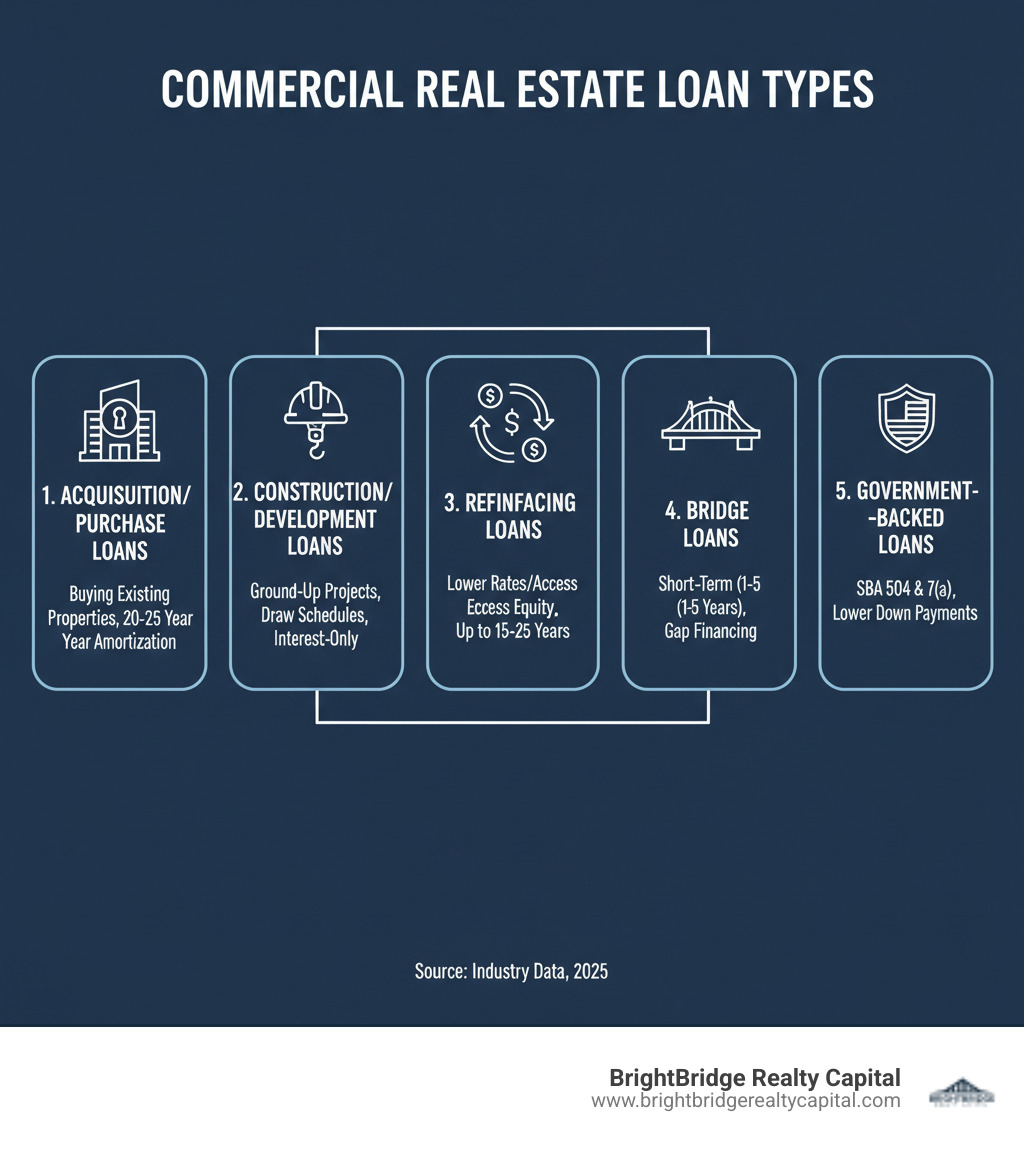
- Acquisition loans for purchasing existing income-producing properties
- Construction financing for ground-up development and major renovations
- Refinancing options to improve cash flow, lower interest rates, or access trapped equity
- Bridge loans for providing short-term, flexible funding to seize time-sensitive opportunities
- Government-backed programs like SBA 504 and 7(a) loans, designed to support small businesses
Commercial property loans operate in a different universe from the residential mortgages most people are familiar with. These are sophisticated financial instruments made to business entities (like LLCs or corporations), not individuals. They typically feature shorter terms, often between 5 and 20 years, and are underwritten based on the property's ability to generate income, not just a personal salary. The loan amounts can range from a few hundred thousand dollars for a small retail space to well over $150 million for large, institutional-grade portfolios. The landscape of lenders is equally diverse, including traditional banks, agile credit unions, specialized private lenders, and government-sponsored programs.
I'm Daniel Lopez, a senior loan officer at BrightBridge Realty Capital. Over the years, I've structured and closed hundreds of millions of dollars in financing, helping investors navigate complex commercial property lending scenarios. I've witnessed firsthand how the right financing can transform an investment, turning a challenging value-add project into a stabilized cash-flowing asset or providing the critical capital needed to expand a portfolio. Conversely, I've also seen promising deals fall apart due to poorly structured debt. My goal is to demystify this process for you.
This comprehensive guide will serve as your roadmap. We will break down every major loan type in detail, explain precisely what lenders scrutinize during the underwriting process, and provide you with the strategic insights needed to match the perfect financing solution to your specific project. By the end, you'll be equipped to speak the language of commercial lenders and make financing decisions with confidence.
The Essentials of Commercial Property Lending

Commercial property lending is the specialized field of finance dedicated to funding the purchase, development, or refinancing of income-generating real estate. This includes a broad spectrum of properties such as office buildings, retail centers, industrial warehouses, multifamily apartment complexes, hotels, and even special-purpose properties like medical facilities or self-storage units. Unlike a residential home loan where the borrower's personal income is paramount, in commercial lending, the property itself is the star of the show. It serves as the primary collateral, and lenders are laser-focused on its capacity to produce a consistent and predictable stream of income.
These are strictly business-purpose loans, granted to legal entities like Limited Liability Companies (LLCs), S-Corporations, or partnerships, which shields the individual investors from personal liability. The underwriting methodology bifurcates depending on the property's use. For an owner-occupied property, where your business will operate from at least 51% of the space, lenders will heavily scrutinize your business's financial health, cash flow, and profitability. For an investment property, the focus shifts entirely to the rental income generated by tenants. Successful commercial real estate ownership is a powerful wealth-building tool, allowing you to build equity, benefit from appreciation, gain tax advantages, and control your physical space.
Understanding Key Differences: Commercial vs. Residential Loans
For investors graduating from residential properties, the commercial lending environment can be a shock. The rules, terms, and expectations are fundamentally different:
- Loan Terms & Structure: Commercial loans typically have shorter terms, commonly 5, 7, or 10 years, compared to the 30-year standard in residential. Many of these loans are not fully amortizing and end with a balloon payment—a large, lump-sum principal payment due at the end of the term. This structure requires the borrower to either sell the property or refinance the loan before the balloon payment is due.
- Amortization Period: To make monthly payments manageable, the payments are often calculated based on a longer amortization schedule, such as 20, 25, or even 30 years, even though the loan is due much sooner.
- Interest Rates: Rates are generally higher than residential mortgages to compensate lenders for the increased perceived risk. Both fixed and variable-rate options are available, with variable rates often tied to benchmarks like the Secured Overnight Financing Rate (SOFR).
- Prepayment Penalties: A major difference is the prevalence of significant prepayment penalties. Unlike residential loans that can often be paid off early with no fee, commercial loans frequently include clauses like yield maintenance or defeasance, which can make refinancing or selling before the term ends very expensive.
- Borrower Entity: Loans are made to a business entity, insulating the individual's personal assets. Lenders perform due diligence on the entity's legal structure and financial standing.
- Underwriting Focus: The primary metric is the property's Net Operating Income (NOI) and its ability to cover the debt payments, measured by the Debt Service Coverage Ratio (DSCR).
The Lender Landscape: Who Provides CRE Financing?
The world of commercial property lending is populated by a diverse cast of capital providers, each with its own niche and risk appetite:
- Traditional and Community Banks: The backbone of the industry. Large national banks have the balance sheets for massive portfolio deals, while smaller community banks offer invaluable local market knowledge and relationship-based lending. They are heavily regulated by bodies like the FDIC and OCC. You can explore their guidance at FDIC guidance on CRE lending and the Comptroller's Handbook on CRE Lending.
- CMBS (Conduit) Lenders: These lenders originate loans with the specific intention of packaging them with other loans into a bundle that is then securitized and sold to investors on the secondary market as Commercial Mortgage-Backed Securities (CMBS). These loans often offer competitive rates and non-recourse terms but are less flexible and have standardized underwriting.
- Life Insurance Companies: "Life cos" are a conservative source of capital, preferring to lend on high-quality, stabilized properties (e.g., a Class A office building with long-term, credit-worthy tenants). They offer some of the best rates and longest terms available but have very strict underwriting criteria.
- Direct Lenders & Private Funds: Companies like us at BrightBridge Realty Capital fall into this category. We provide financing directly to the borrower using our own capital or funds from our investors. This model eliminates intermediaries, allowing for significantly greater speed, flexibility, and creative structuring. We can often close complex deals in a fraction of the time it takes a traditional bank, a critical advantage in competitive markets.
- Government-Backed Programs: The Small Business Administration's (SBA) 504 and 7(a) loan programs are designed to help small businesses acquire owner-occupied commercial real estate. They offer attractive terms, including high LTVs (low down payments) and long repayment periods, making property ownership more accessible.
Exploring the Spectrum of Commercial Real Estate Loans
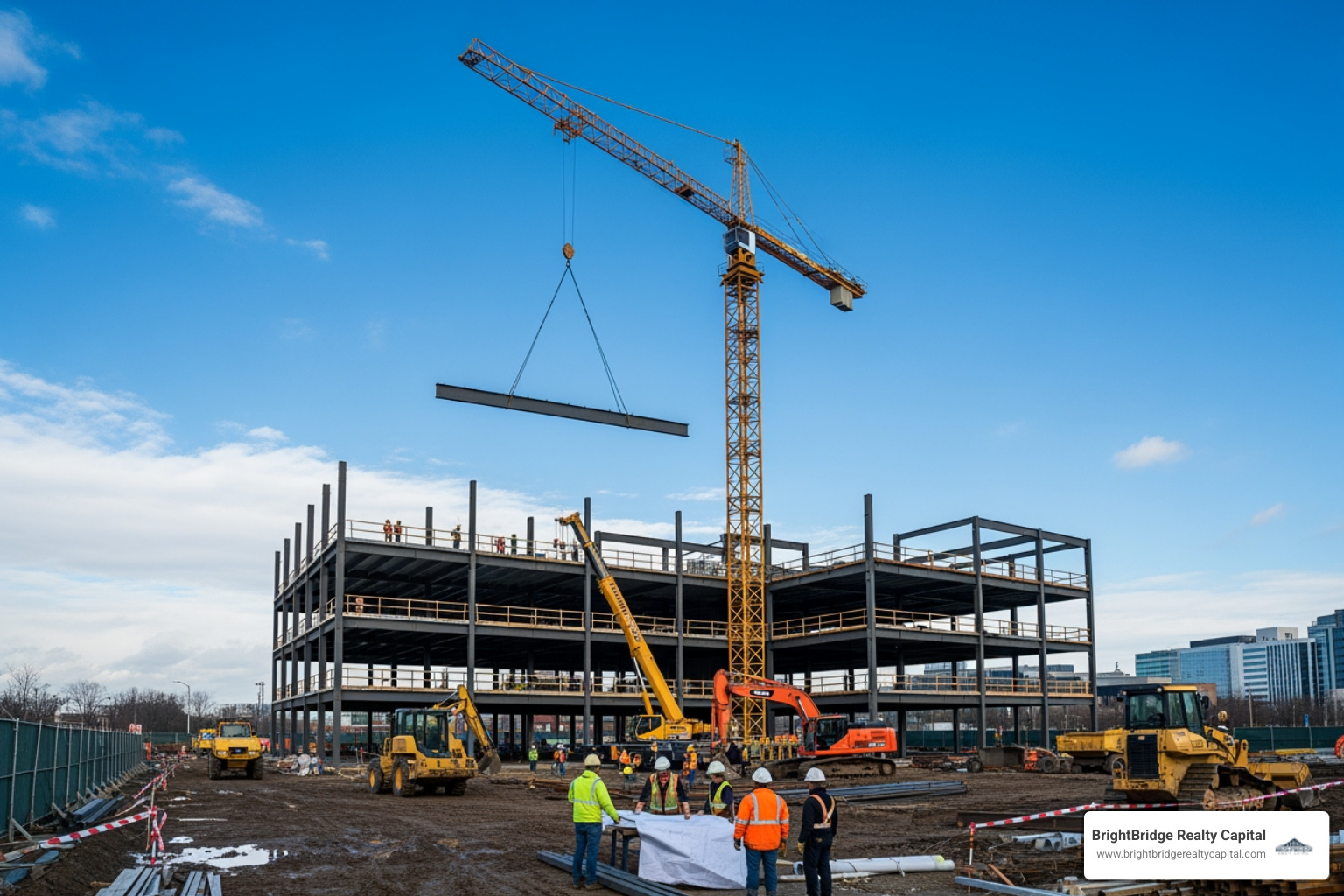
Commercial property lending is not a one-size-fits-all endeavor. It offers a diverse toolkit of financing solutions, each engineered for a specific investment strategy, property type, and point in the investment lifecycle. Aligning the right loan product with your project's unique needs is a critical determinant of its ultimate success and profitability. This section provides a deep dive into the primary loan categories you'll encounter.
Acquisition and Purchase Loans
These are the foundational loans used to purchase existing commercial properties. The structure of an acquisition loan varies significantly based on the property's condition:
- For stabilized properties with a strong history of occupancy and consistent rental income, lenders focus on the Debt Service Coverage Ratio (DSCR), which is the Net Operating Income (NOI) divided by the total annual loan payments. A DSCR of 1.25x or higher is a common benchmark, indicating the property generates 25% more income than needed to service the debt. These loans are often non-recourse, meaning the lender's only remedy in a default is the property itself.
- For value-add properties that require renovations, repositioning, or lease-up, the loan is more complex. It may include a future funding component to cover the cost of improvements. Lenders will underwrite based on a pro-forma or "as-stabilized" value, and these loans are often recourse, requiring a personal guarantee from the sponsor.
- The Loan-to-Value (LTV) ratio for acquisition loans typically ranges from 65% to 80%, necessitating a down payment of 20-35%. Terms are frequently 5-10 years with a balloon payment.
Construction and Development Loans
Used to finance ground-up construction or major redevelopment projects, these are short-term loans with a unique structure.
- Funds are not provided in a lump sum at closing. Instead, they are disbursed in stages, or draws, as construction progresses and specific milestones are met. Each draw request typically requires inspection and certification from an architect or engineer, along with lien waivers from contractors to ensure they are being paid.
- During the construction phase, which can last from 12 to 36 months, borrowers usually make interest-only payments on the funds that have been drawn to date.
- Sizing is based on Loan-to-Cost (LTC), not value. Lenders will typically finance 70-85% of the total project cost (including hard and soft costs). The borrower must contribute the remaining equity.
- Upon completion and stabilization of the property, the construction loan is paid off, usually with a permanent, long-term loan known as a "take-out" loan.
- Lenders often require completion guarantees to mitigate the risk of the project not being finished. For more on this, see the Comptroller's Handbook on CRE Lending.
Refinancing and Cash-Out Refinancing
Refinancing is a strategic tool for optimizing an existing investment. It's not just about getting a lower rate.
- A rate-and-term refinance replaces your current loan with a new one, often to secure a better interest rate, extend the amortization period to improve monthly cash flow, or switch from a variable to a fixed rate.
- A cash-out refinance is a powerful strategy for unlocking the equity you've built in a property. You take out a new, larger loan that pays off the existing debt and provides you with the difference in tax-free cash. For example, if your property is worth $2 million and your current loan balance is $800,000, a lender might give you a new loan at 70% LTV, which is $1.4 million. After paying off the $800,000, you would receive $600,000 in cash to use for new investments, property upgrades, or other business purposes.
Specialized and Short-Term Financing
When speed, flexibility, or complex situations arise, specialized loans are essential.
- Bridge Loans: These are short-term loans (typically 6 months to 3 years) that "bridge" a financial gap. They are perfect for acquiring a property quickly, funding renovations on a value-add project before it qualifies for permanent financing, or providing capital during a lease-up period. They close extremely fast and often feature interest-only payments. At BrightBridge Realty Capital, our direct lending model allows us to close bridge loans in as little as a week, providing a decisive advantage in competitive bidding situations.
- Hard Money Loans: Asset-based loans from private investors or funds that close very quickly (sometimes in days). Approval is based almost entirely on the property's value (the "hard" asset), not the borrower's credit. The trade-off for this speed and relaxed underwriting is much higher interest rates and fees.
- Mezzanine Financing: This is a hybrid of debt and equity used in large, complex transactions. It sits between the senior mortgage and the sponsor's equity in the capital stack. It's technically a loan, but it's secured by a pledge of the ownership equity in the property-holding company, not a mortgage on the property itself. If the borrower defaults, the mezzanine lender can foreclose on the equity and take control of the company.
- SBA 504 and 7(a) Loans: These government-backed programs are specifically for owner-occupied commercial real estate. The SBA 504 program is structured with three parts: a senior loan from a conventional lender (50% of the cost), a junior loan from a Certified Development Company (CDC) backed by the SBA (40% of the cost), and a borrower equity injection of just 10%. The 7(a) program is more flexible and can be used for a wider range of business purposes, including real estate acquisition.
The Application & Underwriting Process: What Lenders Look For

Securing financing through the commercial property lending process can feel like a black box, but it's a logical, risk-based evaluation. Lenders are fundamentally in the business of managing risk, and the application and underwriting process is designed to give them a comprehensive, 360-degree view of the borrower, the property, and the market. Your job as a borrower is to present a clear, compelling, and well-documented case for your project.
The 5 Cs of Credit: A Lender's Framework
Lenders universally rely on a framework known as the "5 Cs of Credit" to evaluate a loan request. Understanding these will help you prepare a stronger application.
- Character: This refers to your reputation and track record. Do you have experience successfully owning and operating similar commercial properties? Do you pay your bills on time? Lenders will review your personal and business credit reports and look for a history of financial responsibility. A strong track record as a real estate operator can significantly influence a lending decision.
- Capacity: This is the quantitative analysis of your ability to repay the loan. For the property, this is measured by the Debt Service Coverage Ratio (DSCR). Lenders will also assess your global cash flow, looking at your personal income and other business interests to ensure you have sufficient capacity to support the debt, especially during a lease-up or renovation period.
- Capital: How much of your own money are you putting into the deal? Lenders want to see that you have significant "skin in the game." This includes the down payment (equity) and post-closing liquidity (cash reserves). Having 6-12 months of principal and interest payments in reserve is a common requirement.
- Collateral: This is the property itself. The lender will scrutinize the quality, location, condition, and type of the property being financed. A well-located multifamily property in a strong market is viewed as much lower risk than a special-purpose property in a tertiary market.
- Conditions: This refers to the purpose of the loan, the loan amount, and the prevailing economic and market conditions. Is the local economy growing? Are vacancy rates for this property type rising or falling? Lenders need to be comfortable with the market dynamics surrounding the deal.
The Crucial Role of Appraisals and Valuation
An independent, third-party appraisal is a non-negotiable component of the underwriting process. It provides the official valuation of the property, which the lender uses to determine the final loan amount. Commercial appraisers typically use three distinct methods to arrive at a value:
- The Income Approach: This is the most important method for income-producing properties. The appraiser calculates the property's Net Operating Income (NOI) and divides it by a market-derived Capitalization (Cap) Rate. The Cap Rate reflects the prevailing rate of return for similar properties in the area.
- The Sales Comparison Approach: Similar to residential appraisals, this method analyzes recent sales of comparable properties in the vicinity. The appraiser makes adjustments for differences in size, location, condition, and amenities to arrive at a value for the subject property.
- The Cost Approach: This method determines what it would cost to replace the property from scratch (including land acquisition and construction costs), minus accumulated depreciation. This approach is most relevant for new construction or unique, special-purpose properties.
To support this analysis, you will need to provide a comprehensive package of documents, including a business plan, 2-3 years of business and personal financial statements and tax returns, a detailed rent roll with lease abstracts, the purchase and sale agreement, and your business's formation documents.
Navigating the Risks of Commercial Property Lending
Both borrowers and lenders must identify and mitigate a variety of risks inherent in commercial real estate.
- Market Risk: Economic downturns, population shifts, or new supply coming online can lead to higher vacancies and downward pressure on rents, directly impacting the property's NOI.
- Interest Rate Risk: If you have a variable-rate loan, a sudden spike in benchmark rates can dramatically increase your monthly payments, eroding cash flow. This is a key consideration when choosing between fixed and floating-rate debt.
- Tenant Risk & Lease Rollover: The financial health of your tenants is your financial health. A major tenant going bankrupt can be catastrophic. Furthermore, having multiple leases expire in the same year (lease rollover risk) creates uncertainty and potential vacancy.
- Liquidity Risk: Commercial real estate is an illiquid asset. Unlike stocks, it cannot be sold instantly. In a down market, it may take months or even years to sell a property without taking a significant loss.
- Regulatory and Environmental Risk: Zoning laws can change, and unexpected environmental issues (like soil contamination) can be incredibly costly to remediate. Thorough due diligence, including a Phase I Environmental Site Assessment, is critical.
Prudent risk management involves stress-testing your financial models, maintaining adequate cash reserves, diversifying your tenant base, and conducting exhaustive due diligence before acquisition. Regulatory bodies like the FDIC and OCC provide extensive guidance to banks on managing these risks, which in turn shapes the underwriting standards that borrowers must meet.
Frequently Asked Questions about Commercial Real Estate Lending
What is the main difference between a commercial and a residential loan?
The primary difference lies in the borrower, the purpose, and the risk assessment. Commercial loans are made to business entities (LLCs, corporations) for the purpose of financing income-producing properties, and the underwriting is centered on the property's cash flow (NOI and DSCR). Residential loans are made to individuals to purchase a primary residence, with underwriting focused on personal income, credit history, and debt-to-income ratios. Beyond this, the structures are vastly different. Commercial loans have shorter terms (5-20 years), often with balloon payments, and almost always include substantial prepayment penalties like yield maintenance or defeasance. Residential mortgages typically have 30-year, fully amortizing terms and can usually be prepaid with little to no penalty.
What is a typical down payment for a commercial property loan?
Expect a significantly higher down payment than for a residential loan. Most commercial lenders require a down payment, or equity contribution, of 20% to 35% of the purchase price. This corresponds to a Loan-to-Value (LTV) ratio of 65% to 80%. This larger equity stake serves two purposes: it reduces the lender's risk exposure and ensures the borrower has significant "skin in the game," aligning their interests with the lender's. The exact LTV will vary based on the property type (e.g., a stable multifamily property might get 80% LTV, while a riskier hotel might only get 65%), the strength of the borrower, and market conditions. The main exception is for government-backed programs like SBA 504 loans, which can allow qualifying owner-occupied businesses to secure financing with as little as 10% down.
What are prepayment penalties in commercial loans?
Prepayment penalties are a common and often costly feature of fixed-rate commercial loans, designed to protect the lender's expected yield. If you pay off the loan early (by selling or refinancing), the lender loses the future interest payments they were counting on. To compensate for this, they charge a penalty. The two most common types are:
- Yield Maintenance: This is a complex calculation that requires the borrower to pay the lender a penalty equal to the present value of the lost interest for the remainder of the loan term. Essentially, you must make the lender "whole" by paying them the difference between your loan's interest rate and the current market rate (typically the yield on a U.S. Treasury bond with a similar duration).
- Defeasance: Instead of paying a cash penalty, the borrower must purchase a portfolio of government securities (like U.S. Treasury bonds) that will generate the exact same cash flow stream as the original loan payments. This portfolio replaces the real estate as the collateral for the loan. Defeasance is a very complex and expensive process, typically found in CMBS loans.
How has technology changed the commercial lending process?
Technology has been a transformative force, injecting speed, efficiency, and transparency into a traditionally slow and opaque industry. What once took months of paperwork can now be streamlined significantly. Modern loan origination systems (LOS) and online portals allow borrowers to submit applications and upload sensitive financial documents securely and efficiently, often cutting processing times in half. On the lender's side, data analytics and artificial intelligence (AI) are revolutionizing underwriting. Algorithms can now analyze vast datasets to assess risk more accurately, model cash flows, and detect fraud, leading to faster and more consistent credit decisions. Furthermore, the rise of FinTech platforms and online marketplaces has democratized access to capital, connecting borrowers with a wider range of lenders than ever before. At BrightBridge Realty Capital, we embrace this technology to deliver on our core promise of speed and certainty. Our streamlined digital process is a key reason we can fund and close deals in as little as a week, giving our clients a powerful competitive edge in a fast-moving market.
Conclusion: Building Your Future with the Right Financing Partner
You've now journeyed through the complex and dynamic world of commercial property lending. If it seems like a lot to absorb, that's because it is. This is a sophisticated field, but the knowledge you've gained from this guide elevates you far above the average investor who approaches financing as an afterthought. You are now equipped with the foundational understanding to make strategic, informed decisions that will define the success of your real estate portfolio.
Let's recap the critical takeaways. We've established the fundamental distinctions between commercial and residential mortgages—from shorter terms and balloon payments to the critical importance of prepayment penalties like yield maintenance. We've explored the full spectrum of the financing toolkit, dissecting the unique purposes of acquisition loans for stabilized versus value-add assets, construction financing with its draw schedules and take-out requirements, powerful refinancing options to unlock equity, and the speed and flexibility of specialized solutions like bridge loans for time-sensitive deals.
Crucially, we pulled back the curtain on the underwriting process. You now understand how lenders use the "5 Cs of Credit" as their evaluation framework and how they lean on the three core valuation methods—Income, Sales Comparison, and Cost—to determine a property's worth. You're also aware of the myriad risks involved, from market and interest rate fluctuations to tenant concentration and liquidity challenges, and the importance of proactive risk mitigation.
Here is the ultimate truth of real estate investing: strategic financing is an offensive weapon, not just a defensive necessity. It's not about finding any loan; it's about securing the right loan structure at the right time to execute your business plan. A well-structured bridge loan isn't just a loan; it's the tool that allows you to acquire and renovate a property that others can't. A savvy cash-out refinance isn't just a new mortgage; it's the mechanism that funds your next acquisition without selling your best-performing asset. The right construction loan transforms a line on a blueprint into a tangible, income-producing community asset. Matching the financial tool to the specific project is where true value is created.
This is precisely where a dedicated financing partner becomes your most valuable asset. At BrightBridge Realty Capital, our entire business model is built on the understanding that real estate investors are entrepreneurs who need speed, flexibility, and certainty from their capital partners. As direct lenders, we eliminate the bureaucratic layers and delays that plague traditional institutions. Our ability to close deals in as little as a week isn't a marketing gimmick; it's a strategic advantage that empowers our clients to win competitive bids and capitalize on fleeting opportunities.
We are more than just a source of capital; we are your strategic advisors. We work with you to structure financing that aligns perfectly with your goals, whether that means funding future renovations for a value-add project or navigating a complex 1031 exchange. We bring institutional-quality execution with the speed and responsiveness of a private lender. Your vision for your real estate future deserves a financing partner who can not only keep pace but help you accelerate.
The knowledge is now yours. The momentum is waiting. Let's get to work.
Ready to take the next step? Find the right rental property loan for your next investment and let's start building your empire together.