Beyond Banks: Exploring Your Direct Lending Options


Summary
Need capital fast? Explore direct lender financing for flexible, non-bank solutions. Discover how direct lending empowers businesses.
Why Direct Lender Financing Is Changing Business and Real Estate Capital
Direct lender financing is a form of lending where non-bank institutions provide loans directly to businesses or real estate investors, bypassing intermediaries like traditional banks. This approach became a powerful alternative after the 2008 financial crisis. In the wake of the crisis, sweeping regulations like the Dodd-Frank Act and Basel III accords were implemented globally to shore up the banking system. While necessary for stability, these rules forced banks to hold more capital against their loans, significantly increasing their cost of lending and reducing their appetite for anything deemed moderately risky. As a result, banks pulled back from lending to middle-market companies and real estate projects, imposing stricter, more rigid requirements on those they would consider.
This regulatory shift created a vacuum, and direct lenders emerged to fill it, offering a more agile and responsive source of capital. This evolution has permanently altered the financing landscape for countless enterprises.
Key Facts About Direct Lender Financing:
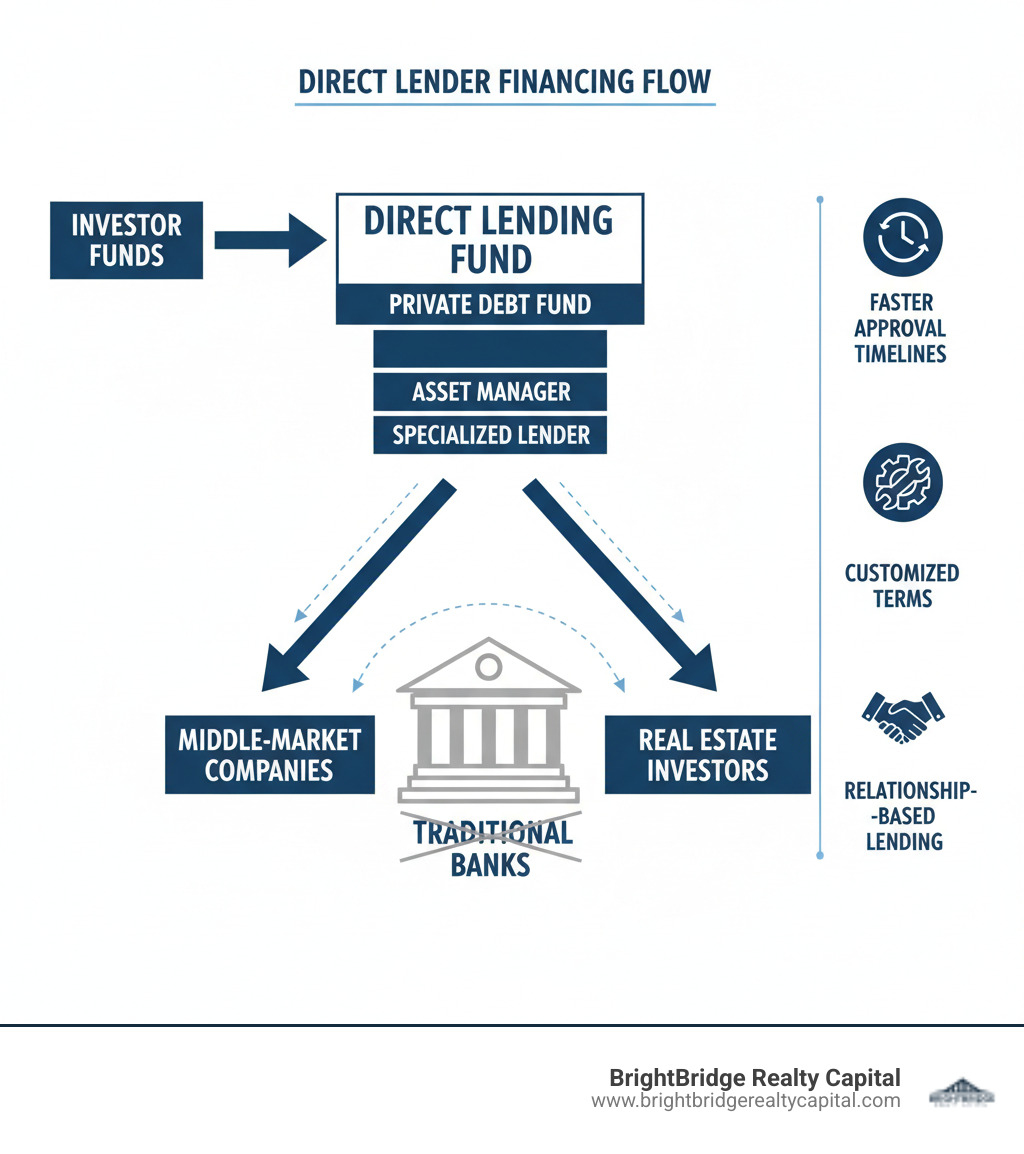
- What it is: At its core, it involves loans from private debt funds, asset managers, or specialized lending companies—not traditional banks. This capital is private, not from public depositors, which is the key to its flexibility.
- Who uses it: The primary users are middle-market companies needing capital for growth or acquisitions, real estate investors executing time-sensitive strategies like fix-and-flips or portfolio expansions, and any business that requires a fast, customized capital solution that doesn't fit a bank's rigid criteria.
- Main benefits: The defining advantages are faster approval and funding timelines, highly customized loan structures tailored to a specific project, and a significant reduction in the bureaucracy and red tape associated with bank loans.
- Typical terms: Most deals are structured as senior secured loans with 5-7 year maturities and floating interest rates, offering security to the lender and flexibility to the borrower.
- Market size: The U.S. direct lending market's growth has been explosive, expanding over 800% in the decade after the financial crisis and reaching approximately $800 billion by 2020. Projections show this growth continuing as more borrowers seek alternatives to traditional banking.
For real estate investors, the traditional bank route often means weeks, or even months, of paperwork, uncertainty, and the constant risk of a last-minute denial. In a competitive market, this delay is a death sentence for a deal. Direct lenders changed this dynamic by streamlining processes, making credit decisions in-house, and focusing on the intrinsic value of the asset and the business plan rather than just historical W-2 income or FICO scores. This asset-centric approach created a lifeline for entrepreneurs and investors, filling a massive financing gap and establishing direct lending as the single largest and most important strategy within the private credit universe today.
I'm Daniel Lopez, a loan officer at BrightBridge Realty Capital in New York. My role is to help real estate investors and business owners navigate the world of direct lender financing for everything from fix-and-flip projects and rental portfolios to large-scale commercial properties. My focus is on a partnership approach, creating clear, actionable strategies that empower clients to close deals faster and with the confidence that their financing is secure.
Direct lender financing terms made easy:
- commercial property funding
- stabilized bridge loan
What is Direct Lending? A Shift from Traditional Banking
Here's the simplest way to think about direct lender financing: a lender provides capital straight to a borrower with no middlemen. This approach is mostly practiced by non-bank lenders like private debt funds and specialized lending companies. We use our own capital or funds raised from institutional investors (like pension funds and endowments), which gives us the ultimate flexibility and control that banks, constrained by regulations designed to protect depositors' money, often lack.
The story of direct lending's rise began in the aftermath of the 2008 financial crisis. New regulations like the Dodd-Frank Wall Street Reform and Consumer Protection Act fundamentally changed banking. Provisions like the Volcker Rule limited banks' ability to engage in certain speculative investments, while heightened capital requirements made them more risk-averse. Banks responded by pulling back from middle-market lending, viewing it as too risky, too complex, or simply not profitable enough under the new rules. With the number of FDIC-insured banks dropping by a staggering 53% between 2000 and 2023, a massive funding gap emerged for the very businesses that drive the economy. Direct lenders stepped in to fill this void.
But this was about more than just filling a gap; it was about offering a fundamentally better alternative. Unburdened by the same regulatory constraints, we provide greater speed, flexibility, and customized solutions. We became the new go-to for businesses and real estate investors who were underserved, misunderstood, or simply moving too fast for the traditional system. If you're curious about how we approach this differently, check out our insights on being a Direct Private Lender.

Direct Lending vs. Bank Loans: The Core Differences
Both direct lenders and banks provide capital, but the similarities largely end there. Understanding these differences in detail can save you weeks of frustration and help you choose the right financing partner for your goals. The table below offers a high-level summary, but the nuances are what truly matter.
| Feature | Direct Lending | Traditional Bank Lending |
|---|---|---|
| Source of Funds | Private debt funds, asset managers, institutional investors (our own capital) | Depositor funds, regulated by federal agencies |
| Speed | Faster approval (days), quicker funding (often within a week) | Slower approval (weeks to months), bureaucratic processes |
| Flexibility | Highly customizable terms, bespoke structures, adaptable covenants | Standardized products, rigid terms, less room for negotiation |
| Risk Appetite | Higher tolerance for specific risks, focus on asset/project viability | Lower risk tolerance, emphasis on strong credit history, extensive collateral |
| Covenants | Often maintenance-based, more pragmatic and business-centric | Often incurrence-based, stringent financial ratios |
| Relationship | Relationship-based, long-term partnership, strategic advice | Transactional, less personal, focus on compliance |
Source of Funds: This is the foundational difference. Banks lend money from their depositors. This money is insured by the FDIC, and as a result, banks are heavily regulated to protect the public. Direct lenders, on the other hand, use private capital from sophisticated institutional investors and high-net-worth individuals who understand the risks and are seeking higher returns. This freedom from depository regulations allows us to be more creative and entrepreneurial in our lending.
Speed: Because we use our own capital and have a flat organizational structure, we can make decisions rapidly. A loan application doesn't have to go through multiple regional and national committees. Our credit committee can convene quickly, evaluate a deal on its merits, and give a clear answer in days. Banks, with their layered bureaucracy and regulatory checklists, can take weeks or even months to move from application to funding.
Flexibility: Banks offer standardized, off-the-shelf loan products. If your project doesn't fit neatly into their box, you're often out of luck. Direct lenders specialize in creating bespoke solutions. We can structure loans with interest-only periods, deferred payments, or seasonal repayment schedules that match a business's cash flow. This customization is our biggest advantage.
Risk Appetite: Banks focus heavily on a borrower's history—credit scores, tax returns, and historical cash flow. Direct lenders are more forward-looking. We focus on the viability of the project or the value of the underlying asset. This allows us to finance projects that banks would reject, such as a real estate developer with a great plan but irregular personal income, or a company investing heavily in growth that has temporarily suppressed profits.
Covenants: Covenants are rules the borrower must follow. Banks often use strict, incurrence-based covenants that can restrict a business's ability to take on new debt or make investments. Direct lenders typically use more flexible, maintenance-based covenants (e.g., maintaining a certain liquidity ratio). This approach is more of a partnership, designed to keep the business healthy rather than to restrict it.
Relationship: The bank lending process is often transactional and impersonal. You may deal with multiple people who don't have a deep understanding of your business. Direct lenders aim to build long-term partnerships. We act as strategic advisors, invested in your success because our success is tied to yours.
The Rise of the Private Credit Market
The growth of direct lending is part of a larger, more profound story: the explosive rise of the private credit market. This market, which encompasses all non-bank corporate lending, has grown into a multi-trillion dollar asset class. Within this category, direct lending has become the dominant and fastest-growing segment.
Over the last 15 years, direct lending surged from just 9% to over 36% of total assets under management (AUM) in private credit, making it the single largest strategy. In the U.S. alone, direct lending AUM grew over 800% in the decade after the financial crisis, reaching approximately $800 billion by 2020 and continuing to climb toward $1.5 trillion. This reflects a fundamental and permanent shift as middle-market companies and real estate investors move away from slow, inflexible traditional banks toward more agile, partnership-oriented lenders. For investors, this market offers attractive, stable, and often floating-rate returns, providing a powerful tool for diversification and yield generation in a complex economic environment. If you're interested in understanding how investors participate in this rapidly expanding sector, take a look at our insights on Direct Lending Investors.
The Advantages of Direct Lender Financing for Borrowers
For real estate investors and business owners, timing is everything. A great property hits the market with a deadline for offers, or a critical renovation needs immediate capital to stay on schedule. In these moments, waiting on a bank is a liability. This is where direct lender financing truly shines, transforming a potential obstacle into a competitive advantage.

The biggest advantages are speed and certainty of execution. With us, you're not submitting an application into a black box and waiting weeks for it to navigate layers of bank committees. We make credit decisions in-house, which means faster approvals and funding—often within days, not months. This speed is matched by unparalleled flexibility. We don't force your unique project into a standardized box; instead, we build customized solutions around your specific goals, timeline, and business plan.
Beyond the structure of the loan, we focus on building a genuine relationship, acting as a strategic partner invested in your success. Another major plus for entrepreneurs and founders is access to non-dilutive capital. Unlike venture capital or private equity, our financing allows you to secure the funding you need to grow without giving up equity or control of your company. Because we focus on the asset and the project's potential, we can often help non-traditional borrowers—like self-employed real estate professionals or rapidly growing businesses—who struggle to get approved by conventional banks that rely on rigid income verification. To understand how this works in practice, check out our guide on the Direct Loan Process.
Faster Approval and Funding
Imagine finding the perfect four-unit property for a fix-and-flip project. The seller is motivated but wants to close in 10 days. With a traditional bank, this is nearly impossible. The typical bank process involves a lengthy application, review by a local loan officer, submission to a regional underwriting committee, a multi-week appraisal process, and a final review, all of which can take 45-60 days. You'd lose the deal before you even got a preliminary approval.
With direct lender financing, the story is completely different. Our streamlined process is designed for speed. You work with a single point of contact. We have fewer decision-makers and can evaluate applications and make credit decisions in a matter of days. We genuinely close deals within a week or two of receiving complete documentation. This rapid turnaround doesn't just get you the property; it allows you to compete with all-cash buyers, giving you a powerful negotiating tool. This efficiency extends across all our mortgage solutions. Learn more about our approach with Direct Funding Mortgage options.
Flexible and Customized Loan Structures
Here's where direct lender financing really sets itself apart from the commoditized world of bank lending. We don't believe in one-size-fits-all financing, because every real estate project and every business has a unique story and a unique path to profitability.
Bespoke terms are our specialty. We can structure repayment schedules that align with your project's cash flows. For a fix-and-flip, this might mean interest-only payments during the renovation phase, with the principal due upon sale. For a business with seasonal revenue, we can structure smaller payments during the off-season and larger payments during peak months. Our covenants are also more pragmatic and business-friendly than a bank's, focusing on ongoing performance metrics that give you more operational breathing room to run your business.
For real estate investors, this flexibility is a game-changer. We offer flexible loan-to-value (LTV) and loan-to-cost (LTC) ratios. On a fix-and-flip project, for example, a bank might only lend 75% of the purchase price, leaving you to cover the rest plus all renovation costs. A direct lender can often finance up to 90% of the purchase price and 100% of the renovation costs, up to a total of 75% of the after-repair value (ARV). For a $300,000 purchase with a $100,000 renovation budget, this means you might only need to bring a fraction of the capital to the table, allowing you to preserve liquidity for your next deal. For rental properties, we look at the asset's projected income potential, not just arbitrary debt-to-income ratios. This flexibility extends across all property types and investment strategies. Our Direct Portfolio Lending solutions demonstrate how we adapt structures for investors with diverse and growing portfolios. The bottom line is we make financing work for your project, not the other way around.
Understanding the Direct Lending Landscape
The direct lender financing world is built around getting capital to the businesses that need it most, particularly the middle market. This segment, typically defined as companies with annual revenues between $10 million and $1 billion, represents a third of U.S. private sector GDP. With $13 trillion in revenue and 50 million workers, these businesses are the engine of the American economy. Yet, they are often caught in a financing gap: too large and complex for a community bank's small business loans, but too small to efficiently access public capital markets. Traditional banks often overlook them, finding the required due diligence too costly for the loan size.
Direct lending provides the vital growth capital these businesses and real estate investors need to expand, acquire competitors, invest in technology, and thrive. Here in New York, we see firsthand how this financing transforms neighborhoods, funding the renovation of apartment buildings and the development of new commercial spaces. Our Direct Commercial Loans are specifically designed for these value-add opportunities.

Key Players: Who Provides and Who Borrows?
The direct lending market brings together two distinct but complementary groups:
On the lending side, you'll find a diverse set of institutions:
- Private debt funds: These are the primary players, pooling capital from institutional investors who want exposure to private credit. These investors include pension funds, university endowments, and sovereign wealth funds seeking stable, income-generating assets.
- Large asset managers: Global firms like Blackstone, KKR, and Apollo have built massive direct lending divisions, leveraging their scale and expertise.
- Insurance companies: Seeking to match their long-term liabilities with predictable, long-duration assets, insurance companies are significant providers of capital.
- Specialized lending platforms: Firms like ours, BrightBridge Realty Capital, focus on specific niches where deep domain expertise provides a competitive edge. Our focus is exclusively on real estate.
The borrowers are equally diverse:
- Middle-market companies: These businesses use direct loans for a variety of strategic purposes, including funding growth initiatives, financing acquisitions (M&A), or facilitating management buyouts (MBOs).
- Real estate investors: This group ranges from individuals flipping a single property to large firms building portfolios of rental properties or developing commercial spaces like retail centers and office buildings.
- Business owners: Entrepreneurs across industries seek direct loans for working capital, equipment purchases, or project-specific funding that banks are unwilling to provide.
At BrightBridge Realty Capital, our focus is squarely on serving real estate investors. We understand the unique challenges and opportunities in this sector. Explore how we work as Direct Real Estate Lenders to support your goals.
Typical Deal Characteristics: What to Expect from direct lender financing
While every deal is customized, most direct loans share common characteristics. They are typically senior secured debt, meaning the lender has the first claim on the company's or property's assets in the event of a default. This senior position reduces the lender's risk, which in turn allows for more flexible terms for the borrower. You'll typically find floating interest rates tied to a benchmark index like SOFR (Secured Overnight Financing Rate), which has replaced the old LIBOR standard. This structure protects lenders in a rising-rate environment and can benefit borrowers if rates decline.
The typical loan maturity is five to six years, though they are often repaid earlier through a sale or refinancing. Maintenance covenants are common, requiring the borrower to maintain certain financial ratios, such as a minimum Debt Service Coverage Ratio (DSCR). Unlike restrictive bank covenants, these are designed to be an early warning system, creating a framework for ongoing communication between the lender and borrower to proactively address any issues. These features—senior security, strong underwriting, and collaborative covenants—contribute to very strong recovery rates for lenders, reflecting the high quality of the underlying assets and the robust structure of the loans. For a deeper look at the data, check out the research on Performance Of Private Credit Funds.
Direct Lending vs. Other Financing Options
Leveraged (or syndicated) loans are arranged by investment banks for very large corporations, with the debt syndicated (sold) to a group of institutional lenders. These deals are much larger and more complex than direct loans. With a syndicated loan, a borrower may have to negotiate with a large, disparate group of creditors, whereas a direct loan involves a relationship with a single lender, allowing for faster decisions and more discretion.
Mezzanine debt is a hybrid of debt and equity. It is unsecured and sits below senior debt in the capital stack, making it riskier for the lender and thus more expensive for the borrower. It often uses "Paid-in-Kind" (PIK) interest, which accrues to the principal balance, and may come with equity participation in the form of warrants, which dilute the owner's stake. In contrast, direct loans are senior, secured, and do not dilute your ownership.
Asset-Based Lending (ABL) is another alternative, where loans are made against specific liquid assets like accounts receivable or inventory. While useful, ABL can be restrictive and is based on formulaic advance rates. Direct lending can be more holistic, looking at the total enterprise value or a property's future cash flow, often providing more capital and greater flexibility.
Direct lending offers a practical middle ground: more flexibility and speed than bank loans without the complexity of syndicated debt or the cost and dilution of mezzanine financing. Our Direct Investment Loans provide the capital you need with terms that make sense for your business.
Navigating the Risks and Future of Direct Lending
Like any form of financing, direct lender financing comes with its own set of considerations and risks for both borrowers and lenders. Understanding them is key to making an informed decision.
For borrowers, the most noticeable factor is the interest rate. Direct loans often carry higher rates than conventional bank loans. This premium isn't arbitrary; it reflects the significant value-add provided: the greater flexibility, speed, customization, and higher risk tolerance of the lender. It's the price for certainty and opportunity—the cost of getting capital quickly with terms that are tailored to your specific project. Many successful investors view this not as a higher cost, but as an investment in opportunity, as the profit from a secured deal far outweighs the marginal difference in interest. Borrowers should also be aware of prepayment penalties. Since these loans are illiquid assets for the lender, there may be a fee for paying the loan off early, so it's important to ensure the loan term aligns with your business plan.
Another factor is the illiquidity of the loan itself. Direct loans are private contracts, typically held to maturity by the lender, and cannot be easily sold or traded. This is more of a structural feature and a concern for the lender than the borrower. For borrowers, it simply reinforces the importance of the partnership; you are entering a multi-year relationship, so choosing a lender you trust and can communicate with is paramount.
From a lender's perspective, the primary risks center on rigorous due diligence and proactive portfolio management. This is where experience and specialization become critical. Experienced lenders like us at BrightBridge Realty Capital take underwriting extremely seriously. Our process involves detailed financial modeling, third-party appraisals, market analysis, management interviews, and legal reviews. We focus on downside protection and structure loans with strong covenants and clear reporting requirements. Our deep expertise in real estate allows us to assess property values, construction budgets, and project feasibility with a level of precision that generalist lenders cannot match. This disciplined approach helps us weather market volatility and protect our investors' capital. Our comprehensive risk management is built into all our Direct Lending Services.
Future Trends and Opportunities in direct lender financing
The outlook for direct lending is exceptionally bright, with several powerful, long-term trends creating a wealth of opportunities for borrowers and lenders alike.
A massive "refinancing wall" is approaching. Nearly $1 trillion in middle-market loans are set to mature by 2030. Many of these loans were originated in a different economic environment, and the banks that hold them may be unwilling or unable to refinance them on favorable terms. These borrowers will increasingly turn to direct lenders for the speed, flexibility, and certainty they need to secure their company's future.
The continued bank retrenchment from middle-market and real estate lending shows no signs of reversing. As regulatory pressures persist and banks focus on their largest corporate clients, direct lenders will remain the primary and most reliable capital source for a huge swath of the economy. This is a permanent structural shift in the financial markets, not a temporary gap.
Perhaps the most exciting trend is the increasing specialization in niches. As the market matures, many direct lenders are developing deep expertise in specific sectors like technology, healthcare, and manufacturing. For us at BrightBridge Realty Capital, that means a laser focus on real estate investment. This specialization allows us to understand local property markets, construction costs, and rental dynamics in ways generalist lenders simply cannot. We know the difference between a Class A and Class B property, the nuances of a value-add strategy, and the key metrics that drive success in a fix-and-flip project. Our focused expertise translates into smarter underwriting, better terms, and more strategic financing for our clients. Learn more about how our specialization benefits investors through our Direct Real Estate Investment solutions.
These powerful trends point to a robust and expanding role for direct lending in the years to come, meaning more options, better service, and more available capital for savvy borrowers.
Frequently Asked Questions about Direct Lender Financing
What types of companies and projects benefit most from direct lending?
Direct lender financing is an ideal solution for a wide range of borrowers who need more speed, flexibility, or complexity than a traditional bank can offer. The primary beneficiaries include:
- Middle-market companies: Businesses with $50 million to $1 billion in revenue are the sweet spot. They are often too complex for standardized bank loans but too small for public markets. They use direct lending for strategic initiatives like leveraged buyouts (LBOs), management buyouts (MBOs), dividend recapitalizations, and acquisition financing.
- Businesses with unique stories: Companies with non-traditional revenue models (like SaaS), those experiencing rapid growth, or those undergoing a major operational transition benefit from lenders who will take the time to understand their specific circumstances and forward-looking business plan, rather than just looking at historical financial statements.
- Borrowers needing speed and certainty: In any time-sensitive situation—like a competitive M&A process or a real estate deal with a short closing window—our streamlined process can be the deciding factor between winning a deal and missing a crucial opportunity.
- Real estate investors: We provide the speed, flexibility, and asset-focused underwriting essential for success in real estate. This is especially true for fix-and-flip projects, rental portfolio acquisitions, and commercial developments. We are a vital partner for investors who may not have traditional W-2 income but have significant experience and a strong business plan.
Are direct lending interest rates always higher than bank loans?
Often, but not always, and it's crucial to look at the complete picture. The rate for a direct loan reflects the added value we provide: speed, certainty, and customization. There is also an "illiquidity premium" since we hold these non-tradable loans on our balance sheet. However, the analysis shouldn't stop at the headline interest rate.
The true value of speed and certainty can be worth far more than a slightly lower rate. Closing a deal in 10 days instead of 60 days can help you secure a competitive property at a better price, and the profit from that single deal can dwarf the total interest cost difference over the life of the loan. The real question is about the total cost of capital, which includes origination fees, legal fees, your own time, and, most importantly, the opportunity cost of a delayed or denied loan from a bank. For many complex or time-sensitive projects that a bank wouldn't finance at any rate, a direct lender's offer is the only viable path forward. The peace of mind that comes with a guaranteed closing from a reliable partner is often worth the premium.
How do I find and choose the right direct lender?
Choosing the right financing partner is one of the most critical decisions you'll make. The wrong choice can lead to delays, unexpected costs, or a failed deal. Here’s what to look for to ensure you're working with a top-tier lender:
- Verify their direct status: This is the most important step. Ensure the firm is lending its own capital and has in-house underwriting and credit decision-making. Many companies market themselves as lenders but are actually brokers who will shop your deal around, adding fees, delays, and uncertainty. Ask them directly: "Are you the direct lender, and will you be servicing this loan?" At BrightBridge Realty Capital, all credit decisions are made internally by our team.
- Check their track record and specialization: Look for a lender with extensive experience, especially in your specific industry or project type. A reputable lender will be able to share relevant case studies and demonstrate their expertise. For real estate, you need a Direct Private Money Lender who intimately knows the market, not a generalist who lends to manufacturing companies one day and real estate the next.
- Prioritize a relationship focus: The best lenders seek to build long-term partnerships. They should be accessible, communicative, and genuinely interested in understanding your business and your goals. Look for a partner who can act as a strategic advisor, not just a source of funds. Ask for references from past borrowers to hear about their experience.
- Demand absolute transparency: A good lender will be upfront and clear about all rates, fees, and terms from the very beginning. Review their term sheet carefully and ask questions about anything you don't understand, including prepayment penalties, covenant details, and all potential fees. If a lender is evasive or the terms seem confusing, it's a major red flag.
We encourage you to ask tough questions. Our goal is to earn your trust and become your go-to financing partner for years to come.
Conclusion
Direct lender financing has fundamentally and permanently changed how businesses and real estate investors access capital. It has evolved from a niche alternative into an essential, mainstream pillar of the modern financial landscape, offering a powerful combination of speed, flexibility, and a true partnership that many borrowers can no longer find at a traditional bank.
The advantages are clear and compelling. Direct lenders close deals in days, not months, providing a decisive edge in competitive situations. They create custom-tailored solutions instead of forcing unique projects into rigid, one-size-fits-all products. For the middle-market companies that form the backbone of our economy and for the real estate investors who build our communities, this has been a transformative development, providing access to non-dilutive capital with terms that align with their vision and strategy.
The future of direct lending is brighter than ever. With a massive wave of debt maturing and banks continuing to pull back from all but the most vanilla loans, the demand for sophisticated, reliable direct lenders will only continue to grow. This isn't a temporary trend or a cyclical phenomenon—it's the future of corporate and real estate finance.
At BrightBridge Realty Capital, we are proud to be at the forefront of this evolution. From our base in New York, we serve real estate investors nationwide with the speed, transparency, and expertise that defines modern direct lending. We don't just provide capital; we invest in relationships and partner with you to ensure your projects are successful and profitable.
Ready to experience the difference that direct lender financing can make for your next real estate investment? Let's start a conversation about your project. Find the right stabilized bridge loan or fix-and-flip financing with us today, and let's build something great together.