The Express Lane to Real Estate: Fast Closing Loan Strategies

Summary
Win deals with speed! Learn how fast closing real estate loans can secure your next property and beat the competition.
Why Fast Closing Real Estate Loans Are a Game-Changer for Investors
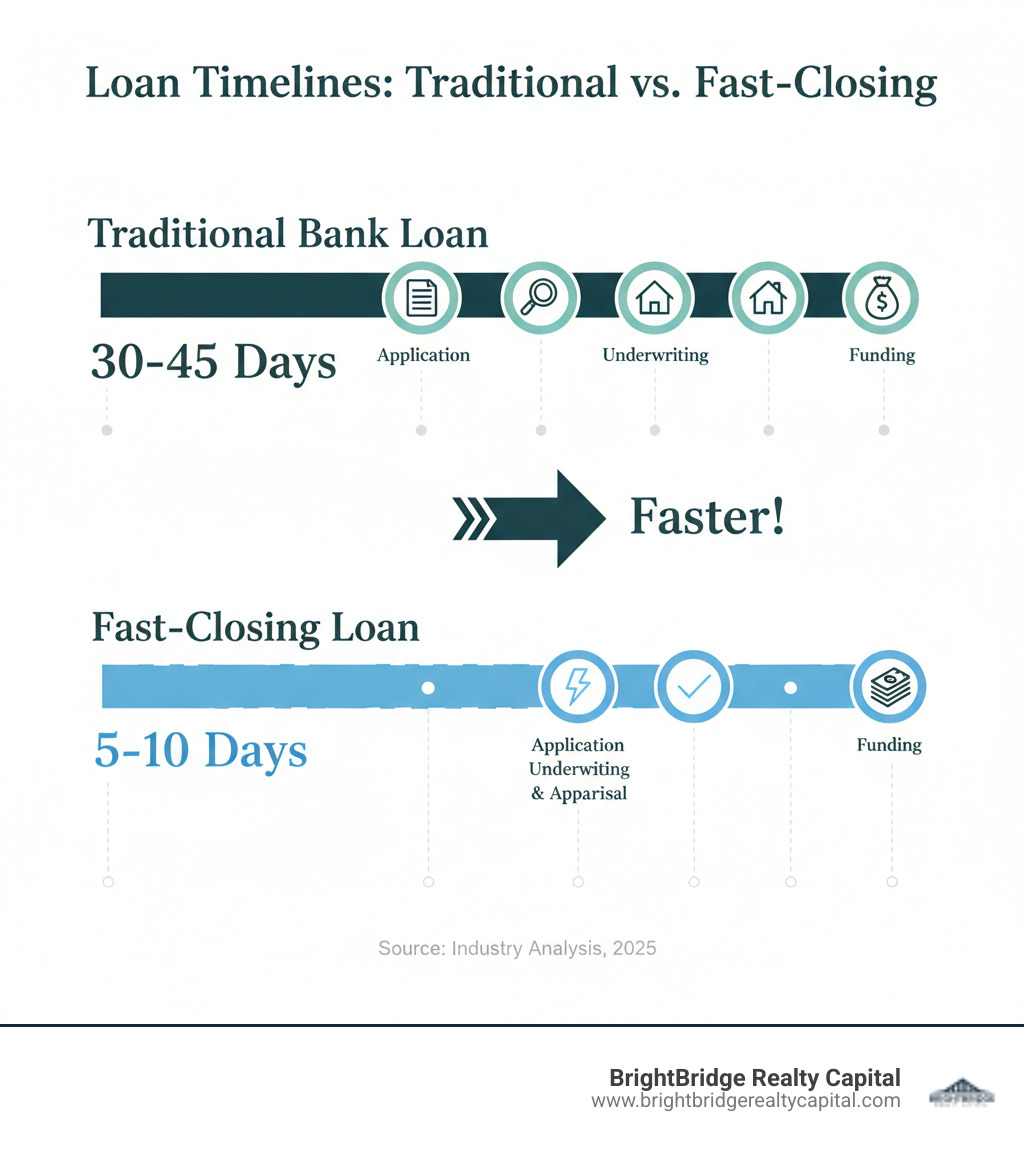
In the high-stakes world of real estate investing, speed is not just an advantage; it's a weapon. Fast closing real estate loans are specialized, short-term financing instruments engineered for investors who need to execute transactions with unparalleled velocity. While traditional banks operate on a timeline of 30-45 days, or even longer, these loans are designed to close within 5-10 business days. This rapid deployment of capital is possible because the lending decision hinges on the intrinsic value of the real estate asset itself, not on a forensic examination of the borrower's personal finances. This asset-centric model makes them the perfect tool for investors navigating hyper-competitive markets, acquiring distressed properties at auction, or capitalizing on fleeting, time-sensitive opportunities that would otherwise be lost to cash buyers or slower competitors.
Traditional bank financing, with its cumbersome and lengthy process, often acts as a bottleneck for ambitious investors. A typical bank loan application can get bogged down for weeks due to appraisal backlogs, multi-layered underwriting committees where a single person can delay a decision, and stringent regulatory requirements that demand extensive documentation of every aspect of a borrower's financial life. For an investor trying to secure a property with multiple offers, this delay is a deal-killer. Sellers, especially motivated ones, will almost always favor an offer that promises a certain close in 10 days over a slightly higher offer contingent on a 45-day financing process.
This is where the strategic power of fast-closing loans becomes clear. Consider the immense benefits:
Unmatched Funding Speed: The ability to close in as little as 5-7 business days is the headline feature. For well-prepared borrowers with a clean deal, some private lenders can even fund within 24-48 hours of a complete application. This speed allows an investor to make offers that are nearly as strong as cash, dramatically increasing their offer acceptance rate. Imagine a scenario where a seller has two similar offers, but one can close in a week while the other needs a month. The choice is obvious.
Drastically Reduced Documentation: Forget the endless scavenger hunt for two years of tax returns, W-2s, pay stubs, and detailed profit-and-loss statements. Fast-closing loans typically require minimal documentation, focusing instead on the purchase contract, entity documents, and the property itself. This is a game-changer for self-employed investors, entrepreneurs, or those with complex income structures that don't fit neatly into a traditional lender's box.
Asset-Based Approval Logic: The underwriting philosophy is fundamentally different. Private lenders focus on the property's Loan-to-Value (LTV) and, for renovation projects, its After-Repair Value (ARV). They are essentially partnering with the investor on the deal, betting on the asset's potential. While credit history is reviewed, it's not the primary decision driver, allowing investors with less-than-perfect credit but a great deal to secure funding.
Decisive Competitive Advantage: Industry data reveals a stark reality: nearly 40% of investors lose out on a desired property because their financing can't meet a 14-day closing deadline. By leveraging fast-closing loans, you immediately move into the top tier of buyers, effectively eliminating a huge portion of your competition.
Inherent Flexibility: These loans are not one-size-fits-all. They are available for a wide array of investment strategies, including fix-and-flip projects, acquiring rental properties (often as a bridge to long-term financing), land acquisition, new construction, and bridging gaps in commercial transactions. The terms can often be customized to the project's specific needs.
In today's dynamic real estate landscape, lucrative properties—from foreclosure auctions to off-market gems—don't wait for slow, bureaucratic processes. Fast-closing loans, offered by agile private lenders who make decisions in-house, have become the indispensable strategic tool that separates proactive, successful investors from those left watching opportunities pass them by.
I'm Daniel Lopez, a loan officer at BrightBridge Realty Capital. My expertise lies in helping investors structure fast closing real estate loans that are precisely tailored to tight timelines and competitive scenarios. I have witnessed firsthand how securing the right financing at the right speed is the critical factor that transforms a potential deal into a closed, profitable investment.
Understanding the Need for Speed: What Are Fast-Closing Loans?

Imagine this scenario: a motivated seller accepts your offer on a prime investment property but includes a critical contingency—you must close in ten days. With a traditional 30-45 day bank loan, you're not just at a disadvantage; you're completely out of the race. This is the precise gap where fast-closing real estate loans emerge as a decisive, strategic tool for savvy investors.
At their core, these are short-term (typically 6-24 months) financing options, often called hard money or bridge loans, designed to facilitate closings in 5-10 business days, not weeks or months. In optimal situations, with a prepared borrower and a straightforward property, funding can even occur in 24-48 hours. This incredible velocity is achieved because the loans are fundamentally asset-based. Lenders in this space, primarily private investment firms and dedicated debt funds, prioritize the property's economic viability over the borrower's personal financial minutiae. They analyze the property's current Loan-to-Value (LTV) and, crucially for renovation projects, its potential After-Repair Value (ARV). This property-centric underwriting allows for approvals in hours, not weeks, because the asset itself secures the loan.
The rise of these loans is directly linked to market dynamics. The private credit market is experiencing explosive growth, with trillions of dollars seeking deployment. This surge in capital is a response to the post-2008 landscape, where traditional banks, constrained by stricter regulations and a more conservative risk appetite, have retreated from certain types of real estate lending. Private lenders have stepped in to fill this void, providing the speed and flexibility that modern investors require.
The Key Differences: Fast-Closing vs. Traditional Loans
To truly grasp why fast-closing real estate loans are a game-changer, a direct comparison with traditional bank loans reveals a stark contrast in philosophy and process:
Timeline: This is the most significant differentiator. A fast-closing loan process is compressed: application, in-house valuation, streamlined underwriting, and funding can all happen within a week. A traditional loan involves a protracted sequence: application, initial processing, ordering a third-party appraisal (which can take weeks), exhaustive underwriting review by multiple departments, a final committee approval, and then scheduling a closing. The former is a sprint; the latter is a marathon.
Underwriting Focus: Fast-closing loans are property-centric. The lender asks, "Is this a good deal? Does the property's value support the loan?" They focus on LTV and ARV. Traditional loans are borrower-centric. The bank asks, "Can this borrower repay the loan from their personal income?" They scrutinize credit scores (often requiring 720+), debt-to-income (DTI) ratios (typically under 43%), and employment history, all based on rigid Fannie Mae and Freddie Mac guidelines.
Documentation: The documentation burden is night and day. A private lender might ask for the purchase contract, entity formation documents (like an LLC operating agreement), a renovation budget, and a summary of the investor's experience. A bank will demand all of that plus two years of federal tax returns (personal and business), recent W-2s or 1099s, 60 days of bank statements for all accounts, and detailed profit and loss statements for business owners. This extensive paperwork is a major source of delays.
Funding Source and Flexibility: Fast-closing loans are funded by private capital—investment groups, family offices, and specialized debt funds. This private backing allows for immense flexibility. Lenders can structure loans with interest-only payments, create interest reserves to roll payments into the loan, and offer customized draw schedules for construction. Traditional loans are funded by large, federally regulated banks that must adhere to strict, inflexible guidelines, leaving little room for creative or customized solutions.
Cost Structure: This speed and flexibility come at a price. Fast-closing loans have higher interest rates (typically ranging from 9-15% annually) and origination points (1-3% of the loan amount paid at closing). This is a strategic trade-off. Investors pay a premium for the ability to access profitable deals they would otherwise lose, viewing the higher cost as a transactional expense necessary to generate a much larger return.
Why Speed Is the New Currency in Real Estate
In today's market, speed is not just a feature; it's the ultimate currency. In competitive markets, sellers are inundated with offers. An offer with a 10-day close and no financing contingency is often perceived as more valuable than a higher offer with a 45-day financing contingency, as it represents certainty and a faster path to liquidity for the seller. This allows investors with fast financing to compete head-to-head with all-cash buyers.
This velocity is also indispensable for capturing time-sensitive opportunities. Distressed properties, such as foreclosures, short sales, and REO (Real Estate Owned by a bank) assets, often come with non-negotiable, rapid closing deadlines that traditional financing simply cannot meet. Similarly, real estate auctions require bidders to have their financing secured before the auction, with the ability to close within days of winning the bid.
The numbers confirm this reality: industry data consistently shows that almost 40 percent of investors lose a property if they cannot close within 14 days. This statistic represents a massive opportunity cost for those shackled to slow, conventional financing. When you can confidently promise a seller a close in 10 days instead of 45, you are no longer just participating in the market—you are dictating the terms and winning the best deals.
How to Secure Fast Closing Real Estate Loans: A Step-by-Step Guide

Securing fast closing real estate loans is a remarkably efficient process, provided you are well-prepared and have aligned with a competent lending partner. The key is to understand that the lender is your partner in the deal, and providing them with a clear, comprehensive picture from the outset is the fastest way to funding. At BrightBridge Realty Capital, we have meticulously engineered our process to move you from application to a funded loan in approximately one week, empowering you to focus on what you do best: finding and executing profitable real estate deals.
Here’s a detailed breakdown of how to navigate the process successfully.
Step 1: Identify the Right Loan Type for Your Project
Your investment strategy is the blueprint; your loan is the tool. Choosing the right tool for the job is critical. A mismatch between your project and your financing can lead to inefficiencies, higher costs, or even failure. Our loan programs are designed to meet specific, real-world investor needs.
Fast-Closing Bridge Loans: These are the ultimate problem-solvers in real estate. A bridge loan is a short-term (typically 6-24 months) interest-only loan that “bridges” a gap in financing. For example, an investor needs to close on a new acquisition before the sale of their existing property is finalized. A bridge loan provides the capital to secure the new property, preventing the deal from falling through. Another common use is for an investor in a 1031 exchange who has identified a replacement property but is facing a closing deadline before their relinquished property sale closes. A clear exit strategy—either the sale of a property or a refinance—is the cornerstone of a successful bridge loan.
DSCR Loans: Debt Service Coverage Ratio (DSCR) loans are the preferred tool for acquiring or refinancing stabilized, income-producing rental properties. Qualification is based on the property's cash flow, not your personal W-2 income. The lender calculates the DSCR by dividing the property's Net Operating Income (NOI) by its total debt service (principal and interest payments). A ratio above 1.0x means the property generates enough income to cover its debt, with most lenders looking for a DSCR of 1.20x or higher. This loan type is perfect for self-employed investors or those building a large rental portfolio, as personal income documentation is not required.
New Construction Loans: Designed for experienced builders and developers, these loans fund ground-up construction projects. Unlike a standard mortgage, funds are not disbursed in a lump sum. Instead, capital is released in a series of “draws” at various pre-agreed-upon stages of completion (e.g., foundation poured, framing complete, etc.). This structure protects both the lender and the borrower by ensuring the project stays on track and on budget. A detailed construction budget, plans, and a strong track record are essential for approval.
Fix-and-Flip Loans: This is the quintessential fast closing real estate loan. It provides the capital to both purchase and renovate a property. Lenders typically fund up to 90% of the purchase price and 100% of the renovation budget, with the total loan amount capped at around 75% of the After-Repaired Value (ARV). For example, on a property purchased for $200,000 with a $50,000 rehab budget and an ARV of $350,000, a lender might offer a loan covering the full $250,000 project cost, as this represents just 71% of the ARV. This high leverage allows investors to preserve capital and scale their operations.
Step 2: The Application and Approval Process for Fast Closing Real Estate Loans
Our objective is to deliver a term sheet (an initial approval) within one business day of receiving a complete submission. A complete package is your ticket to the fast lane. It typically includes:
- A completed loan application.
- The fully executed purchase and sale agreement.
- Entity documents (LLC Operating Agreement, Articles of Organization).
- A detailed scope of work or renovation budget (for fix-and-flip/construction).
- A real estate schedule of owned properties (a list of your current portfolio).
Our underwriting focuses on the deal's viability. We look for a conservative loan-to-value (LTV) ratio, typically around 75%, and a well-articulated exit strategy. While we do perform a credit check, it's primarily to screen for major red flags like recent bankruptcies or foreclosures, not to disqualify for a sub-700 score. Some of our programs have no minimum FICO requirement at all.
Property valuation is the core of our analysis. Depending on the deal, we may use a Broker Price Opinion (BPO), a desktop appraisal utilizing real-time data, or a full narrative appraisal to determine the current value and the ARV. Our streamlined digital application and underwriting platform allows us to process this information rapidly, moving from initial approval to a full underwriting sign-off in just 2-3 days, setting the stage for a swift and predictable closing.
Step 3: Exploring Streamlined Documentation Options
Many of the most successful real estate investors don't have a simple W-2 income. They are entrepreneurs, business owners, or full-time investors with complex financial profiles. Streamlined, or “low-doc/no-doc,” loan programs are specifically designed for this demographic. These programs radically reduce the paperwork burden by focusing almost exclusively on the asset's performance and the borrower's equity position.
With streamlined documentation, we bypass the need for tax returns and income verification. Instead, we might use a “bank statement” program for a self-employed borrower, analyzing 12-24 months of business bank statements to verify cash flow. For a DSCR loan, we require no personal income verification at all, relying solely on the property's rental income to qualify the loan. This isn't about cutting corners; it's about using more relevant data to make a lending decision. By leveraging technology and a common-sense, asset-focused approach, we eliminate the bureaucratic hurdles that slow down traditional lenders, resulting in faster approvals, quicker closings, and a powerful competitive edge for our clients.
Evaluating Your Options: Choosing the Right Lender and Loan

Selecting the right fast closing real estate loan is as critical to your success as finding the right property. The market is filled with lenders, but not all are created equal. Your goal is to find a true financial partner—one who is reliable, transparent, and deeply understands your investment strategy. The cheapest loan on paper is rarely the best. The best loan is the one that closes on time, with the promised terms, allowing you to execute your business plan without costly surprises. At BrightBridge Realty Capital, we build our reputation on this principle. Our rates start at a competitive 9%, but our true value lies in our commitment to transparency, speed, and certainty. When we issue a term sheet, we stand by it. When we say we can close in 5-7 business days, we have the process and capital to make it happen.
Comparing Lenders and Programs
As you vet potential lenders for fast closing real estate loans, move beyond the headline interest rate and scrutinize these critical attributes:
Funding Speed and Certainty: Ask direct questions. "What is your average closing time from a complete application?" "Can you provide a case study or reference for a recent deal that closed in under 10 days?" A true fast-closing lender will have a dedicated in-house team and can provide initial approval or a term sheet within 24 hours. Be wary of lenders who are vague about their timeline, as they may be brokers shopping your deal, adding delays and uncertainty.
Leverage (LTV & LTC): Loan-to-Value (LTV) and Loan-to-Cost (LTC) determine how much of your own capital you must bring to a deal. A lender offering higher leverage—such as 75% of the After-Repair Value (ARV) and up to 95% of the total project cost—allows you to preserve your cash for future deals, enabling you to scale your portfolio more quickly.
Interest Rates & True Cost of Capital (APR): Rates of 9% to 15% are standard for these short-term, high-leverage loans. It's crucial to understand the difference between the interest rate and the Annual Percentage Rate (APR), which includes points and fees. For a short-term flip, the total cost of capital (origination points + total interest paid over your expected holding period) is a more meaningful metric than APR. Calculate this for each loan offer to make an apples-to-apples comparison.
Points & All-In Fees: Most private lenders charge 1-3 origination points (1 point = 1% of the loan amount). However, you must demand a detailed fee sheet. Look for processing fees, underwriting fees, document preparation fees, legal fees, and valuation fees. A transparent lender will provide this upfront with no hidden charges. Ask if points can be rolled into the loan to reduce your cash-to-close.
Prepayment Penalties: This is a critical term for fix-and-flip investors. A prepayment penalty requires you to pay a fee if you pay off the loan before a specified period. For a flipper who plans to sell in 6 months, a loan with a 12-month prepayment penalty is unworkable. Look for lenders with no prepayment penalty or a very short penalty period (e.g., 3-6 months).
Lender's Specialization and Reputation: Does the lender specialize in your type of project? A lender who primarily funds new construction may not understand the nuances of a quick fix-and-flip. Check online reviews, ask for references, and determine if you are working with a direct lender or a broker. A direct lender like BrightBridge Realty Capital uses its own funds and makes its own decisions, providing greater speed and reliability.
Understanding the Costs and Potential Risks
Fast closing real estate loans are powerful tools, but they carry unique risks and costs that must be managed proactively.
The primary risk is a failed exit strategy. Every short-term loan requires a concrete plan to pay it off. There are two main exits:
- Sale of the Property: This is the exit for a fix-and-flip. Risks include construction delays, budget overruns, a softening market that reduces your final sale price, or an extended marketing time that racks up holding costs (interest payments, taxes, insurance).
- Refinance into a Long-Term Loan: This is the exit for the BRRRR (Buy, Rehab, Rent, Refinance, Repeat) strategy. Risks include not being able to qualify for the long-term loan (e.g., a DSCR loan) due to insufficient rental income, a low appraisal value, or a significant rise in long-term interest rates during your renovation period.
Another key feature to manage is the balloon payment. Most of these loans are interest-only, meaning your monthly payment only covers interest, keeping payments low during the project. However, at the end of the loan term (e.g., 12 months), the entire principal balance is due in one large “balloon” payment. If your exit strategy is delayed, you could face default unless your lender offers an extension, which often comes with hefty fees.
Legal and Regulatory Considerations
Navigating the legal landscape is crucial for protecting your investment. A common point of confusion is the 3-day Closing Disclosure rule (TRID). It's important to understand that this federal regulation applies to consumer-purpose mortgages (i.e., for a primary residence). Most fast closing real estate loans are for business purposes and are therefore exempt from TRID requirements. This exemption is a key reason they can close so quickly. However, this also means the onus is on you, the borrower, to perform thorough due diligence on all loan documents.
Working with licensed lenders is non-negotiable. A licensed lender, like BrightBridge Realty Capital in New York, is accountable to state regulatory bodies, ensuring adherence to ethical lending practices and usury laws. A lender's deep familiarity with state-specific hard money regulations is vital for structuring a loan that is both legal and fair.
Finally, we strongly advise all investors to have their loan documents reviewed by experienced legal counsel before signing. A lawyer can identify potentially predatory clauses related to default interest rates, personal guarantees (recourse vs. non-recourse), extension terms, and the fee structure, providing an invaluable layer of protection for you and your assets.
Frequently Asked Questions about Fast Closing Loans
When exploring fast closing real estate loans, investors often have pressing questions about the process, qualifications, and applications. As a loan officer on the front lines, I've compiled detailed answers to the most common concerns to provide clarity and confidence.
How fast can a real estate loan really close?
While the industry standard for fast-closing real estate loans is 5-10 business days, the true speed limit is often set by the borrower's preparedness. At BrightBridge Realty Capital, we have funded deals in as little as 24-48 hours. Achieving this level of velocity requires a perfect alignment of factors. Here’s what a 48-hour closing timeline looks like:
- Day 1 (Morning): The investor submits a complete application package, including the signed purchase contract, LLC documents, a clear scope of work, and a clean preliminary title report.
- Day 1 (Afternoon): Our underwriting team reviews the package, runs a desktop valuation (AVM) on the property, and issues a formal term sheet and loan commitment. The borrower immediately signs and returns the commitment letter.
- Day 2 (Morning): Our legal team prepares the loan documents and sends them to the title company and the borrower for review. The title company confirms the title is clear and ready to insure.
- Day 2 (Afternoon): The borrower signs the closing documents via a mobile notary, and we wire the funds to the escrow agent. The deal is officially closed and funded.
Delays are almost always caused by predictable issues: an incomplete application, title problems like unexpected liens or clouds on title, difficulty accessing the property for an appraisal, or a borrower who is slow to respond. Preparation is the ultimate accelerator.
What's more important for approval: the property's value or my credit score?
The property's value is, without question, the paramount factor. Our lending philosophy is asset-first. We are primarily underwriting the deal itself, focusing on its current Loan-to-Value (LTV) and its After-Repair Value (ARV). This is what enables our speed and flexibility. However, this does not mean credit is irrelevant. We do perform a credit check, but our analysis differs significantly from a bank's. We are not looking for a pristine 800 FICO score. Instead, we are screening for major derogatory events that might indicate a high risk of default, such as a recent bankruptcy, an active foreclosure, or a pattern of serious delinquencies on other debts. A lower credit score (e.g., in the 600s) might result in slightly less favorable terms—perhaps a lower LTV or a slightly higher interest rate—but it is very rarely an automatic disqualification, especially if the deal is strong and the borrower has some liquidity.
Are these loans only for flipping houses?
Absolutely not. While fix-and-flip projects are a very popular use case, the versatility of fast-closing real estate loans is one of their greatest strengths. Sophisticated investors use them for a wide range of strategies:
- Executing the BRRRR Strategy: An investor uses a fast-closing bridge loan to Buy and Rehab a property. Once the renovation is complete and a tenant is in place (Rent), they Refinance with a long-term DSCR loan to pay off the bridge loan and pull cash out. They then Repeat the process.
- Acquiring Rental Portfolios: An investor finds an opportunity to buy a package of several rental properties from a retiring landlord who wants a quick, simple transaction. A fast-closing loan can be used to acquire the entire portfolio at once, after which the investor can refinance each property individually.
- Funding New Construction: A developer needs to close on a piece of land quickly to lock in the price. They use a bridge loan for the land acquisition and then transition into a full construction loan to fund the build.
- Securing Commercial Properties: These loans are frequently used to acquire small commercial assets like retail storefronts, small office buildings, or warehouses, especially in situations where a seller is highly motivated and a quick close can secure a better purchase price.
What is a personal guarantee, and will I be required to sign one?
Yes, in almost all cases, a personal guarantee (PG) is a standard requirement for private and hard money loans. When you take out a loan in the name of your business entity (e.g., an LLC), the personal guarantee is a legal agreement stating that if the LLC defaults on the loan, the lender has the right to pursue your personal assets (such as your primary home, bank accounts, or other investments) to recoup their losses. Lenders require a PG to ensure you have significant “skin in the game” and are fully committed to the project's success. It aligns your interests with the lender's and provides them with a secondary source of repayment, reducing their overall risk.
Can I get a fast-closing loan as a first-time investor?
Yes, it is possible for a first-time investor to secure a fast-closing loan, but the terms will likely be more conservative. Lenders mitigate the risk of inexperience by requiring more from the borrower. While an experienced flipper might get 90% LTC and 75% LTV, a first-time investor might be offered a lower leverage point, such as 80% LTC and 70% LTV. This means the new investor will need to contribute more of their own cash to the deal. Lenders will also look for other compensating factors, such as a high credit score, significant cash reserves (liquidity), or a partnership with an experienced mentor or contractor. At BrightBridge Realty Capital, we have programs designed to help new investors get started, provided they have a well-vetted deal and a solid plan.
Conclusion: Close Deals with Speed and Confidence
In the fiercely competitive arena of modern real estate investing, fast closing real estate loans have evolved from a niche product into a strategic necessity. They are the engine that empowers agile investors to seize opportunities, grow their portfolios, and outperform competitors who are constrained by the slow, bureaucratic timelines of traditional bank approvals. This is not just about financing; it's about transforming your entire approach to deal-making.
The ability to confidently make an offer with a 5-10 business day closing timeline is a profound competitive advantage. It allows you to bid with conviction at real estate auctions, compete on equal footing with all-cash buyers, and acquire valuable distressed properties that are inaccessible to the majority of the market. When industry data shows that nearly 40% of investors lose deals because of slow financing, speed becomes the single most important factor that separates those who build wealth from those who watch from the sidelines.
However, wielding this speed effectively requires more than just access to capital; it demands the right financial partner. A reliable, direct lender who understands the urgency and nuances of real estate investing is indispensable. At BrightBridge Realty Capital, we are that partner. We are not brokers who add layers of delay and uncertainty. We are a direct lender, using our own capital to provide straightforward, transparent, and customized fast-closing financing solutions. Our process is built for speed, with no intermediaries to slow you down and no hidden fees to surprise you at the closing table.
Operating in the heart of New York's demanding market, we know that every day counts and that delays cost deals. Our entire business is structured around providing certainty and velocity. Our partnership is founded on a commitment to clear, constant communication and a shared goal of helping you succeed. We don't just provide loans; we provide the financial firepower and strategic support you need to execute your vision.
Your next profitable investment is out there, waiting to be claimed. Don't let slow, inflexible financing be the barrier that stands between you and your goals.
Take the first step toward your next successful investment. Contact BrightBridge Realty Capital today to discuss your project and discover how we can help you close your next deal with the speed and confidence you deserve. Get a transparent term sheet in 24 hours and see the difference a true lending partner can make.