The Express Lane to Funding: Fast Hard Money for Real Estate

Summary
Secure fast hard money for real estate investments! Learn how quick loans accelerate deals, pros, cons, and steps to get funded fast.
Why Speed Matters in Real Estate Investing
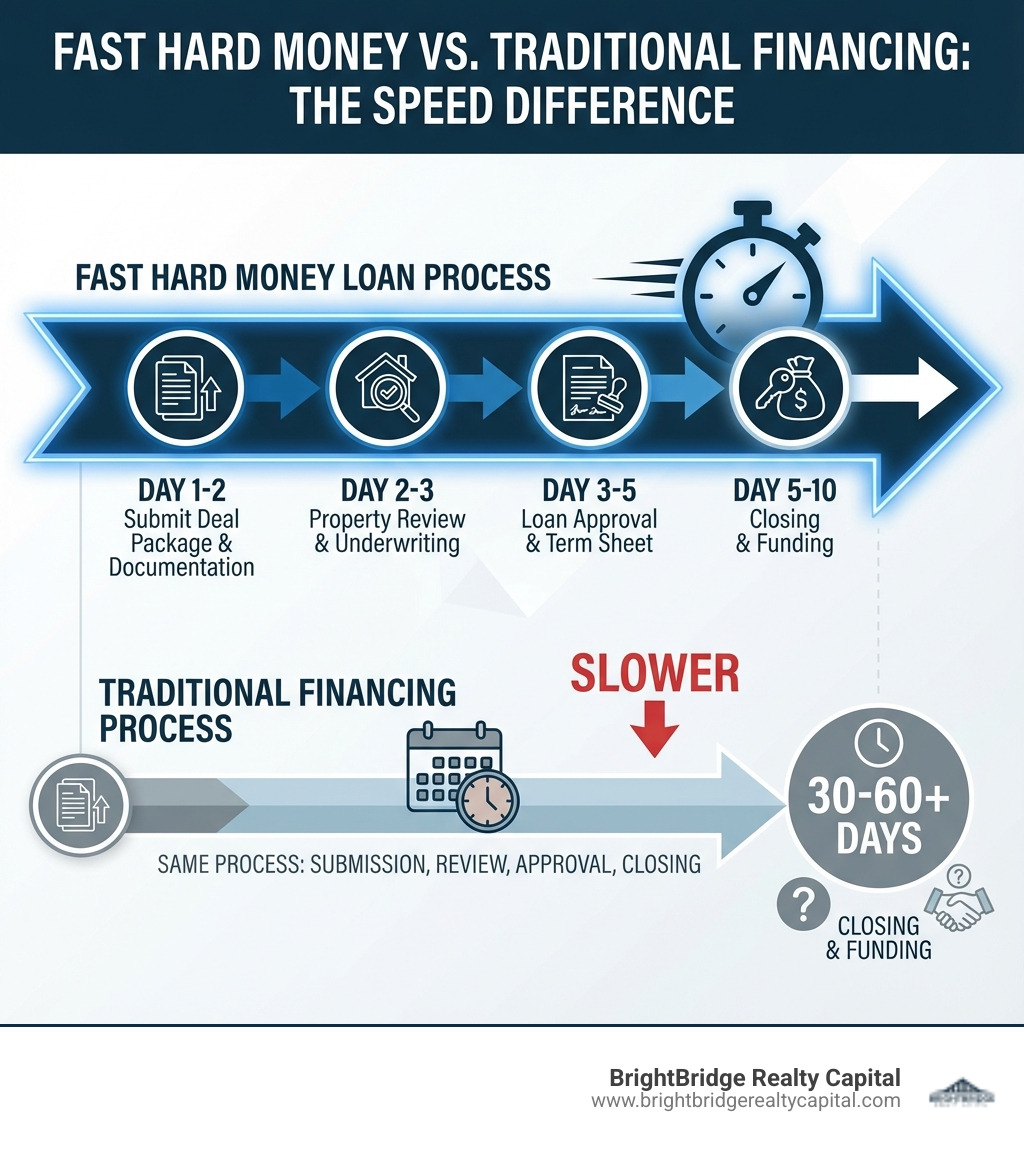
Fast hard money is a short-term, asset-based loan provided by private lenders that can close in as little as 3-10 days, designed specifically for real estate investors who need quick funding to secure time-sensitive deals. Unlike traditional bank loans that take 30-60 days or more, fast hard money focuses on the property's value rather than the borrower's credit score, making it ideal for fix-and-flip projects, rental acquisitions, and competitive market situations. This financial tool is not just about convenience; it's a strategic weapon in an investor's arsenal, enabling them to operate with the agility of a cash buyer.
Key Facts About Fast Hard Money:
- Funding Speed: Close in 3-10 days vs. 30-60+ days for traditional loans
- Approval Basis: Property value (After-Repair Value or ARV) and equity, not primarily the borrower's credit score
- Interest Rates: Typically 8-15% annually
- Loan Terms: Usually 6-24 months, with interest-only payments common
- Best For: Fix-and-flip, rental properties, bridge financing, distressed properties, real estate auctions, and new construction.
Real estate deals move at the speed of capital. When you spot the perfect investment property—perhaps a foreclosure auction, a bank-owned REO, or a pocket listing from a motivated seller—you might have hours or days to act, not weeks. Traditional bank financing, with its lengthy underwriting and bureaucratic hurdles, simply can't keep up with competitive markets where cash buyers dominate and sellers demand quick, certain closings. That's where fast hard money becomes a game-changer, leveling the playing field and allowing you to compete head-to-head with all-cash offers.
The Anatomy of a Time-Sensitive Deal
Why is speed so critical? Consider these common scenarios:
- Real Estate Auctions: Properties sold at auction often require the winning bidder to close the transaction within a very short timeframe, sometimes as little as 10 to 30 days. A conventional loan is a non-starter in this environment. Fast hard money is designed for this exact purpose.
- Bank-Owned Properties (REOs): Banks are not in the business of holding real estate. They are motivated to sell foreclosed properties quickly to get them off their books. An offer with fast, reliable financing is often viewed more favorably than a higher offer contingent on a slow, uncertain bank loan.
- Motivated Sellers: A seller facing a life event (divorce, job relocation, inheritance) may prioritize a guaranteed quick close over squeezing every last dollar out of the property. Your ability to promise a 10-day closing can be the deciding factor.
The Conventional Loan Bottleneck vs. Hard Money Velocity
Hard money lenders can fund deals in as few as 3-5 days with a complete application package, with most closings happening within 7-10 days. This speed isn't just convenient—it's often the difference between securing a profitable deal and watching it go to a competitor. The rapid approval process is possible because hard money lenders focus primarily on the property's current and future value. We spend our time analyzing the asset, not weeks analyzing your tax returns, employment history, and credit profile. A traditional bank's process, burdened by federal regulations like Dodd-Frank, involves multiple layers of approval, stringent appraisal guidelines, and a deep dive into your personal financial history, which can easily stretch the timeline to 45 days or more. For an investor, that's an eternity.
These loans typically come with higher interest rates (8-15% is common) and shorter repayment terms (6-24 months), but for many investors, the cost is justified by the ability to compete with cash buyers, secure below-market properties, and execute renovation strategies without delay. The cost of the loan becomes a calculated expense in a profitable venture, far outweighed by the opportunity cost of missing the deal altogether. Whether you're flipping houses, building a rental portfolio using the BRRRR method, or need bridge financing between deals, fast hard money provides the capital and flexibility that traditional lenders simply cannot offer.
I'm Daniel Lopez, a loan officer at BrightBridge Realty Capital, and I've helped dozens of investors secure fast hard money to capitalize on time-sensitive opportunities that would have been lost waiting for traditional financing. My experience with fast hard money has shown me that speed paired with the right guidance can transform how investors build their portfolios, allowing them to do more deals in less time and scale their businesses exponentially.
If you are new to concepts like Loan-to-Value (LTV) and bridge financing and want a neutral primer, resources such as the Real estate investing overview can help you understand how fast capital fits into broader investment strategies.
Fast hard money vocab to learn:
What Are Hard Money Loans and Why Are They So Fast?
At its core, a hard money loan is a short-term loan secured by real estate. The "hard" in fast hard money refers to the "hard asset" – the property itself – that serves as collateral. Unlike traditional bank loans, which scrutinize a borrower's credit history, income, and debt-to-income ratio, hard money lenders primarily focus on the value and potential of the property being financed. This asset-based lending approach is the secret sauce behind the incredible speed of these loans. The lender's primary concern is the quality of the real estate deal; if the borrower were to default, the lender is confident they can recoup their investment by taking possession of the property.

Fast hard money loans are typically offered by private lenders or investment companies, not conventional banks. This allows us to operate with more flexibility and fewer regulatory constraints, drastically streamlining the entire process. We're talking about a process that can take weeks or months with a bank, condensed into mere days. This speed is crucial for real estate investors in competitive markets like New York, where opportunities can vanish in a blink. Because we use private capital, we set our own underwriting guidelines based on common sense and investment fundamentals, not a rigid, one-size-fits-all checklist from a large institution.
These loans are often used as "bridge loans," providing temporary financing until a property is sold or refinanced with a more traditional, long-term loan. The Loan-to-Value (LTV) or Loan-to-Cost (LTC) ratio, along with the After-Repair Value (ARV) of the property, are key metrics we consider. We're looking at the property's current value, its potential value after renovations, and how much financing we can provide based on those numbers. Our direct lending process means we cut out intermediaries, further speeding up underwriting and funding.
The Role of Property Value vs. Borrower Credit
One of the most distinctive features of fast hard money is our collateral-focused underwriting. While your creditworthiness isn't entirely ignored, it plays a secondary role compared to the property itself. For us, the property is the primary asset securing the loan. This means even if you have a less-than-perfect credit score or a unique financial situation (like being self-employed with fluctuating income) that might deter traditional lenders, a strong real estate deal can still get you funded.
However, this doesn't mean credit is irrelevant. A lender will still likely run a credit check to look for red flags that could impact your ability to execute the project. We are looking for major issues like recent bankruptcies, active foreclosures, or significant unresolved judgments. These can indicate a higher risk of default, even on a good deal. We also consider your experience. A seasoned investor with a track record of successful flips might secure more favorable terms (e.g., a higher LTV or lower interest rate) than a first-time investor. Your experience provides an extra layer of confidence in your ability to manage the project and deliver on the exit strategy.
We assess the property's market value, its potential for appreciation, and the viability of your investment strategy. For instance, if you're looking to acquire a distressed property in a desirable New York neighborhood, we'll evaluate its current value and, more importantly, its After-Repair Value (ARV). The higher the ARV relative to the purchase and renovation costs, the more attractive the deal is to us. We typically look for a healthy equity position, often requiring a down payment or existing equity of 20% to 35% of the property's value. This "skin in the game" ensures you are as committed to the project's success as we are.
Typical Costs and Terms of a Fast Hard Money Loan
Let's be upfront: fast hard money loans come with higher costs than traditional mortgages. Why? Because we take on more risk and offer unparalleled speed and flexibility. Industry-wide, interest rates for hard money loans typically range between 8% and 15%. This is significantly higher than conventional mortgage rates, which might be in the 4-8% range. However, for a short-term, high-profit project, this cost is often negligible compared to the potential returns and the opportunity cost of missing a deal.
In addition to interest, you'll usually encounter origination fees, often called "points." One point equals 1% of the loan amount. These fees typically range from 2% to 5% of the loan amount and compensate the lender for the work of underwriting and processing the loan. Other potential fees can include processing fees, underwriting fees, and legal document preparation fees. A reputable lender will provide a clear term sheet outlining all costs upfront.
The repayment terms for fast hard money loans are short, usually ranging from 3 months to 24 months, with some extending to 36 months. This is a stark contrast to traditional mortgages that span 15-30 years. Many hard money loans are structured with interest-only payments throughout the loan term. This means your monthly payment only covers the interest accrued, keeping your carrying costs low while you renovate the property. The entire principal amount is then due at the end of the term in a single, large "balloon payment." This structure is ideal for fix-and-flip investors who plan to repay the entire loan from the proceeds of the sale.
The importance of a clear exit strategy cannot be overstated. Since these loans are short-term and end with a balloon payment, you must have a solid, realistic plan to repay the loan. The two most common exit strategies are selling the renovated property or refinancing into a long-term, conventional mortgage (a key part of the BRRRR strategy). We want to ensure you have a viable path to success before we fund your deal.
How to Get Fast Hard Money: A Step-by-Step Guide
Securing fast hard money might seem daunting, but we've streamlined the process to be as straightforward as possible. Our goal is to get you funded quickly so you can seize those lucrative real estate opportunities. A prepared borrower is a fast-funded borrower.
Before you even think about applying, you must clearly define your real estate investment strategy. Are you a fix-and-flip enthusiast looking to transform distressed properties into gems? Perhaps you're employing the BRRRR method (Buy, Rehab, Rent, Refinance, Repeat) to build a rental portfolio in New York. Maybe you're focused on acquiring stabilized rental properties, developing raw land, or venturing into new construction. Your strategy will dictate the type of loan you need, the metrics we evaluate, and how you structure your deal.
Step 1: Prepare Your Deal Package
The foundation of a successful fast hard money application is a comprehensive and well-prepared deal package. This is your business plan for the property, and it's where you make your case for its potential. We need to see the numbers clearly and understand your vision. A detailed package includes:
- Property details: Address, property type (SFR, multi-family, commercial), square footage, current condition, and photos/videos.
- Purchase contract: The fully executed agreement to buy the property.
- Detailed Renovation Budget: This isn't a ballpark guess. It's a line-item breakdown of all planned repairs and improvements with cost estimates for labor and materials (e.g., roofing: $15,000; kitchen remodel: $25,000; flooring: $10,000). This shows us you've done your due diligence.
- Scope of Work (SOW): A narrative that complements the budget, describing exactly what work will be done, the quality of finishes, and the project timeline.
- After-Repair Value (ARV) Analysis: Your professional assessment of what the property will be worth after renovations. This should be supported by comparable sales (comps) of recently sold, similar properties in the area. A real estate agent can provide a Comparative Market Analysis (CMA) to support your ARV.
- Clear Exit Strategy: A detailed plan explaining how you will repay the loan. If flipping, what is your target sale price and marketing plan? If refinancing, have you spoken to a mortgage broker to confirm you can qualify for a long-term loan?
For fix-and-flip projects, we often consider up to 90% of the purchase price and 100% of the rehab budget, as long as the total loan amount is less than 70-75% of the ARV. For buy-and-hold strategies, the focus might shift more towards the property's current value and its potential to generate rental income that can cover the debt service.
Step 2: Gather Required Documentation
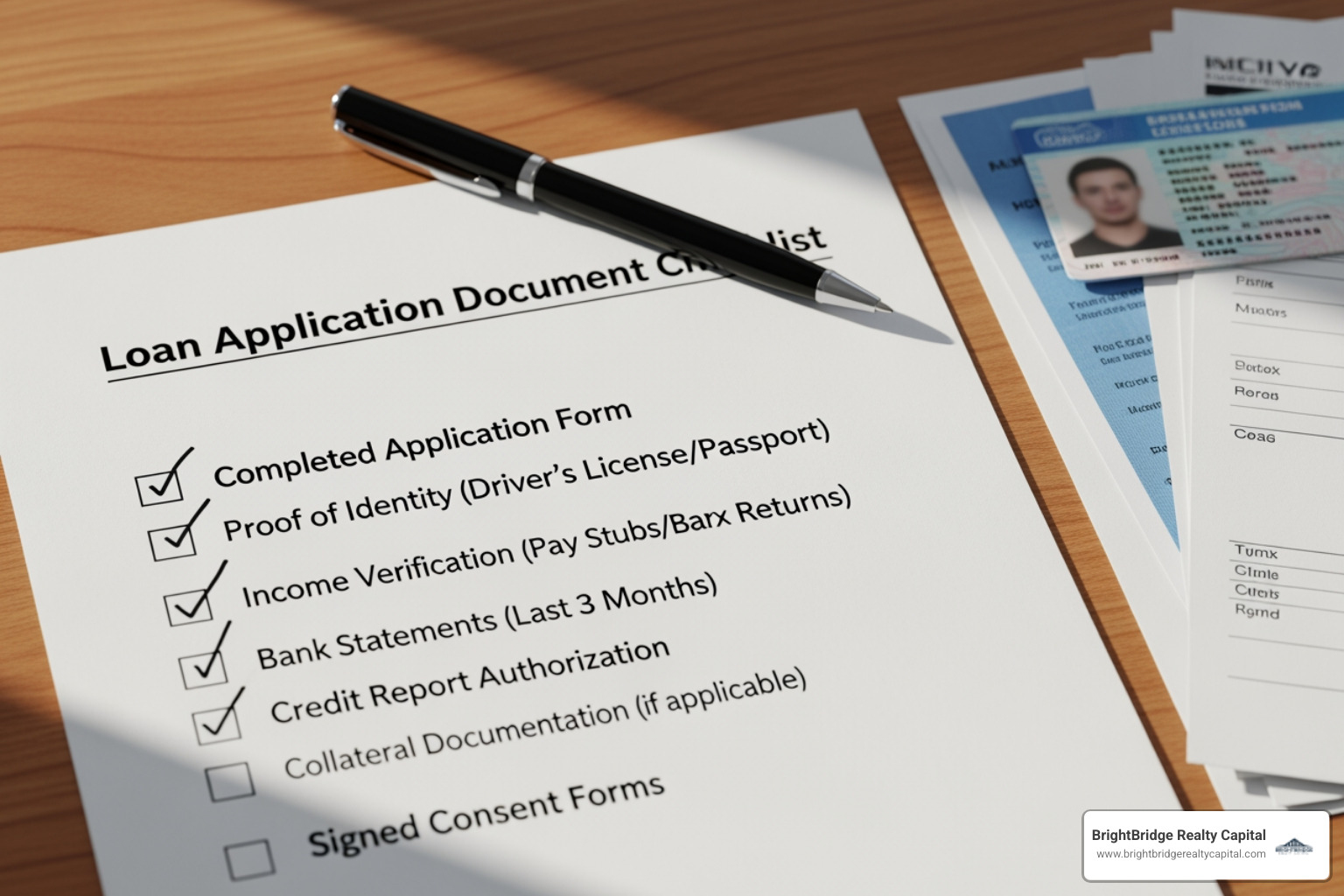
While we focus less on your personal credit history, we still need some essential documents to verify your identity, financial capacity, and the specifics of your deal. Having these ready from day one is the key to a 3-day closing. Here's a list of common documents we'll ask for:
- Proof of Identity: Driver's license, passport for all principals.
- Proof of Funds: Recent bank or investment account statements showing you have the cash for the down payment, closing costs, and initial interest payments.
- Business Entity Documents: Most lenders require you to borrow through an entity (LLC or corporation) for liability and legal reasons. You'll need your Articles of Organization/Incorporation, Operating Agreement, and EIN.
- Property Appraisal or Broker Price Opinion (BPO): The lender will order their own valuation, but providing your own upfront shows preparedness.
- Purchase Agreement: The signed contract and any addenda.
- Real Estate Investment Experience: A schedule of past projects, including purchase/sale prices, rehab budgets, and outcomes. For new investors, highlighting any relevant construction or project management experience is helpful.
Step 3: Find and Vet a Reputable Lender
This step is crucial. While the allure of fast hard money is strong, not all lenders are created equal. You need a partner you can trust, one that operates transparently and has a proven track record. When choosing a lender, consider:
- Lender Reputation: Look for positive online reviews, testimonials, and a long-standing presence in the industry. Ask for references from other investors.
- Transparency on Rates and Fees: A reputable lender will clearly outline all interest rates, points, and any other associated fees upfront. There should be no hidden surprises at the closing table.
- Closing Speed: Confirm their ability to deliver on the "fast" promise. Ask for recent examples of their closing timelines. We pride ourselves on closing deals in as few as 4-7 days.
- Communication: How responsive and clear are they? A good lender will assign you a single point of contact and keep you informed every step of the way.
- Specialization: Ensure they understand the nuances of your specific investment strategy and geographic market, whether it's fix-and-flip, new construction, or rental portfolios in New York.
At BrightBridge Realty Capital, we specialize in providing customized real estate financing solutions nationwide, with a strong focus on New York. Our unique selling proposition is fast hard money closings, often within a week, and direct lending without intermediaries, offering competitive rates and a seamless process.
Step 4: Application and Closing
Once you have your deal package and documentation ready, and you've chosen a reputable lender, the application and closing process for fast hard money is remarkably efficient. Our streamlined application process often begins online. You provide the necessary details, and our underwriting team quickly reviews your project. Because we focus on the asset, not just your credit, our underwriting is quick. We can often provide a term sheet – a summary of the loan's key terms – within 24 hours of receiving a complete package.
The funding timeline is where fast hard money truly shines. While traditional mortgages can take 30-60 days or even longer to get funded, we can typically close in as little as 7-10 days. In some cases, with a full and complete package from an experienced borrower, we've funded loans in as few as 3-5 days. This rapid turnaround allows you to compete effectively with cash buyers and secure properties that would otherwise be out of reach.
Weighing the Options: Pros and Cons of Fast Hard Money
Like any financial tool, fast hard money loans come with their own set of advantages and disadvantages. Understanding both sides is key to making informed decisions and ensuring your investment success. For the savvy investor, the pros far outweigh the cons when used strategically.
| Advantage | Disadvantage |
|---|---|
| Speed of Funding (3-10 Days) | Higher Interest Rates (8-15%) |
| Competitive Edge Against Cash Buyers | Higher Fees (2-5 Origination Points) |
| Flexible Underwriting (Asset-Based) | Short Repayment Terms (6-24 Months) |
| Accessible for Lower Credit Scores | Risk of Foreclosure if Defaulted |
| Financing for Distressed/Unique Properties | Potential Prepayment Penalties |
| Interest-Only Payments for Cash Flow | Not Ideal for Long-Term Financing |
| Direct Lender Communication & Simplicity | Less Regulatory Oversight (Varies by State) |
| Ability to Leverage Capital (OPM) | Requires a Clear and Viable Exit Strategy |
The Top Advantages for Real Estate Investors
The primary reason investors flock to fast hard money is, you guessed it, speed! This rapid funding provides a significant competitive edge in the New York real estate market. When a seller wants to close quickly, a traditional bank loan simply won't cut it. With hard money, you can write offers with short financing contingencies, making your bid nearly as attractive as an all-cash offer.
Our flexible, asset-based underwriting makes these loans accessible to a wider range of investors. This is especially beneficial for those who might have a few dings on their credit report, are self-employed with complex tax returns, or simply can't wait weeks for a bank's approval. We can finance distressed properties that traditional lenders wouldn't touch—properties with structural issues, mold, or fire damage—opening up opportunities for lucrative fix-and-flip projects. The ability to make interest-only payments for the loan's duration also helps manage cash flow during renovations, freeing up capital for the project itself rather than servicing debt.
Furthermore, hard money is a powerful tool for leverage. It allows you to use Other People's Money (OPM) to control more assets and do more deals than you could with your own cash alone. Instead of tying up $400,000 in one cash purchase, you could use that same $400,000 as down payments for four separate hard money loans, dramatically scaling your business and potential returns.
Understanding the Risks and How to Mitigate Them
While the benefits are compelling, it's crucial to understand and respect the risks. The most obvious downside is the higher cost: higher interest rates (8-15%) and origination fees (2-5 points). These loans are designed to be short-term solutions. If your project runs over schedule or budget, those costs can quickly compound and eat into your profits. You must factor these costs into your analysis from the very beginning.
The short repayment window, typically 6-24 months, means you need a robust and realistic exit plan. What if the market shifts and your projected ARV drops? What if your primary contractor quits mid-project? What if your end buyer's financing falls through? The biggest risk is the potential for foreclosure if you can't repay the loan on time. Because the property itself is the collateral and the lender is private, the foreclosure process can be much faster than with a conventional loan.
To mitigate these risks, successful investors are masters of contingency planning:
- Have Multiple Exit Strategies: Your primary exit might be to sell, but what's your Plan B? Could you rent the property out and refinance into a long-term loan? Always have a backup.
- Buffer Your Budget and Timeline: Never assume a best-case scenario. Always add a 15-20% contingency fund to your renovation budget to cover unforeseen issues. Similarly, add at least a month or two to your project timeline.
- Understand All Loan Terms: Read the fine print! Be aware of any prepayment penalties if you pay off the loan early, or extension fees if you need more time. Discuss these terms with your lender upfront.
- Build a Strong Team: Partner with reliable contractors, real estate agents, and, of course, a transparent hard money lender like us. Your team is your best defense against project delays and budget overruns.
- Don't Over-Leverage: Ensure you have enough "skin in the game" (your down payment or equity) and sufficient cash reserves to absorb potential setbacks and make monthly interest payments without stress.
Frequently Asked Questions about Fast Hard Money Loans
We hear a lot of questions about fast hard money, and that's great! It shows you're doing your homework. An educated borrower is a successful borrower. Here are some of the most common inquiries we receive, along with detailed answers.
What credit score is needed for a fast hard money loan?
This is where fast hard money truly differs from traditional loans. While traditional banks might demand a credit score of 680+ (or even 740+ for the best rates), hard money lenders prioritize the property's value and the deal's viability over your personal credit score. The focus is on the "hard asset" itself. Many lenders do not have a strict minimum score, but a mid-600s score is often preferred as it shows a general history of financial responsibility.
However, a low credit score isn't necessarily a deal-breaker if the deal is strong enough (e.g., low LTV, high potential profit). We are more concerned with major credit events like a recent bankruptcy, foreclosure, or large, unpaid judgments. If your credit score is a bit bruised, or you're self-employed and your tax returns don't reflect your true income, fast hard money can still be a viable option because we're looking at the investment's potential, not just your past financial behavior.
Who are these loans best for?
Fast hard money loans are tailor-made for real estate investors who need to act quickly and flexibly. This includes:
- House Flippers: The classic use case. Investors buying distressed properties, renovating them, and selling for a profit. They need speed to secure deals and often require financing for the rehab costs, which we can provide.
- BRRRR Method Investors: Landlords using the Buy, Rehab, Rent, Refinance, Repeat strategy. Hard money is perfect for the first two steps (Buy and Rehab), providing the short-term capital needed before refinancing into a long-term conventional loan.
- Builders and Developers: Those needing construction financing for new builds. Hard money can fund land acquisition and vertical construction, often on a draw schedule.
- Borrowers Who Can't Qualify for Traditional Loans: This includes individuals with lower credit scores, self-employed individuals with complex income documentation, or foreign nationals.
- Investors Competing with Cash Buyers: In a hot market, the ability to close in 10 days with hard money makes your offer nearly as strong as cash.
How quickly can a hard money loan actually close?
This is often the most appealing aspect! While traditional mortgages can take 30-60 days (or even longer) to close, fast hard money loans live up to their name. With a complete application package and clear communication, funding can happen in as few as 3-5 business days. The average closing time we see is typically 7-10 days. This rapid turnaround is possible because we, as private lenders, are not bound by the same extensive regulatory processes as banks. We can make quicker decisions based on the merits of the property and your exit strategy. This speed is invaluable when you're trying to secure a property at auction, beat out other offers, or simply keep your project moving forward without costly delays.
Can I use a fast hard money loan for my primary residence?
Generally, no. Fast hard money loans are considered business-purpose or commercial loans. They are intended for investment properties that will be flipped or held as rentals. Loans for owner-occupied primary residences are subject to a host of consumer protection regulations (like RESPA and Dodd-Frank) that make the traditional hard money model unfeasible. Attempting to use a hard money loan for a primary residence by claiming it's an investment can be considered mortgage fraud.
What is a 'draw schedule' for renovation funds?
When a hard money loan includes financing for renovations, the lender doesn't typically give you all the rehab money upfront. Instead, it's placed in an escrow account and disbursed to you in stages, or "draws," as you complete phases of the project. For example, you might get the first draw after the demolition is done and framing is up. The second draw might come after plumbing and electrical are finished. Before releasing each draw, the lender will usually require an inspection to verify that the work has been completed to a satisfactory standard. This protects both you and the lender by ensuring the project stays on track and the loan-to-value ratio remains in line.
Is a personal guarantee always required?
A personal guarantee (PG) is a promise from the borrower to repay the loan personally if the business entity (your LLC) defaults. For most hard money lenders, a PG is standard practice. It ensures you have personal skin in the game beyond your initial cash investment. However, for very experienced, high-net-worth investors with a long and successful track record with a particular lender, it is sometimes possible to secure a non-recourse loan, which does not include a personal guarantee. These are the exception, not the rule.
Conclusion: Your Strategic Partner for Rapid Real Estate Growth
In the dynamic and often ruthless world of real estate investment, speed is not just a luxury—it is a fundamental requirement for success. Fast hard money loans are not just another financing option; they are a strategic tool that empowers investors to seize fleeting opportunities, compete effectively against cash buyers, and execute their vision with unparalleled efficiency. While they come with higher costs and shorter terms than conventional loans, the ability to act decisively and close a deal in days, not months, can be the difference between explosive portfolio growth and stagnation.
The key to successfully using hard money lies in understanding the trade-offs. You are exchanging a higher cost for speed, flexibility, and opportunity. For the prepared investor who has done their due diligence, created a detailed plan, and has clear exit strategies, hard money is the fuel that powers their investment engine. It enables leverage, facilitates the acquisition of value-add properties that banks won't touch, and provides the agility needed to thrive in any market cycle.
At BrightBridge Realty Capital, we understand the unique needs and pressures faced by real estate investors in New York and across the nation. We are more than just a lender; we are a strategic partner dedicated to your success. We're here to provide the customized and rapid financing solutions, expert guidance, and transparent communication necessary to fund your next real estate deal. Don't let slow, bureaucratic financing hold you back from your next big win. Embrace the power of speed and let's build your real estate empire together.