From Renovation to Revenue: Understanding Fix and Hold Loans
Summary
Unlock passive income with fix and hold loans! Learn how to finance renovations, build rental portfolios, and grow long-term wealth.
Why Fix and Hold Loans Matter for Real Estate Investors
Fix and hold loans are specialized financing products for real estate investors who purchase and renovate properties to hold as long-term rentals. Unlike traditional mortgages or fix-and-flip loans, these are designed for building sustainable, long-term wealth through rental portfolios. While flipping properties can generate quick profits, the fix and hold strategy focuses on creating a stable of income-producing assets that appreciate over time, provide consistent cash flow, and can form the foundation of generational wealth.
Quick Answer: What You Need to Know About Fix and Hold Loans
- Purpose: Finance both the property purchase and all associated renovation costs for properties intended to be held as rentals.
- Loan Term: An initial short-term period, typically 6-24 months for acquisition and rehab, which is then refinanced into long-term financing (e.g., a 30-year mortgage).
- Down Payment: Often as low as 10% of the total project cost, a significant advantage compared to the 20-25% typically required for conventional investment property loans.
- Funding: Can cover up to 95% of the property's purchase price and 100% of the renovation costs, minimizing your out-of-pocket cash investment.
- Qualification: Based on the property's potential value and income (asset-based), not your personal income verification, W-2s, or tax returns.
- Best For: Investors utilizing the BRRRR strategy (Buy, Rehab, Rent, Refinance, Repeat) to scale their rental portfolios rapidly.
Real estate investing is a proven path to financial freedom, and the fix and hold strategy is one of the most effective methods for building a rental portfolio without tying up excessive personal capital. However, the traditional path to financing through banks and credit unions often creates insurmountable roadblocks. These institutions have stringent underwriting requirements, slow approval processes that can kill a deal, and an aversion to financing properties that require significant repairs. This is where the strategic advantage of specialized financing becomes clear.
Fix and hold loans are designed to bridge this critical gap. Offered by private and direct lenders, these financing solutions are built for the realities of real estate investing. They provide the speed needed to compete in today's market, the flexibility to underwrite based on the deal's merit, and the capital to fund both the purchase and renovation costs upfront. This transforms distressed, undervalued properties into stable, cash-flowing assets that power your investment journey.
This comprehensive guide will walk you through every aspect of this financing strategy, from the fundamental mechanics to advanced tactics for portfolio growth.
What is a Fix and Hold Loan? A Deep Dive for Investors

Understanding how fix and hold loans differ from other financing options is crucial for selecting the right tool to execute your investment strategy and achieve your financial goals. This is not just another loan product; it's a purpose-built vehicle for wealth creation through rental real estate.
Defining Fix and Hold Loans
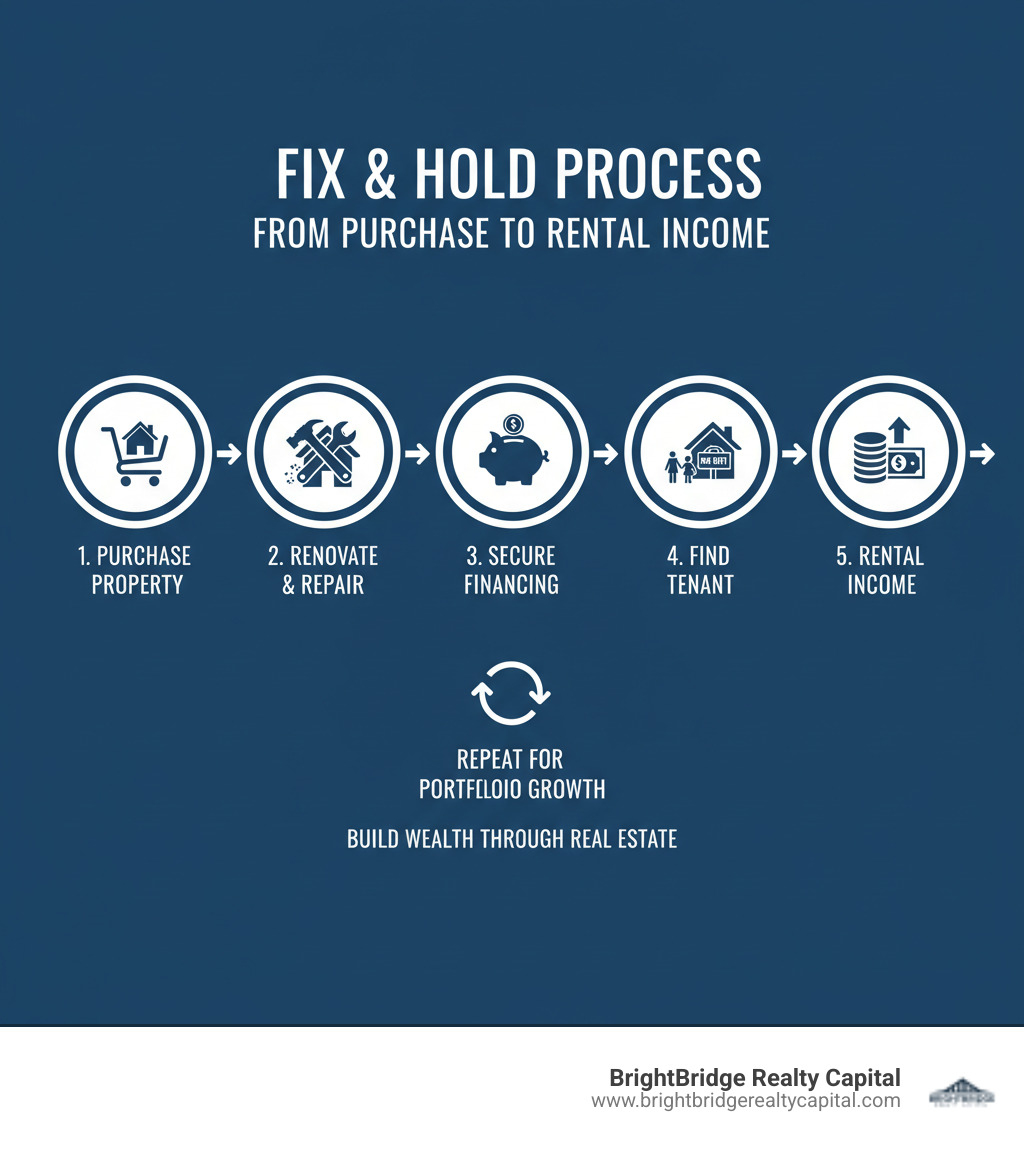
A fix and hold loan is a short-term financing solution, often called a bridge loan, that covers both the purchase price and the renovation costs for a property you intend to keep as a long-term rental. The core of this loan is its two-phase structure. The first phase is the short-term loan (typically 6-24 months) that provides the capital for acquisition and rehabilitation. The second phase is the "exit," where the short-term loan is paid off by refinancing into a long-term, permanent mortgage once the property is renovated, stabilized, and tenant-occupied.
Crucially, these loans are asset-based. This means lenders focus primarily on the property's economic fundamentals—its current value, the cost of repairs, its projected after-repair value (ARV), and its potential rental income. Your personal income and debt-to-income ratio, which are the cornerstones of traditional bank lending, are not the primary qualifying factors. This opens the door for investors who may have complex income streams or who want to keep their personal finances separate from their investment activities.
Fix and Hold vs. Fix and Flip Loans
While both loan types fund the purchase and renovation of properties, their underlying purpose and structure are fundamentally different, aligning with distinct investment strategies.
A fix and flip loan is designed for a transactional profit. The investor's goal is to renovate the property and sell it quickly for a capital gain. The loan term is short, and the exit strategy is the sale of the asset. In contrast, a fix and hold loan is designed for building a portfolio. The goal is to create a long-term, income-producing asset. The exit strategy from the initial short-term loan is not a sale, but a refinance into a permanent rental loan.
| Feature | Fix and Hold Loans | Fix and Flip Loans |
|---|---|---|
| Investment Goal | Long-term rental income, equity growth, and appreciation | Quick resale for a one-time profit |
| Loan Term | Starts short-term (6-24 months) for rehab, then refinances into long-term (15-30 years) | Short-term only (typically 6-24 months) |
| Exit Strategy | Refinance into a long-term rental loan (like a DSCR loan) and hold the property | Sell the property on the open market shortly after renovation |
| Profit Source | Consistent monthly rental income, long-term property appreciation, and equity growth through loan paydown | Capital gains from the difference between total cost and sale price |
| Risk Profile | Focuses on rental market stability, tenant quality, and long-term economic trends | Focuses on short-term market fluctuations, construction timelines, and resale demand |
The initial acquisition loan might appear similar, but the strategic intent dictates the financing path. One builds an annuity-like income stream, while the other generates lump-sum, transaction-based profits.
Fix and Hold Loans vs. Traditional Mortgages
For an investor looking to buy a fixer-upper, a traditional mortgage from a bank is often a non-starter. Here’s a detailed breakdown of how fix and hold loans are fundamentally different and superior for this purpose:
- Speed: We can approve and close a loan in as little as one week. Banks, burdened by regulatory oversight and complex internal committees, can take 45-60 days or longer. In a competitive market, this speed gives you a decisive edge, allowing you to make offers that are as attractive as cash.
- Down Payments: Conventional investment loans typically require 20-25% down on the purchase price alone, with renovation costs paid entirely out of pocket. A fix and hold loan can finance up to 90% of the purchase price and 100% of the rehab, meaning your required cash contribution is dramatically lower, freeing up capital for other opportunities.
- Property Condition: Traditional lenders use appraisal standards (like Fannie Mae guidelines) that often reject properties with significant issues like a bad roof, foundation problems, or outdated electrical systems. Fix and hold loans are specifically designed for these properties; the state of disrepair is seen as an opportunity, not a liability.
- Renovation Funding: A traditional mortgage will not include funds for repairs. An investor would need a separate, often expensive, personal loan or line of credit. A fix and hold loan integrates renovation funding directly into the loan structure, providing a single, streamlined financing package for the entire project.
- Underwriting: This is the most critical difference. Banks use income-based underwriting, scrutinizing your W-2s, tax returns, and personal debt-to-income (DTI) ratio. We use asset-based lending. Our primary questions are: Is this a good property in a good location? Is the renovation budget realistic? Will the property generate enough rent to cover the future mortgage payment? The asset secures the loan, not your personal income statement.
In short, fix and hold loans are engineered from the ground up for real estate investors who need speed, leverage, and flexibility to capitalize on properties that traditional lenders are unwilling or unable to finance.
The Mechanics of Fix and Hold Financing: Terms, Rates, and Leverage

To effectively use fix and hold loans, investors must understand their financial components. This section breaks down the typical terms, the power of leverage, and the associated costs you can expect.
Typical Loan Terms and Interest Rates
A fix and hold loan is a short-term bridge, typically lasting 6 to 24 months, designed to cover the period of acquisition and renovation. During this initial phase, you are usually required to make interest-only payments. This structure is highly advantageous for investors, as it keeps the monthly holding costs low while the property is not yet generating rental income. Your capital is focused on the renovation, not on servicing a large principal and interest payment.
Interest rates for the initial fix and hold loan are higher than conventional mortgages, generally starting around 9.00%. The rate is influenced by factors such as your credit score, your experience level, and the loan-to-cost ratio of the project. However, a key benefit offered by leading private lenders like us is the absence of prepayment penalties. This gives you the flexibility to refinance into a long-term loan as soon as your renovation is complete and the property is leased, without incurring extra fees for paying off the loan early.
Understanding Leverage: LTC, LTV, and ARV Explained
Leverage is the use of borrowed capital to increase the potential return of an investment. In fix and hold lending, it's the magic that allows you to scale. Three acronyms are essential to understanding leverage:
- Loan-to-Cost (LTC): This is the percentage of the total project cost (purchase price + renovation budget) that the lender will finance. For example, we can fund up to 95% LTC. This high leverage dramatically reduces your out-of-pocket cash requirement.
- Loan-to-Value (LTV): This is the loan amount as a percentage of the property's value at a specific point in time. It's used for the initial purchase (based on current value) and, more importantly, for the refinance (based on the new, higher value).
- After-Repair Value (ARV): This is the appraiser's expert opinion of what the property will be worth after all your planned renovations are completed. This is the most critical number in the entire strategy.
Let's see it in action with an example:
- Purchase Price: $200,000
- Renovation Budget: $50,000
- Total Project Cost: $250,000
- A lender offers 90% LTC. The Loan Amount is $250,000 * 0.90 = $225,000.
- Your initial cash investment is $25,000 plus closing costs.
- After completing the rehab, the appraiser determines the ARV is $350,000.
- You then refinance with a long-term loan at 75% LTV based on the ARV. The new loan amount is $350,000 * 0.75 = $262,500.
- This new loan of $262,500 pays off the original $225,000 fix and hold loan, and the remaining $37,500 is returned to you tax-free. You have successfully pulled out your entire initial investment of $25,000, plus an additional $12,500, to use for your next deal.
Common Fees and Closing Costs
Transparency in costs is a hallmark of a reputable lender. While we avoid junk fees, there are standard costs associated with processing a real estate loan:
- Origination Fees: A percentage of the loan amount (typically 1-2 points) to cover the lender's cost of processing and underwriting the loan. We often discount this fee when you commit to refinancing with us.
- Appraisal Fees: Typically $500-$700. This pays a third-party appraiser to determine the property's current value and, crucially, the ARV, which forms the basis of the loan.
- Legal and Recording Fees: Around $695 to cover the cost of preparing legal documents and recording the mortgage with the county.
- Document Preparation Fees: Usually about $1,995. This covers the comprehensive package of loan documents, compliance checks, and coordination required for closing.
- Construction Draws: Rehab funds are not given as a lump sum. They are held in escrow and released in stages (draws) as work is completed. Each draw requires an inspection to verify progress, which may have a small associated fee. This protects you and the lender by ensuring work is done correctly before payment.
We pride ourselves on not charging application fees or prepayment penalties. Our commitment is to provide competitive rates and complete transparency, ensuring there are no hidden costs or surprises at the closing table.
The Fix and Hold Strategy in Action: From Purchase to Portfolio Growth
This section outlines the practical application of fix and hold loans, demonstrating how they serve as the financial engine for proven investment strategies that lead to long-term wealth and passive income.
The BRRRR Method: The Perfect Partner for Fix and Hold Loans
The BRRRR method (Buy, Rehab, Rent, Refinance, Repeat) is a powerful, systematic strategy for building a rental portfolio with minimal initial capital. Fix and hold loans are the ideal financing tool for every step of this process, enabling investors to scale their holdings efficiently.
- Buy: Use a fast, flexible fix and hold loan to acquire an undervalued property. In competitive markets, the ability to close quickly with financing that isn't contingent on a perfect property condition allows you to beat out other buyers who are relying on slower, traditional mortgages.
- Rehab: Use the renovation funds included in the loan to execute your value-add plan. This is where you "force appreciation"—instead of just waiting for the market to rise, you are actively increasing the property's value through strategic improvements. A detailed Scope of Work (SOW) is crucial here to keep your project on time and on budget.
- Rent: Once the renovation is complete, place qualified tenants in the property to begin generating cash flow. This step is critical as the rental income is what will qualify you for the refinance. Thorough tenant screening—including background checks, credit reports, and income verification—is essential to finding reliable, long-term tenants.
- Refinance: This is the key to unlocking your capital. You refinance the short-term fix and hold loan into a long-term mortgage. This new loan is based on the higher After-Repair Value (ARV), not your original purchase price. The goal is a "cash-out" refinance, which provides enough funds to pay off the initial loan and return your original down payment and repair costs.
- Repeat: With your capital recovered, you can now take that same money and use it to buy the next property. This turns a single investment into a self-sustaining engine for portfolio growth, allowing you to acquire multiple properties using the same pool of initial funds.
The Loan Process: A Step-by-Step Guide
We've streamlined our fix and hold loan process to be as simple and investor-friendly as possible, removing the bureaucratic hurdles common with traditional banks.

- Pre-approval: The process begins with a simple application. We verify your liquid assets (for the down payment and reserves) and credit to provide a strong pre-approval letter, often within 24 hours. No W-2s or tax returns are needed.
- Property Acquisition: Once you have a property under contract, you submit the purchase agreement to us. Our team immediately orders the appraisal and title work. We move with urgency, often closing in 7-10 business days.
- Rehab Budget and Plan: You provide your detailed renovation budget and Scope of Work. Our team reviews it to ensure it's realistic and aligns with the projected ARV.
- Construction Draws: The renovation funds are placed in an escrow account. As you complete phases of the project (e.g., demolition, framing, plumbing), you request a draw. An inspector verifies the work, and we release the funds for that portion of the job.
- Tenant Placement: As the rehab nears completion, you market the property and secure a qualified tenant with a signed lease.
- Refinancing: Once the property is leased, we seamlessly transition you from the short-term bridge loan to a long-term rental loan (often a DSCR loan). This process is simplified because we already have your information and are familiar with the property. The goal is to pull your cash out so you can move on to the next deal.
Building Long-Term Wealth and Cash Flow
The fix and hold strategy, powered by the right loan, is a masterclass in building lasting wealth. The benefits compound over time:
- Rental Income: Creates a consistent, passive monthly cash flow that covers the mortgage, taxes, insurance, and other expenses, while generating a profit.
- Property Appreciation: You benefit from both market appreciation (the natural rise in property values over time) and forced appreciation (the value you add through renovations).
- Inflation Hedge: As the cost of living and inflation rise, so do rents and property values. Your asset and the income it produces act as a natural hedge, protecting your investment's purchasing power.
- Tax Benefits: Real estate investors enjoy significant tax advantages, including deductions for mortgage interest, property taxes, operating expenses, and depreciation. (Always consult a qualified tax professional).
- Portfolio Diversification: Real estate is a tangible asset class that can reduce the overall risk of an investment portfolio heavily weighted in stocks and bonds.
A fix and hold loan is the leverage that makes this wealth-generating machine possible. For more insights on growing your rental portfolio, explore Fix and Hold financing.
Qualifying for Fix and Hold Loans and Navigating the Challenges
This section details the refreshingly straightforward eligibility criteria for investors and properties when working with a private lender. It also covers the potential risks inherent in the fix and hold strategy and, more importantly, how to proactively mitigate them.
Eligibility Requirements for Investors
Qualifying for a fix and hold loan with a private lender like us is a fundamentally different experience than applying at a traditional bank. We are focused on the viability of the investment project, not just a narrow view of your personal financial history.
- Credit Scores: While a higher score can result in better terms, we can often work with scores as low as 575. We understand that a credit score is just one piece of the puzzle. A strong deal with a clear path to profitability is more important than a perfect credit history.
- No Income Verification: This is a game-changer for many investors. We do not require tax returns, W-2s, or pay stubs. Our asset-based underwriting approach respects your privacy and acknowledges that many successful investors have income that is difficult to document in a traditional way. This also dramatically speeds up the approval process.
- Experience: Experience is helpful but not mandatory. We welcome first-time investors and view it as our role to provide guidance and act as a partner to help ensure your project succeeds. For new investors, we place a greater emphasis on the conservatism of the budget, the strength of the property's ARV, and the quality of the team you've assembled (e.g., your contractor).
- Liquidity: You will need to show that you have sufficient funds for the down payment, closing costs, and a reserve to cover several months of interest payments and unexpected expenses.
Eligible Property Types
Fix and hold loans are designed for non-owner-occupied investment properties. The key is that the property is being acquired for business purposes—to generate rental income. Eligible property types typically include:
- Single-family homes (SFR)
- 2-4 unit properties (duplexes, triplexes, fourplexes)
- Condominiums and townhouses
- Planned Unit Developments (PUDs)
Essentially, if the property has strong rental demand in its market and a clear path to increased value through renovation, it is likely a good candidate for this type of financing.
Potential Risks and How to Mitigate Them
Every investment carries risk. Successful investors are not those who avoid risk entirely, but those who understand, anticipate, and manage it effectively.
- Renovation Budget Overruns: This is one of the most common pitfalls. Mitigation: Create a highly detailed Scope of Work (SOW) before you even make an offer. Get multiple, fixed-price bids from vetted contractors. Always include a contingency fund of 10-20% of the total rehab budget to cover unforeseen issues like hidden water damage or electrical problems.
- Market Volatility: A downturn in the real estate market could lower your ARV or reduce rental demand. Mitigation: Invest in markets with strong, diverse economic fundamentals (e.g., job growth, population growth). Avoid speculating in overheated markets. Diversifying your portfolio across different neighborhoods or even cities can also spread this risk.
- Tenant Vacancies: An empty property generates no income but still accrues costs. Mitigation: Implement a rigorous tenant screening process. Maintain your properties well to encourage tenant retention. Most importantly, maintain a cash reserve (liquidity) sufficient to cover at least 3-6 months of total expenses (mortgage, taxes, insurance, utilities) for each property.
- Refinancing Challenges: You could get stuck in your short-term, higher-interest loan if you can't qualify for the long-term refinance. This can happen if interest rates rise significantly, or if your property's rental income is not high enough to meet the new lender's Debt Service Coverage Ratio (DSCR) requirement. Mitigation: Be conservative with your rental income projections. Understand the target lender's DSCR requirements (e.g., rent must be 1.25x the mortgage payment) from the beginning and ensure your numbers work. Working with a lender who offers both the bridge and the permanent loan can smooth this transition.
- Carrying Costs: Underestimating the monthly costs during the rehab phase can drain your reserves. Mitigation: Create a detailed budget that includes not just the loan payments, but also property taxes, insurance (like a builder's risk policy), utilities, HOA fees, and basic maintenance. Monitor your spending against this budget closely.
Frequently Asked Questions about Fix and Hold Loans
This section addresses some of the most common questions investors have about the fix and hold financing process, providing clear and direct answers to help you navigate your investment journey.
What are the benefits of using a single lender for the rehab and refinance stages?
Using a single lender who offers a complete "rehab-to-permanent" financing solution provides enormous benefits in efficiency and cost savings. The primary advantage is a streamlined, seamless process. You go through one application and one underwriting process at the beginning. When it's time to refinance, the lender already has your file, understands the property, and is invested in your success. This eliminates the need to start from scratch with a new lender, which saves weeks of time, reduces paperwork, and ensures a much faster transition to your permanent loan. Furthermore, lenders like us who specialize in this process often offer significant pricing concessions for clients who use our integrated solution. This can include discounted origination fees, lower interest rates on the permanent loan, or waived fees. It also builds a strong relationship; as we see you successfully complete projects, it becomes even easier to get your next deal funded.
What are "seasoning requirements" when refinancing?
Seasoning refers to a waiting period that some lenders, particularly conventional banks and agency-backed lenders, impose on a property before they will refinance it based on its new, higher After-Repair Value (ARV). For example, a lender might require you to have owned the property for six or even twelve months before they will use a new appraisal for a cash-out refinance. The lender's rationale is to ensure the increased value is stable and not the result of a temporarily inflated or fraudulent appraisal. This requirement can significantly slow down the BRRRR strategy, as it ties up your capital for an extended period. It is a crucial question to ask any potential long-term lender upfront. A major advantage of working with certain private and direct lenders is that many offer "no-seasoning" refinance options, allowing you to refinance and pull your cash out as soon as the renovation is complete and a lease is signed, dramatically accelerating your ability to scale.
Can I get a fix and hold loan with no real estate experience?
Yes, absolutely. While experience is always a plus, many private lenders, including BrightBridge Realty Capital, are eager to work with first-time investors. Our asset-based lending model prioritizes the quality of the deal over the borrower's resume. We underwrite the property first. We analyze its location, the feasibility of your rehab plan, its potential ARV, and the strength of the local rental market. If the numbers make sense and the deal is solid, we are confident in the investment. For a first-time investor, we may place more emphasis on having a strong team (like an experienced contractor), a conservative budget with a healthy contingency, and sufficient cash reserves. We see it as our role to provide guidance and support to help new investors navigate their first project successfully and become long-term partners. Don't let inexperience be a barrier to starting your real estate investment journey.
Conclusion: Taking the Next Step in Your Investment Journey
You now have a comprehensive understanding of how fix and hold loans function as a powerful and strategic tool for building lasting wealth through rental real estate. They are the essential key that unlocks the ability to execute the BRRRR method effectively, turning a single investment into a scalable, self-sustaining engine for portfolio growth and passive income generation.
We've covered the distinct advantages that set this financing apart: flexible eligibility that doesn't require tax returns, the incredible speed that allows you to secure the best deals, lower down payments that preserve your capital, and integrated funding for both the property purchase and its complete renovation. This strategy positions you perfectly to reap the rewards of real estate investing: forced property appreciation, consistent rental income, and significant tax advantages.
At BrightBridge Realty Capital, we don't just provide loans; we build partnerships with investors like you. As direct lenders, we have the autonomy to provide the speed and flexibility your business needs, often closing deals in a week or less. Our focus is always on your property's potential and the strength of your plan, not on your personal paperwork. We are committed to your success because your success becomes our success.
Are you ready to stop dreaming about a rental portfolio and start building it? We want to hear about your next project. Whether you are a first-time investor looking for guidance or a seasoned pro ready to scale, we have the capital and the expertise to help you achieve your goals.
Explore more info about stabilized bridge loan services to see how we can support your growing portfolio, or reach out to us directly to discuss how our fix and hold loans can be tailored to your specific investment strategy. Your next great investment property is out there—let's make it happen together.