Hard Money Loan Rates: A Guide for Real Estate Investors

Summary
Discover 2025-2026 hard money loan rates (9.5%-15%), factors influencing them, and tips to lower costs for real estate investors.
What Are Hard Money Loan Rates? (Quick Answer for 2025-2026)

Hard money loan rates typically range from 10% to 15% in 2025-2026, with most experienced investors on clean residential deals landing between 11% and 13%. These rates represent the cost of speed and flexibility in a market where traditional banks often move too slowly to capture high-value opportunities.
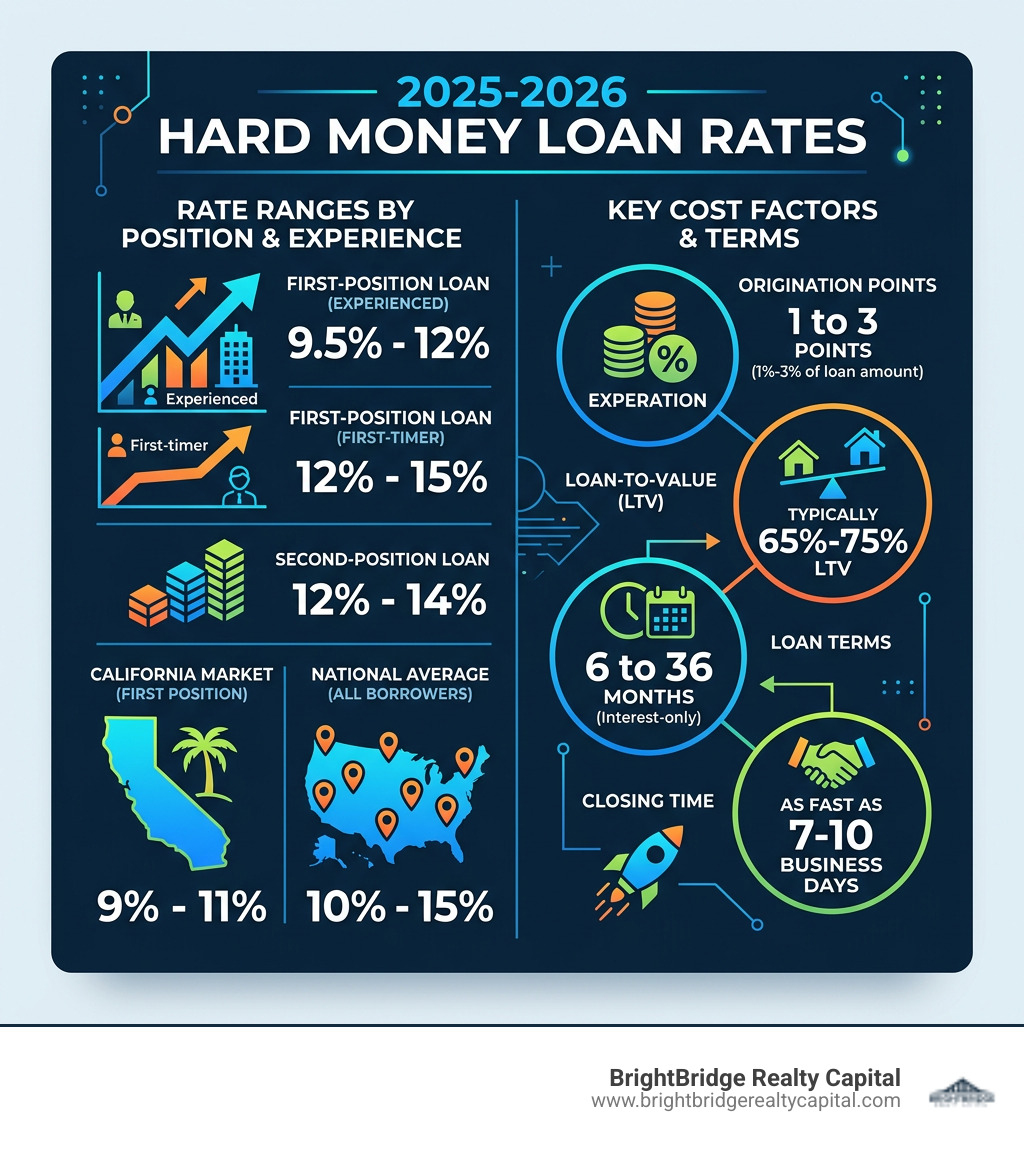
Here's a quick snapshot of current rates by loan type and borrower profile:
| Loan Type / Borrower | Typical Rate Range |
|---|---|
| First-position loan (experienced) | 9.5% - 12% |
| First-position loan (first-timer) | 12% - 15% |
| Second-position loan | 12% - 14% |
| California market (first position) | 9% - 11% |
| National average (all borrowers) | 10% - 15% |
Other costs to factor in:
- Origination points: 1 to 3 points (1%-3% of loan amount)
- Loan-to-value (LTV): typically 65%-75% of the purchase price or ARV
- Loan terms: 6 to 36 months, usually interest-only with a balloon payment
- Closing time: as fast as 7-10 business days, sometimes quicker for repeat clients
These rates are higher than conventional mortgages (currently around 6%-7%), but hard money loans serve a completely different purpose — they're designed for speed, flexibility, and asset-based access to capital, not long-term homeownership. In the world of real estate investing, hard money is often referred to as "bridge" capital because it bridges the gap between the acquisition of a distressed property and its eventual sale or long-term refinance.
For real estate investors, the difference between a good deal and a missed one often comes down to how fast you can close. That's exactly where hard money lending enters the picture — and where the rate conversation gets real. If you are competing against cash buyers, a hard money loan is your most powerful tool because it allows you to make an offer that is nearly as strong as cash, without tying up all your own liquidity.
Whether you're funding your first fix-and-flip or scaling a rental portfolio, understanding what drives hard money pricing can save you thousands per deal. Rates aren't random. They're tied to your experience, the property you're buying, how much equity you bring, and which lender you work with. A first-time borrower might see 13.5% with 3.5 points. An investor with 12 completed deals? Closer to 9%-11%, interest-only, with deferred payments. This tiered pricing structure rewards those who have proven they can execute a business plan and return capital to the lender.
I'm Daniel Lopez, a loan officer at BrightBridge Realty Capital with hands-on experience structuring hard money loan rates across residential and commercial deals in competitive markets. I work daily with investors at every experience level — from first-time flippers navigating rate shock to seasoned operators negotiating institutional pricing. My goal is to help you understand the "why" behind the numbers so you can build a more profitable real estate business.
Hard money loan rates word guide:
Current Hard Money Loan Rates in 2025-2026
As we move through 2025 and look toward 2026, the lending landscape has stabilized compared to the volatility of previous years. While traditional mortgage rates saw significant spikes due to inflationary pressures and Federal Reserve policy shifts, hard money loan rates have remained relatively consistent. This is because hard money is less tethered to the 10-year Treasury and more focused on the risk of the specific asset and the cost of private capital.

Currently, most investors should expect a 2026 forecast where rates hover between 9.5% and 15%. The median rate for an investor with a solid track record is typically around 11% to 13%. These loans are almost exclusively interest-only, meaning your monthly payments cover the cost of the capital while the principal is repaid in a lump sum (balloon payment) at the end of the term. This structure is vital for flippers because it keeps monthly carrying costs low, maximizing the cash available for renovations.
A major question on everyone's mind is: Will Hard Money Loan Rates Actually Drop In 2026? While the Federal Reserve has projected potential minor cuts to the federal funds rate, most experts suggest that rates will remain in the 6% range for traditional products, keeping hard money in its current double-digit bracket for the near term. According to current market trends from Freddie Mac, the 30-year fixed-rate mortgage recently dipped to 5.98%, which provides a window of improved affordability for those looking to exit their hard money loans via refinancing into long-term debt.
Regional Variations in Hard Money Loan Rates
Geography plays a massive role in what you pay. In high-competition markets like California, hard money loan rates are often lower, ranging from 9% to 14%. This is due to the sheer volume of lenders and the high liquidity of the real estate market—if a borrower defaults in Los Angeles or the Bay Area, the lender knows they can sell that asset quickly. The "California discount" is a real phenomenon where the abundance of private capital drives down the cost for borrowers.
Conversely, in the Sunbelt—specifically markets across Texas and Florida—we see strong demand driven by population growth. While inventory is higher in some parts of the Southeast, having financing pre-arranged is still a competitive necessity. In these regions, rates might be slightly higher than in California but lower than in rural or less liquid markets. For a deeper dive into how location affects your bottom line, check out our Interest Rate Impact On Investment Financing 2026 Guide.
Lien Position and Risk Premium
Your "position" in the capital stack determines your risk premium. This is one of the most overlooked aspects of hard money pricing.
- First-Position Lien: The lender is the first to get paid if the property is sold or foreclosed. Rates here are the lowest, typically 9.5% to 12%. This is the standard for most fix-and-flip and bridge loans.
- Second-Position Lien: This is much riskier for the lender. If the property goes into default, the first lender must be paid in full before the second lender sees a dime. Because of this default risk, expect rates to jump to 12% to 14% or higher. Many hard money lenders refuse to take a second position entirely, making this capital more expensive and harder to find.
Factors That Influence Your Hard Money Interest Rate
Lenders aren't just looking at the property; they are looking at the total risk profile of the deal. Unlike a traditional bank that focuses heavily on your debt-to-income ratio and tax returns, a hard money lender is primarily concerned with the "collateral" and the "exit strategy."
The most significant factor is the Loan-to-Value (LTV) ratio. If you are asking for 75% of the property's value, you are a higher risk than someone asking for 50%. More "skin in the game" (a larger down payment) almost always leads to lower hard money loan rates. Lenders also look at the After-Repair Value (ARV) for fix-and-flip projects. If your renovation budget is realistic and the spread between purchase and sale price is wide, your rate may be more competitive. You can find more details on how these numbers are crunched in our guide on Real Estate Loan Rates.
Housing market insights from Redfin show that the "lock-in effect" is finally weakening, meaning more inventory is hitting the market. For investors, this means more opportunities, but also more scrutiny from lenders on property condition and location. Lenders want to ensure that if they have to take the property back, it is in a location where buyers are still active.
Impact of Credit Scores on Hard Money Loan Rates
While hard money is "asset-based," your credit score still matters. Most reputable lenders look for a minimum FICO of 650. Why? Because your credit score is an indicator of your exit strategy. If you plan to flip the house, your credit matters less because the lender expects to be paid back from the sale proceeds. However, if you plan to "Buy, Rehab, Rent, Refinance" (BRRRR), the lender needs to know you can qualify for a traditional bank loan or a DSCR loan to pay them back.
If your score is below 600, you might still get the loan, but expect to pay a premium of 1% to 2% on the interest rate. This is often called a "subprime" hard money rate. Review our full list of Hard Money Loan Requirements to see where you stand and how you can improve your profile before applying.
Property Type and Location Risk
Single-family homes in urban or suburban "bread and butter" neighborhoods get the best rates. They are easy to value and easy to sell. Rural properties, unique "niche" assets, or heavy industrial buildings carry higher rates because they are less liquid. If it takes six months to find a buyer for a property in a rural area, the lender will charge more to compensate for that time-based risk. Additionally, multi-family properties (5+ units) often have different rate structures than residential 1-4 unit properties, usually involving slightly lower rates but higher entry requirements.
Comparing Hard Money to Traditional Financing
It is a common mistake to compare a hard money loan to a 30-year mortgage from a big bank. They are different tools for different jobs. Comparing them is like comparing a rental car to a long-term lease; one is for short-term utility and speed, while the other is for long-term stability.
| Feature | Hard Money | BrightBridge Rental Loans | Traditional Bank |
|---|---|---|---|
| Approval Time | 3-7 Days | 10-21 Days | 45-60 Days |
| Credit Req. | Low (650+) | Moderate (660+) | High (720+) |
| Income Doc. | None/Minimal | DSCR Based | Tax Returns/W2 |
| Rates | 10% - 15% | 7% - 9% | 6% - 7% |
| Term | 6-24 Months | 30 Years | 15-30 Years |
As you can see, hard money is the "sprint" of financing. It is designed to get you into a deal quickly so you can add value through renovation. For a more exhaustive look at the mechanics, read What Is A Hard Money Loan: A Practical Guide.
Speed vs. Cost Trade-offs
The "cost" of hard money is the price you pay for speed. In a competitive market like New York NY, being able to close in 7 days without "bank red tape" is often the only way to win a deal. If a traditional bank takes 60 days to close, the seller will likely take a lower cash offer or a hard money offer just to ensure the deal doesn't fall through. This "opportunity cost" is why seasoned investors don't mind the higher rates—they'd rather have a deal at 12% than no deal at 7%. Learn more about our Hard Money Real Estate Loans and how they facilitate these quick wins.
Why Investors Choose Higher Rates
It comes down to scalability and liquidity. By using hard money, you keep your own cash liquid to fund renovations or put down payments on multiple properties simultaneously. If you have $200,000 in the bank, you could buy one house for cash, or you could use hard money to buy four houses with 20% down on each. The Scotsman Guide on flipper sentiment confirms that investors remain bullish because the demand for move-in-ready homes is still outpacing supply, making the higher interest rates a manageable cost of doing business.
Furthermore, hard money lenders are often more willing to fund the renovation costs as well. This means you aren't just getting a loan for the purchase, but also a "draw" schedule that covers 100% of the construction. This level of leverage is simply not available through traditional banking channels, making hard money the lifeblood of the fix-and-flip industry.
How Experience and Relationships Lower Your Rates
If you are on your first flip, prepare to pay the "newbie premium." Lenders view first-time investors as high risk because they haven't proven they can manage a contractor, stay on budget, or navigate the complexities of a local building department. A single mistake on a first project can wipe out the equity cushion, leaving the lender exposed.
However, after you've closed just one or two deals, your profile changes significantly. Many lenders follow a "3-deal rule"—once you have three successful exits in the last 3-5 years, you move off the lender's high-risk balance sheet and into their "preferred" category. This is where you can start leveraging our Hard Money Lender Direct Ultimate Guide to find the best long-term partners. Preferred borrowers often get access to higher LTVs, lower interest rates, and reduced origination fees.
Leveraging Institutional Capital for Better Terms
Large direct lenders often have relationships with hedge funds or insurance companies. These institutional partners provide cheaper capital, which the lender can then pass on to you in the form of lower points or volume discounts. As you build a portfolio, you become a "volume" client, and lenders will fight for your business. This is the stage where you stop being a "borrower" and start being a "partner." Institutional-backed lenders can offer more stability in their rates, even when the broader market is fluctuating.
Negotiating Better Terms with Experience
Don't be afraid to negotiate once you have a track record. A lender would much rather lend to a proven winner at 10% than a risky beginner at 13%. When you approach a lender for your next deal, show them:
- Portfolio Photos: High-quality before and after shots of your previous projects to demonstrate your quality of work.
- HUD-1 Statements: Proof of successful buys and sells, showing that you can exit a deal profitably and on time.
- Skin in the Game: Offering to put 30% down instead of 20% to lower the rate. This reduces the lender's risk and shows you are confident in the deal.
- Detailed SOW: A professional Scope of Work (SOW) shows the lender you have a plan and aren't just winging it.
Experienced flippers can often negotiate interest-only deferment or lower origination points. See how we offer Competitive Loan Rates for our repeat clients who have demonstrated consistent success in their local markets.
Hidden Costs: Points, Fees, and Closing Timelines
The interest rate is only half the story. To calculate the "True Cost of Capital," you must look at the fees. Many investors get fixated on a 10% interest rate only to realize that the 4 points and $3,000 in junk fees make the loan more expensive than a 12% rate with 1 point.
- Origination Points: Usually 1 to 3 points. Each point is 1% of the loan amount. This is paid at closing and is the lender's primary way of making money on the front end.
- Processing/Underwriting Fees: Flat fees ranging from $995 to $2,500. These cover the cost of the lender's internal team reviewing your documents and the property's title.
- Draw Inspections: If the lender is funding your renovation, they will send an inspector to check progress before releasing funds. These cost $150-$300 per visit. If you have 10 draws, that's an extra $3,000 in costs.
- Extension Terms: What happens if the flip takes 10 months instead of 6? Some lenders charge an extra point to extend the loan for another 3-6 months. Always check the extension clause before signing.
For a full breakdown of these costs, see our Bridge Loan Rates Complete Guide.
Understanding Origination Points and Fees
Some lenders require "prepaid interest," where they take the first few months of payments out of the loan proceeds at closing. This is common for first-time borrowers to mitigate the lender's risk. Additionally, be aware of "buy-back" provisions in some contracts where a lender might have to repurchase a loan if the borrower misses an early payment—this is why they are so strict on initial qualifications. Read more about the Hard Money Loan structure to avoid surprises at the closing table.
The True Cost of Holding
The "monthly carry" is what kills profits. On a $200,000 loan at 12%, you are paying $2,000 a month just in interest. If your contractor disappears for two months, that's $4,000 of pure profit gone. This doesn't even include property taxes, insurance, and utilities. This is why refinance timing is critical. You want to finish the work and sell (or refinance) as fast as humanly possible. Every day you hold the property is a day you are paying the lender. Successful investors treat their hard money loans like a ticking clock, pushing their teams to finish projects ahead of schedule to save on interest costs.
Frequently Asked Questions about Hard Money Loan Rates
What is the average interest rate for a hard money loan in 2026?
In 2026, expect rates to sit in the 10% to 14% range. While this is higher than traditional debt, it reflects the risk-based pricing inherent in short-term, asset-based lending. Market conditions like high demand for housing and limited inventory keep these rates stable because the underlying collateral remains valuable. If the housing market remains strong, lenders are more confident in offering competitive rates.
Do hard money loan rates decrease after my first deal?
Absolutely. Most lenders offer relationship pricing. Once you hit the 3-5 deal threshold, you are no longer a "risk" but a "partner." You can expect points to drop and interest rates to move toward the lower end of the 9.5%-11% spectrum. Some lenders will even offer "revolving lines of credit" to experienced investors, allowing them to pull funds for new deals without a full re-underwriting process.
How does LTV affect my hard money loan rates?
LTV is the primary driver of risk reduction. A 65% LTV loan means the lender has a 35% equity cushion. If you default, they can easily sell the house and get their money back. Because of this security, they will offer you a much better rate than someone asking for 80% or 90% LTV. High-leverage loans (90%+) are available, but they come with the highest interest rates and most stringent experience requirements.
Can I get a hard money loan with a 500 credit score?
Yes, it is possible, but it will be expensive. Lenders will likely require a much larger down payment (35-40%) to offset the risk of your low credit score. They will also look very closely at your exit strategy. If you can't prove how you will pay the loan back, even a great property might not be enough to secure the funding.
Are hard money rates negotiable?
Yes, especially the points. If a lender is charging 3 points, and you have a great deal with a lot of equity, you can often negotiate them down to 1.5 or 2 points. The interest rate itself is often more fixed based on the lender's cost of capital, but there is always some room for discussion if you are a repeat client with a strong track record.
Conclusion
Navigating hard money loan rates doesn't have to be a headache. By understanding that these rates are a strategic tool for growth rather than a long-term burden, you can use them to scale your real estate business faster than you ever thought possible. The cost of the capital is simply one line item in your pro-forma, and as long as the deal's profit margin supports it, the speed of hard money is almost always worth the price.
As we look toward the remainder of 2025 and into 2026, the investors who succeed will be those who build strong relationships with their lenders. By proving your reliability and expertise, you can drive down your cost of capital and increase your competitive advantage in the market.
At BrightBridge Realty Capital, we specialize in being a direct lender that cuts out the middleman. We provide the fast funding you need—often within a week—with the transparency you deserve. Whether you are in New York NY or operating nationwide, we are here to be your strategic partner in every deal you tackle.
Ready to take the next step and see what rates you qualify for? Secure your next deal with competitive rental loans and let us help you build your legacy through smart, fast, and reliable real estate financing.