New York's Hard Money Heroes: Quick Funding for Real Estate Investors

Summary
Get quick funding for your NY real estate investments. Explore hard money New York loans, ideal uses, and find the best lenders now.
Your Guide to Hard Money Loans in the Empire State
Hard money New York loans offer a lifeline for real estate investors navigating one of the world's most dynamic and demanding markets. This specialized financing is fast, asset-based, and can close in just 5-10 business days, a stark contrast to the sluggish 30-60 day timeline of traditional banks. These short-term loans are designed to prioritize the intrinsic value of the property over a borrower's credit score, making them the ideal tool for seizing time-sensitive opportunities across the five boroughs and beyond.
Quick Facts for the New York Investor:
- Average Interest Rate: 11.54% (Q4 2024)
- Average Loan Amount: $1,252,878
- Average LTV: 52%
- Typical Points: 3.3%
- Loan Terms: 12-24 months
- Funding Speed: 5-10 business days
New York's real estate market is a complex ecosystem that moves at an unforgiving pace. With property prices jumping 6.0% in December 2024 alone, hesitation is the enemy of profit. Whether you've uncovered a distressed multi-family property in Brooklyn, a prime fix-and-flip opportunity in Westchester, or a commercial building in Queens needing a quick bridge loan, you simply cannot afford to wait for a conventional lender's lengthy approval process. While traditional banks get bogged down in endless paperwork, income verification, and credit analysis, hard money lenders cut through the noise, focusing on two critical elements: the property's value and your strategic exit plan. This fundamental difference in approach is what gives investors a decisive competitive advantage.
Hard money loans are specifically engineered for investors who need capital now. They are the perfect solution for winning at property auctions, funding extensive rehab projects, or securing a deal when conventional financing is not a viable option. The trade-off for this incredible speed and flexibility is, of course, higher interest rates and shorter repayment terms. However, for savvy investors who understand the time value of money in a market like New York, the cost is often a small price to pay for the opportunity it unlocks.
I'm Daniel Lopez, a senior loan officer at BrightBridge Realty Capital. Over the years, I've had the privilege of helping hundreds of New York investors structure and secure hard money New York deals that have transformed their portfolios. I've seen firsthand how the right financing can turn a seemingly impossible deal into a highly profitable venture. This comprehensive guide is a distillation of that experience, covering everything you need to know to confidently navigate the world of hard money lending, from understanding loan terms to finding a lender you can trust as a true partner.
What is a Hard Money Loan? A New York Investor's Primer
A hard money New York loan is a short-term financing solution for real estate investors, secured by the property itself—the "hard asset"—rather than the borrower's personal financial history. The term "hard money" originates from this focus on a tangible, physical asset as the primary collateral. Unlike traditional banks, which demand extensive income verification, years of tax returns, and a near-perfect credit profile, hard money lenders are principally concerned with the property's equity and its potential. If the deal is strong and your exit strategy is sound, we can often provide funding, even if you've been turned down by a bank for not having enough W-2s or because you're a self-employed investor with complex income streams.
These loans are provided by private individuals or specialized firms like BrightBridge Realty Capital, not large, bureaucratic banking institutions. This private funding source is the key to our agility. It allows for faster decisions, significantly less red tape, and a common-sense approach to underwriting. We focus on the property's existing equity and your investment plan, enabling you to secure approval based on the strength and viability of the deal itself, not just your personal balance sheet.
How Hard Money Differs from Traditional Bank Loans
The differences are not just significant; they are fundamental to understanding when and why to use this type of financing:
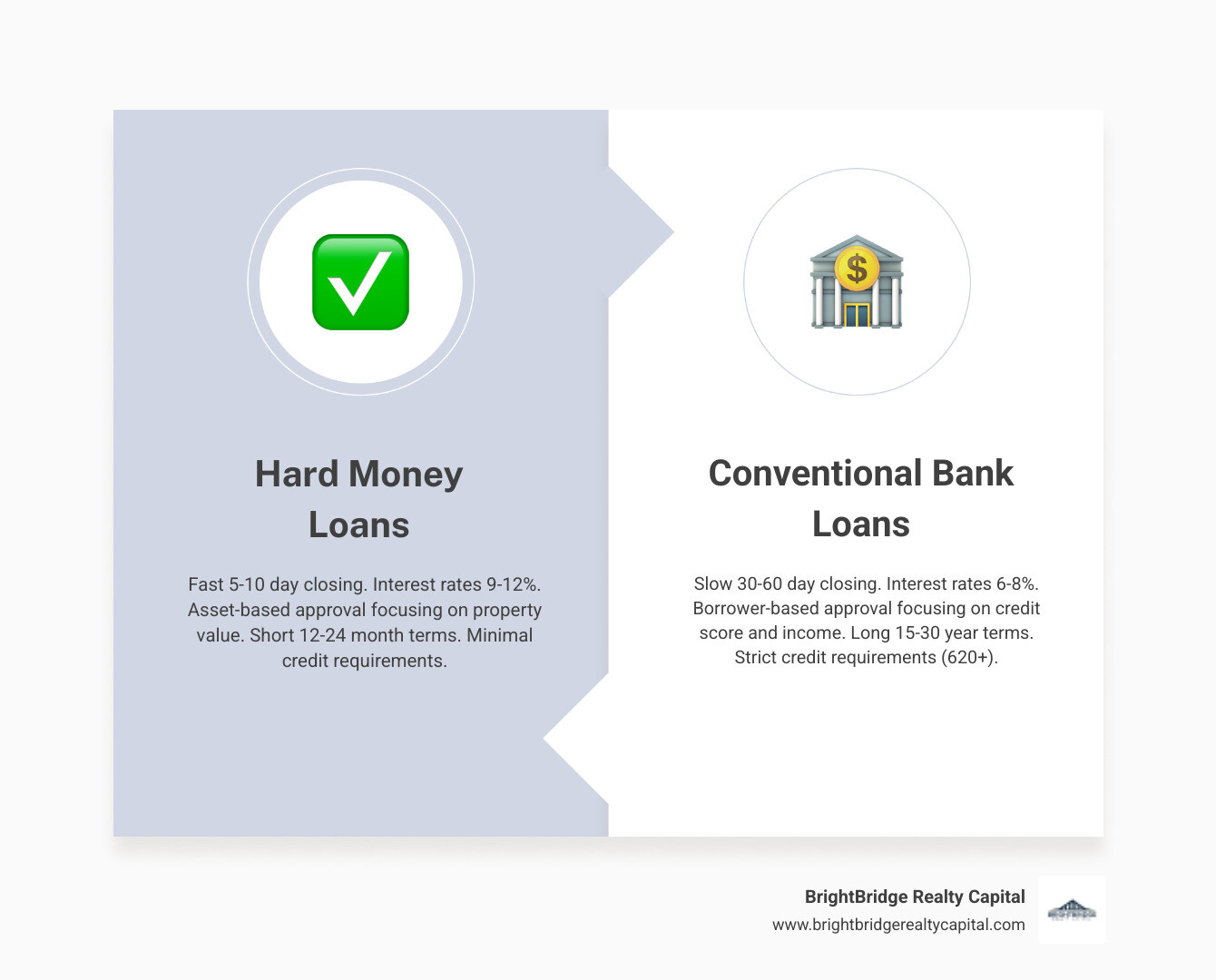
Speed: This is the most celebrated advantage. Hard money loans can close in as few as 5-10 business days, whereas conventional bank loans notoriously take 30-60 days, and often longer. In a market where the best deals are gone in a flash, this speed is not a luxury; it's a necessity.
Underwriting: Our underwriting process is asset-centric. We prioritize the property's current value and, crucially, its after-repair value (ARV). We analyze your scope of work, your budget, and your exit strategy. Banks, in contrast, conduct borrower-centric underwriting. They will meticulously scrutinize your personal financial history, demanding W-2s, tax returns, pay stubs, and a detailed analysis of your debt-to-income (DTI) ratio. While your credit score still matters in hard money (typically a minimum of 600 is preferred), it's a supporting factor, not the make-or-break criterion it is at a bank.
Borrower Qualifications: Hard money is explicitly designed for real estate investors executing short-term projects. This includes flippers, builders, and developers. Traditional loans are geared towards long-term homeowners or landlords with already stabilized, cash-flowing properties. For a hard money lender, a strong deal presented by an investor with a clear plan can be more compelling than a borrower with a long history of W-2 income but a weak project.
Purpose: The use cases are distinct. Hard money is for transitional projects: fix-and-flips, ground-up construction, major renovations, and bridge financing to span a gap. Bank loans are intended for long-term holds, such as purchasing a primary residence or a turnkey rental property.
Flexibility: As private lenders, we have the autonomy to structure creative financing solutions for unique properties or complex situations that would be automatically rejected by a bank's rigid lending guidelines. This could include properties with zoning issues, unpermitted work, or other complications that require a flexible and experienced lending partner.
Why Speed Matters in New York's Competitive Market
New York real estate is notoriously competitive and fast-paced. Time-sensitive deals are the norm, not the exception. Consider a scenario where a seller, facing a personal deadline, lists a property significantly below market value but requires a closing in two weeks. A conventional bank loan is simply not an option. A hard money loan, however, makes this deal possible, allowing you to capture an opportunity your competitors cannot.
Property auctions are another arena where speed is paramount. Auctions demand immediate financing, effectively putting hard money borrowers on the same level as all-cash buyers. Similarly, distressed properties, such as foreclosures or estate sales, often involve motivated sellers who cannot or will not wait for a 60-day closing process. Being able to promise a 10-day close gives your offer immense power.
With New York real estate prices increasing 6.0% in December 2024, every day of delay is a potential cost. Closing a deal in one week instead of two months can be the difference between winning a lucrative project and losing it to a more agile buyer. An offer backed by a reputable hard money New York lender signals to sellers that you are a serious, capable buyer, giving you a powerful competitive edge in any negotiation.
The Anatomy of a Hard money Loan in New York

Understanding the complete financial picture of a hard money New York loan is crucial for accurately budgeting your next deal and ensuring its profitability. While the terms are different from conventional loans, they are straightforward once you know what to look for. Here are the typical components you can expect.
Typical Loan Terms for hard money New York
Interest rates are higher than conventional loans, reflecting the increased risk, short-term nature, and rapid deployment of capital. The average rate for New York hard money loans was 11.54% in Q4 2024, with a typical range of 8% to 15% depending on the deal's strength and the borrower's experience. Payments are almost always structured as interest-only, which keeps monthly carrying costs lower during the project phase. You're paying a premium for speed, flexibility, and the opportunity to leverage the lender's capital.
Origination fees, commonly known as "points," are upfront charges for processing, underwriting, and funding the loan. One point is equal to 1% of the total loan amount. In New York, lenders charged an average of 3.3 points in Q4 2024, with a typical range from 1 to 5 points. For a $1,000,000 loan, 3.3 points would equal a $33,000 fee, which is typically deducted from the loan proceeds at closing. This is a key cost to factor into your acquisition budget.
Loan-to-Value (LTV) and Loan-to-Cost (LTC): These ratios determine how much you can borrow. LTV is based on the property's value, while LTC is based on the total project cost (purchase price plus renovation budget). Lenders are conservative, usually offering 65-75% of the property's after-repair value (ARV). The average LTV for hard money New York deals was 52% in Q4 2024. This conservative leverage means you'll need to bring a significant down payment (typically 20-30% of the purchase price) plus cash for the initial stages of rehab. A good loan-to-value ratio should not be greater than 80% to ensure a healthy equity cushion.
Loan terms are short, designed to be a bridge, not a destination. They usually range from 6 to 24 months, with most deals structured for a 12-month term. This timeframe is intended to give you enough time to purchase the property, complete renovations, and execute your exit strategy, whether that's selling the property or refinancing into a long-term loan. Some lenders offer extension options, but these often come with additional fees.
Cash reserves are a mandatory requirement. Lenders need to see that you have sufficient liquid funds set aside to cover several months of interest payments, your renovation budget, and a contingency fund for unexpected expenses. This demonstrates that you can service the debt and handle project overruns without jeopardizing the investment.
[TABLE] Comparing Hard Money vs. Traditional Loan Costs in NY
Here's a clear comparison of the costs:
| Feature | Hard Money Loan | Traditional Loan |
|---|---|---|
| Interest Rate Range | 11.54% (avg.) | 6-8% (avg.) |
| Fees (Points) | 3.3% (avg.) | 0-1% (avg.) |
| LTV Ratio | 52% (avg.) | 75-85% |
| Closing Time | 5-10 Days | 30-60 Days |
| Credit Score Focus | Asset value | Credit, Income, DTI |
While the sticker price of hard money is higher, the true value lies in its speed. The ability to close in 5-10 days is an invaluable tool for capturing competitive deals and generating returns that would be impossible while waiting for a bank.
Finding and Vetting the Best Lenders for Hard Money New York
Finding the right hard money lender in New York is less like applying for a loan and more like choosing a strategic business partner. The right partner can be instrumental to your success, providing not just capital but also expertise and reliability. Conversely, the wrong choice can jeopardize a deal, waste precious time, and lead to costly surprises. With diligent research, you can identify a dependable lender who aligns with your investment goals.
First and foremost, it's critical to understand the difference between direct lenders and brokers. At BrightBridge Realty Capital, we are a direct lender. This means we use our own capital to fund your loan and our in-house team makes all underwriting decisions. This direct line of communication and control results in faster closings, more consistent terms, and a transparent process from start to finish. Brokers, on the other hand, act as intermediaries, shopping your loan application to various capital sources. While they can sometimes offer a wide range of options, this process can introduce delays, miscommunication, and extra fees as the broker adds their commission on top of the lender's costs.
When evaluating lenders for your hard money New York project, your vetting process should focus on three core pillars: reputation, communication, and transparency. Do they have a proven track record of closing on time, every time? Are they responsive and easy to reach? Are they completely upfront about all costs, with no hidden "junk fees"? A lender who deeply understands the nuances of the New York market—from the complexities of renovating a historic Brooklyn brownstone to the zoning laws affecting a new build in Westchester—will be able to structure your deal more intelligently and anticipate potential roadblocks.
Key Questions to Ask a Potential Lender
Before committing to any lender, arm yourself with these critical questions:
- Are you a direct lender or a broker? This is the most important first question. Working with a direct lender like us ensures speed and accountability.
- What are all of your fees? Ask for a detailed breakdown. Clarify the interest rate, origination fees (points), underwriting fees, processing fees, and any other charges. A reputable lender will provide a clear term sheet. (Remember, NY averages were 11.54% interest and 3.3 points in Q4 2024).
- What is your guaranteed closing timeline? Ensure their timeline aligns with your purchase agreement. We typically close in 5-10 business days, but you need to confirm this for your specific deal.
- Can you walk me through your draw process? For rehab projects, a slow and complicated draw process can halt construction and derail your timeline. You need a lender with a smooth, efficient system for releasing funds as work is completed.
- Do you have prepayment penalties? This is crucial for fix-and-flip investors. A hefty penalty for paying the loan off early can significantly eat into your profits on a quick flip or refinance.
- What are your loan extension policies and costs? Projects can face delays. Understanding the process and fees for extending the loan term upfront is essential for risk management.
Where to Find Reputable Lenders
Your search for the right partner should start with a trusted source. We invite you to begin with BrightBridge Realty Capital—we specialize in fast, flexible, and reliable hard money New York financing.
Beyond us, consider these valuable resources:
- Real Estate Investor Associations (REIAs): Groups like the New York City REIA or the Long Island Real Estate Investors Association are excellent places to get unfiltered referrals and feedback from fellow investors who have firsthand experience with local lenders.
- Referrals from Your Professional Network: Your real estate agent, title company, attorney, or general contractor are on the front lines of deals every day. They know which lenders are reliable, close on time, and are easy to work with—and, just as importantly, which ones to avoid.
A few hours spent thoroughly vetting your lender is one of the highest-return activities you can perform. It can save you thousands of dollars, prevent immense frustration, and secure the financing partner you need to succeed.
Winning Strategies: When to Use Hard Money Loans in NY

Hard money New York loans are not a one-size-fits-all solution; they are precision instruments for specific investment scenarios where speed and flexibility create a decisive competitive advantage. Understanding when to deploy this powerful tool is the key to unlocking opportunities that conventional financing simply cannot accommodate. For the strategic investor, hard money is the catalyst for growth, enabling them to move faster and build their portfolio more aggressively.
Ideal Investment Strategies for Hard Money
- Fix-and-Flip: This is the quintessential use case. Hard money is perfect for funding the purchase and renovation of distressed properties that banks won't touch due to their condition. For example, an investor finds a dated but structurally sound brownstone in Bed-Stuy for $1.2M that needs $300k in renovations. A hard money loan can fund a significant portion of the purchase and sometimes the rehab costs, allowing the investor to complete the project and sell for a projected ARV of $2.1M, all within a 12-month loan term.
- The BRRRR Method: This popular strategy (Buy, Rehab, Rent, Refinance, Repeat) relies heavily on hard money for its initial stages. An investor uses a hard money New York loan for the quick acquisition ("Buy") and renovation ("Rehab") of a multi-family property in the Bronx. Once the units are updated and stabilized with tenants ("Rent"), the investor then refinances with a long-term, lower-rate DSCR (Debt Service Coverage Ratio) loan to pay off the hard money lender ("Refinance"). This pulls their capital back out, allowing them to move on to the next deal ("Repeat
- Bridge Loans: A bridge loan is essential when you need to span a financial gap. Imagine you've found the perfect mixed-use property in Manhattan, but your capital is tied up in another property that is under contract but hasn't closed yet. A hard money bridge loan allows you to acquire the new property immediately, securing the deal before another buyer can. Once your other property sells, you can pay off the bridge loan.
- New Construction: For smaller, in-fill, or ground-up construction projects, hard money provides the speed and flexible draw schedules that large banks often can't offer. Lenders can structure the loan to release funds in stages (draws) as construction milestones are met, from foundation to framing to finishes, ensuring the project stays capitalized and on schedule.
- Cash-Out Refinancing: If you own an investment property with significant equity, a hard money cash-out refinance allows you to quickly access that capital. Instead of waiting months for a bank's home equity line of credit (HELOC), you can get cash in hand in a matter of weeks to fund the down payment on your next deal, cover unexpected business expenses, or seize another opportunity.
Hotspots for hard money New York Investments
Certain areas across the state consistently attract hard money New York activity due to their market dynamics and investment potential:
- Brooklyn: Neighborhoods like Bedford-Stuyvesant, Bushwick, Crown Heights, and Sunset Park remain prime territory for fix-and-flips and multi-family value-add projects. The constant demand for housing and the stock of older properties create a perfect environment for renovation-focused investors.
- Manhattan: While entry costs are high, Manhattan is ideal for high-value residential condo renovations, mixed-use building acquisitions, and commercial bridge loans where speed is absolutely critical to closing complex, multi-million dollar transactions.
- Long Island: Both Nassau and Suffolk counties offer a wealth of suburban opportunities for single-family home renovations, small new construction projects, and fix-and-flips, driven by strong school districts and commuter demand.
- Westchester County: The proximity to NYC, combined with a robust luxury housing market, makes cities like Yonkers, New Rochelle, and White Plains a steady choice for high-end residential flips and new construction projects.
- Upstate Markets: Savvy investors are increasingly looking upstate. Cities like Albany, Buffalo, and Rochester offer significantly lower entry costs, strong rental demand from universities and medical centers, and attractive profit margins. Successful flips in Albany, for example, can range from $137,200 to $257,750, demonstrating the viability of these markets.
The Process, Pitfalls, and Payoffs
The hard money New York loan process is refreshingly straightforward and transparent, especially when compared to the often opaque and prolonged ordeal of traditional bank financing. At BrightBridge Realty Capital, we've refined our process to prioritize speed, clarity, and efficiency, ensuring you can move from application to closing with confidence and certainty.
The Application and Funding Process Explained
Our four-step process is designed to get you funded in record time:
- Step 1: Pre-approval & Initial Consultation. It all begins with a simple conversation about your deal. You tell us about the property, your plans, and your experience. Based on this initial information, we can typically provide a pre-qualification and a preliminary term sheet within 24 hours. This allows you to make offers with confidence.
- Step 2: Documentation Submission. We require only the essential documents needed to underwrite the asset. This typically includes the fully executed Purchase and Sale Agreement, your entity documents (like an LLC Operating Agreement), a detailed renovation budget or scope of work, and a summary of your real estate experience. There are no tax returns or complex personal income statements required.
- Step 3: Appraisal and Underwriting. Our in-house underwriting team works in parallel with a third-party appraisal. The appraiser's job is to determine the property's current "as-is" value and its projected after-repair value (ARV). Our team reviews the title report, the appraisal, and your project plan to finalize the loan terms. The focus remains squarely on the asset, not your personal financial minutiae.
- Step 4: Closing and Funding. Once the appraisal is in and terms are agreed upon, our legal team prepares the closing documents. We work with your attorney and the title company to schedule a closing at your convenience. We can often fund your loan within 5 to 10 business days of your initial application, providing the capital you need with full transparency on all costs.
Advantages vs. Disadvantages
Hard money New York loans are powerful tools, but they are not suitable for every investor or every situation. Understanding the trade-offs is key.
- Advantages: The primary benefits are unmatched speed, the flexibility to structure deals for unique properties, and an approval process based on the property's value rather than your personal credit score. The minimal paperwork and streamlined process are also significant advantages for busy investors.
- Disadvantages: The costs are undeniably higher, including interest rates (8-15%) and origination fees (1-5 points). Furthermore, the short loan terms (typically 12-24 months) create a compressed timeline, which increases risk and leaves less room for error if your project encounters significant delays.
Key Risks and How to Mitigate Them
Avoiding common pitfalls is crucial for a successful and profitable hard money experience. Here's how to protect your investment:
- Flawed Exit Strategy Planning: You must know exactly how you'll repay the loan before you ever sign the closing documents. Whether you plan to sell or refinance, your plan must be realistic, well-researched, and include a backup plan. If refinancing, start talking to long-term lenders months before your hard money loan is due.
- Inaccurate Budgeting: Underestimating rehab costs or overestimating the ARV is the fastest way to lose money. Get multiple, detailed bids from qualified contractors. Always build in a 15-20% contingency fund to cover the inevitable surprises, especially with older New York properties that can hide issues like outdated electrical, plumbing, or asbestos.
- Market Volatility: The New York market is dynamic and can shift. Stay hyper-informed on local trends, comparable sales, and inventory levels. Don't build your entire profit margin on the assumption that prices will continue to rise. Market volatility is a real risk that must be respected.
- Overleveraging: Borrowing the absolute maximum amount possible leaves you with no cushion if things go wrong. A more conservative LTV protects both you and the lender, providing you with more options if you face delays or unexpected costs.
- Foreclosure Risks: No lender wants to foreclose; it's a lose-lose scenario. To avoid this, maintain open communication with your lender, especially if you foresee delays. Have your exit plan in motion well before the loan's maturity date. Don't wait until the last month to list the property for sale or apply for a refinance.
Frequently Asked Questions about Hard Money Loans in New York
As a loan officer on the front lines, I hear many of the same questions from both new and experienced New York investors. Here are clear, straightforward answers to the most common inquiries about hard money New York financing.
How fast can I get a hard money loan in New York?
Exceptionally fast. A pre-qualification can often be issued within 24 hours of your initial inquiry, allowing you to make a confident offer on a property. From a complete application to cash in hand, the entire process can be completed in just 5-10 business days. This speed is a game-changing advantage compared to the 30-60 days (or more) required by traditional banks. To facilitate the fastest possible closing, it's best to come prepared with your property details, a clear renovation budget, and a well-defined exit strategy.
What is the main difference between a hard money loan and a bank loan?
It all comes down to the fundamental focus of the underwriting process. Banks focus on you, the borrower. They conduct a deep dive into your personal finances: your credit score, your income history (often requiring two years of tax returns), and your debt-to-income ratio. They are looking for a borrower who looks perfect on paper and fits neatly into their rigid credit box.
Hard money New York lenders, in contrast, focus on the property, the hard asset. We are primarily concerned with the property's current value, its after-repair value (ARV), and the overall strength of your investment plan. The asset itself is the primary security for the loan. This asset-based approach is why hard money is the ideal financing solution for self-employed investors, foreign nationals, or those with complex deals that don't fit the traditional mold.
Can I get a hard money loan with a low credit score?
Yes, it is often possible. While most hard money lenders, including us, generally prefer to see a credit score of 600 or higher, a strong deal can frequently overcome a lower score. What matters more to an asset-based lender is the strength of your investment plan. This includes having sufficient equity in the property (a lower LTV), a realistic after-repair value supported by strong comps, a detailed and accurate budget, and a clear, viable exit strategy. If you can demonstrate that the property has solid value and your plan to repay the loan is sound, we can often find a way to make the deal work. Your credit history is just one piece of a larger puzzle, not the entire picture. This flexibility is a core benefit of private lending.
Are there special regulations for hard money loans in New York?
Yes, and this is a critical point for investors to understand. In New York, as in the rest of the country, hard money loans are strictly for business or investment purposes. They cannot be used to finance a primary residence or owner-occupied property. This is due to consumer protection laws like the Dodd-Frank Act and New York State regulations designed to protect homeowners. When you apply for a hard money loan, you will be required to certify that the loan is for a business purpose, and the property will be held in an entity, such as an LLC, not in your personal name. This distinction protects both the borrower and the lender and ensures compliance with the law.
Seize Your Next NY Deal with the Right Financing Partner

In the high-stakes arena of New York real estate, speed is the ultimate currency. While your competitors are waiting weeks or months for bank approvals, you could be closing deals, executing your vision, and actively building wealth. Hard money New York loans provide the strategic, high-speed financing needed to act decisively on opportunities, whether it's a distressed multi-family in the Bronx, a luxury flip on Long Island, or a time-sensitive commercial acquisition in Manhattan.
This isn't just about getting fast money; it's about forging a partnership with a lender who understands that a property's potential and a solid business plan are more important than a perfect credit score. It's about working with a team that sees opportunities where banks only see risk.
That's where BrightBridge Realty Capital excels. As a premier direct lender in the New York market, we use our own funds to make fast, common-sense decisions. There are no middlemen, no bureaucratic committees, and no unnecessary delays—just straightforward, reliable financing that closes in as little as a week. We have a proven track record of funding deals for investors at every level, from first-time flippers transforming a single-family home in Brooklyn to experienced developers launching their next major project in Manhattan.
Your next great investment is out there, waiting for a buyer with the vision and the agility to seize it. Don't let slow, inflexible financing hold you back from achieving your goals. Partner with a lender who moves at the speed of the New York market. Ready to move forward and gain the competitive edge you need? Get funding for your next stabilized bridge loan project with BrightBridge Realty Capital today and turn your next opportunity into your next success story.