The HELOC Handbook: Everything You Need to Know About Home Equity Lines of Credit

Summary
Discover how does a HELOC work! Unlock home equity, understand rates, and make smart financial choices with our comprehensive guide.
Why Understanding How a HELOC Works Matters for Real Estate Investors

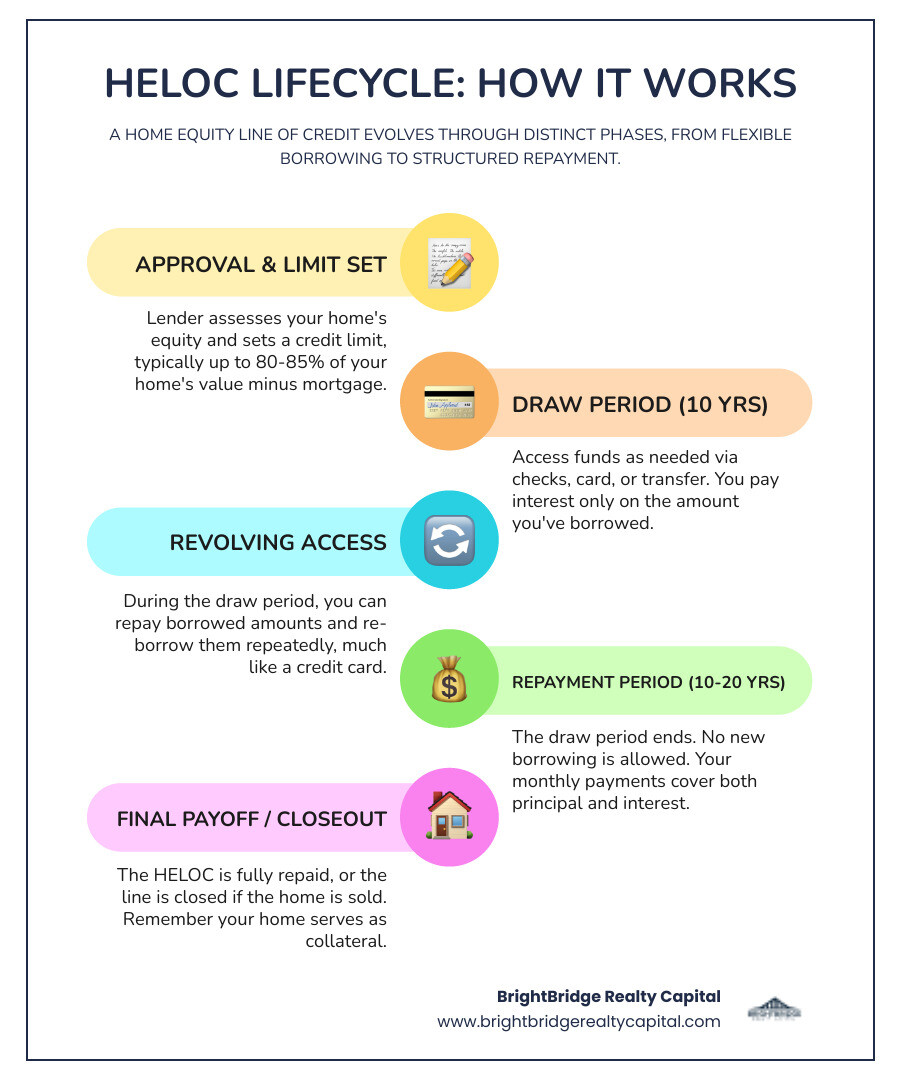
A Home Equity Line of Credit (HELOC) is a powerful financial instrument that functions as a revolving credit facility secured by the equity in your primary residence or, in some cases, an investment property. It works in two distinct phases: a draw period (typically 10 years) for borrowing and interest-only payments, followed by a repayment period (10-20 years) for principal and interest. Key steps include:
- Approval for a credit limit based on home equity (usually up to 80-85% of value minus mortgage).
- Accessing funds via checks, card, or transfers during the draw period.
- Revolving borrowing, allowing you to repay and re-borrow like a credit card.
- Transitioning to repayment, where borrowing stops and monthly payments increase.
- Using your home as collateral, meaning default can lead to foreclosure.
For real estate investors, a HELOC offers the best flexibility to fund renovations, earnest money, or down payments without starting a brand-new loan application every time you need liquidity. This "velocity of capital" is a cornerstone of modern real estate scaling. That speed can matter when sellers want short timelines, contractors require deposits, or you are juggling multiple projects simultaneously. Unlike a traditional loan where you receive a lump sum and pay interest on the whole amount from day one, a HELOC allows you to only pay for what you use, making it an ideal "just-in-case" fund for emergency repairs or unexpected acquisition opportunities.
At the same time, understanding how a HELOC works is what keeps a flexible tool from becoming a fragile one. Variable rates can move quickly in response to Federal Reserve policy, lenders can reduce or freeze a line if the property value drops significantly, and the end of the draw period can create a real payment shock if you aren't prepared. Knowing the rules up front helps you plan your portfolio, reserves, and exit strategies with precision. Investors must also be aware of the "subordination" process if they choose to refinance their first mortgage while keeping the HELOC in place.
Practical ways real estate investors often use a HELOC (when appropriate) include:
- Bridging renovation costs: Funding the "rehab" portion of a BRRRR (Buy, Rehab, Rent, Refinance, Repeat) strategy before the long-term refinance pays the line back down.
- Covering earnest money deposits: Having liquid cash available to secure a contract quickly without waiting for a bank transfer.
- Down payment assistance: Using equity from a primary residence to cover the 20-25% down payment required for a new investment property purchase.
- Paying contractors in stages: Maintaining cash flow by only borrowing what you need as specific milestones in a construction project are met.
- Consolidating higher-interest revolving debt: Using the lower interest rate of a secured HELOC to pay off high-interest credit cards used for business expenses.
I am Daniel Lopez, a loan officer at BrightBridge Realty Capital. I help investors structure financing to leverage equity across portfolios, making complex lending products understandable for strategic decision-making. My goal is to ensure that every client understands not just the interest rate, but the long-term impact of the loan structure on their overall wealth-building journey.
Basic HELOC vocabulary and related topics:
Educational note: This guide is for general information only and is not financial or tax advice. Loan terms vary by lender, property type, and borrower profile. Always consult with a qualified professional before making significant financial decisions.
The Fundamentals: Understanding Home Equity and HELOC Basics
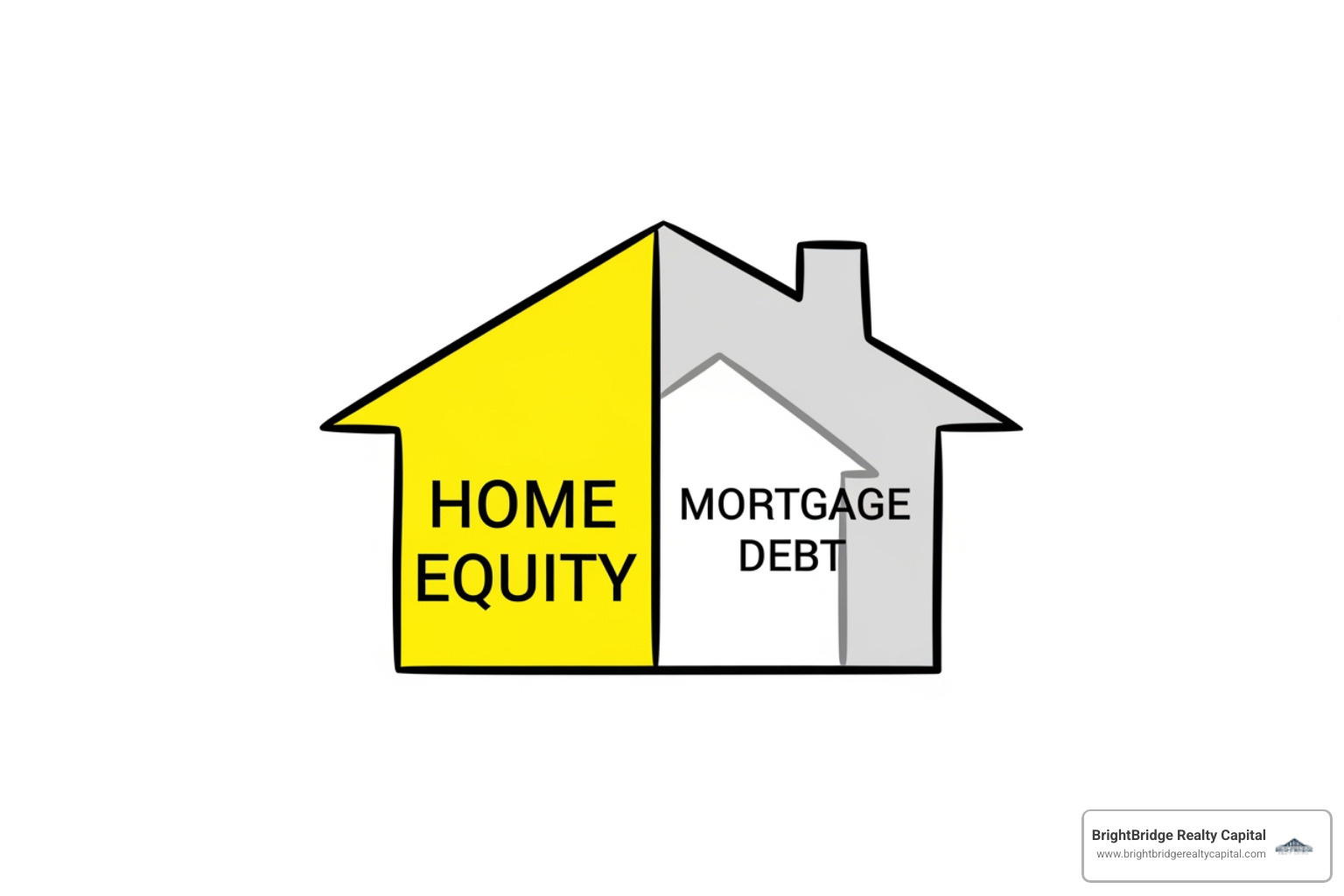
Home equity is the fundamental building block of a HELOC. It represents the portion of your property that you truly "own"—the market value of your home minus any outstanding debts secured by it. If your home is worth $500,000 and you owe $200,000 on your primary mortgage, your equity is $300,000. Equity grows in two primary ways: as you pay down the principal balance of your mortgage through monthly payments, or as the market value of the property rises due to appreciation or improvements.
Lenders use the loan-to-value (LTV) and combined loan-to-value (CLTV) ratios to determine borrowing limits. Most lenders require you to maintain at least 15% to 20% equity in the home to qualify for a line of credit. While some conservative banks limit borrowing to 65% of the home's value, many modern lenders allow tapping up to 80-90% of the value, minus existing mortgage balances. For example, if a lender allows an 85% CLTV on a $500,000 home, the total debt allowed is $425,000. If you already owe $200,000, your HELOC limit would be $225,000.
In 2024, the average HELOC limit exceeded $120,000, highlighting the significant capital available to homeowners who have seen their property values soar over the last several years. However, it is important to remember that market values can fluctuate. If the real estate market cools and your home value drops, your equity shrinks, which can lead to a lender "freezing" or reducing your credit line to protect their interests.
Because a HELOC uses your home as collateral, understanding these basics is vital for protecting your most significant asset. If you are unable to make the payments, the lender has the legal right to initiate foreclosure proceedings to recover the debt. This makes the HELOC a "secured" debt, which is why the interest rates are typically much lower than "unsecured" debts like credit cards or personal loans.
To learn more, see our guide: What is a Home Equity Line of Credit or visit the CFPB: What is a home equity line of credit (HELOC)?
How Does a HELOC Work? The Mechanics of Borrowing and Repayment
A HELOC operates in two distinct phases, each with its own set of rules regarding how you access money and how you pay it back. Understanding the transition between these phases is the most critical part of managing the loan.
The Draw Period: Flexible Access to Cash
The draw period typically lasts 10 years, though some lenders offer 5 or 15-year options. During this time, the HELOC acts much like a credit card. You can borrow money, pay it back, and borrow it again as many times as you like, up to your established credit limit. You only pay interest on the specific amount you have borrowed at any given time. For example, on a $100,000 line, if you use $20,000 to renovate a kitchen, you only pay interest on that $20,000. If you pay that $20,000 back the next month, your interest payment drops back to zero (excluding any annual fees).
Many lenders offer interest-only payments during this phase to keep monthly costs low. This is highly attractive for investors who want to maximize cash flow. However, it is a double-edged sword: making interest-only payments does not reduce your principal balance. If you borrow $50,000 and only pay the interest for 10 years, you will still owe $50,000 on the day the repayment period begins.
The Repayment Period: Paying Back the Balance
After the draw period ends, you enter the repayment period (usually lasting 10 to 20 years). At this point, the "revolving" nature of the loan ends. You can no longer borrow any more money from the line. Your monthly payments will increase significantly because you are now required to pay back both the principal balance and the interest over the remaining term of the loan. This is often referred to as a "fully amortized" payment.
Navigating the "Payment Shock"
The transition from interest-only payments to principal-and-interest payments can cause what is known as "payment shock." This is especially true if interest rates have risen during the 10-year draw period.
Consider a $50,000 balance at 7% interest. During the draw phase, an interest-only payment is roughly $292 per month. Once the 20-year repayment period begins, the payment jumps to approximately $388 to cover the principal. If interest rates have risen to 9% by that time, the payment hits $450. To mitigate this risk, savvy borrowers use several strategies:
- Make voluntary principal payments: Even small payments toward the principal during the draw period can significantly lower the burden later.
- Budget ahead: Treat the end of the draw period as a hard deadline and ensure your income or investment returns can cover the higher payment.
- Refinance the balance: Many borrowers choose to refinance the HELOC balance into a fixed-rate home equity loan or a new mortgage before the repayment period starts.
- Use a conversion option: Some modern HELOCs allow you to "lock in" a fixed interest rate and a set repayment schedule for a portion of your balance during the draw period.
For more details on the legal requirements and disclosures lenders must provide, see the CFPB's HELOC brochure.
The Financials: Understanding HELOC Rates, Fees, and Costs
How do HELOC interest rates work?
Most HELOCs use variable interest rates. These rates are not set arbitrarily by the bank; they are typically tied to a public index, most commonly the U.S. Prime Rate as published in the Wall Street Journal. The lender then adds a "margin" on top of that index based on your creditworthiness and the loan-to-value ratio.
For example, if the Prime Rate is 8.5% and your lender's margin for your credit profile is 1%, your fully indexed rate is 9.5%. Because the Prime Rate is directly influenced by the Federal Reserve's federal funds rate, your HELOC rate can fluctuate monthly. When the Fed raises rates to combat inflation, your HELOC payment goes up. When they cut rates, your payment goes down. This variability makes HELOCs riskier than fixed-rate loans but often provides a lower starting rate.
Some lenders offer introductory "teaser" rates—very low rates for the first 6 to 12 months—to attract new customers. While these can save you money in the short term, it is vital to know what the rate will jump to once the teaser period ends. Explore our Home Equity Loan Rates Guide for more insights into current market trends.
To avoid surprises, confirm these rate-related details before you sign:
- Index and margin: Ask exactly which index is used and whether the margin is fixed for the life of the loan or can be adjusted.
- Rate caps: Most HELOCs have a "lifetime cap" (e.g., the rate can never exceed 18%) and some have "periodic caps" that limit how much the rate can rise in a single year.
- Interest calculation: Most lenders calculate interest daily based on your average daily balance. Understanding this can help you save money by making payments earlier in the billing cycle.
- Minimum draw or minimum payment rules: Some lines require you to take an initial draw of $10,000 or $25,000 at closing, or they may have a minimum monthly payment regardless of how small your balance is.
What are the associated costs and fees?
While HELOCs often have lower closing costs than a standard mortgage, they are not free. Common fees include:
- Origination/Application fees: The cost the lender charges to set up the loan and perform initial underwriting.
- Appraisal fees: Lenders need an accurate valuation of your home. This can range from a full interior appraisal ($500-$1,000) to a quicker "drive-by" or automated valuation (AVM).
- Annual/Maintenance fees: Many banks charge a small fee (typically $50-$100) every year just to keep the line of credit open and available to you.
- Transaction/Inactivity fees: Some lenders charge a fee every time you draw funds, or conversely, a fee if you don't use the line for a certain period of time.
- Early termination fees: If you close the HELOC within the first 2-3 years (perhaps because you sold the house or refinanced), the lender may charge a fee to recoup the closing costs they covered on your behalf.
Two cost concepts that are easy to miss:
- Closing costs vs. "no closing cost" offers: Lenders often market "no closing cost" HELOCs. This usually means the lender pays the appraisal and title fees for you. However, they often recoup these costs by charging a slightly higher interest rate margin or requiring you to keep the line open for a minimum number of years.
- How fees affect flexibility: If you plan to use the HELOC for small, frequent draws to pay contractors, a "per-transaction" fee can become very expensive. In that case, a line with a slightly higher annual fee but no transaction fees would be more cost-effective.
Always compare the Annual Percentage Rate (APR) across at least three different lenders. The APR for a HELOC is calculated differently than a standard mortgage, so read the fine print to understand the total cost over the life of the loan.
Getting Approved and Using Your HELOC Wisely
How does a HELOC work during the application process?
The application process for a HELOC is similar to a standard mortgage but often moves faster. Lenders are primarily looking at the "Three Cs": Collateral (your home's value), Credit (your score and history), and Capacity (your ability to repay). Typically, requirements include:
- Equity: You generally need to keep 15% to 20% equity in the home after the HELOC is added.
- Credit Score: While some lenders accept scores in the 620s, the best rates are reserved for those with scores of 740 or higher.
- DTI Ratio: Your Debt-to-Income ratio (total monthly debt payments divided by gross monthly income) should generally be 43% or less, though some lenders allow up to 50% with compensating factors.
- Income: You must provide verifiable proof of stable employment or consistent investment income.
Documentation needed includes recent pay stubs, W-2s, the last two years of tax returns, bank statements, and your current property tax and insurance details. The process usually takes two to six weeks from application to funding. It is highly recommended to check your credit via Equifax or TransUnion before applying to ensure there are no errors that could delay your approval.
To speed up underwriting and reduce back-and-forth, it helps to get organized before you apply:
- Provide a clear paper trail: If you are using the HELOC for a business purpose, have your business entity documents ready.
- Explain large deposits: Underwriters look for stability; be ready to explain any irregular income or large transfers in your bank statements.
- Schedule of Real Estate Owned: If you own multiple properties, keep a simple spreadsheet listing the address, estimated value, mortgage balance, taxes, insurance, and rental income for each. This is a standard requirement for serious real estate investors.
Pros, Cons, and Smart Uses
Advantages:
- Extreme Flexibility: You only borrow what you need, when you need it. This is perfect for projects with uncertain costs.
- Lower Interest Rates: Compared to credit cards (which can exceed 20-25%) or personal loans, HELOC rates are very competitive.
- Potential Tax Deductions: Under current IRS rules, interest on a HELOC may be deductible if the funds are used to "buy, build, or substantially improve" the home that secures the loan. Always consult a tax professional, as rules changed significantly with the 2017 Tax Cuts and Jobs Act.
Risks:
- Variable Interest Rates: Your payment can rise significantly if market rates go up, which can squeeze your monthly budget.
- Your Home is the Collateral: This is the biggest risk. If you cannot make the payments, you could lose your home to foreclosure.
- Lender Freezes: If the economy takes a downturn and home values drop, the lender can "freeze" your line, meaning you can't draw any more money even if you have a $0 balance.
Smart uses: Home renovations that add value, debt consolidation of high-interest loans, or using a HELOC to buy rental property. Avoid using it for non-essential luxury goods, vacations, or daily living expenses, as you are essentially putting your home at risk for temporary consumption.
A few practical guardrails that can make a HELOC safer to manage:
- Set a target utilization limit: Many investors choose an internal cap (for example, never drawing more than 50% of the available line) to ensure they always have a liquidity buffer for emergencies.
- Stress-test your budget: Before you draw funds, calculate what your payment would be if interest rates rose by 3% or 5%. If that number makes you uncomfortable, borrow less.
- Match the HELOC to a plan: Use the HELOC for projects with a clear "exit strategy"—such as a renovation that will be paid off by a future refinance or the sale of the property.
For more advice, see the FTC Consumer Guide.
HELOCs vs. Other Ways to Tap Home Equity
When deciding how to access your home's value, it is important to compare the HELOC against other popular options. Each has its own strengths depending on your specific financial goals and the current interest rate environment.
The Home Equity Loan: The Predictable Lump Sum
A Home Equity Loan is often called a "second mortgage." Unlike a HELOC, you receive the entire loan amount in a single lump sum at closing. It typically comes with a fixed interest rate and a set monthly payment for the life of the loan (usually 5 to 30 years). This is the best choice for projects with a known, fixed cost, such as a $50,000 roof replacement or a specific debt consolidation plan, where you want the peace of mind of a predictable payment.
The Cash-Out Refinance: Replacing Your Mortgage
A cash-out refinance involves replacing your existing primary mortgage with a completely new, larger mortgage. You pay off the old loan and keep the difference in cash. This is an ideal strategy if current market interest rates are significantly lower than the rate on your existing mortgage. However, if you currently have a very low mortgage rate (like the 3% rates seen in 2020-2021), a cash-out refinance might not make sense, as you would be forced to trade that low rate for a higher one on your entire mortgage balance.
Detailed Comparison Table
| Feature | HELOC | Home Equity Loan | Cash-Out Refinance |
|---|---|---|---|
| Funds Delivery | Revolving line (use as needed) | One-time lump sum | One-time lump sum |
| Interest Rate | Typically variable (Prime +) | Typically fixed | Fixed or variable |
| Monthly Payment | Interest-only (draw) then P&I | Fixed Principal & Interest | New, larger mortgage payment |
| Closing Costs | Low or none | Moderate | High (similar to a new mortgage) |
| Best For | Ongoing projects / Emergencies | One-time fixed expenses | Large sums + lowering primary rate |
Practical Scenarios for Investors
- Choose a HELOC if: You are an active investor who needs a flexible "war chest" to fund multiple small renovations or to provide quick earnest money for new deals over several years.
- Choose a Home Equity Loan if: You have a single, large project with a fixed contractor bid and you want to lock in a fixed rate to avoid the risk of rising interest rates.
- Choose a Cash-Out Refinance if: You need a very large amount of capital (e.g., $200,000+) and you can simultaneously lower the interest rate on your primary mortgage, or if you want to spread the repayment over a full 30-year term.
Home Equity Agreements (HEAs) are a newer, non-loan alternative. In an HEA, a company gives you a lump sum of cash in exchange for a share of your home's future appreciation. There are no monthly payments and no interest rates, but you will owe the company a significant portion of your equity when you sell the home or the contract term ends. This is often used by homeowners who have high equity but low income or poor credit. For more, see our guide on Home Equity Loans on Investment Properties.