Investment Property Refinance: A Smart Move for Savvy Investors

Summary
Unlock equity & boost cash flow with an investment property refinance. Learn types, qualifications & the process for savvy investors.
Why Investment Property Refinance Makes Financial Sense
Investment property refinance is a powerful and strategic financial tool that savvy real estate investors use to enhance their portfolio's performance and accelerate wealth creation. At its core, it involves replacing your existing mortgage on a rental property with a new loan. This isn't just about getting a new loan; it's a calculated move to optimize your financial position. By securing a new mortgage, you can achieve a variety of goals: lower your interest rate to increase monthly cash flow, access the property's built-up equity for new opportunities, change the loan's term to align with your long-term strategy, consolidate higher-interest debts, or switch from a volatile adjustable-rate mortgage (ARM) to a stable fixed-rate loan for greater predictability.
However, it's crucial to understand that refinancing an investment property is a different ballgame than refinancing a primary residence. Lenders view rental properties as carrying a higher risk. Their logic is straightforward: in times of financial hardship, a borrower is more likely to prioritize payments on their own home over a rental property. This elevated risk profile translates into stricter qualification requirements. Lenders typically look for:
- Minimum Equity: At least 25-30% equity in the property (a loan-to-value ratio of 70-75%).
- Credit Score: A strong credit score, often 680 or higher, with the best rates reserved for scores of 720+.
- Debt-to-Income (DTI) Ratio: A DTI ratio under 45%, demonstrating you can comfortably manage your existing debts plus the new mortgage payment.
- Cash Reserves: Liquid assets sufficient to cover at least six months of total housing payments (PITI: principal, interest, taxes, and insurance) for the investment property.
- Documented Rental Income: Proof of consistent rental income, usually through lease agreements and tax returns (Schedule E).
Interest rates for investment properties are also generally 0.5% to 0.75% higher than for primary homes, which is the lender's way of pricing in the additional risk. Despite these higher hurdles, the benefits can be immense. When you've built substantial equity, an investment property refinance unlocks that trapped value, transforming it into active capital. This capital can be deployed for value-add property improvements, used as a down payment on a new acquisition, or simply held to strengthen your overall financial position. It's a sophisticated strategy that allows you to leverage the performance of your existing assets instead of injecting new, out-of-pocket capital.
I'm Daniel Lopez, a loan officer at BrightBridge Realty Capital. My expertise lies in helping real estate investors navigate the complexities of financing. I've guided countless clients in using investment property refinance as a lever to expand their portfolios, optimize cash flow, and achieve their long-term financial goals. This comprehensive guide will cover everything you need to know, from understanding your options to successfully closing the deal.

Why Refinance Your Investment Property?
Owning an investment property is fundamentally about the numbers: generating strong returns, maintaining healthy cash flow, and fostering long-term portfolio growth. If your current mortgage terms are suboptimal, they can act as a drag on your property's financial performance. An investment property refinance serves as a strategic financial tune-up, allowing you to realign your financing with current market conditions and your evolving investment goals. If interest rates have dropped since you first secured your loan, or if your property has appreciated significantly and you've paid down the principal, you've built equity. Refinancing is the mechanism to unlock that value and reshape your entire financial landscape.
The flexibility of refinancing is its greatest strength. It's not a one-size-fits-all solution; it's a versatile tool that can be tailored to your specific objectives. Lowering your monthly mortgage payment directly translates to increased cash flow, which can be reinvested or used to build reserves. Accessing your equity through a cash-out refinance opens a world of possibilities: it can provide the down payment for your next property, fund a major renovation to increase rental income and property value, or allow you to consolidate high-interest debt (like credit cards or personal loans) into a single, more manageable payment at a lower interest rate. Many successful investors have built their real estate empires one smart refinance at a time, using the equity from one property to acquire the next in a powerful cycle of growth.
The Pros and Cons of an Investment Property Refinance
Every significant financial decision involves a careful weighing of trade-offs. Understanding both the advantages and disadvantages is critical to making an informed choice that benefits your portfolio.
Pros:
- Lower Interest Rate: This is the most common motivation. Securing a lower rate, even by a small margin, can save you thousands of dollars over the life of the loan and significantly improve your monthly cash flow. As Realtor and attorney Bruce Ailion notes, "There may never be a better time to refinance an investment property or rental property," especially in a favorable rate environment.
- Better Loan Terms: You gain the ability to restructure your debt. You can switch from an adjustable-rate mortgage (ARM) with its unpredictable payments to a stable fixed-rate loan. You can also change your loan term, for instance, from a 30-year to a 15-year mortgage to build equity much faster and pay less total interest, or vice-versa to lower your monthly payments and maximize cash flow.
- Access to Equity (Cash-Out): A cash-out refinance allows you to tap into the wealth you've built in your property. This liquidity can be a game-changer, providing the capital to execute strategies like the BRRRR method (Buy, Rehab, Rent, Refinance, Repeat) or to diversify your investments.
Cons:
- Closing Costs: Refinancing isn't free. You'll incur closing costs, which typically run 2-5% of the new loan amount. These include appraisal fees, origination fees, title insurance, and other charges that must be factored into your financial analysis.
- Extended Loan Term: If you refinance your 30-year mortgage after 10 years with a new 30-year loan, you are extending your total repayment period to 40 years. While this may lower your monthly payment, it often means paying significantly more in total interest over the long run.
- The Break-Even Point: This is a crucial calculation. You must determine how long it will take for your monthly savings to offset the closing costs. For example, if closing costs are $6,000 and you save $200 per month, your break-even point is 30 months. If you plan to sell the property before this point, refinancing is likely not a financially sound decision.
- Market Timing and Rate Environment: The benefits of refinancing are heavily dependent on current interest rates. If rates are not substantially lower than your existing rate, the marginal savings may not justify the cost and effort of the refinancing process.
Achieving Your Financial Goals
Refinancing is more than just a transaction; it's a strategic tool for proactive wealth building. A cash-out refinance can provide the capital for a down payment on an additional property, creating a powerful multiplier effect for your portfolio's growth. Imagine using $50,000 of equity from Property A to purchase Property B, which then starts generating its own cash flow and appreciation.
You can also use these funds for strategic, value-add renovations. Projects like updating a kitchen with modern appliances and countertops, remodeling a bathroom, or installing durable new flooring can justify higher rents and significantly boost the property's market value. This not only increases your monthly rental income but also builds your equity position even further, setting you up for future financial moves.
Finally, a smart refinance can help you create a robust financial safety net. Having accessible cash reserves is essential for covering unexpected major repairs, property vacancies, or other unforeseen expenses without stress. It's also an effective way to improve your personal balance sheet by paying off high-interest consumer debt, such as credit card balances, by consolidating it into your lower-rate mortgage. These strategies are central to successful Real Estate Investment Strategies that build and protect wealth over the long term.
Types of Investment Property Refinance Loans
When you're ready to move forward with an investment property refinance, you'll find several distinct loan types available, each designed to meet different investor needs. Choosing the right path is critical and depends entirely on your specific financial goals—whether you're aiming to improve cash flow, pull out capital for expansion, or simplify your qualification process.
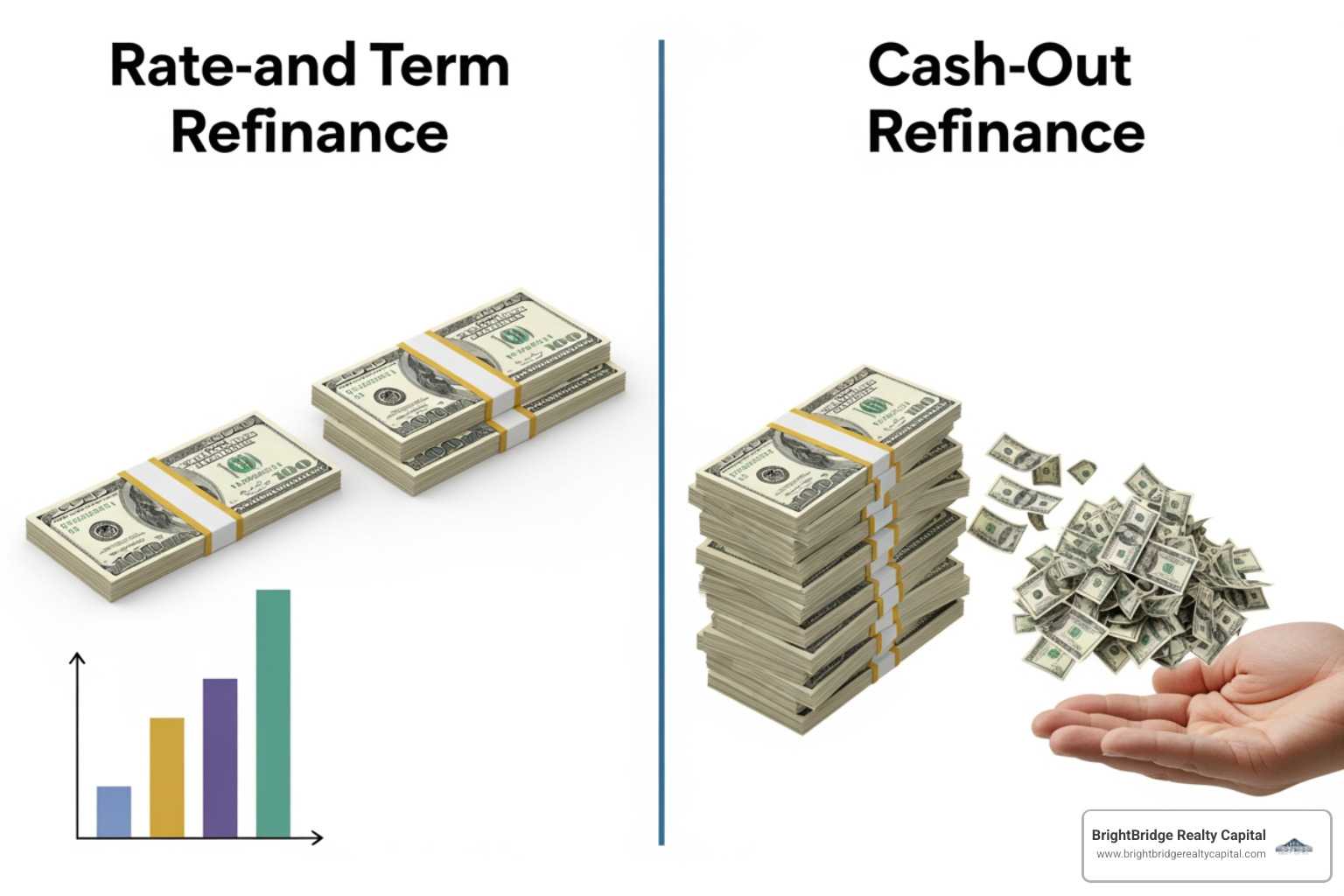
The most common options are rate-and-term refinancing, cash-out refinancing, and DSCR loans. Beyond these, investors with larger holdings might consider portfolio loans. Let's break down each option in detail so you can determine which is the best fit for your strategy.
Rate-and-Term Refinance
A rate-and-term refinance is the most straightforward option. It's a simple swap: you replace your current mortgage with a new one, typically to secure a lower interest rate or change the loan's term. You are not taking any significant amount of cash out (usually limited to a few thousand dollars to cover closing costs). The primary goals are to lower your monthly payment, which improves cash flow, or to adjust your repayment schedule. For example, an investor might switch from a 30-year to a 15-year mortgage to build equity at an accelerated pace and save a substantial amount on total interest paid. Conversely, another investor might refinance from a 15-year back to a 30-year term to reduce their monthly payment and maximize liquidity. This is also the perfect tool to move from a risky adjustable-rate mortgage to a predictable fixed-rate loan. For current market rates, see our guide on Refi Rate for Rental Property.
How Does a Cash-Out Investment Property Refinance Work?
A cash-out refinance is a powerful tool that lets you convert your property's equity into liquid cash. Here’s the mechanics: you take out a new mortgage for an amount that is larger than what you currently owe. The new, larger loan is used first to pay off your existing mortgage balance, and you receive the remaining difference in a lump-sum cash payment (minus closing costs). For example, let's say your property is now worth $500,000 and you owe $250,000. A lender might allow you to borrow up to 75% of the property's value, which is $375,000. This new loan would pay off the $250,000 balance, leaving you with $125,000 in cash (before closing costs).
Investors use this cash strategically for down payments on additional properties, funding major renovations to increase rental income, or consolidating high-interest debt. It's the engine behind many growth-focused investment strategies. Most lenders require you to leave at least 25% equity in the property after the refinance, corresponding to a maximum 75% loan-to-value (LTV) ratio. Explore this option further in our guide on Real Estate Cash Out Refinance.
DSCR (Debt Service Coverage Ratio) Loans
DSCR loans are a game-changer, designed specifically for real estate investors. The key benefit is that you qualify based on your property's cash flow, not your personal income. This means the lender is primarily concerned with whether the rental income is sufficient to cover the property's expenses. We don't need to see your W-2s, personal tax returns, or pay stubs. Instead, we verify that the property's rental income can cover its monthly debt obligations.
The Debt Service Coverage Ratio is calculated by dividing the property's gross rental income by its total monthly housing payment (PITI: Principal, Interest, Taxes, and Insurance). Most lenders look for a DSCR of at least 1.25, which signifies that the property generates 25% more income than its expenses. A ratio of 1.0 means the income just covers the debt. This loan type is ideal for self-employed investors, those with complex income situations, or investors with large portfolios who want to avoid the hassle of extensive personal income documentation. At BrightBridge Realty Capital, our DSCR Loans offer a streamlined and efficient process, and we even provide No Doc DSCR Loans for maximum efficiency.
Portfolio Loans
For investors who own multiple properties, managing individual mortgages for each can become cumbersome. A portfolio loan addresses this by allowing you to refinance several properties under a single, consolidated loan. Instead of juggling multiple payments, you have one monthly payment. This type of loan is offered by portfolio lenders (like BrightBridge Realty Capital) who keep the loans on their own books rather than selling them on the secondary market. This gives them the flexibility to create customized terms and underwriting guidelines, often allowing them to finance more than the 10-property limit imposed by conventional lenders like Fannie Mae and Freddie Mac. Portfolio loans are an excellent tool for experienced investors looking to streamline their finances and scale their operations more effectively.
Qualifying for an Investment Property Refinance
Qualifying for an investment property refinance is a more rigorous process than securing a loan for a primary residence. Lenders inherently view rental properties as a higher-risk asset class. Their underwriting is guided by the assumption that if a borrower encounters financial distress, they will make every effort to keep their own home, while a rental property mortgage might be the first payment to be missed. This perception of increased risk directly leads to stricter qualification standards across the board.
However, these standards are not insurmountable. If you operate your investment property as a business, maintain meticulous records, and keep your personal finances in strong order, you should be well-positioned to qualify for a beneficial refinance.

Lender Requirements and Eligibility
Lenders meticulously assess several key financial indicators to determine your creditworthiness and the viability of the investment. Here’s a deeper look at what they scrutinize:
- Credit Score: While some programs may accept scores as low as 620, a score of 720 or higher is strongly recommended to secure the most competitive interest rates and favorable terms, especially for a cash-out refinance. Your credit score is a direct reflection of your reliability as a borrower, and a higher score reduces the lender's perceived risk.
- Debt-to-Income (DTI) Ratio: Your DTI ratio is your total monthly debt payments divided by your gross monthly income. For conventional loans, lenders typically want to see a DTI of 45% or less, though some programs may go up to 50%. This calculation includes your primary mortgage, car loans, student loans, credit card payments, and the proposed new payment for the investment property. A good debt-to-income ratio is 36% or less, which gives you more borrowing power.
- Equity/Loan-to-Value (LTV): For a rate-and-term refinance, you'll typically need at least 25% equity (75% LTV). For a cash-out refinance, the requirement is often stricter, with some lenders capping the LTV at 70% (requiring 30% equity). Multi-unit properties (2-4 units) may require even more equity, as they are seen as having higher operational complexity and risk.
- Cash Reserves: Lenders need to see that you have a financial cushion. You'll be required to show liquid assets (in checking, savings, or brokerage accounts) sufficient to cover 6 to 12 months of the total mortgage payment (PITI) for the investment property. This reassures the lender that you can cover expenses during a potential vacancy or unexpected repair.
- Portfolio Size: If you own multiple financed properties, you may run into limits set by conventional lenders like Fannie Mae and Freddie Mac, who typically cap the number of financed properties at 10. Investors exceeding this limit will need to work with a portfolio lender that offers more flexible programs like DSCR loans.
Using Rental Income to Qualify
A significant advantage for real estate investors is that the income generated by the property itself can be used to help you qualify for the loan. This is especially beneficial for investors whose personal income might not be sufficient on its own. To use this income, you must provide thorough documentation, which typically includes:
- A current, executed lease agreement for each unit.
- At least two years of Schedule E (Supplemental Income and Loss) forms from your federal tax returns, which report your rental income and expenses.
- Sometimes, proof of recent rent payments through bank statements.
Lenders apply a conservative approach when calculating this income. They will typically use only 75% of your gross monthly rental income. This 25% reduction is known as a "vacancy factor" and is intended to account for potential vacancies, maintenance costs, and property management fees. This ensures that the qualification isn't based on overly optimistic, best-case-scenario income projections, protecting both you and the lender from over-leveraging the property. For more details, you can review Fannie Mae's official guidelines on Selling Guide: B3-3.1-08, Rental Income.
Using rental income can be a game-changer, particularly for self-employed investors or those looking to scale their portfolio. Learn more in our guide on Home Loans That Take Rent Into Consideration.
The Step-by-Step Refinance Process
Navigating an investment property refinance can seem like a complex undertaking, but it becomes far more manageable when you break it down into a clear, step-by-step process. Understanding each stage will empower you to move through the transaction with confidence and efficiency.
Finding the Right Lender
This is arguably the most critical step in the entire process. Choosing the right lending partner is about more than just finding the absolute lowest advertised interest rate; it's about finding a lender who truly understands the nuances of real estate investing. You need a partner who can offer loan products tailored to investors, like DSCR or portfolio loans. As a direct lender, we at BrightBridge Realty Capital fund our loans in-house, which eliminates middlemen and bureaucratic red tape. This direct control allows us to offer greater flexibility, customized solutions, and the ability to close quickly—often in a week or less, a significant advantage in a fast-moving market.
When evaluating your options, it's essential to shop around. Don't just compare interest rates; compare the Annual Percentage Rate (APR), which includes most of the loan's fees and gives a more accurate picture of the total cost of borrowing. Request loan estimates from at least three different lenders—such as a large national bank, a local credit union, and a specialized direct lender like us. Ask other investors in your network for recommendations; their firsthand experience is invaluable. Our guide on Best Investment Property Mortgage Lenders can provide further insight into what to look for in a quality lending partner.
From Application to Closing
Once you've selected a lender, the journey from application to closing begins. Here’s what you can expect:
- Application & Documentation: You'll start by completing the lender's formal loan application. You will then need to gather and submit a comprehensive set of documents. This typically includes personal financial information like W-2s, recent pay stubs, and two years of tax returns, as well as proof of assets via bank and brokerage statements. For the property itself, you'll need your current mortgage statement, homeowners insurance policy, property tax bills, and, most importantly, current lease agreements and two years of Schedule E tax filings to document rental income. If the property is held in an LLC, be prepared to provide formation documents and an operating agreement.
- Property Appraisal: The lender will order an independent appraisal to determine the property's current fair market value. For an investment property, the appraiser may use both the Sales Comparison Approach (comparing it to similar sold properties) and the Income Approach (valuing it based on its income-generating potential). This appraised value is critical as it establishes the loan-to-value (LTV) ratio, which dictates how much you can borrow.
- Rate Lock: At some point during the process, you will have the option to lock your interest rate. A rate lock protects you from market fluctuations for a specified period, typically 30 to 60 days, while your loan is being processed. This provides certainty about your final rate and payment.
- Underwriting: This is the formal verification stage. The lender's underwriting team will conduct a deep dive into all your financial documents and the property details. They verify your income, assets, and credit history, and ensure the property's value and condition meet their lending guidelines. They are essentially confirming that you and the property represent an acceptable level of risk.
- Closing Disclosure: By law, you must receive a Closing Disclosure (CD) at least three business days before your scheduled closing. This five-page document provides the final, itemized details of your loan: the interest rate, monthly payment, and a full breakdown of all closing costs. Review it meticulously and compare it to your initial Loan Estimate to ensure there are no surprises.
- Closing Day: This is the final step where you sign all the legal documents. You'll need to bring a valid government-issued ID and a cashier's check for your closing costs and any required reserves. Once the documents are signed and the funds are disbursed, your new loan officially replaces your old one.
We've engineered an Efficient Loan Process to make your investment property refinance as smooth and transparent as possible. Ready to begin? You can start the mortgage refinance process with us today.
Frequently Asked Questions about Investment Property Refinancing
It's natural and wise to have questions when considering a financial move as significant as refinancing a rental property. Below are detailed answers to some of the most common questions we hear from real estate investors.
How does refinancing an investment property differ from a primary residence?
Refinancing an investment property is fundamentally different because lenders view it as a business transaction with higher inherent risk. If you face financial hardship, the assumption is you'll prioritize your primary home mortgage. This perception leads to several key distinctions:
- Higher Interest Rates: Expect rates to be approximately 0.5% to 0.75% higher than for a comparable loan on a primary residence. This premium compensates the lender for the added risk.
- Stricter Qualification Standards: You'll face higher requirements for equity, credit, and cash reserves. Lenders typically require at least 25% equity (a 75% LTV), whereas a primary home refinance might be possible with less. A stronger credit score (720+ is often preferred) is also needed to secure the best terms.
- Use of Rental Income: A major advantage is that the property's rental income can be used to help you qualify. Lenders typically count about 75% of the gross rent towards your qualifying income, which can significantly boost your borrowing capacity.
- Deeper Cash Reserves: Lenders will require you to have sufficient liquid assets to cover at least six months (and sometimes up to 12 months) of the property's total monthly payments (PITI). This provides a safety net in case of vacancies or unexpected repairs.
- Tax Implications: The mortgage interest deduction rules can be different. While interest is generally deductible as a business expense on a rental property, the specifics can be more complex than for a primary home. It's wise to consult with a tax professional.
What are the typical closing costs for an investment property refinance?
Closing costs for an investment property refinance typically range from 2% to 5% of the total loan amount. On a $400,000 loan, this would translate to between $8,000 and $20,000. These costs are a bundle of various service fees required to close the loan, including:
- Origination Fees: A fee charged by the lender to cover the costs of processing and underwriting the loan. This can be a flat fee or a percentage of the loan amount (known as "points").
- Appraisal Fee: The cost of hiring a licensed appraiser to determine the property's current market value.
- Title Insurance and Search Fees: This covers the cost of a title search to ensure there are no other claims on the property and an insurance policy to protect the lender (and optionally, you) against future claims.
- Attorney Fees: In some states, a real estate attorney is required to be present at or facilitate the closing.
- Recording Fees: A fee paid to the local county or municipal government to officially record the new mortgage lien against your property.
Some lenders may offer a "no-cost" refinance, but this is a misnomer. The costs are typically rolled into the loan principal or absorbed by charging a higher interest rate.
How soon can I refinance an investment property after purchasing it?
This depends on the lender's "seasoning period"—a required waiting time after purchase before you can refinance. For conventional loans, most lenders require you to wait 6 to 12 months. This period allows you to establish a consistent payment history and, if applicable, document a track record of rental income. Seasoning requirements are a way for lenders to mitigate the risk of financing speculative, rapid-fire property flips.
However, these rules can vary. A simple rate-and-term refinance might have a shorter seasoning requirement than a cash-out refinance, which is viewed as higher risk. Furthermore, some specialized loan programs, like DSCR loans, may have shorter or even no seasoning requirements, as their underwriting is focused on the property's cash flow rather than how long you've owned it. There is also a crucial exception known as "delayed financing," which allows investors who purchased a property with cash to immediately pull their cash back out via a refinance without a waiting period.
Can I refinance a property held in an LLC?
Yes, absolutely. In fact, many savvy investors hold their properties in a Limited Liability Company (LLC) for asset protection and liability purposes. However, not all lenders will refinance a property titled to an LLC. Large conventional banks often prefer to lend to individuals. You will need to work with a lender, like BrightBridge Realty Capital, that specializes in investor loans and is comfortable with LLCs. The process is similar, but you will need to provide your LLC's formation documents, operating agreement, and Certificate of Good Standing. The loan will typically still require a personal guarantee from you as the principal of the LLC.
Conclusion
You now have a comprehensive understanding of how to strategically use an investment property refinance to your advantage. This is not merely a financial transaction but a powerful lever for portfolio growth. Whether your objective is to lower your monthly payments to boost cash flow, tap into your hard-earned equity to fund your next acquisition, or restructure your debt for better long-term stability, refinancing is a critical tool in the sophisticated investor's toolkit. You understand the distinct benefits of rate-and-term, cash-out, and DSCR loans, and you're equipped to choose the path that aligns perfectly with your goals.
At BrightBridge Realty Capital, we are built from the ground up to serve the unique needs of real estate investors. We specialize in what matters most to you: fast closings, flexible and creative loan structures, and clear, consistent communication. As direct lenders, we control the entire process, which allows us to eliminate the delays and frustrations common with traditional banks. We often close loans in a week or less because we know that in real estate, speed is a competitive advantage. We see ourselves as partners in your success, dedicated to providing the customized financing solutions you need to thrive at any stage of your investment journey.
Your investment properties hold tremendous, often untapped, potential. A strategic refinance is the key to unlocking that potential and turning it into tangible action—more properties, better returns, and a stronger, more resilient financial future.
Ready to take the next step and put your equity to work? Explore your rental loan options with BrightBridge Realty Capital today. Let's have a conversation about your portfolio and build something great together.