Unlock Your Portfolio: Investment Property Loans Explained
Summary
Discover how a loan for investors powers real estate growth, leverage, and tax benefits. Compare types, eligibility, and strategies now!
Why Smart Investors Turn to Financing
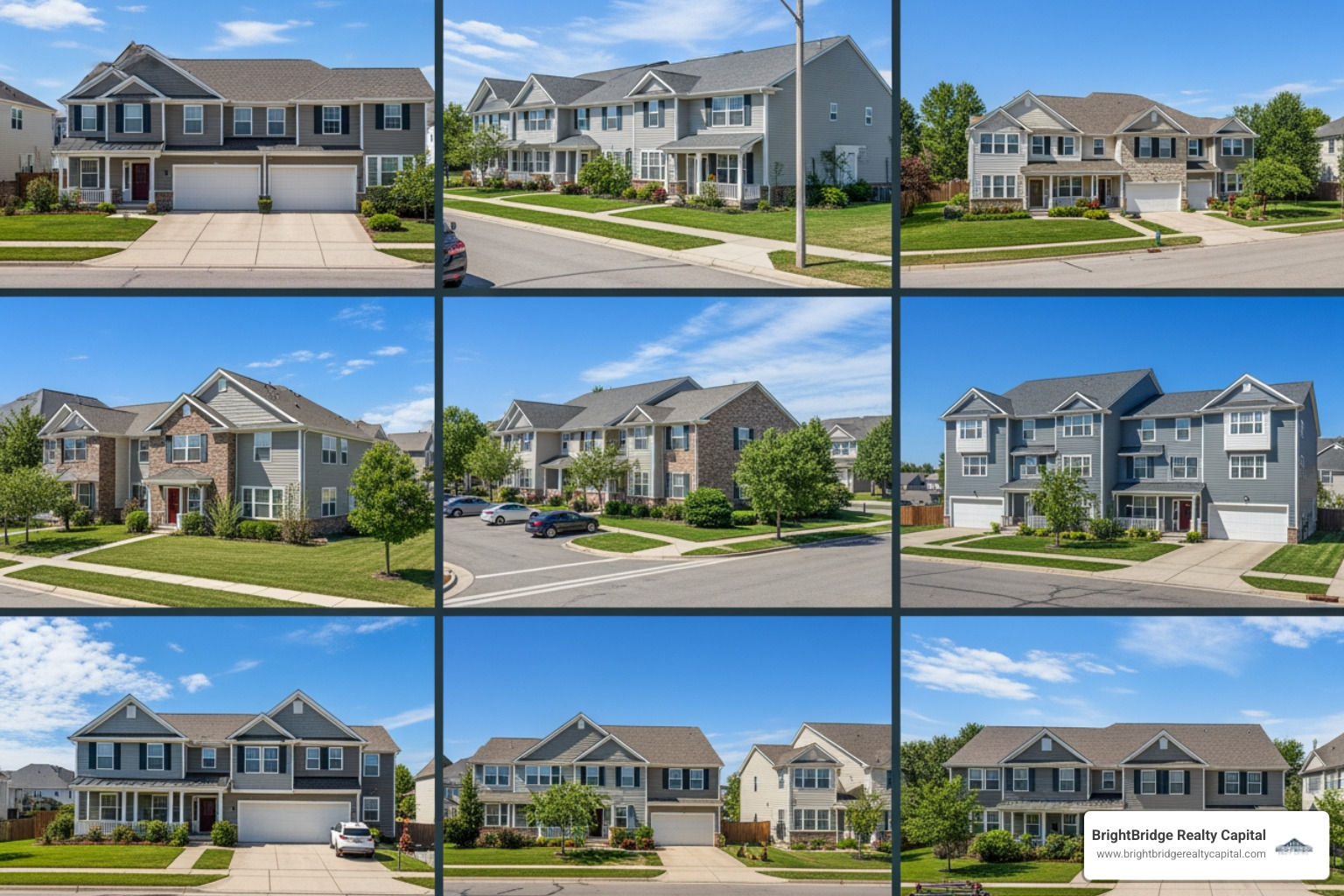
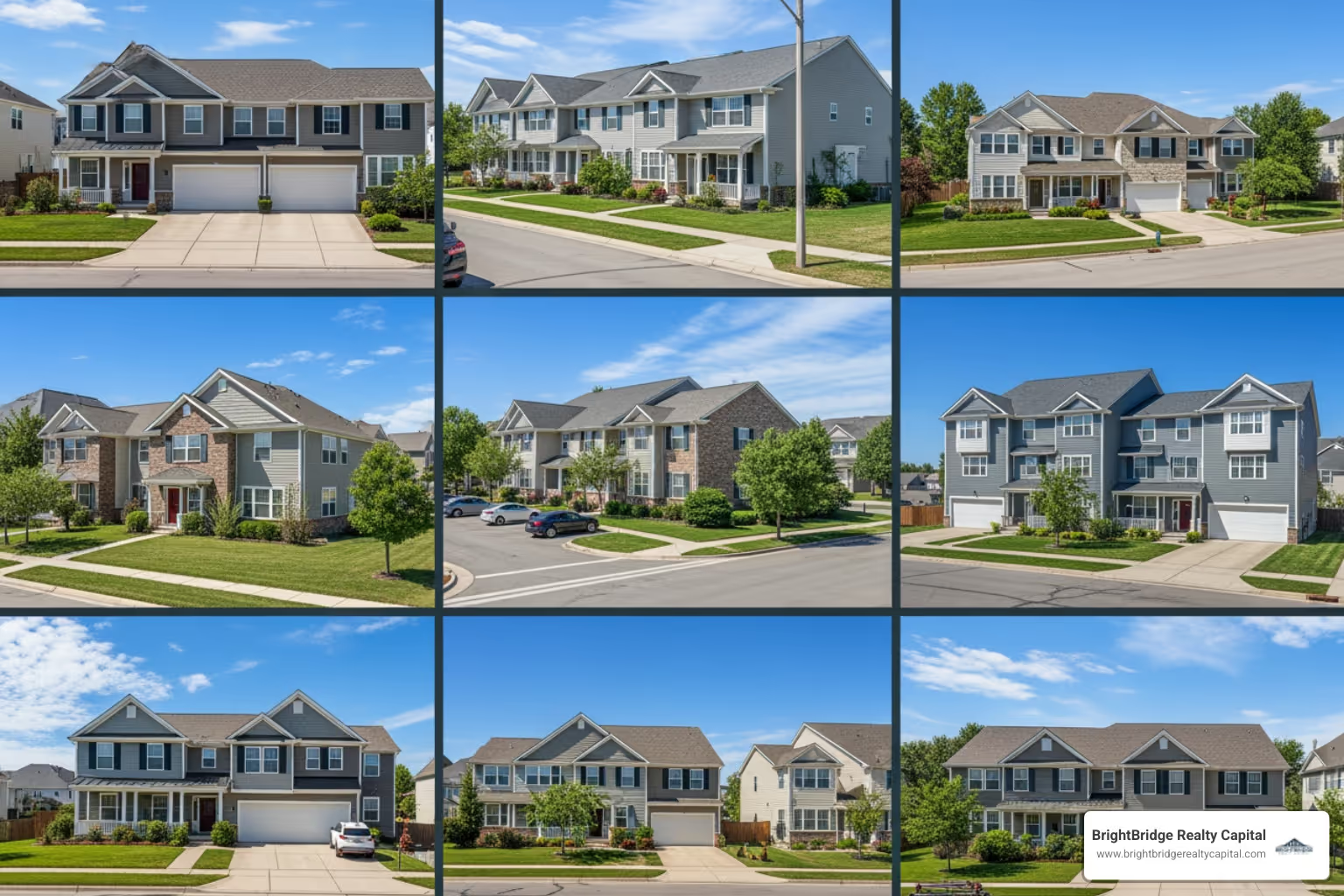
Loan for investors is a sophisticated financing tool that allows real estate professionals to purchase, renovate, or expand rental portfolios without tying up their entire liquid capital. In the world of high-stakes real estate, cash is king, but leverage is the queen that protects the king. These loans are structured fundamentally differently than traditional consumer mortgages. While a standard home loan focuses on your personal ability to pay back the debt through a salary, investor loans focus on the property's income potential, its after-repair value (ARV), or its existing cash flow. This shift in focus enables faster closings, more flexible terms, and the ability to scale a portfolio at a pace that would be impossible using only personal savings.
Here's a comprehensive breakdown of what you need to know:
- Core Purpose: These loans are designed to acquire, refinance, or renovate investment properties, including single-family rentals, multi-family units, and commercial spaces.
- Key Loan Types: The market offers Hard money loans, bridge loans, DSCR (Debt Service Coverage Ratio) loans, ground-up construction loans, and portfolio loans.
- Approval Basis: Lenders prioritize property value, location, and projected cash flow over the borrower's debt-to-income (DTI) ratio.
- Speed of Execution: Private lenders can often close in as little as 7 to 10 business days, whereas traditional banks may take 45 to 60 days.
- Interest Rates: Typically range from 10-18% for short-term hard money; long-term DSCR products are lower, often 1-3% above standard residential rates.
- Loan Terms: Short-term options (6-24 months) are built for flips; long-term options (up to 30 years) are designed for buy-and-hold strategies.
- Loan-to-Value (LTV): Usually ranges from 65% to 80% of the property value, though some programs offer higher leverage based on the purchase price.
- Tax Advantages: Interest payments on investment loans are generally tax-deductible as a business expense, significantly lowering the effective cost of capital.
The single biggest advantage of using a loan for investors is leverage. Borrowing to invest means you can control a much larger asset base with a smaller amount of your own money. This concept, known as the "Velocity of Capital," allows you to move from one deal to the next without waiting years to save up a new down payment. Research and historical data show that an investor who borrows $100,000 at a 4.5% interest rate to earn a 5% return on a larger asset can end up with significantly more wealth over a decade than an investor who saves and invests the same total amount incrementally. This is because the leveraged investor is earning returns on the bank's money as well as their own.
However, leverage is a double-edged sword. While it magnifies gains in a rising market, it can also magnify losses during a downturn. If property values drop or vacancy rates rise, the debt obligation remains the same. This is why understanding the mechanics, costs, and exit strategies of investment loans is critical before signing on the dotted line.
I'm Daniel Lopez, a senior loan officer at BrightBridge Realty Capital. Over the last decade, I've helped hundreds of investors structure loans for investors across diverse asset classes—from urban fix-and-flips to suburban rental portfolios and complex ground-up construction projects. My mission is to demystify the underwriting process, explain the nuances of DSCR calculations, and help my clients make confident, data-driven financing decisions that align with their long-term wealth goals.
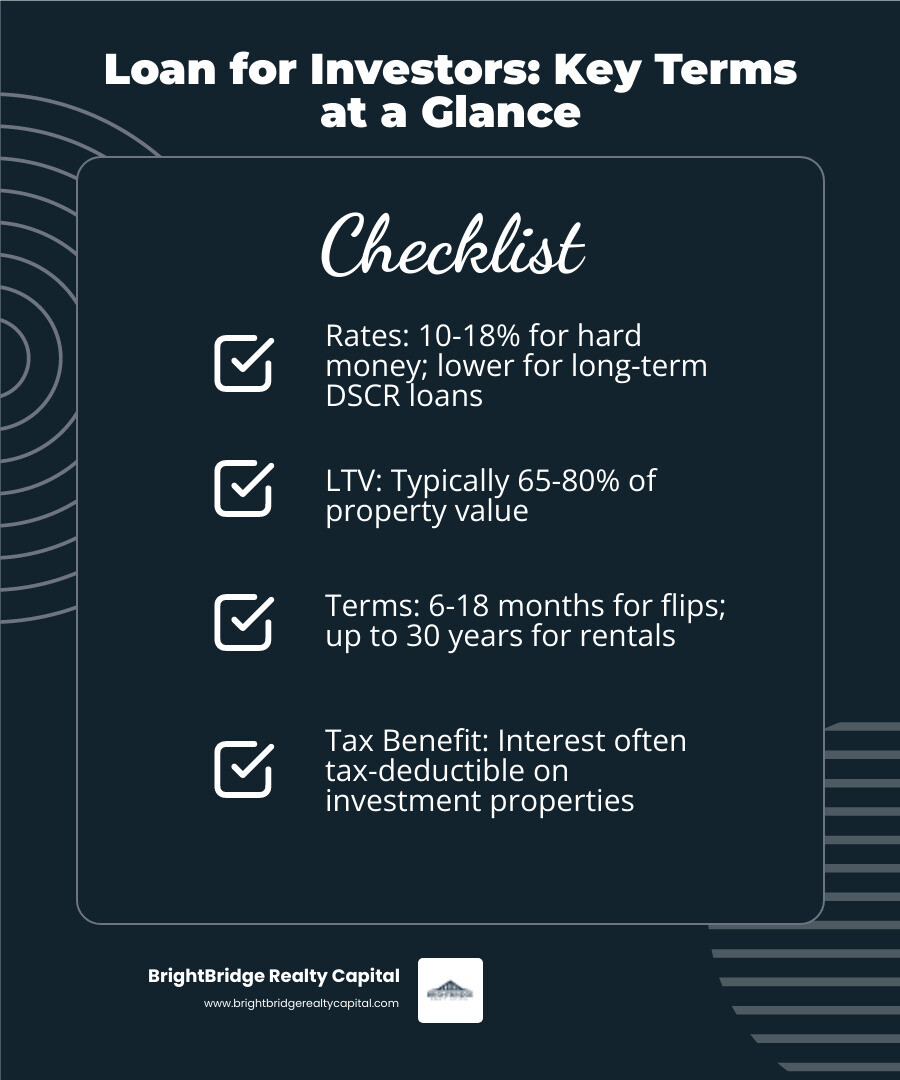
Loan for investors terms and resources at a glance:
What is a Loan for Investors and How Does it Work?
At its core, a Loan for investors is a specialized financial instrument designed to help you acquire, improve, or maintain income-producing real estate assets. Unlike a traditional mortgage for a primary residence—where a bank scrutinizes your W-2 income, personal debt-to-income ratio, and even your lifestyle expenses—investor loans prioritize the asset itself. This is often referred to as "asset-based lending."

When we discuss an Investor Loan Real Estate, we are looking at a product that allows you to maintain liquidity. Liquidity is the lifeblood of a growing real estate business. Instead of exhausting your cash reserves on a single property purchase, you use the lender's capital to fund the majority of the acquisition. This "leverage" is the primary engine of wealth creation in real estate. It allows a small-scale investor to transform into a large-scale developer by spreading their available capital across multiple projects simultaneously.
The Philosophy of Asset-Based Lending
In many cases, these products fall under the umbrella of Asset-based lending. This means the property serves as the primary security for the debt. Lenders evaluate the deal based on the "Three Pillars of Investment Underwriting":
- The Property's Value: What is the property worth today, and what will it be worth after improvements (ARV)?
- The Property's Income: Does the rental income exceed the operating expenses and the debt service?
- The Borrower's Experience: Does the investor have a track record of successfully managing similar projects?
If the property can generate enough rent to cover the mortgage (a concept measured by the DSCR), or if it has enough equity to protect the lender in the event of a default, the deal becomes viable. This is especially true for Investment loans overview that focus on long-term business development rather than just short-term speculation.
The Mechanics of Repayment and Structure
How you pay back the loan is just as important as the initial funding. In the investor world, we typically see two main payment structures:
- Interest-Only Payments: This is the preferred choice for fix-and-flip investors and builders. By only paying the interest portion of the loan each month, you keep your monthly carrying costs to an absolute minimum while you focus your capital on renovations or stabilizing the property. This maximizes your cash flow during the "hold" period. You can learn more about how this applies to rentals here: Interest Only Loan For Rental Property.
- Principal and Interest (Amortizing): This is the standard for long-term rental holds. You pay down the balance over time, usually over a 15, 20, or 30-year period. This builds equity through "debt paydown," which is one of the four main ways real estate investors make money (alongside cash flow, appreciation, and tax benefits).
Lenders use the Loan-to-Value (LTV) ratio to determine their risk exposure. For example, if a property is appraised at $1,000,000 and the lender offers an 80% LTV, they will provide $800,000 in debt. You, the investor, must provide the remaining $200,000 as equity (the down payment). Repayments are typically automated through Pre-authorized debits (ACH) to ensure the loan remains in good standing without manual intervention.
Tax Deductibility and the "Real" Cost of Capital
One of the most powerful aspects of a Loan for investors is the potential for significant tax savings. In most jurisdictions, the interest paid on a loan used for business or investment purposes is fully tax-deductible. This is a massive advantage over personal debt (like a primary mortgage, which has strict limits, or credit card debt, which has none).
When you factor in your marginal tax rate, the government is essentially subsidizing a portion of your investment. For instance, if you are in a 30% tax bracket and your loan interest rate is 7%, your "effective" interest rate after the tax deduction is only 4.9%. This contributes to Investment Property Financing being a core strategy for generational wealth building. By using borrowed funds, you maximize your Return on Equity (ROE) because you are earning returns on the full value of the property, not just the small slice of cash you put down. This creates a compounding effect that can significantly outperform simple saving and investing out-of-pocket over a 20-year horizon.
Types of Investment Loans for Real Estate
Not all investment properties are created equal, and therefore, the loans used to finance them shouldn't be either. Whether you are purchasing a turnkey multi-family building in the Midwest or a distressed "fixer-upper" in the heart of New York City, selecting the right loan product is the difference between a profitable venture and a financial drain.
For those looking to expand their footprint, Real Estate Acquisition Loans provide the initial capital needed to secure a property quickly. If you already own a portfolio of several properties, you might look into a Portfolio Loan Real Estate. This product bundles multiple properties under a single loan umbrella, which often results in lower aggregate interest rates, simplified monthly management, and the ability to tap into the collective equity of the entire portfolio.
A popular choice for modern rental investors is the DSCR Loans (Debt Service Coverage Ratio). These loans are revolutionary because they do not require tax returns, pay stubs, or employment verification. The lender simply requires that the property’s gross rental income exceeds the monthly mortgage payment (including taxes, insurance, and HOA fees). If the ratio is 1.2x or higher, the loan is typically approved based on the property's performance alone.
| Feature | Hard Money Loan | DSCR Loan | Traditional Mortgage |
|---|---|---|---|
| Approval Time | 7–14 Days | 21–30 Days | 45–60 Days |
| Interest Rates | 10% – 18% | 7.0% – 9.5% | 6.5% – 8.5% |
| Primary Criteria | Asset Value / ARV | Property Cash Flow | Borrower Credit / Income |
| Term Length | 6 – 24 Months | 30 Years | 15 – 30 Years |
| LTV | 65% – 75% | 75% – 80% | 75% – 80% |
| Documentation | Minimal | Low (No Tax Returns) | High (Full Doc) |
Hard Money and Bridge Loans for Investors
When speed and flexibility are the absolute priorities, investors turn to Hard Money Loans Explained. These are short-term, higher-interest loans funded by private individuals or specialized lending firms. They are the lifeblood of Fix-and-flip strategies, where an investor needs to buy a distressed property that a traditional bank wouldn't touch due to its condition. Hard money lenders focus on the After-Repair Value (ARV)—what the house will be worth once it's beautiful.
Bridge Loans For Real Estate Investors act as a temporary financial "bridge" until long-term financing can be secured or the property is sold. For example, if you find a great deal but your current property hasn't sold yet, a bridge loan allows you to seize the new opportunity without waiting. Because these are collateral-based, the lender cares more about the property's equity and your exit strategy than your personal credit history. This is why Fix And Flip Loans For Investors are essential for anyone looking to revitalize neighborhoods and turn a profit.
Specialized Financing: Construction and Portfolio Loans
For those moving beyond simple renovations into ground-up development, New Construction Loans For Investors provide the capital for both horizontal development (clearing land, installing roads and sewers) and vertical construction (building the actual structures). These loans are unique because the money is not given all at once; it is disbursed in "draws" as specific construction milestones are met and verified by an inspector.
If you are a seasoned professional with a large collection of rental units, specialized portfolio expansion loans can help you tap into the "dead equity" of your existing buildings to fund new acquisitions. While 100% financing is extremely rare and usually requires cross-collateralization (using one property as security for another), some flexible private structures allow for very low down payments if the overall deal strength and the investor's track record are exceptional. This level of financing requires a deep relationship with a direct lender who understands the nuances of the local market.
Eligibility and Requirements for Securing Funding
While a loan for investors is significantly more flexible than a standard bank loan, it is important to understand that these are not "easy money" or "no-strings-attached" products. Lenders are in the business of managing risk, and they have specific criteria to ensure their capital is protected. To successfully navigate the application process, you must present yourself as a professional, prepared borrower.
The Core Requirements
To get started with a private or asset-based lender, you’ll typically need to provide the following:
- Credit Score: While private lenders are far more flexible than Fannie Mae or Freddie Mac, a credit score of 600 to 660 is usually the baseline for decent rates. A score above 720 will unlock the most competitive LTVs and the lowest interest rates.
- Experience and Track Record: For fix-and-flip or ground-up construction loans, your experience is a major underwriting factor. Lenders want to see a "HUD-1" or closing statement from previous successful projects. If you are a beginner, you may be required to bring a larger down payment or partner with an experienced contractor.
- Debt Service Coverage Ratio (DSCR): For long-term rental properties, the lender will calculate the Debt Service Coverage Ratio. The formula is simple: Net Operating Income / Total Debt Service. Ideally, your property should earn at least 1.2x the mortgage payment in rent. Some lenders will go down to 1.0x (break-even) if the borrower has high liquidity.
- Liquidity and Reserves: You’ll need to prove you have the Investment Property Loan Down Payment plus enough "reserves" to cover 3 to 6 months of loan payments, taxes, and insurance. This ensures that if a tenant leaves, you won't immediately default on the loan.
Understanding the Underwriting Metrics
How To Get Real Estate Investor Loan success often comes down to understanding the technical metrics lenders use. Beyond the DSCR, lenders may look at "Global Debt Service" (GDS) and "Total Debt Service" (TDS) ratios. These measure your total debt obligations (including your personal home and car) against your total income. However, the beauty of specialized programs like the DSCR Loans Explained guide is that they allow you to bypass these personal income checks entirely, focusing solely on the property's performance.
The Cost of Capital: Rates and Fees
The cost of a Loan for investors is naturally higher than a primary residence loan because the risk to the lender is higher (statistically, people are more likely to default on an investment property than their own home). Rates are often tied to the Prime Rate or the SOFR (Secured Overnight Financing Rate).
Current Investment Property Mortgage Rates for long-term loans might hover 1% to 3% above standard residential rates. For short-term hard money, you might see rates from 10% to 15% plus "points." Beyond the interest rate, you must budget for:
- Origination Fees (Points): Usually 1% to 3% of the total loan amount, paid at closing.
- Appraisal Fees: Investor appraisals are more expensive because they often include a "Rent Schedule" and an "As-Repaired Value" analysis.
- Exit Fees: Some bridge loans charge a small fee (0.5% to 1%) when you pay the loan off early.
- Extension Fees: If your renovation project takes 14 months instead of the agreed 12, you may have to pay a fee to extend the loan term for another 3 to 6 months.
Risks and Strategic Considerations of Borrowing to Invest
Borrowing money to make money is a classic wealth-building strategy, but it is not without significant peril. Real estate markets are cyclical, and volatility can turn a "sure thing" into a financial headache if you are over-leveraged. Successful investors aren't just good at finding deals; they are masters of risk management.
The Danger of Magnified Losses
The primary risk of using a loan for investors is magnified losses. Leverage works both ways. Consider this: if you buy a $500,000 property with $100,000 of your own money (20% down) and the market value drops by 20%, you haven't just lost 20% of your investment—you have lost 100% of your equity. You now owe the bank exactly what the house is worth, leaving you with zero profit. This is why How Investors Analyze Real Estate Deals is such a vital skill. You must account for:
- Interest Rate Risk: If you have a floating or variable rate, a spike in national interest rates could eat your entire monthly profit margin.
- Exit Strategy Failure: What happens if you can’t sell the flip because the market cooled? Or what if you can’t refinance the bridge loan because your credit score dropped? You must always have a "Plan B" and "Plan C."
- Vacancy and Maintenance Risk: A single month of vacancy or a major roof leak can wipe out a year's worth of cash flow. Your loan payments don't stop just because the tenant stopped paying.
Understanding Why Banks Deny Real Estate Investors can help you avoid common pitfalls, such as having too much debt-to-income or choosing a property in a declining neighborhood with poor "absorption rates."
Leverage vs. Out-of-Pocket: The Liz vs. Mike Case Study
To understand why investors take these risks, let’s look at a detailed comparison between two investors, Liz and Mike, over a 10-year period.
- Liz (The Saver): Liz is risk-averse. She saves $2,500 a year for 10 years and invests it into a high-yield account or small stocks. Her total out-of-pocket contribution is $25,000. After 10 years of modest growth, her portfolio is worth approximately $35,066.
- Mike (The Investor): Mike takes a $100,000 Loan for investors at a 4.5% interest rate on day one. He uses this to buy a rental property. His total out-of-pocket costs over 10 years (including the interest payments and his initial small down payment) total roughly $29,467—very similar to Liz's total savings.
However, because Mike's $100,000 asset was working for him from the very first day, and he benefited from both rental income and property appreciation, his net position after 10 years is $52,277.
Mike ended up with $17,211 more than Liz, despite spending nearly the same amount of money. This is the power of leverage. Mike made his money work harder and faster. This is the essence of Unlocking Real Estate Investment Success. By using the bank's capital, Mike was able to achieve a much higher internal rate of return (IRR) on his personal cash.
Frequently Asked Questions about Investment Loans
Can I get a loan for investors with no money down?
While "no money down" deals are the holy grail of real estate, they are difficult to find in the professional lending space. Most reputable lenders require at least 15% to 20% skin in the game. However, you can explore How To Finance A Rental Property With No Money Down by using cross-collateralization. This is where you use the equity in a property you already own to secure the down payment for a new one. Other options include Investment Property Loans With No Down Payment through private equity partners, "gap funding" lenders, or seller financing (where the seller acts as the bank).
How fast can I close on an investment property loan?
In a competitive market, speed is often the difference between winning a deal and losing it to a cash buyer. While a traditional big-box bank might take 45 to 60 days to navigate their committee-based underwriting, private lenders like BrightBridge specialize in Why Speed Matters For Real Estate Investors. We can often provide a firm term sheet within 24 hours and move to the closing table in as little as 7 to 10 business days. This Investor Immediate Response Advantage allows you to make "as-is" offers with confidence.
What is the difference between a DSCR loan and a hard money loan?
Think of it as the difference between a "project" loan and a "performance" loan. A hard money loan is for a short-term project (like a fix-and-flip) and is based on the property's future potential value once renovated. A Debt Service Coverage Ratio Loan is a long-term (30-year) mortgage for a rental property that is already occupied or ready for tenants. Hard money gets you through the renovation; DSCR is the long-term "exit" that provides monthly cash flow. You can find more details in our Hard Money Rental Complete Guide.
Do I need to close the loan in my personal name or an LLC?
Most professional loans for investors actually require you to close in the name of a business entity, such as an LLC or a Corporation. This is because these loans are considered commercial transactions rather than consumer loans. Closing in an LLC provides you with an extra layer of liability protection and can make it easier to manage the property's finances separately from your personal life. It also allows for easier partnership structures if you are investing with others.
What is "Seasoning" and why does it matter?
Seasoning refers to the length of time you have owned a property or the length of time your funds have been in a bank account. Many lenders require 3 to 6 months of "seasoning" before they will allow you to do a "cash-out refinance" based on the new, higher appraised value of a property. Understanding seasoning requirements is crucial for investors using the BRRRR method (Buy, Rehab, Rent, Refinance, Repeat).
Conclusion: Building Your Legacy Through Strategic Financing
Navigating the world of Loan for investors can feel like learning a complex new language, but the financial rewards are well worth the effort. By moving beyond the limitations of traditional consumer banking and embracing the power of asset-based lending, you can scale your portfolio faster, increase your monthly cash flow, and build lasting, generational wealth.
At BrightBridge Realty Capital, we understand that every investor's journey is unique. A one-size-fits-all approach doesn't work in the dynamic world of real estate. We provide direct lending with no intermediaries, ensuring you get the most competitive rates, transparent fee structures, and the fastest closings in the industry. Whether you are looking for a high-leverage bridge loan for a New York brownstone or a nationwide rental portfolio solution for 50 single-family homes, our team of experts is here to guide you through every step of the underwriting process.
Real estate investment is a marathon, not a sprint, but the right financing acts as the high-performance fuel that keeps you ahead of the pack. Ready to take the next step in your investment journey? Explore our comprehensive Rental Loans programs and let's work together to unlock your portfolio's true potential. Your next great deal is waiting—make sure you have the capital ready to seize it.


