Non-Recourse, Multifamily, Industrial: Demystifying Bridge Loans

Summary
Demystify multifamily bridge loan financing. Discover how to use it for acquisition, renovation, and stabilization strategies.
Why Multifamily Bridge Loans Matter for Today's Investors

A multifamily bridge loan is a short-term financing tool that helps real estate investors acquire, renovate, or stabilize apartment buildings before securing permanent financing or selling the asset. In today's dynamic real estate market, characterized by fluctuating interest rates and intense competition for quality assets, the speed and flexibility offered by bridge financing have become more critical than ever. These loans empower investors to navigate uncertainty and capitalize on opportunities that would otherwise be out of reach.
Quick Answer: What is a Multifamily Bridge Loan?
- Purpose: Short-term financing (typically 12-36 months) for acquiring, renovating, or stabilizing multifamily properties. For example, an investor might use a bridge loan to purchase a 100-unit building with 70% occupancy, fund renovations to modernize the units, and cover operating costs until the property reaches 95% occupancy, at which point it qualifies for a permanent loan.
- Key Features: Fast closing (often in 7-45 days), interest-only payments, high leverage up to 75-85% of the total project cost (LTC) or Loan-to-Value (LTV), and floating rates typically based on the SOFR index. The rapid closing capability is a significant competitive advantage, allowing investors to make offers that are nearly as strong as all-cash proposals.
- Typical Costs: Interest rates generally range from 6.5% to 8% over a benchmark rate like SOFR, plus origination fees of 1-2% of the loan amount. Exit fees of 0.25-1% may also apply, but these are frequently waived if the investor refinances into a permanent loan with the same lender, creating a powerful incentive for a long-term partnership.
- Best For: Investors pursuing time-sensitive acquisitions, executing value-add business plans, purchasing properties that are not yet stabilized enough for permanent financing, and strategically bridging the gap to more favorable long-term agency or bank loans.
If you've ever identified a promising multifamily deal but lacked the immediate capital or found yourself constrained by the slow, cumbersome approval process of a traditional bank, a bridge loan is likely the solution you need. These financial instruments are specifically engineered for speed and adaptability, enabling investors to act decisively when timing is the most critical element of a deal's success.
Bridge loans can close in days or weeks, not the months typical of conventional financing. They are fundamentally asset-based, meaning lenders place a greater emphasis on the property's intrinsic and potential value rather than solely on the borrower's personal credit history. By featuring interest-only payments, these loans are structured to preserve an investor's cash flow, freeing up capital for essential renovations and operational needs. They are perfectly suited for properties that do not yet meet the stringent underwriting criteria of permanent financing due to issues like high vacancy, deferred maintenance, or incomplete construction.
The primary trade-off for this speed and flexibility is higher interest rates and associated fees when compared to long-term, stabilized loans. However, for the right kind of deal—one where an investor can rapidly add significant value and then refinance or sell—the increased cost is often a small price to pay for the immense strategic advantage and potential for substantial returns. For instance, the higher interest cost over an 18-month term may be easily offset by the millions in equity created through a successful renovation and lease-up strategy.
I'm Daniel Lopez, a loan officer at BrightBridge Realty Capital. With extensive experience helping investors nationwide, I specialize in structuring multifamily bridge loans that are tailored to the unique demands of tight timelines and hyper-competitive markets. My role is to guide borrowers through the complexities of short-term financing, ensuring they have the right capital structure to execute their value-add strategies and build long-term wealth in real estate.
Common Multifamily bridge loan vocab:
What is a Multifamily Bridge Loan and How Does It Work?
A multifamily bridge loan is a short-term financing solution, providing capital to real estate investors until permanent financing is secured or the property is sold. Think of it as temporary scaffolding for your investment, allowing you to build value before erecting the permanent structure. It's the financial jet fuel for an asset in transition, providing the thrust needed to reach a higher, more stable altitude where long-term financing can take over.
These loans are specifically designed to "bridge the gap" for properties that are not yet stabilized. This could be due to low occupancy, ongoing renovations, or a short operating history that disqualifies them from traditional long-term financing. Unlike conventional bank loans, which involve lengthy and rigid approval processes, bridge loans prioritize speed, flexibility, and a forward-looking assessment of the property's future potential.
The essence of a multifamily bridge loan is its asset-based nature. Lenders focus intensely on the property itself—its location, condition, and, most importantly, its projected After Repair Value (ARV). This involves a deep analysis of the submarket, rent comparables, and the feasibility of the investor's business plan. This underwriting philosophy makes bridge loans the ideal tool for repositioning properties, whether that means executing extensive renovations, filling vacant units to increase cash flow, or resolving other property-level issues that depress its current value.
Speed is a defining hallmark of these loans. While traditional commercial loans can take 60 to 120 days to close, bridge loans often close in just 7 to 45 days. This rapid deployment of capital is a game-changer, enabling investors to seize time-sensitive opportunities, such as portfolio sales or assets in distress, before competitors with slower financing can react.
However, this speed and flexibility come with a critical requirement: a clear and viable exit strategy. Because multifamily bridge loans are short-term by design (typically 12 to 36 months), investors must present a concrete plan to repay the loan. The two most common exits are refinancing into a permanent loan once the property is stabilized or selling the improved asset for a profit. A lender will rigorously vet this exit plan, as their repayment depends on its success.

The Core Concept: Bridging the Gap
At its core, a multifamily bridge loan provides temporary financing for properties in a state of transition. This could be an aging apartment building that needs significant rehabilitation to compete in the modern market, a newly constructed property in its initial lease-up phase, or a strategic acquisition that must close faster than any bank could manage. We see these loans as a vital pathway to institutional-quality permanent loans for properties that are currently unstabilized. For example, an investor might acquire a property in a rapidly growing Texas suburb, using a bridge loan to fund cosmetic upgrades and bring rents to market levels before seeking a long-term Fannie Mae loan.
In another instance, as seen in New York, developers utilize specialized "Bridge to Stabilization Loans" for newly completed small multifamily rentals that have not yet achieved the stabilized occupancy required by permanent lenders. These loans, providing up to $8 million in senior-secured debt, can also finance the final stages of construction or cover the crucial waiting period for long-term financing known for its favorable terms but notoriously lengthy origination process.
Key Differences from Traditional Bank Loans
The distinctions between multifamily bridge loans and traditional bank loans are stark and significant, reflecting their different purposes and risk appetites:
- Underwriting Focus: Traditional banks are backward-looking, scrutinizing a borrower's historical personal income (tax returns, W-2s) and the property's existing cash flow (trailing 12-month financials). Bridge lenders are forward-looking, more interested in the property's potential value and the credibility of the investor's business plan. They underwrite the deal, not just the borrower.
- Property Value vs. Borrower Credit: While good credit is always beneficial, a bridge lender gives far more weight to the sponsor's real estate investment history and the viability of the asset itself. A strong track record of successful projects can often overcome a less-than-perfect credit score. This contrasts sharply with traditional lenders, who may outright reject a loan for a property with high vacancy or significant deferred maintenance, regardless of the sponsor's plan.
- Faster Closing Times: Bridge loans can close in a matter of days or weeks because private lenders typically have a more streamlined process, with smaller credit committees and the authority to make decisions quickly. Traditional banks, burdened by bureaucracy and extensive regulatory requirements, can take months to move from application to funding.
- Flexible Terms: Bridge loans offer a level of customization rarely seen in conventional lending. This includes features like interest-only payments to maximize cash flow, the ability to fund future renovation costs in draws, and the inclusion of interest reserves to cover debt service during the stabilization period. Many also lack prepayment penalties, allowing investors to exit into a permanent loan as soon as their business plan is complete.
- Higher Interest Rates: The trade-off for speed, flexibility, and lending on a transitional asset is higher cost. The interest rates and fees reflect the higher risk the lender undertakes. A stabilized property with proven cash flow is a much safer bet than a vacant building requiring a full renovation. However, successful investors view this higher cost as a strategic investment, enabling a much larger potential profit on the back end.
Strategic Use Cases for Multifamily Bridge Loans
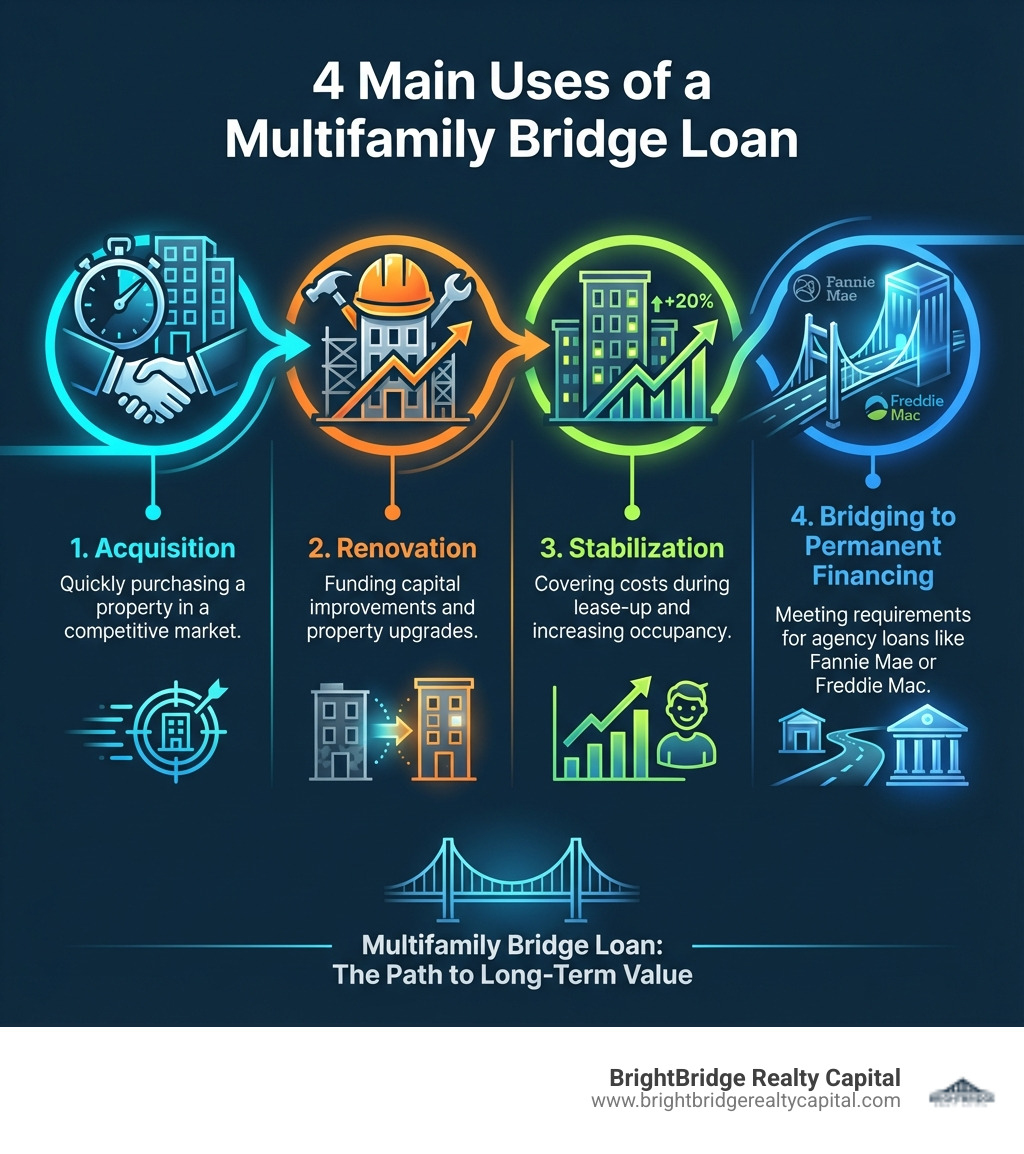
Multifamily bridge loans are not just a financing product; they are a strategic weapon for investors focused on value-add projects and property repositioning. They provide the critical, time-sensitive capital required to transform an underperforming asset into a stabilized, income-producing property, thereby paving the way for highly favorable long-term financing or a profitable sale.
Seizing Time-Sensitive Acquisition Opportunities
In a competitive real estate market, speed is the ultimate currency. A multifamily bridge loan can be the decisive factor that separates a winning bid from a losing one. Imagine a 50-unit building comes to market from a retiring landlord. The property is well-located, but rents are 20% below market, and the units are dated. The seller, eager to move on, is prioritizing a quick, certain close and has set a 21-day deadline. A traditional bank, with its 60-90 day timeline, cannot compete. An investor armed with a bridge loan, however, can confidently make a compelling offer with a hard closing date, effectively competing with all-cash buyers. This advantage is especially potent for acquiring distressed assets, properties emerging from bankruptcy or foreclosure, or in 1031 exchange scenarios where closing deadlines are absolute.
Fueling Renovations and Property Upgrades
One of the most powerful applications of a multifamily bridge loan is financing the capital expenditures (CapEx) needed for renovations. These improvements are the engine of a value-add strategy, directly boosting a property's appeal, rental income, and overall market value. Bridge loans are structured to fund this process. Renovations can range from light cosmetic touches (Tier 3: new paint, fixtures, landscaping) to moderate upgrades (Tier 2: new kitchens, bathrooms, flooring) to extensive gut renovations (Tier 1: reconfiguring floor plans, replacing major systems). A well-structured bridge loan will include a future funding facility for this CapEx, allowing our clients to draw down funds as work is completed. This structure, along with interest reserves to cover debt service during the renovation, ensures the project stays on track without straining the investor's liquidity. More info about renovating your building.
Achieving Stabilization and Lease-Up
Many properties, particularly newly constructed buildings or recently acquired value-add projects, are not yet stabilized. Stabilization is a key milestone, typically defined by lenders as achieving a certain physical occupancy (e.g., 90% or more) for a sustained period (e.g., 90 consecutive days), resulting in a Debt Service Coverage Ratio (DSCR) that meets permanent loan requirements (e.g., 1.25x). A multifamily bridge loan provides the financial runway to get there. It can cover operating shortfalls, property taxes, insurance, and marketing costs during the critical lease-up phase. For example, a bridge loan can provide an 18-to-24-month term, giving an investor ample time to execute renovations, attract new tenants at higher market rents, and establish a consistent revenue stream, thereby transforming the property's economic profile and making it attractive to long-term lenders.
Bridging to Permanent Financing
Perhaps the most explicit function of a multifamily bridge loan is to serve as a temporary, strategic solution until a property is ready for permanent financing. Many of the most desirable long-term loan products—particularly agency loans from Fannie Mae and Freddie Mac, or loans from CMBS lenders and life insurance companies—have strict underwriting requirements for occupancy, net operating income, physical condition, and borrower experience. If a property doesn't meet these benchmarks at the time of acquisition, it's ineligible. A bridge loan provides the capital and, just as importantly, the time to meet those requirements. We specialize in "Bridge-to-Agency" loans, which are specifically designed for investors who acquire or refinance properties with the clear intention of transitioning to permanent agency financing once the asset is stabilized. This strategic approach allows investors to secure much better long-term rates and terms by first improving the asset's financial performance. In many cases, when we provide the subsequent permanent financing, the exit fees on the bridge loan can be waived, creating a seamless, cost-effective transition from acquisition to long-term hold.
Understanding the Anatomy of a Multifamily Bridge Loan
To effectively utilize multifamily bridge loans, it's crucial for investors to understand their financial anatomy. This includes how leverage is calculated, the structure of interest rates and fees, and powerful features like interest-only payments and non-recourse options. Lenders rely on key metrics like Loan-to-Cost (LTC), Loan-to-Value (LTV), and After Repair Value (ARV) to structure the loan, often providing financing up to 85% LTC or 80% LTV based on the projected stabilized value.
For example, consider a property with a purchase price of $8 million and a planned renovation budget of $2 million, for a total project cost of $10 million. The projected After Repair Value (ARV) is estimated at $13 million. A lender might offer a loan based on 80% of the cost, which would be $8 million. This loan would cover the entire purchase price, leaving the investor to fund the renovation and closing costs. Alternatively, a lender might structure the loan at 75% of the ARV, resulting in a loan of $9.75 million, which would cover the acquisition and a significant portion of the renovation budget.
Typical Loan Terms and Structures
When considering a multifamily bridge loan, several key parameters define its structure:
- Loan Amounts: These can vary dramatically based on the asset and lender, ranging from as little as $50,000 for a small property from a local lender to over $75 million for large institutional-grade assets. In markets like New York, for instance, we commonly see bridge loans up to $8 million for stabilization projects.
- Term Lengths: Bridge loans are inherently short-term, with typical initial terms ranging from 12 to 36 months. This timeline is designed to align with the projected duration of the value-add business plan.
- Extension Options: Recognizing that renovation and stabilization can face delays, many loans include built-in extension options. These are typically for 6- or 12-month periods and can be exercised for a fee (e.g., 0.25% to 0.50% of the loan balance), provided the loan is not in default and the project is showing progress.
- Amortization: A primary advantage is that multifamily bridge loans are almost always structured with interest-only payments during the initial term. This means the borrower only pays the interest each month, not any principal, which keeps monthly payments low and preserves capital for renovations and operations.
Interest Rates, Fees, and Associated Costs
The cost of multifamily bridge loans is generally higher than permanent financing, a premium paid for speed, flexibility, and the higher risk associated with transitional assets.
- Floating (SOFR-based) Rates: Most bridge loans today have floating interest rates tied to an index like SOFR (Secured Overnight Financing Rate), which replaced LIBOR as the standard benchmark. The final rate is the index plus a spread (e.g., SOFR + 4.50%). Spreads can range from 350 to 700 basis points (3.5% to 7.0%) over the index, depending on the deal's risk profile. To manage rate risk, many borrowers purchase an interest rate cap.
- Origination Fees: These are upfront charges for underwriting and processing the loan, typically ranging from 1% to 2% of the total loan amount. This is often referred to as "points."
- Exit Fees: Some lenders charge an exit fee, often 0.25% to 1% of the loan balance, upon repayment. This fee is frequently waived if the borrower refinances into a permanent loan with the same lender, creating a seamless capital solution.
- Extension Fees: As mentioned, extending the loan term will incur a fee, typically around 0.25% to 0.50% for each extension period.
- Third-Party Costs: Borrowers are also responsible for third-party reports and legal fees. This includes the appraisal, environmental site assessment (Phase I), property condition report, and the lender's legal counsel fees, which can collectively range from $20,000 to $50,000+ depending on the loan size and complexity.
The Power of Interest-Only Payments and Non-Recourse Options
Two features that make multifamily bridge loans particularly attractive to sophisticated investors are interest-only payments and non-recourse options:
- Interest-Only Payments: This structure dramatically lowers the monthly debt service compared to an amortizing loan. For example, a $5 million loan at an 8% interest-only rate has a monthly payment of $33,333. If that same loan were amortizing over 25 years, even at a lower 6.5% rate, the principal and interest payment would be approximately $33,500. The interest-only structure maximizes cash flow during the value-add phase when revenue is often suppressed, allowing that capital to be reinvested into the property to accelerate stabilization.
- Non-Recourse Options: Many multifamily bridge loans are non-recourse, which means the lender's sole recourse in the event of a default is the property itself. The borrower is not personally liable for the debt. This is a critical feature for protecting the borrower's other personal and business assets. However, all non-recourse loans include "standard carve-outs" for so-called "bad boy" acts like fraud, intentional misrepresentation, or theft, which would trigger personal liability.
The Pros and Cons: A Balanced Perspective
Like any sophisticated financial tool, multifamily bridge loans come with a distinct set of advantages and disadvantages. A clear-eyed, balanced perspective is crucial for investors to determine if this financing option aligns with their specific deal, risk tolerance, and, most importantly, their exit strategy. Ultimately, the decision hinges on weighing the significant rewards of speed and leverage against the inherent risks of higher costs and shorter timelines, all while ensuring a robust and achievable exit plan is in place.
Key Advantages: Speed, Flexibility, and High Leverage
The primary benefits of a multifamily bridge loan are directly tied to the fast-paced, opportunistic nature of real estate investment:
- Speed: This is the single biggest draw. The ability to close in days or weeks, rather than months, is a powerful competitive advantage. What this means for you: You can compete effectively against all-cash buyers, secure deals with tight closing deadlines (like 1031 exchanges or auctions), and capitalize on fleeting market opportunities that traditional financing would force you to miss.
- Flexibility: Bridge loans offer more customizable terms than rigid, one-size-fits-all conventional loans. This includes tailored loan lengths, repayment schedules, and future funding for renovations. Many are also open to prepayment without penalty. What this means for you: You can structure the loan to include renovation funds and have them disbursed as you complete work, rather than needing all the capital upfront. This aligns the financing directly with your business plan.
- High Leverage: These loans often allow for higher leverage, with Loan-to-Cost (LTC) up to 85% and Loan-to-Value (LTV) up to 80% (based on the stabilized value). What this means for you: You can acquire and improve properties with less upfront equity. This conserves your capital for other investments, covers unexpected project costs, and ultimately amplifies your portfolio's growth potential.
- Less Stringent Underwriting: Bridge loan underwriting focuses more on the asset's potential and the sponsor's track record than on historical income or personal tax returns. What this means for you: You can secure financing for properties that don't yet have strong, stabilized cash flow, such as a building with high vacancy or one in the middle of a major renovation.
Potential Disadvantages: Higher Costs and Short Timelines
While powerful, the advantages of multifamily bridge loans are balanced by notable drawbacks that demand careful management:
- Higher Interest Rates: The convenience and speed come at a price. Interest rates are typically several percentage points higher than those for permanent financing, with rates starting around 8% and sometimes reaching the low teens for riskier deals. How to mitigate this risk: Develop a solid, efficient execution plan. The faster you can stabilize the property and exit the loan, the less total interest you will pay. Meticulously model all costs against the projected increase in value to ensure the return on investment justifies the expense.
- Multiple Fees: Beyond the interest rate, bridge loans often include origination fees (1-2%), exit fees (0.25-1%), extension fees (0.25%+), and legal fees. These can add up, increasing the total cost of capital. How to mitigate this risk: Obtain a detailed term sheet and closing cost estimate upfront that clearly lists all potential fees. Ask your lender about waivable fees, such as exit fees for refinancing with them, to create a more cost-effective path.
- Short Timelines: The short-term nature of these loans (typically 12-36 months) creates pressure on investors to execute their business plan quickly and efficiently. Delays in construction, permitting, or lease-up can jeopardize the exit strategy. How to mitigate this risk: Conduct thorough due diligence before closing. Have your general contractor selected, permits in process, and a detailed, realistic timeline for your entire value-add plan. Build in a buffer for unexpected delays.
- Balloon Payments: At the end of the loan term, the full principal balance is due in a single, large balloon payment. If the property isn't stabilized and ready for refinance, or if the capital markets have shifted unfavorably, this can create significant financial strain. How to mitigate this risk: Be proactive. Begin conversations with permanent lenders at least 6-9 months before your bridge loan matures. Track your progress against your pro forma financials to ensure your property is on a clear path to meet the stabilization and DSCR requirements for your take-out financing.
Navigating the Application and Lender Selection Process
Obtaining a multifamily bridge loan involves a process that is streamlined for speed but remains thorough in its evaluation. Effective preparation and choosing the right lending partner are the two most critical factors for a smooth, successful, and certain transaction.
When preparing your application package, meticulous organization is key. A best practice is to create a comprehensive digital folder or physical binder with clear sections for "Property Information," "Sponsor Financials," and "Business Plan." Your business plan is the centerpiece of the application; it must be more than just an idea. It should be a detailed roadmap that outlines your complete repositioning strategy, including a line-item renovation budget, a project timeline with key milestones, pro forma financials showing projected post-renovation income and expenses, and market rent comparables to substantiate your assumptions. Key documents to include are the property address, purchase and sale agreement, current rent roll, trailing 12-month operating statements, and personal financial statements for all key principals.
Eligibility Criteria for a Multifamily Bridge Loan
Lenders evaluate several core factors to determine a borrower's and a project's eligibility:
- Sponsor Experience: Lenders have a strong preference for experienced real estate investors with a proven track record of successfully executing similar value-add projects. If you are a newer sponsor, you can strengthen your application by partnering with an experienced operator or by hiring a professional, well-regarded third-party property management company.
- Real Estate Track Record: A history of successful acquisitions, renovations, and profitable exits is highly valued. Lenders want to see that you have navigated the complexities of a repositioning project before.
- Property Eligibility: Bridge loans are available for a wide range of multifamily assets, including conventional apartments (Class A, B, and C), student housing, affordable housing, and seniors housing. The most common targets are Class B and C properties in good locations, as they typically offer the greatest potential for value creation through renovation and operational improvements.
- Market Location: While we provide financing nationwide, a property's location in a strong, growing market with positive demographic and employment trends significantly impacts its potential for stabilization and a successful exit. Lenders will analyze submarket data to confirm the viability of your rent growth projections.
- Minimum Net Worth and Liquidity: Key principals are typically required to meet certain net worth and post-closing liquidity requirements. This is not just a checkbox; it demonstrates to the lender that you have the financial stability and reserves to handle unexpected costs, construction overruns, or operating shortfalls during the transitional period.
The Application and Closing Process for a Multifamily Bridge Loan
The process for securing a multifamily bridge loan is built for efficiency:
- Initial Sizing & Pre-approval: After an initial discussion and review of basic deal information, many lenders can provide a preliminary loan sizing and pre-approval decision within 24-48 hours.
- Term Sheet: If the project is a good fit, you'll receive a detailed term sheet outlining the proposed loan amount, interest rate, fees, term, and other key conditions. This is a non-binding offer that lays the groundwork for the loan.
- Due Diligence: Once the term sheet is signed and a deposit is paid, the lender begins formal due diligence. This involves ordering third-party reports like the appraisal, environmental report (Phase I ESA), and property condition assessment. The lender's team will also conduct a deep dive into your financial documentation, the rent roll, and market data.
- Underwriting & Credit Committee: The loan officer packages all the information for the internal underwriting team, which scrutinizes the deal's strengths, weaknesses, and risks, with a heavy focus on the feasibility of the exit strategy. The package is then presented to a credit committee for final approval.
- Funding Timeline: Once approved, loan documents are drafted, and the closing is scheduled. The entire process, from term sheet to funding, can range from as little as seven days for a straightforward deal to a more standard 30-45 days for complex transactions.
Choosing the Right Lender: Key Considerations
Selecting the right lender is as important as selecting the right property:
- Direct Lender vs. Broker: As a direct lender, we control the capital and the decision-making process, which translates to faster closings, greater certainty of execution, and a more seamless, transparent experience.
- Certainty of Execution: Look for lenders with a strong reputation for closing on the terms they issue. The last thing an investor needs is for a lender to "re-trade" the deal at the last minute, changing rates or terms just before closing.
- Experience in Multifamily: Choose a lender with deep expertise in multifamily real estate and value-add strategies. They will understand the nuances of your business plan and can be a valuable strategic partner.
- Transparency on Fees: A good lender is upfront and clear about all potential fees—origination, exit, extension, and legal—so you can accurately calculate your total cost of capital.
- Relationship and Future Capabilities: Does the lender view this as a one-off transaction or the beginning of a long-term relationship? A lender with in-house servicing and the ability to provide your permanent financing can offer significant cost savings (e.g., waived exit fees) and a smoother transition for your next phase.
Frequently Asked Questions about Multifamily Bridge Loans
How do current market conditions influence bridge loans?
Current market conditions, especially fluctuations in interest rates and capital availability, significantly influence the use and structure of multifamily bridge loans. In a rising rate environment, for example, permanent financing can become more expensive and harder to obtain, increasing the demand for bridge loans as a solution. Investors may use a bridge loan to acquire a property and lock in financing for 2-3 years, giving them time to execute their value-add plan while hedging against further rate increases. The flexibility of bridge loans often allows for an early payoff without penalty, so if rates unexpectedly decrease, an investor can refinance into a cheaper permanent loan ahead of schedule. Furthermore, in volatile markets where property values might be uncertain (i.e., cap rates are expanding), a bridge loan provides the time needed to increase a property's Net Operating Income (NOI) through renovations and rent growth. This increased NOI can offset a higher cap rate, ensuring the property still appraises at a value sufficient for a successful refinance exit.
What are "standard carve-outs" in a non-recourse loan?
While multifamily bridge loans are often non-recourse—meaning the lender agrees not to pursue the borrower's personal assets in a default—this protection is not absolute. All non-recourse loans contain "standard carve-outs," also known as "bad boy guarantees." These are specific actions by the borrower that are so egregious they effectively void the non-recourse protection and trigger full personal liability. These carve-outs are designed to ensure the borrower acts in good faith and protects the lender's collateral. Common examples include:
- Fraud or material misrepresentation during the application process.
- Misappropriation or theft of property income, insurance proceeds, or security deposits.
- Gross negligence or willful misconduct in the management of the property.
- Filing for voluntary bankruptcy or colluding in an involuntary bankruptcy.
- Making an unauthorized transfer or sale of the property without the lender's consent.
- Failing to pay property taxes or insurance, leading to a lien or lapse in coverage.
- Causing or failing to remediate environmental contamination on the property.
Can a bridge loan be used for a value-add investment strategy?
Absolutely. A multifamily bridge loan is the quintessential financing tool for value-add strategies. These loans are specifically structured to facilitate the acquisition and transformation of underperforming properties. By using a bridge loan, investors can:
- Acquire Quickly: Act decisively on undervalued properties that do not qualify for traditional financing due to their current physical or financial state.
- Fund Renovations: Secure the capital needed for both the acquisition and the subsequent renovation budget, often within a single loan structure with future funding for CapEx.
- Stabilize Operations: Cover operating expenses, interest payments (sometimes through a built-in reserve), and lease-up costs to methodically increase occupancy and rental income.
Mini Case Study: An investor group used a $12 million bridge loan to acquire a 150-unit, 1980s-vintage Class C apartment complex. The loan was structured with $10 million for the acquisition and a $2 million facility for renovations. Over an 18-month period, the investor systematically renovated all unit interiors, updated the exterior paint, and added a community dog park and fitness center. This allowed them to increase average rents by $350 per unit. Once the property reached 92% occupancy for 90 days, it was appraised at a new stabilized value of $18 million. The investor then secured a $13.5 million (75% LTV) permanent loan, which paid off the $12 million bridge loan in full, returned all of their initial equity, and provided additional tax-free cash-out proceeds.
What is the difference between a bridge loan and a hard money loan?
While the terms are sometimes used interchangeably, there are key distinctions. Both are short-term, asset-based loans that close quickly. However, multifamily bridge loans are typically provided by more institutional private lenders, debt funds, or banks for larger commercial assets. They tend to have more formal underwriting, slightly lower interest rates (e.g., SOFR + 3.5% to 7.0%), and are used for clear value-add or stabilization business plans. Hard money loans are often funded by smaller groups of private investors or individuals, carry higher interest rates (e.g., 10% to 15%+) and higher points, have shorter terms (6-12 months), and are more commonly used for smaller residential properties (1-4 units) or land deals. Think of bridge lending as the institutional, more refined version of hard money lending.
Conclusion: Is a Multifamily Bridge Loan Your Next Strategic Move?
For the savvy real estate investor, a multifamily bridge loan is far more than just temporary financing; it's a powerful strategic tool designed to create value and unlock opportunity. Throughout this guide, we've seen how these loans offer unparalleled speed and flexibility, enabling investors to seize time-sensitive acquisitions, fuel ambitious renovation projects, and methodically stabilize properties that are not yet ready for conventional financing. The ability to make interest-only payments preserves crucial cash flow for the business plan, while non-recourse options (with standard carve-outs) provide a critical layer of personal liability protection.
The ideal candidate for a multifamily bridge loan is an investor with a clear vision and a plan. This is typically an experienced operator who can identify an underperforming asset, create a detailed roadmap for adding value, and execute that plan within a defined timeframe. A well-defined exit strategy—whether that's refinancing into permanent debt or executing a profitable sale—is not just a suggestion; it is the cornerstone of a successful bridge loan transaction. While the higher costs and shorter timelines demand meticulous planning and disciplined execution, the strategic advantage and profit potential gained often far outweigh these considerations.
Before pursuing a bridge loan, ask yourself these critical questions:
- The Deal: Is this opportunity time-sensitive or for an asset that cannot qualify for permanent financing today?
- The Plan: Does the property have clear, demonstrable value-add potential? Have I created a detailed, line-item budget and a realistic timeline for my business plan?
- The Exit: Do I have a clear and viable exit strategy? Have I modeled the future valuation and confirmed that a refinance or sale is achievable within the loan term?
- The Numbers: Have I run the numbers to ensure the projected profit margin comfortably exceeds the higher costs associated with the bridge loan?
- The Team: Do I have the experience, team, and resources (contractors, property management) to execute the plan successfully and on schedule?
At BrightBridge Realty Capital, we understand the intricate nuances of the multifamily market in New York and across the nation. We don't just provide capital; we partner with our clients to help them navigate the complexities of their projects and unlock the full potential of their real estate investments. If you have a project that could benefit from quick, flexible capital and a clear path to long-term success, a conversation with an experienced loan officer can provide the clarity you need. We invite you to explore your options with us.
Get a quote for your stabilized bridge loan today and let us help you bridge the gap to your next successful venture.