Nationwide Hard Money: Fast Funding for Your Real Estate Ventures

Summary
Unlock fast real estate funding with Nationwide hard money. Learn how to get quick capital for fix-and-flip, new construction, and commercial deals.
Why Real Estate Investors Turn to Nationwide Hard Money Lending
In the high-stakes world of real estate investment, speed is not just an advantage; it's a necessity. Nationwide hard money lending has emerged as the definitive solution for investors who need to act decisively. This specialized financing provides fast, flexible capital secured by the intrinsic value of a property, not by a borrower's personal financial history. For savvy investors, it's the key to unlocking opportunities that would otherwise be lost to slower, more bureaucratic funding methods.
Here’s a deeper look at what makes nationwide hard money lending indispensable:
- Unparalleled Speed: The ability to close a deal in 3-10 business days is a stark contrast to the 45-60 day (or longer) timeline required by traditional banks. This speed transforms an investor's offer into a near-cash equivalent, giving them immense leverage in competitive bidding situations.
- Asset-Centric Approval: Approval is fundamentally based on the property's existing equity and its After-Repair Value (ARV). This means a project with strong potential can get funded even if the borrower has a complex income situation or a credit score that doesn't meet stringent bank criteria.
- Versatile Application: Hard money is not a one-size-fits-all product. It is adaptable to a wide array of investment strategies, including fix-and-flip projects, the acquisition of rental properties, ground-up new construction, and the purchase or refinancing of commercial assets.
- Broad Geographic Access: True nationwide lenders operate across state lines, providing consistent and reliable funding without the geographic restrictions often imposed by local banks or credit unions.
- Strategic Loan Terms: These are short-term instruments, typically ranging from 6 to 24 months, with interest rates generally between 9% and 15%. The terms are designed to bridge the gap from acquisition to stabilization or sale, allowing the investor to execute their plan and exit.
Imagine this common scenario: a perfectly distressed property hits the market in a desirable neighborhood—an ideal fix-and-flip. You know it will be gone in days. With a traditional bank, the process is a non-starter. You'd be required to submit years of tax returns, detailed profit and loss statements, personal bank statements, and employment verification. After weeks of document gathering, you'd face an even longer wait for the underwriting committee to review your file. By that time, the property you identified is not just under contract; it has likely already been sold to an all-cash buyer or an investor using hard money.
Hard money loans solve this critical timing problem. They bypass the bureaucracy by focusing on the two elements that truly matter for a successful investment: the value of the asset and the viability of your exit strategy. In today's competitive markets, where multiple offers are the norm, presenting a seller with a financing contingency that allows for a 10-day close is profoundly more attractive than one that requires a 60-day waiting period. As industry data consistently shows, hard money lenders can approve and fund loans in an average of just 14 days, with expedited deals closing in as little as 3-5 days. This velocity is the difference between securing a highly profitable project and being left on the sidelines.
Whether your goal is to flip a single-family home, build a robust portfolio of rental units, or develop a commercial property from the ground up, hard money lending provides a clear and efficient path to financing when traditional avenues are closed or simply too slow. These loans are specifically engineered for the needs of real estate investors, not conventional homeowners, and they prioritize the deal's profit potential over rigid, backward-looking financial metrics.
I'm Daniel Lopez, a dedicated loan officer at BrightBridge Realty Capital. My expertise lies in structuring nationwide hard money loans that empower investors across the country. From complex fix-and-flip projects and portfolio acquisitions to time-sensitive commercial deals, I have a track record of simplifying the financing process. My mission is to help you close deals with confidence and speed, enabling you to build lasting wealth through real estate.
What is a Hard Money Loan and How Does It Work?
A hard money loan is a short-term financing instrument secured directly by real estate. In fundamental contrast to traditional mortgages, which place heavy emphasis on a borrower's creditworthiness and income history, hard money lenders prioritize the property's value, equity, and potential. This asset-based lending philosophy makes it an indispensable tool for real estate investors who require rapid access to capital or who may not meet the rigid criteria of conventional financial institutions.
The capital for these loans comes from private sources rather than large depository banks. Hard money lenders are typically private investment companies, groups of high-net-worth individuals, or mortgage funds that use their own capital. The term "hard" in "hard money" is a direct reference to the "hard asset"—the physical property—that collateralizes the loan. This distinction is crucial, as it underpins the entire lending model, which is built on speed, flexibility, and a pragmatic assessment of the real estate deal itself.
The primary benefits are transformative for investors. They include exceptionally fast approval and funding timelines, highly flexible and common-sense underwriting, and the ability to finance properties that banks would categorically reject. For investors operating in fiercely competitive markets like New York, NY, this speed is a strategic weapon, enabling them to compete with all-cash offers and seize opportunities that demand immediate action.
However, this accessibility and speed come with important trade-offs. Hard money loans inherently carry higher interest rates and origination fees than traditional bank loans. Their repayment terms are also much shorter, typically ranging from six months to a few years. It is absolutely essential for borrowers to perform meticulous due diligence and incorporate these higher financing costs into their investment analysis to ensure the project's profitability.
Hard Money vs. Traditional Bank Loans
To fully grasp the strategic value of Nationwide hard money, it's vital to compare it directly against traditional bank financing. The analogy of a sprint versus a marathon is apt; both will get you to a finish line, but they are designed for entirely different purposes and operate at vastly different paces.
| Feature | Hard Money Loans | Traditional Mortgages |
|---|---|---|
| Approval Basis | Primarily property value (collateral/asset-based). Focus on LTV and ARV. | Borrower's credit score, income, debt-to-income (DTI) ratio, and employment history. |
| Speed | Extremely fast, with closings in as little as 3-10 business days. | Extremely slow, with an average closing time of 45-60 days or more. |
| Loan Term | Short-term, typically 6 months to 2 years, with some flexibility for extensions. | Long-term, most commonly 15 or 30 years. |
| Interest Rates | Higher, typically ranging from 9% to 15% or more, reflecting higher risk and speed. | Lower, historically ranging from 4% to 7% for highly qualified borrowers. |
| Borrower Focus | Exclusively for business purposes, serving real estate investors, flippers, and developers. | Primarily for consumers (homebuyers) and long-term property owners. |
| Documentation | Streamlined; focuses on the property, purchase contract, and renovation budget. | Extensive; requires tax returns, pay stubs, bank statements, and detailed personal financial data. |
As the comparison illustrates, the differences are profound. While a traditional mortgage is the ideal instrument for a homebuyer planning to live in a property for decades, it is fundamentally ill-suited for the fast-paced, opportunity-driven world of professional real estate investment.
Key Benefits of Nationwide Hard Money
At BrightBridge Realty Capital, we specialize in delivering the core advantages that make Nationwide hard money a formidable tool for investors.
- Speed of Funding: This remains the number one reason investors seek hard money. While a bank's 45-60 day closing process causes deals to fall through, we can approve and wire funds in a matter of days. This rapid execution allows you to acquire properties at auction, meet a seller's tight closing deadline, or lock down a deal before competing offers can materialize.
- Flexible Underwriting: Our underwriting process is built on logic and the value of the asset. We are not bound by the rigid, automated decision-making models used by banks. If you have a solid investment property with significant equity and a clear, profitable exit strategy, we can often look past issues like a recent job change, self-employment status, or minor blemishes on a credit report.
- Less Credit-Dependent: For investors with a FICO score below the typical 720+ required by conventional lenders, or for those with a limited credit history (such as new investors or foreign nationals), hard money offers a vital lifeline. The property's value and potential are the primary qualifiers, not your personal credit history.
- Access to Capital for Unique Properties: Traditional lenders are risk-averse and often have strict prohibitions against financing certain types of properties. This includes distressed homes needing significant renovation, non-owner-occupied properties, commercial buildings in transition, or properties with zoning irregularities. We embrace these opportunities, providing capital for a wide range of projects that banks simply will not consider.
- Seizing Fleeting Market Opportunities: In dynamic real estate markets like New York, NY, the window of opportunity can open and close in an instant. A motivated seller, an off-market deal, or a short-sale opportunity requires the ability to act immediately. Our fast funding provides the agility you need to capitalize on these moments before they vanish.
Potential Risks and How to Mitigate Them
While the advantages are compelling, a prudent investor must also understand and plan for the associated risks.
- Higher Costs: Hard money loans feature higher interest rates (e.g., 9-15%) and origination fees, known as points (e.g., 1-5% of the loan amount). These costs compensate the lender for the increased risk, speed, and flexibility they provide.
- Mitigation: Meticulous financial modeling is key. You must build every single cost—interest payments, points, closing costs, and fees—into your project's budget from day one. Your projected profit margin must be robust enough to comfortably absorb these expenses. A deal with thin margins is not a good candidate for hard money.
- Risk of Foreclosure: The short-term nature of these loans means the repayment deadline approaches quickly. Unexpected project delays, such as contractor issues or permitting hold-ups, or budget overruns can put you at risk of defaulting on the loan, which could lead to foreclosure.
- Mitigation: A bulletproof exit strategy is non-negotiable. Before you even apply, you must have a primary and secondary plan. For a fix-and-flip, this means having a conservative After-Repair Value (ARV) supported by strong market comparables. For a rental, it means having a clear path to refinance into a long-term loan. Additionally, maintaining a contingency fund (reserves) to cover unexpected costs and potential delays is a critical best practice.
- Importance of a Solid Exit Strategy: This is not just a suggestion; it is a core underwriting requirement. Lenders must be convinced that you have a well-researched, realistic plan to repay the loan in full at maturity.
- Mitigation: Your exit strategy must be detailed and backed by data. If you plan to sell, provide at least three recent, comparable sales that justify your projected sale price. If you plan to refinance, provide quotes from long-term lenders or demonstrate that the property's projected cash flow will meet the criteria for a DSCR loan.
- Calculating All Costs Upfront: The total cost of a hard money loan goes beyond the interest rate and points. You must account for appraisal fees, inspection costs, legal fees, title insurance, and closing costs.
- Mitigation: Demand absolute transparency from your lender. We provide a detailed term sheet and closing statement that clearly itemizes every single fee. There should be no surprises at the closing table. If a lender is vague about costs, consider it a major red flag.
- Working with Transparent Lenders: The private lending industry is less regulated than traditional banking, and unfortunately, some unscrupulous players exist. Partnering with a reputable, honest lender is paramount to your success.
- Mitigation: Conduct thorough due diligence on your lender. Check their state licensing and look for their NMLS number. Scour online reviews on platforms like Yelp!, Google, and BiggerPockets. Ask for references from past borrowers. A reputable lender will encourage your questions and provide clear, straightforward answers.
The Ultimate Guide to Nationwide Hard Money Loans
Nationwide hard money loans are a remarkably versatile financial instrument, strategically designed for the modern real estate investor navigating dynamic markets like New York, NY. Their application extends far beyond a single investment model, proving effective for a diverse range of strategies including fix-and-flips, rental portfolio construction, new development projects, and commercial property repositioning. At BrightBridge Realty Capital, our objective is to serve as a catalyst for your portfolio's growth by providing efficient, reliable, and strategically structured capital.

Who Are the Primary Borrowers?
Hard money loans are tailored for a specific class of borrowers who prioritize speed, certainty of execution, and flexibility over the lower costs of traditional financing. These investors understand that the opportunity cost of a lost deal far outweighs the higher expense of a hard money loan.
- Real Estate Flippers (Fix-and-Flip Investors): This is the quintessential hard money borrower. A flipper's business model depends on acquiring undervalued properties, renovating them efficiently, and selling them quickly for a profit. Hard money allows them to close in days, securing the property before competitors, and often provides the capital needed to fund the renovations as well.
- Landlords and Buy-and-Hold Investors (BRRRR Method): Investors using the BRRRR (Buy, Rehab, Rent, Refinance, Repeat) strategy heavily rely on hard money for the initial acquisition and rehab phases. They use a short-term hard money loan to quickly purchase and renovate a property. Once the property is stabilized and rented, they refinance into a long-term, lower-rate conventional or DSCR loan to pull their capital out and repeat the process.
- Real Estate Developers: Developers use hard money for land acquisition and vertical construction. When a prime parcel of land becomes available, a developer can use a hard money loan to secure it quickly. This financing can also cover initial development costs (soft costs) before they can secure a larger, traditional construction loan, or it can fund the entire project if bank financing is unavailable.
- Borrowers with Credit or Income Hurdles: An investor might have a significant down payment and a wealth of experience, but a recent business venture could make their income look inconsistent on paper, or a past financial event may have damaged their credit score. For these borrowers, who have substantial equity or a great deal, hard money lenders offer a path to financing where banks would see a dead end.
- Self-Employed and Full-Time Investors: Traditional lenders require extensive income verification through W-2s and pay stubs. For self-employed investors, whose income is documented through complex tax returns with numerous write-offs, this can be a nightmare. Asset-focused hard money lenders bypass this by concentrating on the property's value, offering a far more streamlined and logical process.
Common Loan Purposes and Property Types
The adaptability of Nationwide hard money allows it to be deployed across a vast spectrum of real estate projects and asset classes, particularly in diverse urban environments like New York, NY.
- Single-Family Residences (SFR): The bread and butter of many investors. Used for fix-and-flip projects, acquiring rental properties, or as a bridge loan.
- Multi-Family Properties (2-4 Units): Ideal for investors looking to scale their rental portfolios. Hard money can be used to acquire and renovate duplexes, triplexes, and quadplexes.
- Apartment Buildings (5+ Units): We provide financing for larger multi-family complexes, funding acquisitions, value-add renovations (e.g., upgrading units to increase rents), or providing bridge financing until the property is stabilized for long-term debt.
- Commercial Properties: This broad category includes retail spaces (strip malls, standalone storefronts), office buildings, hotels/motels, self-storage facilities, industrial warehouses, and medical facilities. Hard money is often used to reposition these assets.
- Mixed-Use Properties: Common in urban cores like New York, NY, these properties combine residential apartments with ground-floor retail or office space. Hard money lenders understand the dual income streams and complex valuation of these assets.
- Undeveloped Land: For developers, hard money can fund the acquisition of raw land (land loans) or lots that are ready for construction (shovel-ready lots).
- Bridge Loans: A critical tool used to "bridge" a gap in financing. For example, an investor might use a bridge loan to purchase a new investment property before the sale of their existing property has closed, effectively allowing them to act without a sale contingency.
- Cash-Out Refinance: For investors who own property with significant equity, a hard money cash-out refinance allows them to quickly tap into that equity to raise capital for a new investment, a business need, or any other purpose.
How Lenders Determine Eligibility and Terms
When we underwrite a hard money loan, our analysis is laser-focused on the strength of the deal and the quality of the underlying asset. While borrower experience is a factor, it is secondary to the property's economic potential.
- Loan-to-Value (LTV): This is the ratio of the loan amount to the property's current appraised value. For a purchase, it's based on the lesser of the purchase price or the appraised value. For a refinance, it's based on the current appraised value. Lenders typically offer up to 65-75% LTV. For example, on a property valued at $500,000, a 75% LTV loan would be $375,000.
- After-Repair Value (ARV): This is the most critical metric for renovation projects. ARV is the estimated market value of the property after all proposed improvements are completed. An appraiser determines this value based on the renovation plan and comparable sales of recently updated properties. We often lend up to 70-75% of the ARV. This ensures that upon completion, there is sufficient equity to guarantee a profitable sale or a successful refinance.
- Loan-to-Cost (LTC): Highly relevant for construction and heavy renovation projects, LTC measures the loan amount as a percentage of the total project cost (purchase price + renovation costs). Some lenders, especially for experienced borrowers, may offer up to 90% LTC, which can significantly reduce the borrower's out-of-pocket cash requirement.
- Borrower Experience and Track Record: While not the primary factor, a borrower's history matters. An investor with a documented track record of successful projects may be offered more favorable terms, such as a higher LTV/LTC, a lower interest rate, or fewer points. For new investors, a well-structured deal and a clear plan are essential to demonstrate capability.
- Property and Market Analysis: We conduct a deep dive into the property itself—its location, condition, and unique attributes. We analyze market trends, absorption rates, and recent comparable sales (comps) to validate the investment thesis. In a market like New York, NY, a block-by-block analysis is often necessary.
- Exit Strategy Evaluation: Your plan for repaying the loan is paramount. We rigorously scrutinize your proposed exit. If the plan is to sell, is the ARV realistic and supported by market data? If the plan is to refinance, does the projected rental income support the debt service coverage ratio (DSCR) required by long-term lenders? A vague or overly optimistic exit strategy is a common reason for a loan to be declined.
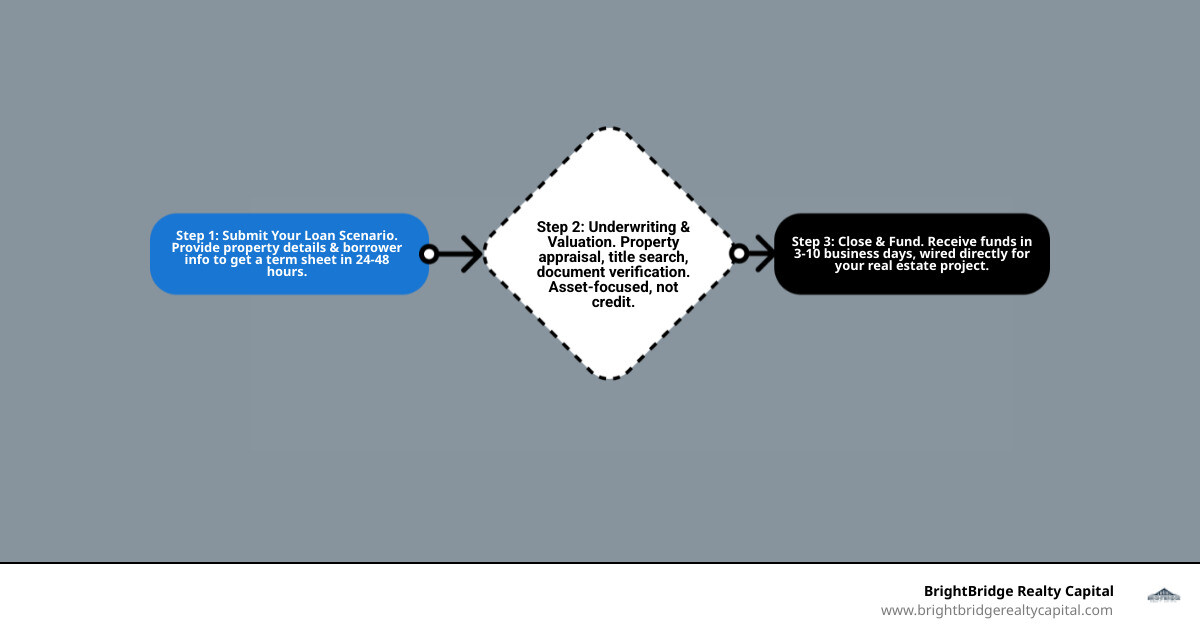
The Application and Funding Process: From Inquiry to Closing
One of the most compelling features of Nationwide hard money lending is the radically streamlined and efficient application-to-funding timeline. We have meticulously engineered our process to eliminate the bottlenecks and redundancies that plague traditional lending. As a direct lender, we control the entire process from start to finish, meaning fewer intermediaries, faster decisions, and a more transparent, seamless experience for you, the investor.

Step 1: Submitting Your Loan Scenario
The journey begins not with a mountain of paperwork, but with a simple conversation. We encourage you to reach out with your investment scenario so we can quickly assess its viability.
- Initial Inquiry and Application: The first step is to provide us with the high-level details of your deal. This can be done through a simple online form or a 15-minute phone call. You'll provide basic information about yourself or your business entity (e.g., LLC), a summary of your real estate investment experience, and the core details of the property you wish to finance.
- Key Property and Project Details: We need to understand the asset. Be prepared to provide the property address, property type, purchase price, and a summary of your plans. For a renovation project, this includes an estimated rehab budget and the projected After-Repair Value (ARV). For a rental, it includes projected rents.
- Essential Borrower Information: While we are asset-focused, we do need to understand the borrower. We will ask for a summary of your liquidity (to verify you have funds for the down payment, closing costs, and reserves) and run a credit report. It's important to reiterate that a low credit score is not an automatic disqualifier if the deal is strong.
- Rapid Deal Analysis: Our experienced loan officers will immediately analyze your scenario. We are trained to identify the key strengths and potential weaknesses of a deal within minutes. We are looking for a sound investment opportunity with a logical path to profitability and a clear exit.
- Receiving a Preliminary Term Sheet: If your project aligns with our lending criteria, we will issue a preliminary term sheet (also known as a Letter of Intent or LOI). This document is a non-binding offer that clearly outlines the proposed loan amount, interest rate, origination points, loan term, and other key conditions. You can expect to receive this within 24-48 hours of your initial submission.
Step 2: Underwriting and Property Valuation
Once you review and accept the preliminary terms, we immediately initiate the formal underwriting process. This is where our asset-based approach delivers maximum efficiency.
- Focused, Asset-Based Underwriting: Our underwriting team's primary focus is on the real estate. We cut through the red tape that bogs down conventional lenders, concentrating on validating the property's value and the feasibility of your business plan. We verify the numbers you provided and ensure the deal makes sense from a risk-management perspective.
- Property Appraisal and Valuation: We will order a third-party appraisal to determine the property's as-is market value and, for renovation projects, its After-Repair Value (ARV). For hard money loans, appraisers are often selected for their expertise in investment properties and their ability to complete reports on an expedited timeline. This valuation is the cornerstone of our loan amount calculation.
- Title Search and Insurance: A clean and clear title is essential for any real estate transaction. We will order a title search from a reputable title company to ensure there are no outstanding liens, judgments, or ownership disputes (i.e., a "cloud on title"). Once the title is cleared, a lender's title insurance policy is secured to protect our lien position.
- Streamlined Document Verification: We will request a concise list of necessary documents. This typically includes your signed purchase and sale agreement, entity documents (like your LLC operating agreement and articles of organization), a detailed renovation budget or scope of work, and bank statements to verify your proof of funds for the equity contribution. Our goal is to keep this as simple and straightforward as possible.
Step 3: Closing and Funding Your Deal
This is the final and most critical stage, where our commitment to speed culminates in you getting the keys to your property.
- Preparation of Final Loan Documents: Once underwriting is complete and all conditions have been satisfied, our legal team prepares the final, binding loan documents. These typically include the Promissory Note (your promise to repay), the Deed of Trust or Mortgage (which secures the property as collateral), the Loan Agreement (detailing the terms and conditions), and a Personal Guaranty.
- Closing Coordination: We work in close partnership with the title company or closing attorney to schedule a smooth and efficient closing. We are equipped to handle both in-person and remote closings to accommodate your needs.
- Direct Wiring of Funds: Immediately upon the execution of all closing documents, the loan funds are wired directly to the title company. The title company then disburses the funds to the seller and any other necessary parties, officially completing the transaction.
- The Power of a Fast Close: While traditional bank loans can languish in underwriting for 45-60 days, our entire process, from application to funding, is frequently completed within 3-10 business days. For highly organized borrowers with straightforward deals, we have closed in as little as 3-5 days. This speed makes your offer nearly as powerful as cash, giving you a decisive edge in any negotiation.
How to Find and Choose a Reputable Lender
Successfully navigating the world of Nationwide hard money is critically dependent on the quality of your lending partner. A truly reputable lender is far more than just a source of capital; they are a strategic ally who possesses a deep understanding of real estate investment, offers sound advice, and is invested in your success. The due diligence you perform when selecting a lender is every bit as important as the due diligence you conduct on the property itself.
Vetting a Reputable Nationwide Hard Money Lender
Here is a comprehensive checklist for vetting potential lenders to ensure you partner with a transparent and reliable professional:
- Verify Licensing and Credentials: Legitimate lenders are licensed to operate. For loans in New York, NY, and other states, verify their credentials. A key resource is the NMLS Consumer Access website, where you can search for a company or individual loan originator by their NMLS ID number. This confirms they are registered and meet federal and state standards. A lender who cannot provide an NMLS ID should be avoided.
- Scrutinize Online Reviews and Reputation: The experiences of past borrowers are invaluable. Go beyond the testimonials on the lender's own website. Search for them on independent platforms like Google Reviews, Yelp!, and real estate investment forums like BiggerPockets. Look for consistent themes. Are they praised for speed, transparency, and communication? Or are there recurring complaints about last-minute changes, hidden fees, and unresponsiveness? Pay attention to how the lender responds to negative reviews, as this can reveal their commitment to customer service.
- Demand Absolute Transparency on Rates and Fees: A trustworthy lender will be completely upfront about all costs. Be wary of any lender who gives vague answers or quotes an exceptionally low rate without providing a detailed breakdown. Insist on a written term sheet that itemizes every single charge. Common "hidden fees" to watch out for include: processing fees, underwriting fees, document preparation fees, legal review fees, and exit or prepayment penalties. We believe in total transparency, ensuring you understand every line item before you commit.
- Assess Communication, Responsiveness, and Expertise: In the fast-paced world of real estate, time is money. A good lender will be highly responsive, returning your calls and emails promptly. More importantly, they should be able to provide clear, knowledgeable answers to your questions about loan structures, market conditions, and the closing process. If you struggle to get a call back during the initial inquiry phase, it's a major red flag for how they will perform when your deal is on the line.
- Ask for References: Don't be afraid to ask the lender for references from recent borrowers or real estate professionals they work with (like agents or title companies). A confident, reputable lender will be happy to connect you with people who can vouch for their performance.
Current Trends in the Nationwide Hard Money Market
The Nationwide hard money market is dynamic and constantly evolving, shaped by technological innovation, economic shifts, and the changing needs of sophisticated real estate investors. At BrightBridge Realty Capital, we remain at the forefront of these trends to provide the most effective and competitive financing solutions.
- The Rise of Specialized Loan Products for Rental Portfolios: The demand for rental properties has led to the creation of innovative loan products beyond the traditional fix-and-flip loan. The most significant of these is the DSCR (Debt Service Coverage Ratio) loan. DSCR loans qualify a borrower based on the property's ability to generate cash flow to cover the mortgage payment, rather than on the borrower's personal income. This allows investors to scale their rental portfolios more easily and is often used as the long-term refinancing exit for a short-term hard money bridge loan.
- Integration of Technology for Unprecedented Speed: The hard money industry is rapidly adopting technology to accelerate every stage of the lending process. Online application portals, automated document collection systems, and AI-driven data analytics for preliminary underwriting are becoming standard. This technological integration is the primary driver behind the dramatic reduction in closing times, turning a process that once took weeks into one that can be completed in days.
- Increased Flexibility and Customization for Experienced Investors: As the market matures, lenders are increasingly recognizing the value of repeat business from seasoned investors. For borrowers with a proven track record of successful projects, lenders are offering greater flexibility. This can manifest as higher leverage (e.g., higher LTV or LTC, sometimes financing 100% of renovation costs), lower interest rates and points, and more customized loan structures, such as lines of credit for multiple projects.
- Heightened Competition and Rate Compression: The success and growth of the hard money sector have attracted more capital and more lenders into the space. This increased competition has had a positive effect for borrowers, leading to more competitive interest rates and fees, especially for high-quality deals in desirable markets. This makes it more important than ever for investors to compare term sheets from multiple reputable lenders to secure the best possible financing.
- Focus on Bridge-to-Perm Solutions: Sophisticated lenders are no longer just offering a short-term loan; they are providing a complete financing solution. This means offering a hard money bridge loan for acquisition and rehab, with a clear and pre-approved path to a long-term rental loan (like a DSCR loan) from the same lender once the project is complete. This creates a seamless, one-stop-shop experience for the investor, reducing uncertainty and streamlining the entire BRRRR process.
Frequently Asked Questions about Hard Money Lending
As specialists in Nationwide hard money, we encounter many excellent and insightful questions from both new and experienced investors. Clarity is key to a successful partnership, so we've compiled detailed answers to some of the most common inquiries we receive.
Can I get a hard money loan with bad credit?
Yes, in many cases, you absolutely can. This is one of the most fundamental advantages of hard money lending. Our underwriting process is asset-based, meaning our primary focus is on the intrinsic value of the real estate collateral and its potential after renovation (the After-Repair Value or ARV). A borrower's personal credit score is a secondary consideration, not the primary gatekeeper it is with a traditional bank. While we do review your credit history as part of our overall risk assessment, a strong deal with significant protective equity and a well-defined exit strategy can often compensate for a low FICO score, a past bankruptcy, or other credit challenges. We have successfully funded many investors whose property presented a compelling investment opportunity, even when their personal credit was less than perfect.
What are the typical interest rates and fees?
Hard money loans have higher costs than conventional bank loans, which is a direct reflection of the speed, flexibility, reduced documentation, and increased risk the lender undertakes.
- Interest Rates: Typically, interest rates range from 9% to 15%. The exact rate depends on several factors, including the perceived risk of the deal, the loan-to-value (LTV) ratio, the property type, the location, and your experience as a borrower. A seasoned investor with a low-LTV deal on a standard property will receive a more favorable rate than a first-time flipper with a high-LTV deal on a complex project.
- Origination Fees (Points): Lenders charge an upfront fee, known as points, to originate the loan. One point is equal to 1% of the total loan amount. These fees typically range from 1 to 5 points. For example, on a $300,000 loan, 2 points would equal a $6,000 fee, which is usually deducted from the loan proceeds at closing.
At BrightBridge Realty Capital, we are committed to full transparency. We provide a detailed term sheet that clearly outlines all rates and fees, so you can accurately budget your project costs with no surprises.
How quickly can a hard money loan be funded?
The speed of funding is the hallmark of Nationwide hard money and a primary reason investors utilize this financing. While a traditional bank loan can take a grueling 45 to 60 days (or more) to close, a hard money loan can often be funded in just 3 to 10 business days from the initial application. This incredible speed is possible because our underwriting is streamlined and asset-focused. The process hinges on a quick, professional property appraisal and a clean title report. The exact timeframe is often dependent on how quickly we can get an appraiser to the property and receive the completed report, but our internal processes are designed for maximum velocity. Our goal is always to get you funded as fast as possible so you can secure your investment opportunity.
Can I use a hard money loan to buy a primary residence?
Generally, no. Hard money loans are commercial financial products intended for business purposes only—specifically, for real estate investment properties that will be flipped or held for rental income. They are not intended for owner-occupied primary residences or second homes. This is due to strict consumer protection laws, such as the Dodd-Frank Act and the Truth in Lending Act (TILA), which impose significant regulations and disclosure requirements on loans made to consumers for personal, family, or household purposes. Reputable hard money lenders structure their loans for business-entity borrowers (like an LLC) to ensure compliance and focus exclusively on investment properties.
What is a 'draw' in a construction or rehab loan?
When a hard money loan includes funds for renovation or construction, the lender does not typically give you all the construction money upfront. Instead, the funds are disbursed in stages, known as "draws," as work is completed. The process usually works like this: You complete a phase of the project (e.g., demolition and framing) using your own capital. You then submit a draw request to the lender, who will send an inspector to the property to verify that the work has been completed according to the agreed-upon scope of work. Once verified, the lender reimburses you for that phase of the project. This draw process protects both the borrower and the lender by ensuring loan funds are used as intended and the project is progressing on schedule.
What happens if I can't repay the loan when the term ends?
This is a critical question that highlights the importance of a solid exit strategy. If you are approaching the maturity date of your loan and are not ready to repay it, the first step is to communicate with your lender immediately. If the project is progressing well and you just need more time, many lenders will offer a loan extension. An extension typically involves a fee (e.g., 1% of the loan balance) and allows you to extend the loan term for a set period, such as 3 or 6 months. However, if you default on the loan without an extension, the lender has the right to begin foreclosure proceedings to take control of the property and recover their capital. This is why having a realistic timeline and contingency plans is essential.
Conclusion: Seize Your Next Real Estate Opportunity
Nationwide hard money loans are far more than a simple financing alternative; they are a powerful strategic tool meticulously crafted for the modern real estate investor. In the fast-paced, hyper-competitive markets of today, particularly in dynamic hubs like New York, NY, the ability to act with speed and certainty is what separates successful investors from the rest. The unparalleled velocity and flexibility offered by hard money lending can be the single most decisive factor in acquiring lucrative properties, executing time-sensitive projects, and ultimately, building substantial, generational wealth through real estate.
These loans are the engine for a variety of investment strategies. For the fix-and-flip investor, they provide the speed to capture a deal and the capital to transform it. For the BRRRR investor, they are the critical first step in a scalable system of portfolio growth. For the developer, they are the bridge from raw land to a completed project. By focusing on the asset's value rather than the borrower's past, hard money lending opens doors that traditional finance firmly shuts.
At BrightBridge Realty Capital, we live and breathe real estate investment. Our entire business is built around providing customized, nationwide financing solutions that empower our clients. We are a direct lender, which means our commitment to fast closings, competitive rates, and a seamless, transparent process is not just a promise—it's the foundation of our model. We eliminate the bureaucratic delays and frustrating uncertainty of traditional lenders because we understand that in your business, time is your most valuable asset. We are here to help you convert potential into tangible profit.
Don't let slow, inflexible financing be the bottleneck that stands between you and your next great deal. The opportunities are out there, but they won't wait. It's time to partner with a lender who can move at the speed of your ambition. Get started on your next real estate venture by submitting your loan scenario to BrightBridge Realty Capital today. Let's work together to build your success story, one profitable deal at a time.