The Ultimate Guide to Private Hard Money and Interim Real Estate Financing

Summary
Discover private hard money loans: rates, LTV, fix-and-flip strategies, risks & exit plans for real estate investors.
What Is Private Hard Money (and Is It Right for You)?

Private hard money is a short-term, asset-based loan funded by private individuals or companies — not banks — where the property itself serves as the primary collateral. Unlike traditional financing, which relies heavily on the borrower's personal financial history, hard money focuses on the intrinsic value of the real estate asset and the viability of the specific project.
Here's a quick snapshot of the typical landscape:
| Feature | Private Hard Money |
|---|---|
| Loan basis | Property value (LTV/ARV), not credit score |
| Typical interest rates | 10% to 18% (depending on risk and region) |
| Loan-to-value (LTV) | 50% to 75% of current or after-repair value |
| Loan terms | 6 to 18 months (extensions up to 36 months) |
| Closing speed | As fast as 5 to 10 business days |
| Points (fees) | 2 to 6 points (1 point = 1% of loan amount) |
| Best for | Fix-and-flip, bridge financing, distressed assets, time-sensitive deals |
If you've ever been told "no" by a bank — or couldn't wait 45 to 60 days for a traditional mortgage to clear the underwriting hurdles — private hard money exists specifically to fill that gap. It is the "grease" in the gears of the real estate market, allowing investors to move with the speed of a cash buyer while maintaining their own liquidity.
It's important to understand that this is not a long-term mortgage solution. It's a strategic tool: fast, flexible, and built around the deal, not your tax returns or debt-to-income ratios. These loans have been a staple of the American real estate market since the late 1950s. During that era, shifts in the U.S. credit industry and tightening bank regulations pushed savvy investors toward alternative financing. What was once a "lender of last resort" niche has evolved into a sophisticated, multi-billion dollar industry used by professional flippers, commercial developers, and portfolio investors who prioritize speed and execution over the lowest possible interest rate.
But like any powerful financial tool, it comes with significant trade-offs. Higher interest rates, shorter repayment timelines, and real consequences if a project stalls or an exit strategy fails. This guide walks you through every nuance — from the mechanics of underwriting to the legal protections and strategic use cases.
I'm Daniel Lopez, a loan officer at BrightBridge Realty Capital in New York. I've spent years helping borrowers navigate complex private hard money structures across residential and commercial deals. I've seen how these loans can save a deal from the brink of collapse and how they can be used to scale a real estate empire. I'll share the insider perspective on what works, what doesn't, and what red flags you should watch for.
Simple private hard money word guide:
Understanding Private Hard Money: Definition and Mechanics
At its core, a Hard money loan is a specific type of financing where the borrower receives funds based primarily on the value of a specific parcel of real estate. Unlike a bank that looks at your W-2s, tax returns, and debt-to-income (DTI) ratio for months, we look at the "hard asset"—the property itself. This is why it is called "hard" money; the security is the physical, tangible asset.
In private money lending, the property acts as the ultimate safety net. If a borrower stops paying, the lender takes the property through foreclosure to recoup the investment. Because of this, lenders are much more concerned with the quick-sale value (what the property would sell for in a 30-to-60-day window) rather than a speculative future market value. These are often referred to as non-conforming loans because they don't "conform" to the rigid, standardized guidelines set by government-sponsored entities like Fannie Mae or Freddie Mac.

The Evolution of Private Hard Money
The industry has undergone a massive transformation since its 1950s origins. Back then, it was often seen as a "lender of last resort" for those in financial distress. However, the landscape shifted significantly after the 2008 financial crisis. New regulations like the Dodd-Frank Act and the Basel III accords made it much harder for traditional banks to lend on "risky" projects, such as fix-and-flips, ground-up construction, or distressed properties. Banks became risk-averse, focusing only on the most pristine borrowers and properties.
This created a massive vacuum in the market that was filled by professional organizations and institutional private lenders. Groups like the National Private Lenders Association have helped standardize the industry, moving it away from "guy-with-a-checkbook" lending toward sophisticated, business-purpose loans with clear terms and professional servicing. Today, private hard money is a primary choice for serious investors who prioritize speed, scalability, and the ability to close multiple deals simultaneously.
How Lenders Assess Risk and Determine Loan Amounts
When we evaluate hard money real estate loans, we aren't just looking at the purchase price. We perform a deep dive into the asset's current and potential value through several lenses:
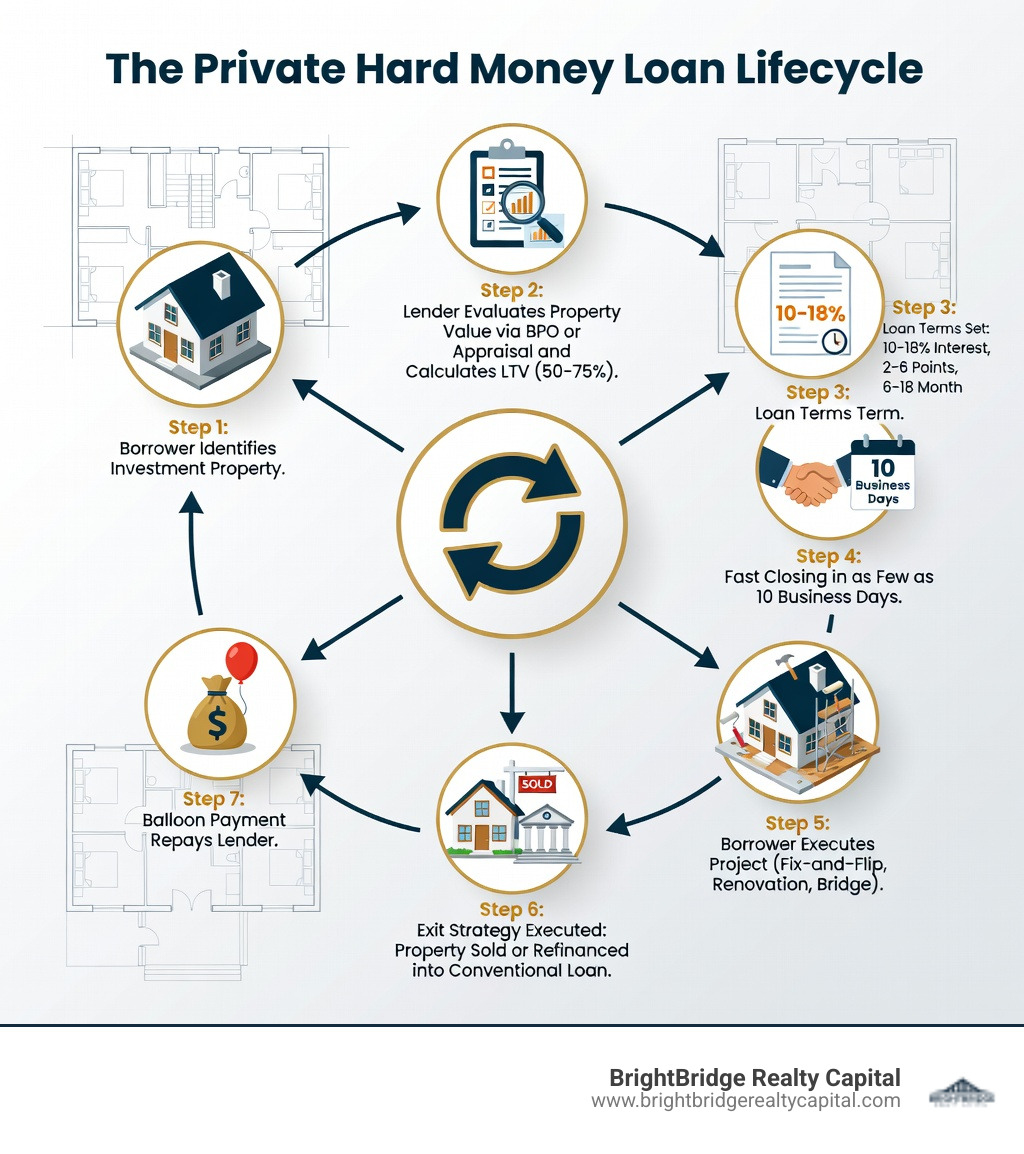
- Broker Price Opinion (BPO): Often, instead of a full 2-week appraisal, we use a BPO or a simplified appraisal to get a fast, accurate look at what local experts think the property is worth in its current state. This allows us to move at the speed of the market.
- First Lien Position: To protect our capital, we almost always require a "first lien position." This means if the property is sold or foreclosed upon, we are the first ones to get paid. Second liens are rare in the hard money world and usually carry much higher interest rates.
- Personal Guarantees: Even though the loan is asset-based, most professional lenders require a personal guarantee. This means you are personally responsible for the debt, ensuring you have "skin in the game" and are committed to the project's success.
- Liquidity Requirements: We want to see that you have enough cash on hand to cover the interest payments, the down payment, and any unexpected renovation costs. We don't want to see a borrower spend their last dollar just to get to the closing table.
- Experience Level: While we lend to new investors, your track record matters. A borrower who has successfully completed five flips in the same neighborhood will often receive better terms (lower rates and higher LTV) than a first-time investor.
Hard Money vs. Traditional Bank Loans
The biggest difference between private lending vs bank financing is the hierarchy of priorities. Banks care about you (your credit score, your job stability, your historical income). Private lenders care about the deal (the property value, the renovation plan, and the exit strategy).
According to Experian research on hard money mechanics, traditional banks often take 30 to 50 days to close a loan. In a competitive market like New York, Los Angeles, or Miami, that delay can cost you the deal. Private hard money lenders can often fund in as little as 7 to 10 business days because they aren't bogged down by the same federal regulatory oversight that requires extensive "ability to repay" documentation for consumer loans.
| Feature | Traditional Bank Loan | Private Hard Money |
|---|---|---|
| Approval Time | 30–60 Days | 3–10 Days |
| Credit Score | Usually 680–740+ | Flexible (often 600+) |
| Property Condition | Must be move-in ready | Can be distressed/dilapidated |
| Documentation | Extensive (Tax returns, pay stubs) | Minimal (Focus on asset/exit) |
| Down Payment | 3%–20% | 20%–35% |
| Loan Term | 15–30 Years | 6–24 Months |
Why Investors Choose Private Hard Money
Speed is the most obvious answer, but flexibility is the secret sauce. Many private real estate lenders can look past a recent foreclosure, a bankruptcy, or a low credit score if the property has significant equity. For example, if you are buying a property for $200,000 that is actually worth $400,000, a private lender will likely fund that deal regardless of your personal credit history because the collateral is so strong.
Furthermore, banks generally refuse to lend on properties that are in poor condition—those with no functioning kitchen, mold issues, or structural damage. For an investor, these are often the best deals because they can be purchased at a steep discount. Private financing serves as a means-to-an-end financing tool. You use the high-cost capital to secure and fix the property, then transition to cheaper bank debt once the property is "stabilized" and meets traditional banking standards.
The Role of Private Hard Money in Fix-and-Flip Projects
For hard money fix and flip lenders, the goal is to provide renovation capital quickly. If you find a distressed brownstone in Brooklyn that needs a total gut job, a bank won't touch it. Private hard money allows you to buy it, fund the repairs through a "draw schedule," and get it back on the market while the "traditional" buyers are still waiting for their bank's appraisal to come back. This speed-to-market is what allows flippers to beat out the competition and secure properties that would otherwise be lost to cash buyers. In many cases, a hard money approval letter is treated as being "as good as cash" by sellers.
Key Metrics: Rates, LTV, and Costs
Understanding the math is crucial before signing a term sheet. You aren't just paying interest; you are paying for the speed, the risk the lender is taking, and the convenience of the capital. Hard money is expensive capital, but when used correctly, it yields a higher return on equity than using your own cash.
Typical Terms and Points
A LendingTree guide on hard money costs notes that interest rates typically range from 10% to 18%. While that sounds high compared to a 7% mortgage, remember that you are usually only paying it for a few months, not 30 years.
- Points: These are upfront fees paid at closing. One point equals 1% of the loan amount. Most hard money bridge loans charge between 2 and 4 points. These points cover the lender's overhead, underwriting costs, and the risk of the short-term nature of the loan.
- Interest-Only Payments: To keep your monthly cash flow manageable during the renovation phase, most of these loans don't require you to pay down the principal every month. You pay the interest, and then pay the full loan balance (the "balloon payment") at the end of the term.
- Duration: Most terms are 6 to 18 months. If you need more time because of permit delays or contractor issues, some lenders offer extensions for an additional fee (usually 0.5 to 1 point).
Understanding Borrower Costs and Fees
Beyond interest and points, you need to budget for several other line items that can impact your bottom line:
- Appraisal or BPO Fees: Usually $500–$1,500. This is paid upfront to verify the property value.
- Legal Documentation: Since these are custom contracts often involving LLCs, legal fees can range from $1,000 to $3,000. This covers the drafting of the note, mortgage, and personal guarantee.
- Rehab Draw Fees: If you are getting a hard money rehab loan, the lender will send an inspector to check your progress before releasing funds for the next phase of work. Each "draw" usually costs $200 to $500.
- Title Insurance and Recording Fees: These are standard costs for any real estate transaction to ensure the title is clear and the lien is properly recorded.
Key Math Terms to Know:
- LTV (Loan-to-Value): The percentage of the current value we will lend (e.g., 70% of a $100k house = $70k loan).
- ARV (After-Repair Value): What the property will be worth after you fix it up. Many lenders will lend up to 70% or 75% of the ARV. This is the most important metric for flippers.
- LTC (Loan-to-Cost): The percentage of the total project cost (purchase + repairs) that the lender will cover. Some lenders will cover 80-90% of the total cost if the ARV supports it.
- Debt Service Coverage Ratio (DSCR): For rental properties, lenders look at whether the rent covers the mortgage payment. A DSCR of 1.2 means the rent is 20% higher than the loan payment.
Strategic Use Cases and the Importance of an Exit Strategy
Private hard money isn't just for flippers. It's a versatile tool for various real estate hurdles that require creative financing solutions.
Who Benefits Most from Private Hard Money?
- Developers: Using hard money construction loans to get a project out of the ground, complete the foundation and framing, and then qualify for a traditional construction draw once the project is "de-risked."
- Land Buyers: Land is notoriously hard to finance through banks because it doesn't produce income. Private lenders often step in here, lending based on the land's potential for development.
- "Asset Rich, Cash Poor" Borrowers: If you have a property worth $1 million with no mortgage but your credit is 550 due to a medical emergency or business failure, you can still get a loan based on that equity to restart your business or consolidate debt.
- Rental Investors: Using hard money rental property loans to "BRRRR" (Buy, Rehab, Rent, Refinance, Repeat). Hard money provides the initial capital to buy and fix the property, which is then refinanced into a long-term 30-year rental loan.
Cross-Collateralization and Blanket Mortgages
If you don't have enough of a down payment for a new deal, some hard money bridge loan lenders allow you to use equity in other properties you own as collateral. This is called cross-collateralization. By "blanketing" multiple properties under one loan, you can often achieve 100% financing on your new purchase because the lender's total risk is spread across several assets. This is a powerful way to scale a portfolio without constantly needing new cash injections.
Defining a Viable Exit Strategy
This is the most important part of your application. A hard money lender doesn't want to own your property; they want their money back with interest. According to FDIC insights on commercial lending, having a clear, documented "exit" is what separates a professional investor from a gambler. If you don't have a plan for how to pay the loan back in 12 months, you shouldn't take the loan.
Common exit strategies include:
- Selling the Property: The most common for flippers. The loan is paid off at the closing table when the new buyer's funds arrive.
- Refinancing: Moving the debt to a long-term, lower-interest hard money rental complete guide or a conventional bank loan once the repairs are done and the property is occupied by a tenant.
- Cash-Out Refinance: Using the new, higher value of the property to pull out your initial investment and pay off the hard money loan, effectively leaving you with a cash-flowing asset and no money left in the deal.
Risk Management and Legal Protections
While private hard money is less regulated than consumer mortgages, it isn't the "Wild West." There are significant legal frameworks and risk management strategies that protect both parties.
Risks for Borrowers and Lenders
For borrowers, the biggest risk is the cost of time. If your project takes 18 months instead of the planned 6, those 12% interest payments will eat your profit alive. There is also the risk of foreclosure. Because these loans have shorter windows and balloon payments, if you can't sell or refinance by the time the term is up, the lender can take the property. This is why having a "Plan B" exit strategy is vital.
For lenders, the risk is market volatility and project failure. If property values drop by 20% or if a contractor disappears with the renovation budget, the equity cushion disappears. This is why most professional private real estate loans cap out at 65-75% LTV. They need that 25-35% buffer to protect their investors' capital in case of a market downturn.
Legal Protections and Usury Laws
Every state has laws regarding the maximum interest rate a lender can charge. In New York, for example, usury laws are quite strict for personal loans. To comply with these laws, most hard money loans are structured as "business-purpose" loans made to an LLC or Corporation rather than an individual. This is a standard industry practice that also provides the borrower with some liability protection.
As a borrower, you should always look for transparency. Avoid lenders who ask for large "upfront fees" before they've even given you a formal commitment letter. A reputable lender will follow best practices outlined in the OCC handbook on commercial real estate, ensuring all fees are disclosed on the closing statement (HUD-1 or Settlement Statement). Always have a real estate attorney review your loan documents to ensure there are no "predatory" clauses like excessive prepayment penalties or hidden fees.
How to Become a Private Money Lender
If you have extra capital and don't want to swing a hammer, you can be the lender. Small-time investors often start by "parking" their cash with established firms or by funding deals for people they trust in their local real estate investment association (REIA).
However, jumping in head-first is risky. We recommend reading a private money lender complete guide or investing in a managed hard money fund. This allows you to earn a passive return (usually 8-12%) while the fund manager handles the "dirty work" of underwriting, site visits, checking HUD statements, and managing the legal process of foreclosure if a deal goes south. It's a way to get real estate exposure without the headaches of property management.
Frequently Asked Questions about Private Hard Money
What is the difference between hard money and a bridge loan?
The terms are often used interchangeably in the industry. However, "hard money" usually refers specifically to the asset-based nature of the loan, often for distressed properties needing work. A "bridge loan" is a broader term for any short-term loan that "bridges" the gap until permanent financing or a sale occurs. All hard money loans are bridge loans, but not all bridge loans are hard money loans.
Can I get a hard money loan for a primary residence?
Generally, no. Most private lenders strictly avoid "owner-occupied" residential loans. These loans are subject to heavy consumer protection regulations (like the Truth in Lending Act and the Ability-to-Repay rule) that make them legally risky for private lenders. Private hard money is almost exclusively for investment, commercial, or business purposes.
How do I find a reliable private lender in New York?
Look for lenders with a physical presence and a long track record in the local market. New York is a unique market with specific foreclosure laws and building codes. If you are looking for hard money loans nyc, hard money loans new york, or a specific hard money loan ny, ensure the lender understands the nuances of the five boroughs and the surrounding counties.
Do I need an LLC to get a hard money loan?
While not always strictly required by law, most professional lenders require you to close in the name of an LLC. This clarifies that the loan is for a business purpose and provides a layer of legal separation between your personal assets and the investment project.
What happens if I can't pay the balloon payment on time?
Communication is key. Most lenders would rather grant a 3-month extension (for a fee) than go through the expensive and time-consuming process of foreclosure. If you have a valid reason for the delay (like a pending sale or a slow permit office), most lenders will work with you. However, if you stop communicating, the lender will move to protect their investment through legal action.
Conclusion
Private hard money is the fuel that keeps the real estate investment engine running. It provides the speed to win auctions, the flexibility to fix "un-bankable" houses, and the leverage to grow a portfolio significantly faster than you could with your own cash alone. It is a sophisticated tool for sophisticated investors who understand that the cost of capital is secondary to the opportunity that capital creates.
At BrightBridge Realty Capital, we specialize in being a direct lender. We don't act as "middlemen" who shop your deal around to dozens of different sources; we use our own capital to provide quick, nationwide solutions. We understand the urgency of real estate and the need for common-sense underwriting that looks beyond a credit score.
Whether you're doing your first flip in Queens, renovating a multi-family complex in Texas, or looking for a bridge to stabilize a commercial asset, we focus on making the process seamless and transparent. Ready to move on a deal? More info about stabilized bridge services can help you transition from a high-interest rehab loan into a steady, long-term position. Let's get your next project funded and your vision realized.