Unlock Your Investment Potential: A Guide to Rental Property Loans

Summary
Unlock your investment potential with rental property financing. Learn loan types, requirements & benefits for real estate success.
Why Rental Property Financing Matters for Your Investment Success
For aspiring and seasoned investors alike, the path to financial freedom is often paved with real estate. But unlocking that potential requires a crucial tool: rental property financing. This isn't just about getting a loan; it's about securing the right capital to build a wealth-generating machine. It works fundamentally differently than getting a loan for your primary home, and understanding these differences is the first step toward success. Lenders view an investment property not as a home, but as a business—and they underwrite the loan accordingly.
Here’s a snapshot of what that means for you:
- Larger down payments: Expect to put down 15-25% (or more). Lenders require more "skin in the game" to ensure you're committed to the investment's success.
- Higher credit scores: While you might get a primary mortgage with a lower score, for investment properties, most lenders want to see 680+, and often 740+ for the best terms on non-owner-occupied properties.
- Stricter requirements: You'll need significant cash reserves (typically 6-12 months of payments), lower debt-to-income ratios, and a stronger overall financial profile to prove you can handle the added risk.
- More financing options: The world of investment finance is vast. Beyond conventional loans, you can explore powerful tools like DSCR loans, hard money loans, portfolio loans, and creative strategies like seller financing.
- Interest rates run higher: Rates are typically 0.5-3% above primary residence rates. This isn't arbitrary; it's how lenders price in the higher perceived risk of an investment property loan.
For over 145 years, real estate has been a proven wealth builder, consistently outperforming stocks and bonds through cycles of boom and bust. Investment properties offer a powerful combination of steady cash flow, significant tax benefits, long-term appreciation potential, and critical portfolio diversification. But these benefits are only accessible if you can secure the right financing to acquire the assets in the first place.
The challenge? Traditional banks, while reliable, often move too slowly for competitive real estate markets. Their rigid, one-size-fits-all qualification criteria can sideline even creditworthy investors, and their requirements become even stricter as you try to scale your portfolio beyond one or two properties. This is precisely where understanding all your financing options becomes a strategic advantage.
I'm Daniel Lopez, a loan officer at BrightBridge Realty Capital, where I specialize in helping investors navigate complex rental property financing structures. I've guided everyone from first-time house hackers using an FHA loan on a duplex to experienced portfolio builders leveraging DSCR loans to acquire multiple properties without touching their personal income documents. Whether you're buying your first rental or expanding a multi-property empire, I'll walk you through exactly how rental property loans work and which options are best suited to your unique investment strategy.
Understanding Investment Property Loans
An investment property loan is a mortgage specifically used to purchase a residential property you plan to rent out for income or, in some cases, renovate for a profitable resale. These loans are designed for properties that are not your primary residence, such as single-family homes, condominiums, duplexes, triplexes, fourplexes, and even small apartment buildings. The fundamental difference from a primary mortgage lies in how lenders perceive and calculate risk. Because you won't be living in the property, lenders consider it a business venture and a higher-risk investment. This perspective directly influences the qualification requirements, loan terms, and interest rates you'll be offered.
Owner-Occupied vs. Non-Owner-Occupied
A crucial distinction in rental property financing is whether the property will be owner-occupied. This single factor dramatically changes your loan options, making real estate investing more accessible than many beginners realize.
Owner-occupied investment property loans are for multi-unit properties (two to four units) where you live in one unit and rent out the others. This popular strategy, known as "house hacking," is arguably the best entry point for new investors. By purchasing a duplex, triplex, or fourplex and living in one unit for at least one year, you can qualify for the highly favorable financing terms typically reserved for primary residences. For example, an FHA loan can require as little as 3.5% down, and a VA loan may offer 0% down for eligible veterans. Conventional loans for owner-occupied 2-4 unit properties also become more accessible, with potential down payments as low as 5% and more lenient credit score requirements (sometimes as low as 620). The trade-off is that you become a landlord to your neighbors, which requires a certain temperament, but the financial advantages are immense.
Non-owner-occupied investment property loans are the standard for investors building a portfolio of rentals where they do not intend to live. From a lender's standpoint, the risk profile is significantly higher. Statistical data shows that in times of financial hardship, a borrower is far more likely to default on a rental property mortgage than on the mortgage for their own home. This increased "propensity to default" is why lenders impose stricter requirements to mitigate their risk.
Key Differences from a Primary Mortgage
Here’s a more detailed breakdown of how investment property loan requirements differ from those for a primary home:
- Down Payment: Expect to put down 15-25% or more. For a conventional loan on a single-unit investment, 15% is sometimes possible, but 20% is more common. For 2-4 unit non-owner-occupied properties, 25% is the standard requirement. This larger equity position gives you more "skin in the game," reducing the lender's risk.
- Credit Score: A minimum score of 620 is the absolute floor for most programs, but a score of 680-740+ is strongly preferred and necessary to secure competitive terms on non-owner-occupied properties. A higher score demonstrates a history of responsible credit management and can unlock lower interest rates.
- Cash Reserves: Lenders need to see that you have a safety net. You'll be required to have 6 to 12 months of the property's total monthly mortgage payment (PITI: Principal, Interest, Taxes, and Insurance) in liquid assets. These funds must be separate from your down payment and closing costs and serve as a buffer for vacancies, unexpected repairs, or other income disruptions.
- Debt-to-Income (DTI) Ratio: Your DTI ratio (total monthly debt payments divided by gross monthly income) is a critical metric. For investment properties, lenders prefer a lower DTI, typically below 45%, to ensure you can comfortably handle the additional mortgage payment. The good news is that they will often allow you to use a portion of the property's projected rental income to help you qualify.
- Interest Rates: To compensate for the higher risk, interest rates on investment property loans are typically 0.5% to 3% higher than for primary residences. This practice is known as risk-based pricing; the higher the perceived risk, the higher the rate.
- Underwriting: The underwriting process is more rigorous and detailed. Lenders will meticulously scrutinize your entire financial picture, including your income stability, the source of your down payment funds (expect to explain any large, recent deposits), and your experience as an investor. They will also use 75% of the property's projected rental income (based on a lease or a rental appraisal) to offset the new mortgage payment, a crucial calculation that can make or break a deal.
Exploring Your Rental Property Financing Options
Once you understand the fundamental differences in underwriting, the next step is to choose the right financing path for your specific deal. The good news is that investors have a wider array of tools at their disposal than typical homebuyers. The challenge is figuring out which one aligns with your strategy, timeline, and financial profile. At BrightBridge Realty Capital, we believe the right financing can make or break an investment. Let's walk through your options, from the most traditional to the most creative.

Traditional Financing: Conventional & Government-Backed Loans
Conventional loans are the workhorses of rental property financing. These are loans issued by private lenders that conform to the guidelines set by Fannie Mae and Freddie Mac. They are the standard, go-to option for many investors with strong financial profiles. You'll typically need a 15-25% down payment and a credit score above 620 (with 680+ being much more competitive). Lenders also prefer a debt-to-income ratio below 36-45%. The main advantages are competitive 30-year fixed rates and predictable terms. The downsides include a slower, more document-intensive approval process and a limit on the number of properties you can finance (typically 10).
If you plan to house hack (live in one unit of a 2-4 unit property), conventional loans become more accessible, potentially allowing for a down payment as low as 5% on a duplex or 15-20% on a triplex/fourplex.
Government-backed loans like FHA and VA are primarily for primary residences but can be masterfully used for investment purposes. If you buy a multi-unit property and live in one unit for at least a year, you can unlock incredible terms. An FHA loan allows for a 3.5% down payment and is more forgiving on credit scores. For 3-4 unit properties, it may be subject to a "self-sufficiency test" to ensure the rental income covers the mortgage. Eligible veterans can use a VA loan for the same purpose with zero down payment, a benefit that is nearly unmatched in the lending world.
Flexible Rental Property Financing Strategies
When traditional loans don't fit the speed or scale of your ambitions, alternative financing becomes essential.
Hard money loans are short-term (1-3 years), asset-based loans ideal for fix-and-flips or acquiring a property quickly in a competitive market. Lenders focus on the property's After Repair Value (ARV) rather than your personal income, allowing for closings in as little as 7-10 days. In exchange for this speed and flexibility, expect higher interest rates (8-15%) and origination fees. They are an entry strategy, not a long-term hold solution.
Private money loans come from individual investors, often within your personal or professional network. Terms are highly negotiable, offering unparalleled flexibility. This could mean a lower down payment, a creative payment structure, or financing for a project a bank wouldn't touch. It's crucial to formalize the agreement with a promissory note and a mortgage or deed of trust to protect both parties.
DSCR loans (Debt Service Coverage Ratio) are a game-changer for scaling a portfolio. These loans qualify you based almost entirely on the property's income, not your personal DTI. The lender calculates the DSCR by dividing the property's Net Operating Income by its total mortgage payment (PITI). If the ratio is above a certain threshold (typically 1.20x or higher), you can get the loan—no W-2s or personal tax returns needed. This is a powerful tool for self-employed investors or those who have hit the conventional loan limit, and it's a specialty at BrightBridge Realty Capital.
Portfolio loans are offered by smaller banks and credit unions that keep loans "in-house" rather than selling them. This gives them more underwriting flexibility. They are particularly useful for investors with more than 10 financed properties or those with unique financial situations. A common type is a "blanket loan," which covers multiple properties under a single mortgage, simplifying management.
Bridge loans provide temporary financing to "bridge" the gap between buying a new property and selling an existing one or securing long-term financing. They are short-term and asset-based, similar to hard money, but are often used to unlock equity from one property to purchase another.
Seller financing (or owner financing) occurs when the property seller acts as the lender. The buyer makes mortgage payments directly to the seller. All terms—interest rate, down payment, loan term—are negotiable. This can be a fantastic way to bypass traditional bank requirements, but it's crucial to have an attorney review the agreement to ensure you're protected.
Home equity loans and HELOCs let you borrow against the equity in your primary residence. A Home Equity Line of Credit (HELOC) is a revolving line of credit, like a credit card, which is great for ongoing renovation costs. A home equity loan provides a one-time lump sum. Both can be used to fund a down payment or an entire all-cash purchase, but it's vital to remember your primary home is the collateral.

| Loan Type | Speed | Down Payment | Qualification Basis | Best For |
|---|---|---|---|---|
| Conventional | Moderate-Slow | 15-25%+ | Borrower's credit, income, DTI | Long-term rentals, stable income, good credit |
| DSCR | Fast-Moderate | 20-25%+ | Property's cash flow (rental income) | Experienced investors, portfolio growth, less income verification |
| Hard Money | Very Fast | 10-25%+ | Property's value (ARV) | Fix-and-flips, quick acquisitions, short-term |
| Private Money | Flexible | Negotiable | Relationship, property, investor's discretion | Unique situations, flexible terms |
| HELOC/Equity | Moderate | N/A (uses equity) | Borrower's credit, primary home equity | Down payments, leveraging existing assets |
Refinancing Your Rental Property
Refinancing is a critical strategy for managing and growing your portfolio. A cash-out refinance lets you take out a new, larger mortgage to access the equity you've built, providing tax-free cash that can fund your next purchase or pay for renovations. This is the cornerstone of the popular BRRRR (Buy, Rehab, Rent, Refinance, Repeat) strategy. A rate-and-term refinance simply replaces your current loan with a new one to secure a lower interest rate or change the loan term (e.g., from a 15-year to a 30-year to improve cash flow). Refinancing is also the standard exit strategy for short-term loans, like converting a hard money loan into a long-term DSCR or conventional loan once a property is renovated and stabilized with a tenant.
Qualifying for Your Loan: Requirements & Application
Securing rental property financing requires meticulous preparation and a deep understanding of what lenders are looking for. They aren't just lending you money; they are becoming your business partner. Their goal is to identify financially sound borrowers who grasp the risks and rewards of real estate investment. Knowing what to expect and preparing in advance can transform a daunting process into a straightforward one.

Building a Strong Borrower Profile
Before you even apply, your goal should be to present yourself as an ideal candidate. This means taking proactive steps:
- Credit Health Check: Pull your credit reports months in advance. Dispute any errors, pay down high-balance credit cards to lower your utilization, and ensure a consistent history of on-time payments.
- Aggressive Saving: Start building your capital stack. This includes not only your down payment but also your closing costs (typically 2-5% of the purchase price) and the required cash reserves.
- Document Organization: Create a digital folder and begin gathering all necessary financial documents. Having everything ready demonstrates your seriousness and organization, making the lender's job easier and your approval faster.
Key Requirements for Rental Property Financing
Lenders need to see that you have the financial discipline and a sufficient cushion to handle an investment property. Here are the core requirements you'll need to meet:
- Credit Score: While a 620 score might technically get you in the door for some programs, you should aim for 680 or higher for conventional loans. A score of 740+ is the gold standard for securing the best interest rates and terms on non-owner-occupied properties.
- Down Payment: Be prepared to put down 15% to 25% of the purchase price. This larger equity stake immediately reduces the lender's risk and demonstrates your commitment to the property.
- Debt-to-Income (DTI) Ratio: Lenders typically want to see a back-end DTI (all your monthly debt obligations, including the new proposed mortgage, divided by your gross monthly income) below 45%. They will often count 75% of the property's projected rental income to help you qualify, which can significantly improve your DTI calculation.
- Cash Reserves: You must have liquid funds to cover 6 to 12 months of the property's PITI (principal, interest, taxes, and insurance). These funds must be readily accessible in accounts like checking, savings, or a brokerage account, and they are separate from your down payment.
The Application and Documentation Process
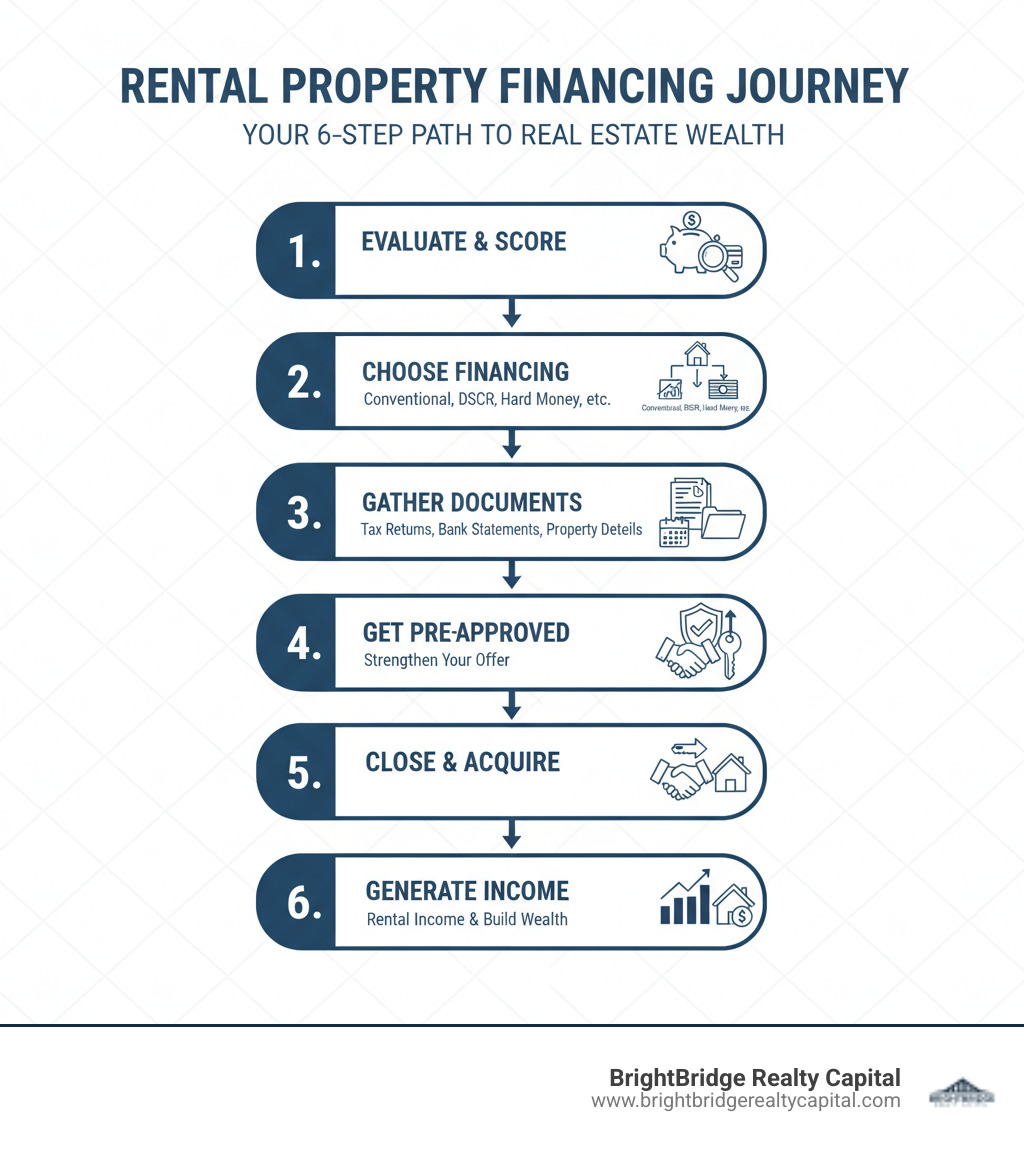
Getting pre-approved before you shop for properties is a non-negotiable first step. It clarifies your budget, strengthens your negotiating position, and shows sellers you're a serious, qualified buyer. The documentation process is thorough but predictable. Be prepared to provide:
- Income Verification: Typically two years of W-2s and federal tax returns, plus your last 30 days of pay stubs. If you're self-employed, lenders will average the net income from your last two years of tax returns.
- Asset Verification: Two to three months of statements for all asset accounts (checking, savings, 401k, brokerage) to verify your down payment and cash reserves. Be ready to source and explain any large, non-payroll deposits with a paper trail.
- Rental Income Proof: For an occupied property, you'll need a copy of the current lease agreement. For a vacant property, the appraiser will complete a Comparable Rent Schedule (Form 1007) to establish a market rent value, which the lender will use for qualifying.
- Property Appraisal: The lender will order an independent appraisal to confirm the property's market value and condition, ensuring they aren't lending more than the asset is worth.
- Credit Report: The lender will pull your credit report to review your payment history, outstanding debts, and overall creditworthiness.
At BrightBridge Realty Capital, we streamline this process. As a direct lender, we make the decisions in-house, which means faster turnarounds, fewer documentation hurdles, and a clear path to closing so you can secure your investment opportunity without delay.
Why Invest? Benefits & Key Metrics
When you successfully secure the right rental property financing, you're not just buying a building—you're acquiring a powerful asset designed to generate wealth from multiple angles, often around the clock. Understanding the full spectrum of benefits and the metrics used to measure them is essential for making smart investment decisions.

The Multifaceted Benefits of Owning Rental Properties
The appeal of rental properties goes far beyond simply collecting a rent check. Here's what makes this strategy so powerful:
- Consistent Cash Flow: After all operating expenses and the mortgage are paid, the remaining monthly rent becomes a predictable income stream. This cash flow can supplement your primary income, or, with enough properties, replace it entirely.
- Property Appreciation: Historically, US home prices have consistently outpaced inflation. This means your asset grows in value over time. This includes natural appreciation from market demand and forced appreciation, which you create by making strategic improvements that increase the property's value and rental income.
- The Power of Leverage: This is perhaps the most potent wealth-building tool in real estate. With a 20% down payment of $60,000 on a $300,000 property, you control 100% of the asset. If that property appreciates by just 5% in one year, its value increases by $15,000. That $15,000 gain represents a 25% return on your initial $60,000 cash investment, not including cash flow.
- Significant Tax Benefits for Landlords: The IRS allows you to deduct nearly all expenses associated with owning and operating a rental, including mortgage interest, property taxes, insurance, repairs, and property management fees. The most powerful benefit is depreciation—a "paper loss" that allows you to deduct a portion of the property's value (the structure, not the land) over 27.5 years for residential real estate. This can significantly reduce or even eliminate your taxable income from the property. Furthermore, a 1031 Exchange allows you to defer paying capital gains taxes when you sell a property, as long as you reinvest the proceeds into a new, like-kind property.
- Portfolio Diversification: Real estate often moves independently of the stock and bond markets. Holding physical assets provides a hedge against market volatility and inflation, adding stability and balance to your overall investment portfolio.
Important Metrics for Evaluating a Rental Property
Never buy a property based on emotion. Run the numbers. These key metrics will help you objectively determine if a property is a sound financial investment.
- Capitalization Rate (Cap Rate): This metric provides a quick, unleveraged snapshot of a property's profitability. It's calculated by dividing its Net Operating Income (NOI) by the purchase price. Example: A $300,000 property with an NOI of $18,000 has a Cap Rate of 6% ($18,000 / $300,000). Many investors target a Cap Rate of 6-10%, depending on the market.
- Cash-on-Cash Return (CoC): This is one of the most important metrics because it measures the return on the actual cash you invested. It's your annual pre-tax cash flow divided by your total cash investment (down payment + closing costs). Example: For that $300,000 property, you invest $65,000 (20% down + closing costs). Your annual mortgage payment is $14,000. Your pre-tax cash flow is $4,000 (NOI of $18,000 - mortgage of $14,000). Your CoC Return is 6.15% ($4,000 / $65,000). Most investors target an 8-12% minimum.
- The 1% Rule & The 50% Rule: These are quick screening tools. The 1% Rule suggests a property's monthly rent should be at least 1% of its purchase price (e.g., a $250,000 property should rent for at least $2,500/month). The 50% Rule is a rule of thumb for estimating expenses, stating that operating expenses (excluding the mortgage) will average about 50% of the gross rental income.
- Net Operating Income (NOI): This is the foundation for most other calculations. It is your gross rental income minus all operating expenses (property taxes, insurance, vacancy, repairs, management, etc.), but before subtracting your mortgage payment. It represents the property's ability to generate profit on its own.
- Return on Investment (ROI): This is the broadest measure of performance, accounting for cash flow, appreciation, and equity build-up from loan paydown over time. It gives you the most holistic picture of your total return.
Frequently Asked Questions about Rental Property Loans
After years of helping investors at BrightBridge Realty Capital structure their financing, I've noticed the same questions and concerns come up repeatedly. Getting clear, direct answers is key to moving forward with confidence. Let me address the most common questions about rental property financing.
Is it difficult to get a loan for a rental property?
It's not necessarily difficult, but it is more demanding and requires more preparation than financing a primary home. Lenders impose stricter criteria because they view investment properties as a higher business risk. If you were to face financial hardship, you're statistically more likely to stop paying the mortgage on a rental before you stop paying for the roof over your own head. To compensate, lenders require a stronger credit score (aim for 680+, ideally 740+), a larger down payment (15-25%), and significant cash reserves (6-12 months of PITI payments). However, for a borrower with a solid credit history, sufficient savings, and well-organized documentation, securing a loan is absolutely achievable. The key is preparation.
What is the minimum down payment for an investment property?
The minimum down payment depends entirely on the loan program and the property type. For a standard non-owner-occupied investment property using a conventional loan, expect to put down 15% to 25%. A single-family home might qualify for 15% down, but many lenders require 20%, and multi-unit properties (2-4 units) almost always require 25% down. However, if you plan to "house hack" by living in one unit of a multi-unit property, you can access much lower down payments. An FHA loan may require only 3.5% down, and a VA loan could allow for 0% down for eligible veterans. These owner-occupant programs are the most powerful way to enter the market with minimal capital.
Can I use the expected rental income to qualify for the loan?
Yes, and this is a critical advantage for real estate investors. Lenders will typically allow you to use 75% of the projected gross monthly rent to help you qualify. They use 75% instead of 100% to create a conservative buffer that accounts for potential vacancies and maintenance expenses. To use this income, you'll need to provide documentation. For a property that is already occupied, a copy of the signed lease agreement is required. For a vacant property, the lender will rely on a "Comparable Rent Schedule" prepared by the appraiser, which estimates the fair market rent based on similar local rentals. This projected income can be used to offset the new mortgage payment, making it much easier to meet the lender's DTI requirements.
How many investment property loans can I have?
This is a common question for investors looking to scale. With traditional conventional financing (loans backed by Fannie Mae and Freddie Mac), there is a limit. Most individuals can have a maximum of 10 financed properties. Once you hit this limit, you can no longer get a conventional loan. This is where alternative financing becomes essential. Portfolio loans and DSCR loans are specifically designed for this scenario, as they are not subject to Fannie/Freddie limits. This allows investors to continue growing their portfolios well beyond the 10-property threshold.
What is the difference between a mortgage broker and a direct lender?
A mortgage broker acts as an intermediary. They take your application and shop it around to various wholesale lenders to find a loan program. They don't fund the loan themselves. A direct lender, like BrightBridge Realty Capital, underwrites and funds the loan with its own capital. The primary advantage for an investor working with a direct lender is speed, certainty, and control. Because we make the decisions in-house, we can often close deals much faster, provide more flexible solutions for complex situations, and offer a more streamlined, transparent process from start to finish. When a great investment opportunity arises, this speed can be the deciding factor in getting your offer accepted.
Conclusion: Secure Your Next Investment
You've now got a comprehensive roadmap for navigating the world of rental property financing. We've moved from the foundational principles—understanding why investment property loans are different from primary residence mortgages—to exploring a full toolkit of financing options, from conventional loans to creative strategies like DSCR and hard money. You've learned what lenders demand (strong credit, solid down payments, and deep cash reserves), and you've seen the compelling, multi-faceted reasons why rental properties continue to be such powerful wealth-building tools for those who master the acquisition process.
The essential truth is this: successful real estate investing isn't just about finding the right property. It's about strategically aligning your financing with your investment goals. A first-time house hacker leveraging an FHA loan needs a completely different financing approach than a seasoned investor using a DSCR loan to scale a portfolio. A fix-and-flip project requires a different set of tools than a long-term, buy-and-hold rental. Understanding these nuances—and having a lending partner who can provide access to the right options—makes all the difference between stagnation and growth.
In today's fast-moving real estate landscape, opportunity doesn't wait. Traditional banks, with their bureaucratic processes and rigid guidelines, often move at a glacial pace. This can mean losing out on great deals to more nimble, cash-ready competitors. For investors who need to act with speed and certainty, direct lenders offer a significant competitive advantage. There are no middlemen. There are no unnecessary delays. You get direct access to the decision-makers and straightforward financing that moves at the speed of your investment opportunities.
At BrightBridge Realty Capital, we've built our entire business around this principle: helping investors like you close quickly and confidently. Whether you're purchasing your first duplex in the Bronx or adding your tenth property to a portfolio in Brooklyn, we provide customized solutions tailored to your specific situation. Our team understands the unique challenges and opportunities of the New York market intimately, and we've helped countless investors secure the financing they need—often closing in a fraction of the time a traditional bank would take.
The best investments don't wait around. Neither should your financing.
Ready to build a financing strategy to capture your next cash-flowing asset? Let's talk about how we can help you secure your next property.