The Ultimate Guide to Rental Property Loans in New York

Summary
Get your rental property loan New York. Discover loan types, eligibility, and local programs to invest in NYC real estate.
Why Securing the Right Rental Property Loan in New York Can Make or Break Your Investment
A rental property loan New York is a specialized form of financing meticulously designed for purchasing or refinancing real estate intended to generate income. This is not your standard home mortgage. While a primary mortgage focuses on your personal ability to pay, an investment loan scrutinizes the property itself as a business asset. Lenders are underwriting a business plan, not just a home. This distinction is critical in a market as complex and lucrative as New York, where the right financing structure is the bedrock of a successful real estate portfolio.
Unlike a standard mortgage, these loans account for potential rental income, but also come with more stringent requirements. Lenders view investment properties as inherently riskier; if financial hardship strikes, a borrower is more likely to default on a rental property than their own home. To mitigate this risk, lenders have specific criteria.
Key features of rental property loans in New York include:
- Down Payment: Expect to put down 20-25% of the purchase price. This substantial equity stake ensures you have significant "skin in the game," reducing the lender's risk and demonstrating your commitment to the investment.
- Credit Score: A minimum score of 620 is often the entry point, but to access the most competitive rates and favorable terms, a score of 700, and ideally 740+, is necessary. Your credit history is a direct reflection of your financial discipline.
- Loan Types: The toolkit is vast, ranging from Conventional and jumbo loans to highly specialized products like portfolio, DSCR (Debt Service Coverage Ratio), hard money, and bridge loans. Each serves a different strategy and timeline.
- Interest Rates: Be prepared for rates that are typically 0.50% to 1.00% higher than those for primary residences. This premium compensates the lender for the increased risk associated with investment properties.
- Qualifying Income: A major advantage for investors is the ability to use up to 75% of the property's projected rental income to help qualify for the loan, making it easier to meet debt-to-income requirements.
- Cash Reserves: Lenders will require you to have liquid assets (typically 6-12 months of the property's total monthly payment) to cover vacancies, repairs, and other unforeseen expenses.
- Closing Speed: This can be a deal-breaker. Traditional banks can take 45-60 days, while private and direct lenders can often close in a matter of days, giving you a powerful edge in competitive bidding situations.
New York's real estate market is a tale of two landscapes: the high-density, high-cost environment of New York City and its suburbs, and the more accessible, steady-growth markets upstate. From the strong rental demand in Buffalo and Rochester to the unique dynamics of a Brooklyn brownstone or a Manhattan condo, understanding your financing options is the first step toward building generational wealth. Today's financing landscape extends far beyond traditional banks. Savvy investors leverage DSCR loans that focus on property cash flow instead of personal income, use hard money loans for speed and flexibility in renovations, and tap into various local programs for rehab or energy efficiency grants. While investment property rates are higher, the right loan structure, tailored to your specific property and goals, is what ultimately ensures strong returns and long-term success.
I'm Daniel Lopez, a loan officer at BrightBridge Realty Capital. I specialize in helping investors navigate the intricate world of rental property loan New York financing. From structuring complex DSCR loans for expanding portfolios to providing fast bridge financing for time-sensitive acquisitions, my focus is on providing the capital and strategic advice you need. This guide will cover everything you need to know to secure the right financing for your New York investment, turning market challenges into profitable opportunities.
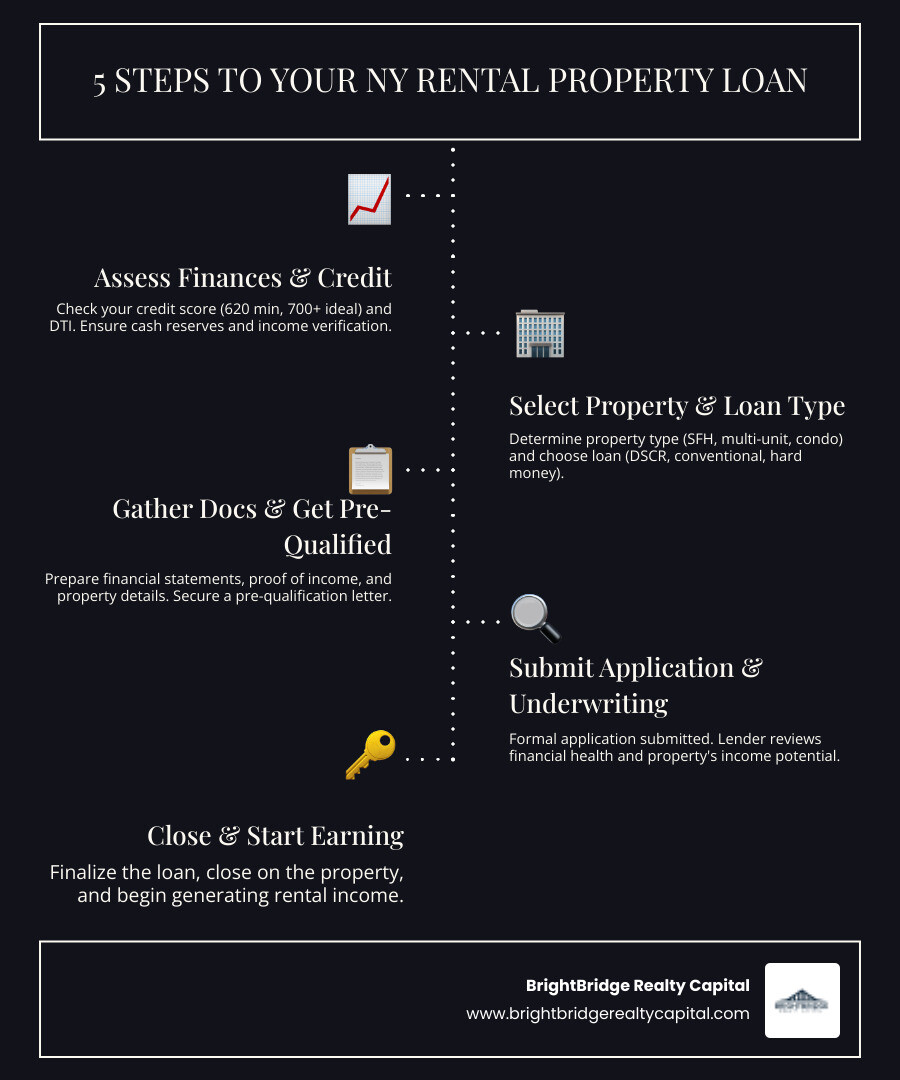
Understanding the Types of Rental Property Loans
Navigating rental property loan New York options requires a deep understanding of the diverse financial tools at your disposal. Each loan type is designed for a specific purpose, investor profile, and property. At BrightBridge Realty Capital, we operate as direct lenders, which means we underwrite and fund loans in-house. This allows us to close in as little as a week, providing the speed and certainty required to win deals in New York's hyper-competitive market. Let's walk through the primary loan types in detail.
Conventional Conforming MortgagesThese are the workhorses of the residential mortgage world, adhering to the guidelines set by government-sponsored enterprises (GSEs) Fannie Mae and Freddie Mac. For rental properties, expect a down payment of at least 20-25% and stricter debt-to-income (DTI) requirements. Underwriters will analyze your global DTI, including your primary residence and all other debts. A key limitation is the GSE cap on the number of financed properties an investor can have, typically limited to ten. While offering predictable terms and competitive rates, the process is notoriously slow and document-intensive, making it less suitable for time-sensitive acquisitions.
Jumbo MortgagesIn New York's high-cost areas like NYC, Westchester, and Long Island, many properties exceed the conforming loan limits set by the FHFA. This is where jumbo mortgages come in. These non-conforming loans can finance properties up to $9.5 million or more. However, the qualification standards are exceptionally high. Lenders will demand excellent credit (often 720+), a low DTI ratio, and substantial liquid reserves—sometimes requiring 12 months or more of mortgage payments. Underwriting is more manual and meticulous, but jumbo loans can offer creative features like interest-only payment periods to improve initial cash flow.
Portfolio and Blanket LoansFor serious investors with multiple properties, these loans offer efficiency and flexibility. A portfolio loan is held on the lender's own books (or "portfolio") rather than being sold to the secondary market. This gives the lender discretion to create more flexible underwriting guidelines, making them a great option for investors with unique financial situations. A blanket loan is a single mortgage that covers two or more properties. This simplifies loan management, reduces paperwork, and can offer better overall terms. A key feature to look for is a "release clause," which allows you to sell one of the properties from under the blanket mortgage without having to refinance the entire loan.
Hard Money LoansWhen speed is the top priority, hard money loans are unparalleled. These are short-term (typically 6-24 months), asset-based loans where the primary underwriting focus is the property's value—specifically its After-Repair Value (ARV)—not your personal credit score or income. They come with higher interest rates and origination points, but they can close in a matter of days, allowing you to compete with all-cash offers. Hard money is ideal for fix-and-flip projects or for quickly acquiring a property before securing long-term, conventional financing (the "buy, rehab, rent, refinance, repeat" or BRRRR strategy).
DSCR (Debt Service Coverage Ratio) LoansThis is a game-changer for real estate investors. A DSCR loan qualifies you based almost entirely on the property's projected cash flow. The lender calculates the ratio of the property's Net Operating Income (NOI) to its proposed mortgage payment. A ratio of 1.25 or higher is typically required, meaning the property's income is 25% more than its debt service. The main advantage is the reduced personal documentation; you often don't need to provide tax returns or W-2s. This is perfect for self-employed investors or those who want a streamlined process. Be aware that DSCR loans often come with slightly higher rates and may include prepayment penalty clauses.
Bridge LoansAs the name suggests, bridge loans provide short-term capital to "bridge" a financial gap. For example, you might use a bridge loan to purchase a new rental property before you've sold an existing one. They are also used to fund renovations on a property before it can qualify for permanent financing. While similar to hard money in their short-term nature, bridge loans are often used by more established investors to facilitate complex transactions and portfolio adjustments.
Key Differences: Second Home vs. Rental Property Financing
Lenders draw a very sharp line between second homes and rental properties, and misrepresenting your intent can lead to serious consequences, including accusations of occupancy fraud. A second home is for your personal enjoyment, while a rental property is a business. This fundamental difference impacts every aspect of the loan.
| Feature | Second Home Financing | Rental Property Financing |
|---|---|---|
| Owner Occupancy | Must be lived in by the owner for some part of the year. It's considered a personal residence. You must have exclusive control over the property and it must be a reasonable distance from your primary home. | Owner does not have to live in the property. It is acquired purely for investment purposes to generate income. |
| Rental Income | Generally, cannot be rented out or managed by a rental company. If rented, it's typically for short periods (e.g., vacation rentals), but this can complicate financing and may push it into the investment property category. | Primary purpose is to generate rental income. Lenders factor projected rental income into qualification (often up to 75% of gross monthly rent as determined by an appraiser). |
| Down Payment | Typically lower than rental properties, starting around 10-15% (depending on loan size, property type, and credit score). | Higher down payment requirements, usually 20-25% of the total property value. Some specialized programs might offer slightly lower options, but 20% is the standard minimum. |
| Interest Rates | Generally lower than rental properties, as they are considered less risky due to owner occupancy and higher down payments than primary homes. | Typically 0.50% to 1.00% higher than primary residences and second homes. This reflects the increased risk lenders associate with investment properties (higher default rates). |
| Loan Options | Conventional conforming, jumbo mortgages (including interest-only options). | Conventional conforming, jumbo, portfolio, DSCR, hard money, bridge loans. More specialized options are available to suit different investment strategies. |
| Qualifying | Based strictly on personal income, credit, and existing debts. No rental income can be used to offset the mortgage payment. | Based on personal income, credit, debts, AND the property's income-generating potential. DSCR loans focus almost exclusively on the property's income. |
| Property Type | Must be a one-unit home that can be used year-round. Co-ops are often not allowed for either Agency or Non-Agency loans for investment properties. | Can be up to four units for residential loans. Condos are available in the Agency space but generally not for Non-Agency investment loans. Co-ops are typically not allowed for investment loans. |
| Tax Implications | Potential for certain tax deductions related to property taxes and mortgage interest, but not business-related deductions like depreciation or operating expenses. | Significant tax benefits, including deductions for operating expenses (repairs, insurance, property management), depreciation, mortgage interest, and property taxes. |
A second home must be a one-unit property you occupy part-time, while a rental property is purchased to generate income and can have up to four units for residential loans. The tax implications also differ significantly, with rental properties offering far more deductions for business expenses.
Choosing Your Lender: Direct Lenders and Private Lending Solutions
Who you work with for a rental property loan New York matters immensely. Traditional banks are notoriously slow, with rigid, one-size-fits-all underwriting that can cost you deals in a fast-moving market. At BrightBridge Realty Capital, we are a direct lender built for speed and flexibility. By cutting out the middlemen and making decisions in-house, we work directly with you to approve your loan, often closing in a week or less. This speed gives you a powerful competitive advantage, making your offer nearly as attractive as cash to sellers.
Private lending also offers a level of customization that banks can't match. We structure solutions around your unique circumstances and the specifics of the deal, rather than forcing you into a rigid box of guidelines. Our seamless, tech-enabled process is designed for investors, by investors, making all the difference when you're focused on building wealth through New York real estate.
Qualifying for Your Loan: Eligibility and Financials
Securing a rental property loan New York requires a thorough examination of both your financial health and the property's investment potential. The underwriting process is where lenders meticulously evaluate risk—your ability to repay the loan and the property's capacity to generate sustainable income. At BrightBridge Realty Capital, we take a holistic approach, looking at the complete picture to structure loans that work for real-world investment scenarios, not just what looks good on paper.

Eligibility for a rental property loan New York
Lenders assess several key factors when you apply for an investment property loan. Being prepared with strong credentials in each area will significantly improve your chances of approval and help you secure the best possible terms.
Your credit score is the primary indicator of your financial reliability. While most lenders require a minimum FICO score of 620, a score of 700 or higher is where you start to see real benefits. A score above 740 will typically secure the best rates and terms available, potentially saving you tens of thousands of dollars over the life of the loan. For example, the difference in interest rate between a 680 and 740 score could be as much as 0.50%, which on a $500,000 loan is a difference of $2,500 per year.
Your debt-to-income (DTI) ratio compares your total monthly debt obligations (including your primary mortgage, car loans, student loans, and the proposed new mortgage) to your gross monthly income. For investment properties, lenders typically look for a DTI between 36% and 45%. Crucially, lenders will often factor in up to 75% of the property's expected rental income (as determined by an appraiser's rental schedule or a signed lease). This can dramatically help you qualify. For instance, if a property is projected to rent for $4,000/month, a lender can add $3,000 to your monthly income in the DTI calculation.
Cash reserves are non-negotiable. Lenders need to see that you have liquid assets available to cover several months of PITI (Principal, Interest, Taxes, and Insurance) payments, plus other operating expenses. This financial safety net demonstrates that you can handle a period of vacancy or an unexpected major repair without defaulting on the loan. The standard requirement is 6 to 12 months of PITI in a verifiable account.
For income verification, the process differs based on your employment. W-2 employees will need to provide recent pay stubs, W-2s for the past two years, and federal tax returns. Self-employed borrowers face more scrutiny and typically need to provide two years of personal and business tax returns, a year-to-date profit and loss (P&L) statement, and several months of recent business bank statements to show consistent cash flow.
You can use projected rental income to qualify. Lenders will generally consider up to 75% of this income, supported by a signed lease for the property or a Form 1007 (Single-Family Comparable Rent Schedule) completed by an appraiser. A track record of successful property management, even on a smaller scale, further strengthens your application and gives the underwriter more confidence.
Financial Considerations: Down Payments, Rates, and Limits
The down payment for a rental property in New York is almost always 20-25%. This is significantly higher than for a primary residence because lenders view investment properties as higher risk. A larger down payment reduces your loan-to-value (LTV) ratio, which not only lowers the lender's risk but often results in a lower interest rate and more favorable loan terms for you. Sourcing for the down payment can come from savings, a HELOC on your primary residence, or sometimes gift funds, though the latter is more restricted on investment deals.
Loan limits vary by loan type. Conforming loans have county-specific limits set by the FHFA, which are higher in designated high-cost areas like New York City and its surrounding counties. For properties exceeding these limits, jumbo mortgages are necessary. At BrightBridge Realty Capital, we can structure jumbo loans up to $9.5 million or more, opening up opportunities in New York's premium markets.
Remember to budget for closing costs, which typically run 2-5% of the loan amount. These costs cover essential services like the appraisal, title insurance, attorney fees, loan origination fees, and recording fees.
Comparing Interest Rates for a rental property loan New York
You'll generally choose between fixed-rate mortgages, which offer a stable, predictable payment for the entire loan term (usually 15 or 30 years), and adjustable-rate mortgages (ARMs). ARMs start with a lower fixed rate for an initial period (e.g., 5, 7, or 10 years) before adjusting based on market conditions. Many investors prefer ARMs to maximize initial cash flow, especially if they plan to sell or refinance the property before the adjustment period begins. Interest-only options are also available, particularly on jumbo and portfolio loans, which can further enhance early-stage returns.
Be aware that investment property mortgage rates are typically higher than primary residence rates to compensate for the perceived higher risk. The final rate you receive is influenced by your credit score, loan-to-value (LTV) ratio, the specific loan product (DSCR and hard money loans have higher rates than conventional), and overall market conditions. A crucial term to understand is the prepayment penalty, which is common on non-conventional loans like DSCR products. This is a fee charged if you pay off the loan within a specified period (e.g., the first 3-5 years), and it's something you must factor into your long-term strategy.
For properties with 5+ units, you'll need commercial real estate financing. This is a different world, where underwriting is based almost entirely on the property's income performance (like its Net Operating Income) rather than your personal finances. At BrightBridge Realty Capital, we help you find the rate and loan structure that best fits your investment strategy, whether it's a single-family rental or a large multifamily building.
Navigating the Landscape of Rental Property Loan New York Programs
New York State and its municipalities offer a rich and complex ecosystem of programs aimed at housing development, energy efficiency, and community revitalization. While BrightBridge Realty Capital specializes in fast, direct private lending for acquisitions and refinancing, a savvy investor understands how to strategically layer these public and quasi-public initiatives into their overall plan. These programs can provide supplemental capital, reduce operating costs, or offer favorable terms that enhance a project's profitability. Think of them as valuable tools to use in conjunction with your primary financing.
State and City Affordable Housing Financing
If your investment strategy includes creating or preserving affordable housing, several powerful agencies can be instrumental. In New York City, the Department of Housing Preservation & Development (HPD) and the Housing Development Corporation (HDC) are the primary drivers. They offer a suite of financing programs, such as HPD’s Extremely Low & Low-Income Affordability (ELLA) Program or HDC’s Mix & Match Program, which blend public subsidies with private loans to fund the new construction and preservation of affordable multifamily properties. Statewide, New York State Homes and Community Renewal (HCR) offers similar support, providing low-cost financing and tax credits for projects that serve low- and moderate-income tenants.
A key resource often utilized in these deals is the SONYMA Mortgage Insurance Fund. This fund provides mortgage insurance for multifamily rental projects, which significantly reduces the risk for the primary lender. This credit enhancement can improve your financing options, leading to lower interest rates or higher loan amounts for projects that meet specific affordability or community development goals.
Local and Rehab-Specific Programs
Many of the most impactful programs are highly localized and focus on property improvement and rehabilitation. These can often be paired with an acquisition loan from a direct lender like BrightBridge Realty Capital. For example, an investor might secure a fast hard money loan from us to purchase a distressed property, and then apply for a local rehab grant to help fund the renovations before refinancing into a long-term DSCR loan.
Examples of these programs are found across the state:
- In Buffalo and Erie County, Home HeadQuarters offers a Landlord Property Improvement Fund with loans and grants to address code violations and lead paint hazards.
- The City of Elmira Landlord Property Improvement Program provides grants to property owners for exterior improvements.
- The Onondaga County Rental Rehab Program assists investors in purchasing and renovating 1-4 unit properties in targeted neighborhoods.
- In Syracuse, the Vacant Property Revitalization Program (VRP) offers substantial grant funding (sometimes up to $35,000 per unit) for the complete rehabilitation of vacant residential units.
These programs not only provide crucial capital but also align your investment with community goals, which can lead to smoother approvals and broader support.
Green and Energy-Efficient Financing
New York is a national leader in promoting energy efficiency, offering programs that can dramatically reduce a property's operating costs and therefore increase its Net Operating Income (NOI) and overall value.
The New York State Energy Research and Development Authority (NYSERDA) facilitates low-interest financing for a wide range of energy-saving projects, from new insulation and windows to high-efficiency heat pumps and solar panel installations. For larger, more complex projects, the New York City Energy Efficiency Corporation (NYCEEC) provides flexible loans for comprehensive energy retrofits in multifamily buildings.
PACE (Property Assessed Clean Energy) financing is an innovative mechanism available in many participating municipalities. It allows you to fund 100% of your green upgrades through a special assessment added to your property tax bill. This offers long-term, fixed-rate capital that stays with the property upon sale, making it an attractive option for major retrofits. Finally, for institutional-scale projects, the NY Green Bank acts as a specialized financial entity, investing in large-scale clean energy projects, including high-performance affordable housing that can serve as a model for sustainable development.
While we at BrightBridge focus on the core acquisition and refinance loan, we encourage our clients to explore these complementary programs. We are always happy to discuss how they might fit into your overall capital stack after securing your primary financing with us.
Strategies for Different Property Types and Investors
New York's incredibly diverse real estate market demands a customized, strategic approach to financing. The ideal rental property loan New York for a single-family home in Syracuse is vastly different from what's needed for a mixed-use building in the Bronx. At BrightBridge Realty Capital, we don't offer one-size-fits-all products; we tailor financing solutions to the specific property, the investor's experience level, and their long-term goals.
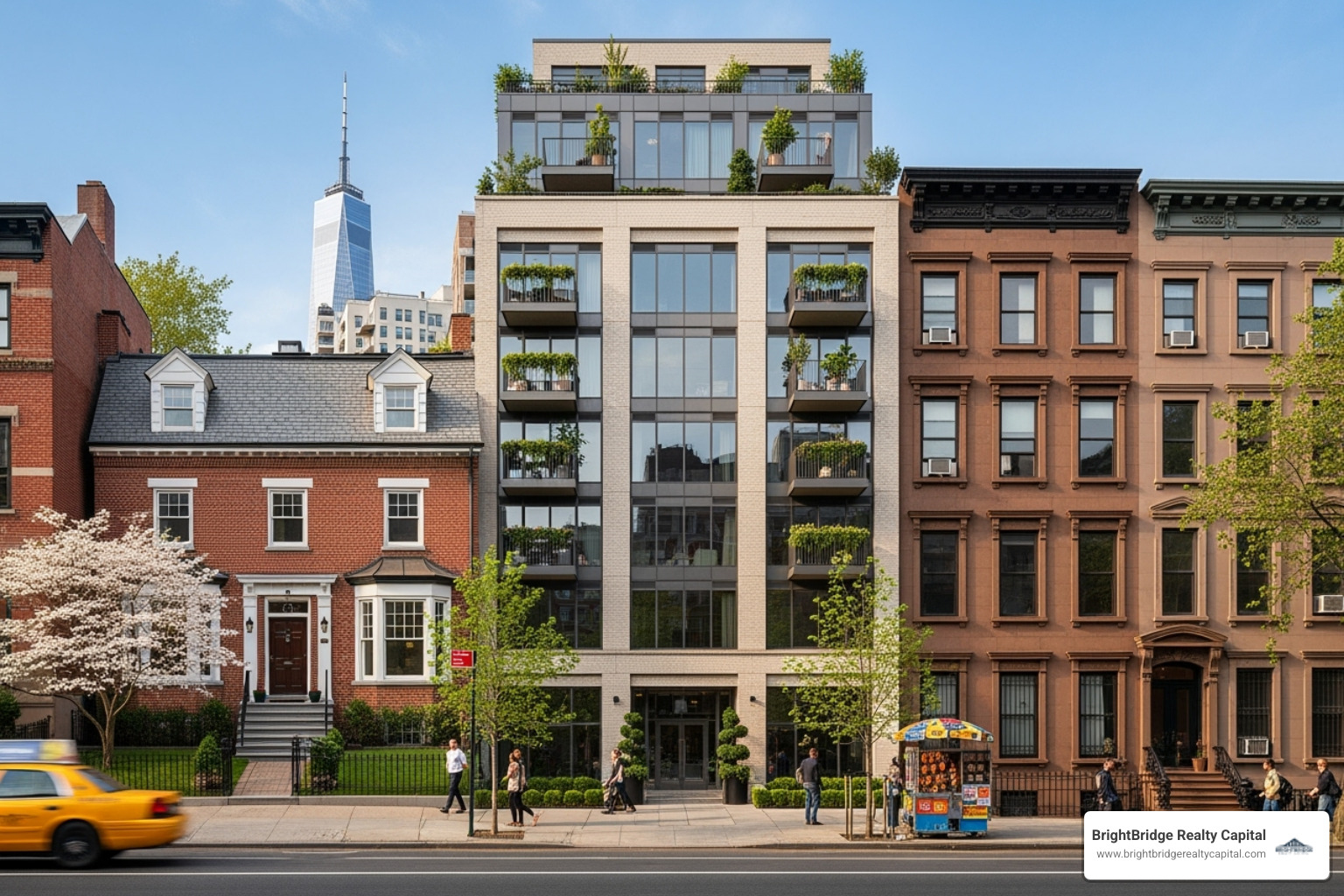
Financing Single-Family vs. Multi-Unit Properties
The number of units in a property is the first and most critical dividing line for financing options.
For 1-4 unit residential properties, you can access a wide range of residential investment loans, including conventional, jumbo, and DSCR loans. For these properties, lenders perform a hybrid analysis, evaluating both your personal financial strength (credit, income, assets) and the property's income potential. As an investor, you can use up to 75% of the projected rental income to help you qualify, which is a significant advantage.
For 5+ unit properties, you cross the threshold into commercial real estate. The lending focus shifts almost entirely away from your personal finances and onto the property's economic performance. Underwriters will scrutinize documents like the Trailing 12-Month Operating Statement (T-12), the current rent roll, and tenant lease agreements. The key metrics are the property's Net Operating Income (NOI) and its Debt Service Coverage Ratio (DSCR). We offer specialized commercial real estate loans new york designed for these larger, income-producing assets.
Loans for Condos, Co-ops, and Fixer-Uppers
New York's unique housing stock presents specific financing challenges and opportunities that require deep local knowledge.
Condos: Financing a condo for investment involves a two-part underwriting process. The lender evaluates you, the borrower, and also the condominium association itself. They will conduct a condo review to check the association's financial health, its budget and reserves, the percentage of owner-occupants versus renters, and whether any single entity owns more than 10% of the units. A key distinction is "warrantable" vs. "non-warrantable" condos. A non-warrantable condo (e.g., one with ongoing litigation or a high concentration of renters) cannot be financed with a conventional loan, requiring a more specialized portfolio or private loan.
Co-ops: Financing an investment co-op is notoriously difficult. When you buy a co-op, you are not buying real estate; you are buying shares in a corporation that owns the building and receiving a proprietary lease for your unit. This requires a "share loan," not a mortgage. Most lenders, including the GSEs, will not finance co-ops for investment purposes due to the complexity of foreclosing on shares versus real property. Furthermore, the co-op board must approve not only you as a buyer but also your intention to rent out the unit, and many boards have strict rules against non-owner-occupants.
Fixer-Uppers: For properties needing significant work, traditional financing is often not an option. This is where short-term, rehab-focused loans are essential. We provide construction loans new york for ground-up new builds. For renovations, a short-term, asset-based loan like a hard money loan ny is the perfect tool. These loans can often cover the purchase price and 100% of the rehab budget, with loan amounts based on the property's After-Repair Value (ARV). The loan is structured with a construction holdback, where funds for the renovation are released in draws as work is completed.
Special Programs and Strategies for Different Investors
First-Time Landlords: If you're new to real estate investing, a popular and effective strategy is "house hacking." This involves purchasing a 2-4 unit property, living in one unit, and renting out the others. Because you will be an owner-occupant, you can qualify for more favorable financing, such as an FHA loan with a very low down payment (as little as 3.5%). The rental income from the other units can then be used to cover most or all of the mortgage payment. This is an excellent way to learn the business with reduced financial risk.
Experienced Investors: As you build your portfolio, your financing strategies will evolve. You may start using DSCR loans and no-doc mortgage ny solutions to streamline the application process, focusing on property income rather than endless personal paperwork. Experienced investors also frequently use a 1031 Exchange to defer capital gains taxes when selling one investment property and buying another "like-kind" property. Financing is a critical component of a successful 1031 exchange, as strict timelines must be met. An experienced lender like BrightBridge Realty Capital understands these nuances and can guide you to the right solution for every stage of your investment journey.
Frequently Asked Questions about Rental Property Loans in New York
After years of helping investors secure financing for properties across New York, from Manhattan to Buffalo, I've heard just about every question imaginable. Here are detailed answers to some of the most common and important ones.
Can I use projected rental income to qualify for a loan?
Yes, absolutely. This is one of the most powerful features of a rental property loan New York. Lenders understand that the property is a business asset designed to generate revenue. For most loan types, including conventional and DSCR loans, lenders will consider up to 75% of the projected gross rental income when evaluating your application. The remaining 25% is discounted to account for potential vacancies and maintenance costs. To verify this income, you will typically need to provide either a fully executed lease agreement if the property is already rented, or an appraiser-completed Form 1007 (Single-Family Comparable Rent Schedule) or Form 1025 (Small Residential Income Property Appraisal Report), which establishes the fair market rent based on comparable local properties. This additional income is added to your personal income, which can significantly lower your debt-to-income (DTI) ratio and help you qualify for a larger loan.
What is a DSCR loan and how does it work in New York?
A Debt Service Coverage Ratio (DSCR) loan is an increasingly popular tool that qualifies you based on the property's income potential, not your personal income. The DSCR is a simple calculation: the property's Net Operating Income (NOI) divided by its total mortgage payment (principal, interest, taxes, and insurance, or PITI). Most lenders look for a DSCR of 1.25 or higher, which means the property's net income is 125% of its debt obligation, providing a healthy cash flow cushion. If the ratio is below 1.0, it means the property has negative cash flow. Investors in New York love DSCR loans because they require minimal personal income documentation—no W-2s, no tax returns, no pay stubs. This makes them ideal for self-employed individuals, retirees, or investors with complex finances who want a fast, streamlined process focused solely on the quality of the investment deal itself.
How long does it take to close on a rental property loan in New York?
The closing timeline depends entirely on your choice of lender and can be the deciding factor in a competitive offer situation. Traditional banks and credit unions are known for their slow, bureaucratic processes, often taking 45 to 60 days, or even longer, to close a loan. This delay can cause you to lose out on a property to a faster-moving buyer. In contrast, direct private lenders like BrightBridge Realty Capital are built for speed. Because we make all lending decisions in-house and have a streamlined, tech-enabled process, we can often close in as little as one to two weeks. This speed gives you a significant negotiating advantage, allowing you to make offers with short closing dates that can compete with all-cash buyers.
What are prepayment penalties and are they common on New York rental loans?
A prepayment penalty is a fee a lender charges if you pay off all or part of your loan ahead of schedule, typically within the first few years. These are very common on non-conventional loan products like DSCR loans and other portfolio or private loans. They are illegal on conventional (Fannie/Freddie) loans. A typical structure is a "step-down" penalty, such as "5-4-3-2-1," meaning you'd pay a penalty equal to 5% of the loan balance if you pay it off in the first year, 4% in the second, and so on. Lenders use these to ensure they earn a certain amount of interest on the loan to make it profitable. As an investor, you must be aware of any prepayment penalty and factor it into your strategy. If you plan to sell or refinance the property within the penalty period, the cost could significantly impact your returns.
Can I get a rental property loan in New York if I live out of state?
Yes, it is very common for out-of-state investors to purchase rental properties in New York. However, lenders will have additional requirements. They will want to see that you have a solid, professional property management plan in place. You will need to provide the name and contact information for a local, licensed property management company you intend to hire. Lenders are wary of long-distance self-management, as it increases the risk of neglect and tenant issues. Additionally, lenders will require higher cash reserves for out-of-state investors to ensure there's a buffer to handle any issues that arise when you're not physically present.
What's the difference between a mortgage broker and a direct lender?
A mortgage broker acts as an intermediary. They take your loan application and "shop" it around to multiple different lenders to find a potential match. They do not fund the loan themselves. A direct lender, like BrightBridge Realty Capital, is the actual source of the capital. We process, underwrite, and fund the loan with our own money. The advantage of working with a direct lender is speed, certainty, and accountability. You are communicating directly with the decision-makers, which eliminates miscommunication and delays. While a broker can offer variety, a direct lender offers a streamlined, efficient path to closing.
Your Partner in New York Real Estate Investment
The journey through New York's real estate market is as thrilling as it is complex. From the brownstone-lined streets of Brooklyn to the steady cash-flowing single-family homes upstate, this state presents incredible opportunities for investors who are well-prepared and properly financed. Whether you're eyeing your first rental property using a house-hacking strategy or expanding a multi-unit portfolio with a 1031 exchange, the right financing partner is the critical variable that separates watching opportunities slip away from closing deals that build lasting wealth.
Throughout this comprehensive guide, we've explored the deep and varied landscape of rental property loan New York options. We've moved beyond the basics, delving into the nuances of conventional mortgages, the high-stakes world of jumbo loans, and the strategic power of specialized tools like DSCR financing and hard money solutions. We've walked through the rigorous qualification process, highlighting the importance of credit, reserves, and DTI. We've examined the ecosystem of state and local programs that can complement your primary financing and discussed tailored strategies for challenging assets like non-warrantable condos and investment co-ops. The common thread woven through every topic is this: in a market as competitive as New York, you must have a lender who understands your goals and can move at the speed of opportunity.
At BrightBridge Realty Capital, we've built our business around a simple, powerful philosophy: real estate investors need more than just capital—they need a strategic partner who can deliver it quickly, efficiently, and without the bureaucratic maze that traditional lenders create. Our direct lending model means you're working with the decision-makers from day one, not intermediaries who slow down the process and create uncertainty. We've structured our underwriting to focus on what matters most: the viability of your project and the property's ability to generate strong returns.
Speed is more than a convenience in New York real estate—it's a currency. It's often the single deciding factor in securing the right property at the right price. While traditional banks measure their closing times in weeks or months, we consistently close loans within a week, and sometimes even faster. This isn't just about internal efficiency; it's about arming you with a decisive competitive advantage when multiple investors are vying for the same asset. It allows your offer to stand shoulder-to-shoulder with cash.
Our flexibility extends far beyond timing. We offer customized solutions that fit your specific situation, whether you're a seasoned investor with a complex portfolio or a first-time landlord navigating the market. From DSCR loans that qualify based on property cash flow rather than personal income documentation, to hard money options for quick acquisitions and fix-and-flip projects, we have designed our products around the real-world needs and strategies of sophisticated New York investors. We understand the challenges of financing a non-warrantable condo, the urgency of a 1031 exchange timeline, and the need for a reliable capital partner when scaling your business.
The path to building wealth through rental properties starts with a deep understanding of your options and choosing a financing partner who is as invested in your success as you are. We're not here to simply process your loan application—we're here to help you structure deals that make financial sense, navigate the unique challenges of the New York market, and move with conviction when opportunities arise. Your success is our success.
Ready to take the next step in your New York real estate investment journey? Explore your rental property loan options today and discover how BrightBridge Realty Capital's fast, flexible, and reliable financing solutions can help you secure your next investment property. Your future in New York real estate starts with the right partner—and we're ready to prove why that partner should be us.