Decoding Your Rental Property Loan Terms Without a Law Degree

Summary
Master rental property loan terms: Compare loans, qualify easily, boost DSCR, and secure better rates for investment success.
What You Need to Know About Rental Property Loan Terms (Before You Sign Anything)

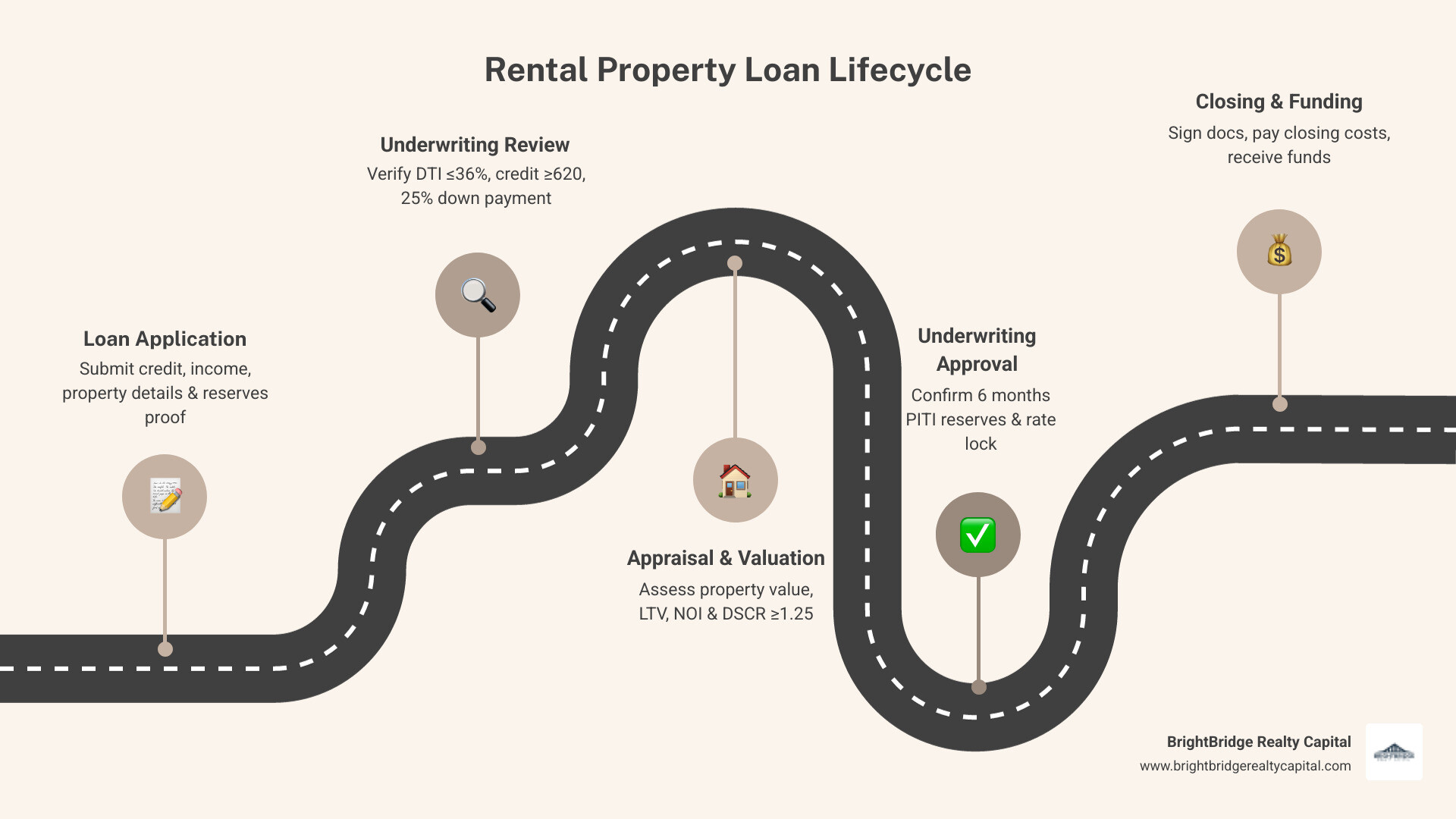
Rental property loan terms are the conditions, costs, and timelines attached to financing a non-owner-occupied investment property — and they're meaningfully different from what you'd get on a standard home mortgage. In the current economic landscape, understanding these terms is not just about getting a loan; it is about ensuring your investment remains profitable over the long term. Every percentage point on an interest rate and every month added to a reserve requirement directly impacts your cash-on-cash return.
Here's a quick breakdown of what to expect in the current market:
| Term | Typical Requirement |
|---|---|
| Down payment | 25% or more (sometimes 15-20% for single-family) |
| Minimum credit score | 620 (720+ for best rates and lower fees) |
| Max debt-to-income (DTI) | 36% to 45% (depending on the lender) |
| Cash reserves | 6 to 12 months of mortgage payments (PITI) |
| Interest rate premium | 0.5% to 0.875% above primary residence rates |
| Loan term | Up to 30 years (fully amortized) or 5-10 year balloons |
| Property type | 1–4 units (non-owner-occupied) |
These stricter terms exist because lenders view investment properties as higher risk. Historical data shows that when cash gets tight, investors are statistically more likely to prioritize their personal home over a rental — so lenders price in that risk from day one. This is known as the "default risk premium," and it is the primary driver behind the higher costs you will encounter.
This guide cuts through the jargon so you can walk into any lender conversation knowing exactly what you're looking at — and what you're agreeing to. We will explore the nuances of debt service coverage, the impact of property classification, and the specific documentation required to prove your investment's viability.
I'm Daniel Lopez, a loan officer at BrightBridge Realty Capital with hands-on experience helping investors structure and close deals across a wide range of rental property loan terms — from conventional financing to creative alternatives. Whether you're expanding a portfolio or locking in your first rental, I'll walk you through what actually matters in today's competitive real estate environment.
Common rental property loan terms vocab:
How Rental Property Loan Terms Differ from Primary Mortgages
If you’ve ever bought a home to live in, you might remember the "warm and fuzzy" feeling of a 3% down payment and a low interest rate. When we talk about rental property loan terms, we have to leave those warm fuzzies at the door. Financing an investment property is a business transaction, and lenders treat it with a level of scrutiny that can feel a bit like an interrogation. The underwriting process is designed to stress-test not just your finances, but the property's ability to survive market fluctuations.
The fundamental difference lies in how the property is used. A primary residence is where you sleep, keep your dog, and hang your hats. It is an emotional and essential asset. A rental property is an income-generating asset. Because you don't live there, lenders assume that if the economy takes a nosedive, you’re more likely to stop paying the mortgage on your rental before you stop paying the mortgage on the roof over your own head. This psychological distinction is the foundation of all investment lending policy.
Default Risk and Pricing
To protect themselves against this perceived "default risk," lenders apply a "risk cushion." This translates directly into your wallet as an interest rate premium. On average, expect to pay 0.5% to 0.875% more on an investment loan than you would for an owner-occupied home. In some market conditions, that spread can even climb to 1% or 2% higher. Furthermore, lenders often charge higher "points" or origination fees on investment properties to compensate for the additional work required in the underwriting phase.
Lenders also want to ensure you aren't committing "occupancy fraud"—claiming you'll live in the property to get better terms when you actually intend to rent it out. This is why rental property financing options come with such specific residency declarations. If you are caught committing occupancy fraud, the lender can call the loan due immediately, and you could face legal consequences.
Property Classification Standards
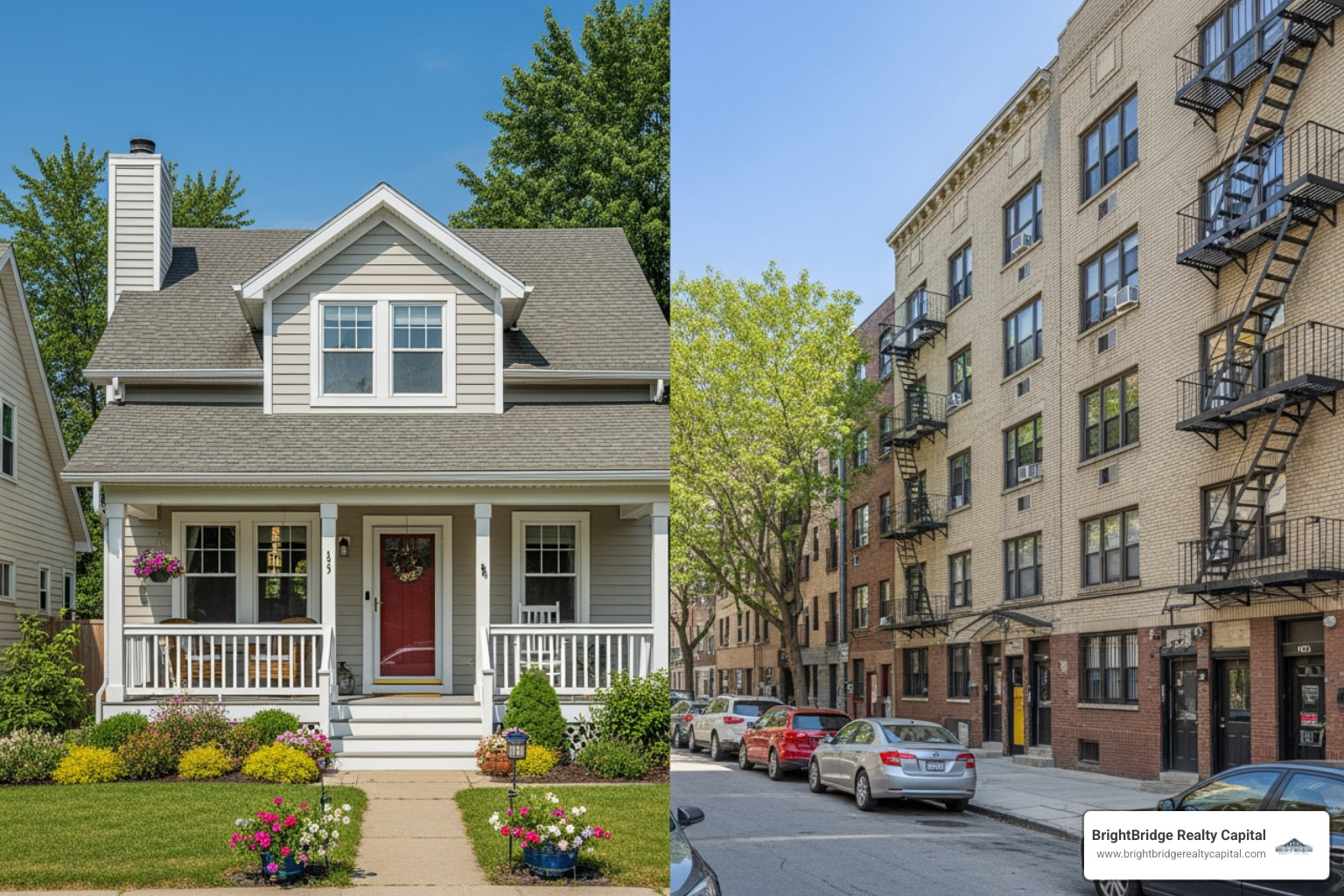
In residential lending, size matters. Most rental property loan terms apply to properties with 1 to 4 units. This is a critical distinction in the eyes of Fannie Mae and Freddie Mac. Once you hit 5 units or more, you’ve officially entered commercial residential real estate, which is a completely different world of financing.
- 1-4 Units: Typically financed via residential-style loans (even if for investment). These loans are often eligible for 30-year fixed rates and are easier for individual investors to obtain.
- 5+ Units: Requires a commercial loan, which often has shorter repayment terms (5 to 20 years), higher down payments (up to 35%), and may involve "balloon" payments where the entire balance is due after a set period.
In New York, where brownstones and multi-family units are the backbone of the rental market, understanding this "4-unit cutoff" is vital for your strategy. A 4-unit building in Brooklyn might qualify for a standard 30-year fixed mortgage, while a 5-unit building next door would require a commercial loan with much more aggressive terms.
Standard Qualification Requirements for Investors
Because the stakes are higher, the "barrier to entry" is steeper. You can't just walk in with a smile and a paycheck; you need a fortress-like balance sheet. Lenders are looking for stability, liquidity, and a track record of financial responsibility.
Credit and Income Verification
While some programs allow for a minimum credit score of 620, don't expect the red carpet treatment at that level. To unlock the most competitive rental property loan terms, you generally need a score of 720 or higher. Scores below 700 often trigger significant "hits" to your interest rate or require a much larger down payment to offset the risk. For example, a borrower with a 680 score might be required to put 30% down, whereas a borrower with a 760 score could get the same rate with only 20% down.
Lenders also look closely at your Debt-to-Income (DTI) ratio. For a primary residence, you might get away with a DTI of 43% or even higher. For a rental, many conventional lenders want to see that number at or below 36%. They want to know that even if your tenant stops paying rent for a few months, your personal income can carry the weight of your debts. They will calculate your DTI by adding up all your monthly debt obligations—including the new mortgage, taxes, and insurance—and dividing it by your gross monthly income.
We also have to talk about documentation. Be prepared to provide a mountain of paperwork, including:
- Two years of personal and business tax returns (all pages and schedules).
- Recent W-2s or 1099s from the last two years.
- Two months of bank statements for all accounts (to prove the source of your down payment).
- Proof of any existing rental income (leases and Schedule E from your tax returns).
- A detailed "Schedule of Real Estate Owned" (SREO) if you already own multiple properties.
Down Payment and Reserve Assets
The days of "nothing down" are largely over for "true" investment properties. Standard rental property loan terms usually require a down payment of 25% or more. While some conventional programs allow for 15% or 20% on single-family homes, putting down less than 20% is rare because private mortgage insurance (PMI) is often unavailable or prohibitively expensive for rentals. As the CFPB warns on PMI for low down payments, if you do find a way to put down less, the added cost of insurance can eat your cash flow alive.
Lenders also demand "reserves." This is liquid cash sitting in your bank account after the deal closes. Most require at least six months of PITI (Principal, Interest, Taxes, and Insurance) for the subject property. If you own multiple rentals, they may require reserves for every single property in your portfolio—sometimes up to 6 months for each. This ensures that a single vacancy doesn't cause a domino effect of defaults across your entire portfolio. For a deeper dive into these nuances, check out our complete guide to rental property loans.
Exploring the 8 Most Common Rental Property Loan Terms
Not all loans are created equal. Depending on your goals—whether you’re a "buy and hold" landlord or a "fix and flip" artist—the right loan type can make or break your ROI. Choosing the wrong structure can lead to thousands of dollars in unnecessary interest or, worse, a loan that you cannot refinance when you need to.
1. Conventional Rental Property Loans
These are the most common and are typically what people think of when they imagine a mortgage. They follow guidelines set by Fannie Mae and Freddie Mac.
- Terms: Usually 30-year fixed rates, though 15-year options are available for those who want to build equity faster.
- Limits: Fannie Mae and Freddie Mac allow an individual to have up to 10 financed properties, though many local banks limit this to four to reduce their own exposure.
- Pros: Lowest interest rates available and predictable monthly payments.
- Cons: Strictest qualification rules regarding DTI and credit scores.
2. FHA Multifamily Loans
Wait, isn't FHA for first-time buyers? Yes, but it's also a powerful "house hacking" tool. If you buy a 2-4 unit property and live in one unit for at least a year, you can qualify for FHA terms.
- Down Payment: As low as 3.5%.
- Requirement: You must occupy one unit as your primary residence. This is a popular strategy for new investors to get started with very little capital.
3. VA Multifamily Loans
Similar to FHA, veterans and active-duty members can buy a multi-unit property with $0 down, provided they live in one of the units. This is an incredible way to start a rental portfolio with almost no capital. The VA also allows you to use the projected rental income from the other units to help you qualify for the loan.
4. Portfolio Loans
A portfolio loan is held by the lender who issues it, rather than being sold to the secondary market (like Fannie Mae).
- Pros: Because the lender keeps the risk, they can be more flexible with credit scores, DTI, or property types that don't fit standard boxes.
- Cons: Often come with slightly higher rates or "balloon" payments where the balance is due in 5, 7, or 10 years.
5. Blanket Mortgages
For investors with multiple properties, a blanket mortgage covers several properties under one loan. This is often used by professional investors to consolidate their debt.
- Feature: It uses cross-collateralization. If you sell one property, a "release clause" allows you to pay off a portion of the loan and keep the rest of the properties covered without refinancing the whole thing.
6. DSCR Loans (Debt Service Coverage Ratio)
These are the "cool kids" of the investment world right now. Instead of looking at your personal tax returns or W-2s, the lender looks at the property's ability to pay for itself. If the rent covers the mortgage plus a little extra, you’re in. Learn more about DSCR loans to see if your property qualifies. These are ideal for self-employed investors or those with many properties who no longer qualify for conventional loans.
7. Private Money and Hard Money
When you need speed over cost, private lenders (like us at BrightBridge Realty Capital) provide quick funding without the red tape of a big bank. These are typically used for "fix and flip" projects or to bridge the gap until a property can be stabilized and refinanced.
- Pros: Closings in as little as a week and based primarily on the property's value.
- Cons: Higher interest rates (8% to 12%+) and shorter terms (usually 1-3 years).
8. Seller Financing
This is when the person selling the house acts as the bank. You make payments to them instead of a mortgage company. It’s rare, but it can offer incredibly flexible rental property loan terms if the seller is motivated. You might negotiate a lower down payment or a lower interest rate than the current market offers, especially if the seller owns the property free and clear.
Financial Metrics Lenders Use to Evaluate Your Deal
Lenders don't just care about your credit score; they care about the property’s "math." If the math doesn't work, the loan doesn't happen. You need to be able to speak the language of these metrics to present your deal effectively.
Debt Service Coverage Ratio (DSCR)
This is the holy grail of rental metrics. It measures the property’s ability to cover its own debt. Lenders use this to determine the maximum loan amount they are willing to provide.
- The Formula: Net Operating Income (NOI) / Annual Debt Service.
- The Target: Most lenders look for a DSCR between 1.25 and 1.40.
A DSCR of 1.25 means the property generates 25% more income than is required to pay the mortgage. This provides a "buffer" for vacancies and repairs. Some lenders allow for a "rental income offset," where they count 75% of the projected rent toward your qualifying income to help your DTI. The 25% "haircut" is standard to account for the reality that no property is 100% occupied 100% of the time.
Valuation and Performance Analysis
Lenders also look at several other key indicators to ensure the property is a sound investment:
- Loan-to-Value (LTV): The loan amount divided by the property value. For rentals, lenders rarely go above 75% or 80% LTV. The more equity you have in the deal, the less likely you are to walk away.
- Cap Rate (Capitalization Rate): Your NOI divided by the purchase price. It helps lenders compare the property to others in the New York market. A "good" cap rate varies by neighborhood, but it tells the lender how much return the property generates relative to its cost.
- Cash-on-Cash Return: Your annual pre-tax cash flow divided by the total cash you invested. This is the metric most investors care about, as it shows the actual yield on their out-of-pocket money.
- Operating Expense Ratio (OER): Total operating expenses divided by gross income. If this number is too high, it suggests the property is being managed inefficiently.
Understanding these rental property financing strategies is essential for presenting a deal that a lender can't refuse. If you can show a lender a detailed pro-forma that accounts for all these metrics, you demonstrate that you are a professional investor who understands the risks.
How to Secure More Favorable Rental Property Loan Terms
You aren't just a passenger in the loan process; you can take the wheel and drive toward better terms. Small adjustments in your financial profile or the way you structure the deal can save you tens of thousands of dollars over the life of the loan.
Proactive Steps for Better Rental Property Loan Terms
- Shop Around: Research from Freddie Mac shows that comparing five loan quotes can save borrowers an average of $3,000. Don't just take the first offer from your local bank. Different lenders have different "appetites" for risk at different times.
- Lower Your Credit Utilization: Even if your score is high, having maxed-out credit cards can spook a lender. Pay down balances 60 days before applying to ensure your score is at its absolute peak when the lender pulls your credit.
- Bring More Cash: A 30% down payment will almost always result in a better interest rate than a 20% down payment. Lenders have "pricing tiers," and crossing into a higher equity tier can significantly lower your rate.
- Use an LLC: While it doesn't always lower the rate, it can protect your personal assets and allow for easier partnership structures. Be aware of the rental property loan rates for LLCs before you set up your entity, as some lenders charge a small premium for lending to a business entity.
- Consider a Rate Buy-Down: You can pay "discount points" upfront to lower your interest rate for the life of the loan. If you plan to hold the property for 10+ years, this is often a very smart financial move.
Don't forget the tax side of things! IRS tips on rental tax breaks show that while your interest rate might be higher, that interest is often tax-deductible, which softens the blow to your bottom line. You should also look into depreciation, which can offset a significant portion of your rental income.
Documentation and Professional Preparation
The faster and cleaner your paperwork, the better you look to an underwriter. Have your Profit & Loss (P&L) statements ready, keep your lease agreements organized in a digital folder, and be prepared to pay for a professional appraisal. In New York's competitive market, being "loan ready" can be the difference between winning a bid and losing out to a cash buyer. Lenders love working with organized borrowers because it makes their job easier and reduces the time to close. If you can provide a complete "loan package" on day one, you are much more likely to get your deal through the finish line without hiccups.
Frequently Asked Questions about Rental Property Loans
What is the minimum down payment for a rental property?
For a "true" investment property (where you don't live), the minimum is typically 15% to 20% for a single-family home and 25% for a multi-unit property. If you choose to "house hack" with an FHA loan, you can go as low as 3.5%, but you must commit to living in one of the units for at least 12 months.
Can I use rental income to qualify for the loan?
Yes! Most lenders will allow you to use 75% of the projected rental income (verified by an appraiser or existing leases) to help you qualify. The 25% "haircut" is to account for potential vacancies and maintenance costs. If the property is currently vacant, the appraiser will provide a "comparable rent schedule" to estimate what the property will earn.
Why are interest rates higher for investment properties?
Risk. Statistics show that people are much more likely to walk away from an investment property than their own home during financial hardship. Lenders charge a higher rate to compensate for that increased likelihood of default. Additionally, investment loans cannot be sold to the same government-backed pools as primary mortgages, which increases the cost of capital for the lender.
What is a prepayment penalty, and do rental loans have them?
A prepayment penalty is a fee charged if you pay off the loan too early (usually within the first 3-5 years). While conventional loans rarely have them, many DSCR and commercial loans do. Always ask your lender about the "prepays" before signing, as they can be expensive if you plan to sell or refinance quickly.
How long is the "seasoning period" for a refinance?
Most lenders require you to own a property for at least 6 to 12 months before you can do a "cash-out" refinance based on the new appraised value. This is known as the seasoning period. If you try to refinance earlier, they may only lend based on your original purchase price plus documented renovation costs.
Conclusion
Mastering rental property loan terms is the key to moving from "someone who owns a house" to "a real estate investor." While the requirements are stricter and the costs are higher, the rewards—passive income, tax advantages, and long-term wealth—are well worth the effort. The most successful investors aren't necessarily the ones with the most cash; they are the ones who understand how to leverage debt effectively and navigate the complexities of the lending market.
At BrightBridge Realty Capital, we understand that in the New York market, timing is everything. We specialize in providing the quick, flexible funding that traditional banks often can't match. Whether you need a DSCR loan to scale your portfolio or a fast-closing private loan to snag a distressed property before someone else does, we're here to help you navigate the jargon and get the deal done. We pride ourselves on being partners in your growth, not just a source of capital.
Ready to see what terms you qualify for? Apply for rental loans today and let's get your next investment off the ground. Our team is ready to review your deal and provide a customized financing solution that fits your specific investment strategy.