Bridge loan requirements and how to survive them


Summary
Discover unregulated bridging loan requirements, secure fast approval with strong LTV & exit strategy. Survive & thrive in property investments!
When Speed and Flexibility Define Your Next Deal

An unregulated bridging loan is a short-term, asset-backed loan used to finance investment or commercial property — not your primary residence. It falls outside FCA consumer protection rules, which is exactly what makes it faster and more flexible than a traditional regulated loan. In the fast-paced world of real estate investment, the ability to deploy capital quickly is often the difference between a successful acquisition and a missed opportunity. These loans are designed for professional investors, developers, and business owners who require a bespoke financial solution that traditional high-street banks are simply not equipped to provide.
Quick answer — what you need to know:
| Feature | Unregulated Bridging Loan |
|---|---|
| Purpose | Investment, development, buy-to-let, business |
| Regulation | Not governed by the FCA |
| Typical term | 1-24 months (most commonly 12 months) |
| LTV | Up to 75-80% (higher with additional security) |
| Speed | Can fund in as little as 5-14 days |
| Key requirement | Clear exit strategy + security property |
| Rates | From ~0.55% per month |
Real estate moves fast. A deal at auction won't wait weeks for a bank to process paperwork. A distressed property that doesn't qualify for a conventional mortgage still needs financing. That's the gap unregulated bridging loans are built to fill. Over the last decade, the landscape of UK property finance has shifted significantly. As traditional lenders have tightened their criteria and lengthened their approval processes due to increased regulatory burdens, the alternative finance market has stepped in to provide the liquidity necessary for the market to function efficiently.
Bridging loan books hit a record £8.1 billion in 2024 — a clear sign that investors are turning to short-term alternative finance in growing numbers. This growth is driven by the versatility of the product. Whether it is a developer looking to fund a heavy renovation project, a landlord looking to secure a property before selling another, or a business owner needing to unlock equity for operational growth, the unregulated bridge is the primary tool of choice.
I'm Daniel Lopez, a loan officer at BrightBridge Realty Capital, where I specialize in helping real estate investors structure and close deals — including situations where an unregulated bridging loan is the right tool for the job. From fix-and-flip projects to portfolio expansion, I've guided borrowers through the full spectrum of short-term financing. My experience has shown me that while the interest rates might be higher than a standard mortgage, the value of the opportunity secured often far outweighs the cost of the capital. This guide covers everything you need to make a confident decision, from understanding the legal nuances to mastering the application process.
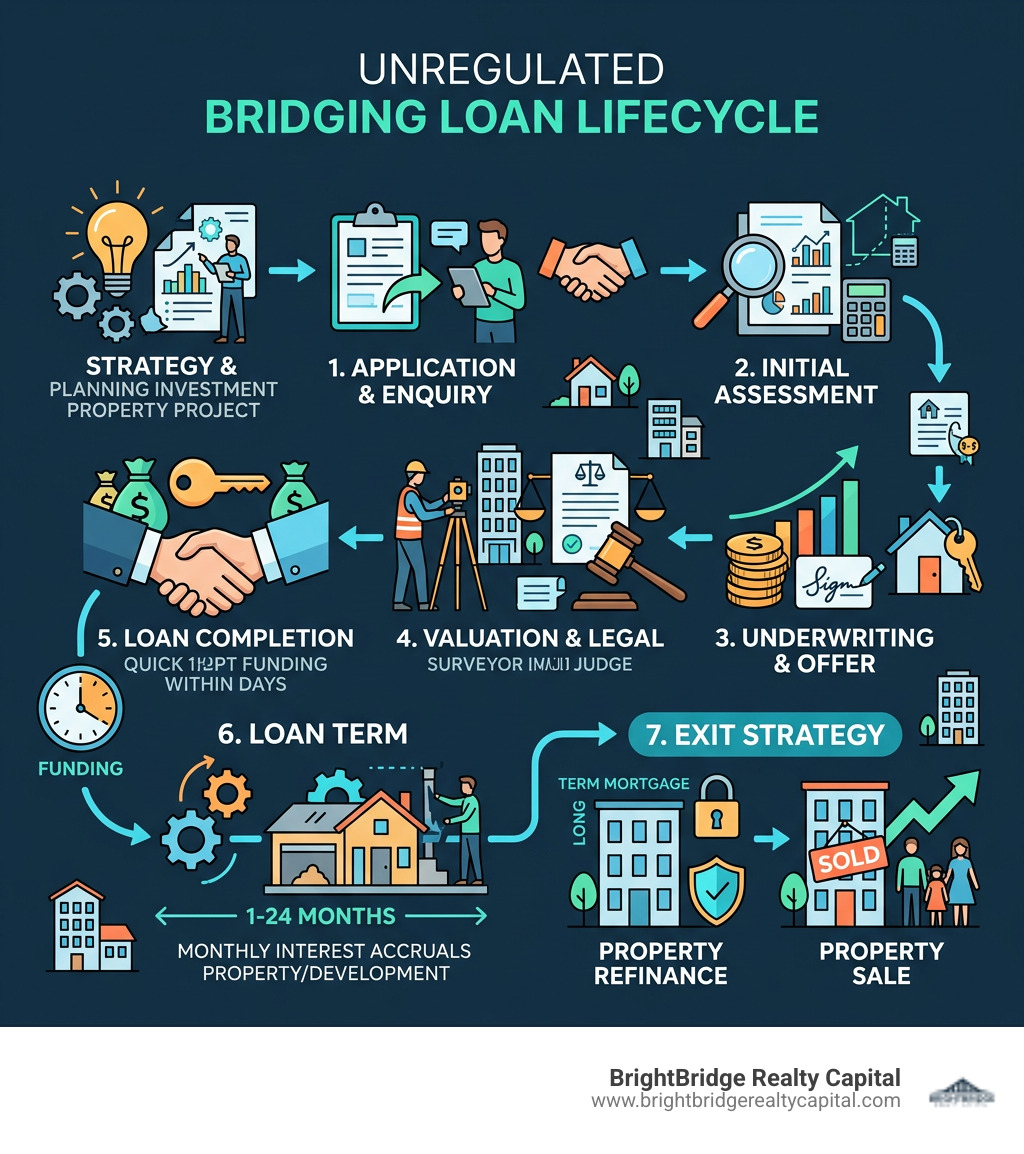
Unregulated bridging loan word list:
What is an Unregulated Bridging Loan?
At its core, an unregulated bridging loan is a short-term financial solution designed to "bridge" the gap between a property purchase and a long-term exit, such as a sale or a conventional mortgage. Unlike residential mortgages you might get for your own home, these loans are specifically for investment properties or business purposes. The fundamental philosophy behind this type of lending is that it is "asset-first." While a bank looks at your salary and your monthly spending habits, a bridging lender looks at the property's value today, its potential value tomorrow, and how you intend to repay the debt.
The term "unregulated" often sounds a bit scary to the uninitiated, but in the lending world, it simply means the loan is not overseen by the FCA. This lack of oversight isn't because the lenders are "cowboys"—it’s because the borrower is acting as a business or investor rather than a vulnerable consumer buying a primary residence. The Financial Conduct Authority (FCA) regulates loans where the borrower or their family will live in the property. When the property is purely for investment, the law assumes the borrower is a sophisticated entity capable of conducting their own due diligence and understanding the risks involved.
Because these are asset-backed loans, the lender focuses primarily on the value of the collateral (the property) and the feasibility of the repayment plan. This leads to a much deeper level of bridge loan meaning for the investor: it represents liquidity. Whether you are eyeing commercial assets, land for development, or a residential "fix-and-flip," this type of financing offers the flexibility that traditional banks, bogged down by bureaucracy, simply cannot match. It allows for "non-status" lending, where the borrower's personal financial history is secondary to the strength of the real estate deal itself. This is particularly useful for entrepreneurs who may have complex income streams that don't fit into a standard bank's automated "tick-box" system.
Understanding the Distinction: Unregulated vs. Regulated Bridging Loans
Choosing the right financing path starts with knowing which category your project falls into. The distinction is usually determined by the purpose of the loan and who will be living in the property. This is not a choice the borrower makes based on preference; it is a legal classification based on the usage of the security property.
| Feature | Regulated Bridging Loan | Unregulated Bridging Loan |
|---|---|---|
| Occupancy | Borrower or family lives in >40% of property | Investment or commercial use only |
| Regulation | FCA Regulated | Common Law / Industry Standards |
| Approval Time | 4–8 weeks (typically) | 5–14 days (can be faster) |
| Max Term | Usually capped at 12 months | Up to 24 months (flexible) |
| Focus | Affordability and credit score | Asset value and exit strategy |
The "40% occupancy rule" is the primary differentiator. If you or an immediate family member intend to occupy 40% or more of the property, the loan must be regulated. This applies even if you are only living there temporarily while renovating. However, for unregulated vs regulated bridging loans, investors prefer the unregulated side because it allows for a streamlined process. You aren't forced to jump through the same affordability hoops required for a consumer loan, which opens up more bridge loan options for complex projects. For instance, if you are purchasing a mixed-use building with a shop on the ground floor and flats above, the loan will be unregulated as long as you don't intend to live in those flats yourself.
While you sacrifice the specific consumer protections of the FCA, you gain the ability to close deals that would otherwise be impossible. Most reputable lenders in this space still adhere to high professional standards, often being members of organizations like the NACFB or FIBA. These organizations ensure that lenders follow a code of conduct, providing transparency in fees and fair treatment of borrowers. The lack of FCA regulation does not mean a lack of legal recourse; the loan agreement is still a legally binding contract subject to UK common law, and lenders are highly motivated to maintain their reputation within the professional investment community.
Key Benefits of an Unregulated Bridging Loan
The most obvious advantage is the speed of funding. In a competitive market, being able to show a "cash-like" capability is a superpower. When a seller sees a buyer backed by a bridging facility, they know the deal is less likely to fall through due to mortgage delays.
- The 28-Day Auction Window: If you buy at auction, you usually have 28 days to complete. A traditional mortgage won't clear in time; an unregulated bridge will. This allows investors to pick up distressed assets at a discount.
- Non-Status Lending: Lenders are often "non-status," meaning they care less about your personal income or credit history and more about the property's potential. This is vital for those with self-employed income or past credit blips.
- Asset-Based Underwriting: This focuses on the bridge-loan-funding being secured by the property value itself. If the property has significant equity, the lender's risk is mitigated.
- Tailor-Made Solutions: Because these aren't "cookie-cutter" products, terms can be negotiated to fit a specific project timeline, whether that's 3 months or 18 months. You can often choose to roll up interest so there are no monthly payments to manage during the construction phase.
Essential Requirements for Approval
To survive the application process, you need to understand what we look for when we evaluate a deal. It isn't just about having a "good feeling" about a property; it's about the data, the security, and the viability of the project. Lenders in the unregulated space are risk-takers, but they are calculated risk-takers.

The first requirement is a solid security property. We need to know exactly what we are lending against. This involves a professional valuation report from a surveyor to determine the Open Market Value (OMV). In some cases, we also look at the Gross Development Value (GDV)—what the property will be worth once your planned works are finished.
- Loan-to-Value (LTV): Most unregulated lenders offer between 70% and 80% LTV. This is usually calculated against the purchase price or the current value, whichever is lower. If you have additional property to offer as security (cross-collateralization), some lenders can even push toward 100% of the purchase price.
- Deposit Requirements: Generally, you’ll need a cash deposit of at least 20-25%. This "skin in the game" reassures the lender that you are committed to the project’s success and have the financial buffer to handle unexpected costs.
- Legal Due Diligence: Even though it's fast, our legal teams will still perform title searches and check for any encumbrances, such as restrictive covenants or outstanding charges. Following UK Finance guidelines ensures the process remains robust and transparent. You will need a solicitor who is experienced in bridging finance to ensure the paperwork moves as quickly as the lender does.
- Experience: While not always mandatory, having a track record of successful projects can help you secure better rates. If you are a first-time developer, the lender may look more closely at your professional team (contractors, architects, etc.).
For a deeper dive into the financial side, check out our bridge-loan-rates-complete-guide.
The Critical Role of an Exit Strategy in an Unregulated Bridging Loan
If there is one thing that can make or break your application, it is your exit strategy. A bridging loan is a temporary fix; we need to know exactly how you plan to pay it back. Without a credible exit, the loan is simply too risky for any professional lender to touch.
A viable exit strategy usually falls into one of three categories:
- Refinancing: Moving the debt to a long-term commercial mortgage or buy-to-let loan once the property is stabilized or renovated. This is common for "BRRR" (Buy, Refurbish, Rent, Refinance) investors.
- Property Sale: Selling the asset after completing works or once the market value has increased. The lender will want to see evidence of the local market's liquidity to ensure the property can sell within the loan term.
- Development Completion: Using the sale of finished units to clear the facility. For larger developments, this might involve a phased repayment as units are sold off.
Lenders who follow BDLA standards will look for proof that your exit is realistic. If you plan to refinance, do you have a Decision in Principle from a long-term lender? If you plan to sell, is the timeline achievable? We often suggest having a "Plan B." For example, if the property doesn't sell, can you rent it out and cover a mortgage? Having a clear plan is the best way to manage your bridging-finance risks and ensure a smooth transition out of the bridge. Remember, the lender does not want to repossess the property; they want their capital returned with interest so they can lend it out again.
Common Use Cases for Investors and Developers
Where does an unregulated bridging loan truly shine? In scenarios where traditional finance says "no" or "not fast enough." The versatility of these loans allows them to be applied to a wide array of complex real estate challenges.
- Property Development: Whether it's ground-up construction or a commercial property conversion, bridging loans provide the initial capital to get the project moving. This is often used for "heavy refurb" where the property is currently uninhabitable.
- Auction Purchases: As mentioned, the speed is essential for meeting strict 28-day completion deadlines. Auction buyers often use bridging to secure the property and then take their time arranging long-term finance.
- Buy-to-Let Investments: Investors often use a bridge to buy a property that is currently "unmortgageable" (e.g., no kitchen or bathroom), fix it up, and then move it to a standard BTL mortgage. This is a classic strategy for adding value to a portfolio.
- Chain Breaking: For commercial entities, a bridge can prevent a deal from collapsing if a buyer elsewhere in the chain pulls out. It allows the transaction to proceed while the other sale is finalized.
- Business Capital: Sometimes a business owner needs to raise funds quickly for equipment, inventory, or tax bills and uses their commercial property as collateral. This is often faster than applying for a traditional business loan.
- HMO Conversions: Converting a single-family home into a House in Multiple Occupation (HMO) requires significant upfront capital. Bridging finance can cover the purchase and the conversion costs before the property is refinanced onto an HMO mortgage.
- Land Acquisition: Securing land, with or without planning permission, is a common use case. Investors might use a bridge to buy land quickly and then use the time to secure or improve planning consents, which significantly increases the land's value.
For more specialized insights, see our guide on bridge-loans-for-real-estate-investors.
Frequently Asked Questions about Bridging Finance
How quickly can I get an unregulated bridging loan?
Typically, the process takes between 5 and 14 days. However, if you have all your documentation ready—including your valuation and legal paperwork—some direct lenders can fund in as little as 48 to 72 hours. The bottleneck is usually the valuation and the legal searches. Getting a "Decision in Principle" (DIP) is the first step and usually happens within hours of your inquiry. For more on timing, see our quick-bridging-finance-guide-94f62.
Can I get a loan with bad credit?
Yes. Because these are "non-status" loans, we focus on the equity in the property and the strength of your exit strategy. While a history of adverse credit might affect the interest rate or the LTV offered, it is rarely an automatic "no" like it would be at a high-street bank. We look for the "why" behind the credit issues and focus on the current viability of the deal.
What are the typical interest rates and fees?
Rates generally start around 0.55% to 0.65% per month. You should also expect:
- Arrangement Fee: Usually 1-2% of the loan amount, often deducted from the loan at completion.
- Valuation Fee: Paid to the surveyor to assess the property.
- Legal Fees: To cover both your and the lender's solicitors. In bridging, the borrower typically pays both sets of legal costs.
- Rolled-up Interest: Many investors choose to "roll up" the interest, meaning no monthly payments are made; instead, the interest is added to the loan balance and paid at the end. This preserves cash flow during the project.
Can I use an SPV (Special Purpose Vehicle) to borrow?
Absolutely. In fact, many unregulated bridging loans are made to Limited Companies or SPVs rather than individuals. This is often preferred for tax efficiency and to keep the investment separate from personal finances. Lenders will usually require personal guarantees from the directors of the company.
What is the difference between a 1st and 2nd charge?
A 1st charge means the bridging lender is the primary lender and has first claim on the property if things go wrong. A 2nd charge sits behind an existing mortgage. Unregulated 2nd charges are common for business purposes, such as raising capital from an investment property that already has a small mortgage on it.
Survival Tips for the Savvy Borrower
Navigating unregulated bridging loans requires a bit of strategy. Because these loans are more expensive than long-term debt, efficiency is key. Here is how you can ensure you come out on top:
- Overestimate Your Timeline: If you think the renovation will take six months, take a nine-month loan. It is much cheaper to pay a loan off early (most lenders have no early repayment charges after a small minimum term) than to scramble for an extension. Extensions can be costly and are not always guaranteed.
- Be Transparent: If there's an issue with the property, such as Japanese Knotweed or a structural crack, or if there's a blip in your credit, tell us upfront. We can usually work around problems if we know about them early. Discovering them during the legal process can kill a deal.
- Check the Lender's Pedigree: Look for lenders who are part of the ASTL or IMLA. This ensures they follow a code of conduct even in an unregulated market. You want a lender with a track record of actually delivering the funds they promise.
- Have a "Plan B" Exit: If the market dips and you can't sell for the price you wanted, can you rent the property out and refinance instead? Lenders love a backup plan. It shows you are a professional who has considered all market conditions.
- Build a Professional Team: Having a reliable solicitor and a knowledgeable broker can save you thousands. Bridging is a specialist field; using a solicitor who usually only does residential conveyancing can slow the process down significantly.
- Understand the Total Cost: Don't just look at the monthly rate. Calculate the total cost of borrowing, including all fees and the cost of the exit. This gives you a true picture of the project's profitability.
Conclusion
The property market waits for no one. In an environment where opportunities appear and disappear in the blink of an eye, having access to fast, flexible capital is your greatest asset. Whether you are looking to secure a prime Manhattan commercial space, a residential portfolio in a booming neighborhood, or a complex development site, an unregulated bridging loan offers the speed and flexibility you need to stay ahead of the competition.
At BrightBridge Realty Capital, we pride ourselves on being more than just a source of funds. We are your partners in growth. We understand the nuances of the UK property market and the pressures that investors face. As a direct lender, we cut out the middleman, offering you fast closings—often within a week—and competitive rates that help your bottom line. Our nationwide reach and seamless process mean you can focus on what you do best: finding and developing great real estate.
We believe that every deal is unique, and we treat it as such. Our team of experts is here to help you structure your finance in a way that maximizes your returns and minimizes your risk. From the initial inquiry to the final exit, we provide the transparency and support you need to succeed in today's challenging market.
Ready to take the next step in your investment journey? Secure your stabilized bridge loan today and see how we can help you bridge the gap to your next success. Don't let a lack of immediate capital stand in the way of your next great deal.