Making Paradise Possible: Vacation Property Financing Explained


Summary
Unlock your dream vacation home! Learn about vacation property financing, loan types, and qualification to make it a reality.
Your Path to Paradise: Why Vacation Property Financing Matters
Vacation property financing is the key that unlocks the door to owning your dream getaway, a tangible asset that serves as both a personal sanctuary and a powerful tool for wealth creation. In an era where experiences are valued more than ever and remote work has redefined our relationship with home, the allure of a second property has never been stronger. Whether you're envisioning a rustic mountain cabin for family retreats, a sun-drenched beachfront condo for rental income, or a hybrid property that does both, the right financing strategy is the critical first step that transforms a dream into a deed.
The market has responded to this surging demand. The vacation rental sector has exploded, with projections showing continued robust growth. More than half of today's travelers now prefer the space, privacy, and unique character of vacation rentals over traditional hotels, creating a massive and sustained opportunity for property investors. This cultural shift has made vacation property financing more competitive and accessible than ever before, with a growing number of lenders offering specialized products for this unique asset class.
Here's a snapshot of what you need to know about vacation property financing:
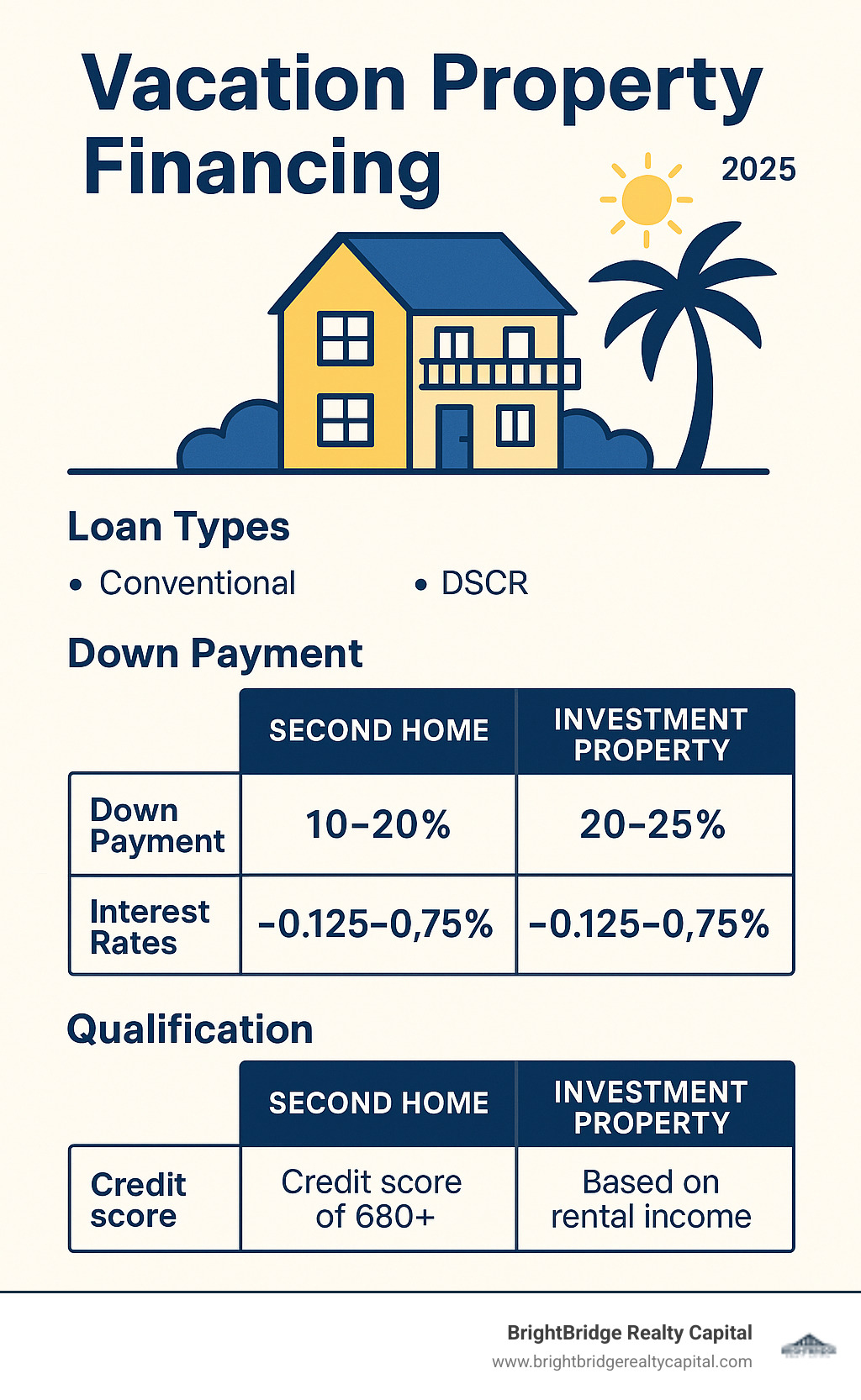
- Second Homes (Personal Use): These typically require a down payment of 10-20%. Interest rates are slightly higher than for a primary residence, but the path to qualification is similar, focusing on your personal financial health.
- Investment Properties (Rental Focus): Expect to need a 20-25% down payment or more. Qualification often hinges on the property's potential to generate rental income, not just your personal salary.
- DSCR Loans: A game-changer for investors, these loans focus almost exclusively on the property's cash flow (Debt Service Coverage Ratio) rather than requiring extensive personal income verification.
- Interest Rates: As a general rule, expect rates to be 0.125% to 0.75% higher than the mortgage on your primary home, reflecting the lender's perceived increase in risk.
- Credit Scores: A score of 680 or higher is the typical entry point, with scores of 720 and above securing the most favorable rates and terms.
But here's the fundamental challenge: vacation properties don't fit the standard, one-size-fits-all mortgage mold. Lenders view them as a higher risk than your primary residence. If financial hardship strikes, a borrower is far more likely to default on their lake house than the home they live in every day. This elevated risk profile means different rules, stricter requirements, and specialized strategies apply. Understanding these distinctions is not just helpful—it's absolutely crucial for securing the best possible financing terms and avoiding costly mistakes.
As Daniel Lopez, a loan officer at BrightBridge Realty Capital, I've spent my career guiding countless investors through the complexities of vacation property financing. I've helped clients secure loans for everything from personal family retreats to burgeoning short-term rental portfolios. My experience has consistently shown that the right preparation, a clear understanding of the lending landscape, and a well-structured loan can turn ambitious vacation property dreams into profitable, tangible realities.
Vacation property financing terms you need:
Understanding the Landscape: Vacation Home vs. Investment Property

Here's a critical distinction that trips up many aspiring buyers: not all vacation properties are created equal in the eyes of a lender. The way you intend to use your dream getaway—your primary motivation for buying—completely changes the landscape of your vacation property financing options, requirements, and long-term costs. Before you even look at a loan application, you must be clear on this point.
Think of it from the lender's perspective. They are essentially asking one simple question: "Are you buying a place to relax, or are you buying a business?" Your answer to this question determines everything, from the size of your down payment and the interest rate you'll pay to the type of documentation you'll need to provide.
Let's break down the three main property classifications that lenders use.
1. Primary Residence: This is the simplest category. It's the home you live in most of the year, the address on your driver's license, and where you're registered to vote. Lenders offer the best terms on primary residences because the borrower's motivation to keep making payments is highest. Nobody wants to lose the roof over their head, making it the lowest-risk loan for a financial institution.
2. Second Home: This is your personal escape—the weekend cabin, the beach house for summer vacations, or the mountain retreat for ski season. While you might rent it out for a couple of weeks a year to offset costs (more on that later), its primary purpose is for your own enjoyment. To enforce this distinction, most lenders apply a "50-mile rule," requiring the second home to be at least 50 miles away from your primary residence. This helps prove it's a genuine getaway, not just another property down the street that could be a disguised rental. Lenders will also look for property characteristics consistent with a vacation spot (e.g., located in a resort area). They want to ensure you're not trying to use the more favorable second-home financing to buy a pure investment property.
3. Investment Property: This category is all about the money. You are purchasing this property specifically to generate income through rentals, whether that's long-term tenants on an annual lease or a revolving door of short-term vacation renters on platforms like Airbnb and Vrbo. The property's financial performance—its ability to generate positive cash flow—is what matters most, not how much you'll personally enjoy staying there. In fact, for many investment loans, the lender assumes you will not be using it personally at all.
From a lender's perspective, this distinction is entirely about risk assessment. They construct a risk hierarchy:
- Lowest Risk: Primary Residence. You live there, so you'll fight to keep it.
- Moderate Risk: Second Home. It's a luxury, not a necessity. If money gets tight, it might be the first thing to go. The risk is higher than your primary home but is still anchored by your personal financial strength.
- Highest Risk: Investment Property. Its success is not just tied to your finances but also to external market conditions, vacancy rates, changing local regulations, and the quality of your tenants or guests. This volatility makes it the riskiest proposition for a lender.
This risk assessment directly and significantly impacts your loan terms, down payment requirements, and interest rates. Higher perceived risk means lenders demand more protection upfront in the form of a larger down payment and charge a higher interest rate to compensate for that risk.
How Financing Differs for Each Property Type
The financing path you take will diverge dramatically based on your property's classification. Understanding these differences is the key to saving thousands of dollars and setting yourself up for success.
Conventional Second Home Loans: This is the most common route for personal vacation homes. The process feels similar to getting your primary mortgage, but with a few key adjustments. You can often qualify with as little as 10% down, provided you have a strong credit profile (typically a FICO score of 680 or higher, with the best terms reserved for 720+). However, be prepared for interest rates that are approximately 0.125% to 0.375% higher than those for a primary residence. The underwriting process is focused squarely on your personal financial picture: your stable income, your credit history, and your overall debt-to-income (DTI) ratio. Lenders need to be confident that you can afford both your primary mortgage and this new second home payment without relying on any potential rental income. Occupancy rules are strict; you'll likely have to sign a document at closing affirming that you intend to occupy the property for a portion of the year for personal use. Misrepresenting an investment property as a second home is mortgage fraud, a serious offense.
Investment Property Loans: When you're buying a business, you need a business-oriented loan. The requirements are more stringent. You will almost always need a down payment of 20% to 25% or more. Interest rates typically run 0.5% to 0.75% higher than conventional primary home loans, reflecting the lender's increased risk. The most significant difference is in the underwriting process. While your personal credit is still important, the focus shifts from your personal income to the property's income-generating potential. Lenders will perform a detailed analysis of the Debt Service Coverage Ratio (DSCR), which is a formula to determine if the property's projected gross rental income can comfortably cover its total expenses, including the mortgage payment, taxes, insurance, and HOA fees. A ratio of 1.25 or higher is often required, meaning the property is expected to generate 25% more income than its expenses. This focus on property performance is what makes DSCR loans so powerful for real estate investors.
Understanding these distinctions upfront is non-negotiable. It allows you to choose the right financing strategy, set realistic expectations, and approach lenders with the correct information. Whether you're planning family vacations or building a rental empire, knowing how lenders view your purchase is the first and most important step toward successful vacation property financing.
Your Guide to Vacation Property Financing Options
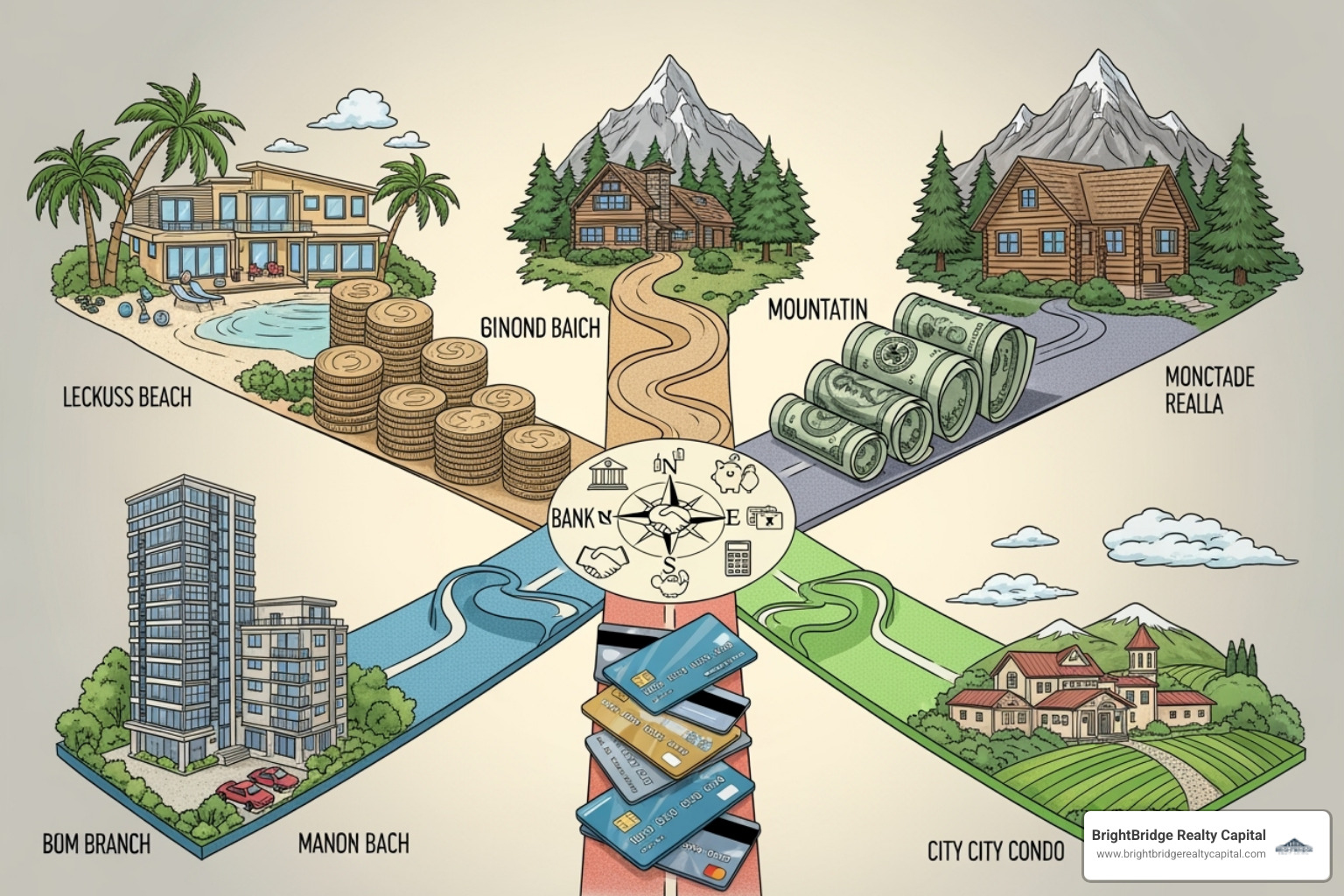
Finding the right vacation property financing doesn't have to feel like navigating a maze. Think of it like choosing the perfect vacation destination—there's no single best answer, but there is a perfect match for your specific goals, financial situation, and risk tolerance. The key is to understand your primary objective from the outset. Are you buying a cozy retreat for personal family getaways? Or are you acquiring an asset designed to generate a steady stream of rental income? Your intended use is the compass that will guide you to the right loan product.
Let's walk through the main financing paths, breaking down the mechanics, pros, and cons of each so you can confidently pick the one that aligns with your dreams and your wallet.
Specialized Vacation Property Loans (for Second Homes)
If your primary goal is personal enjoyment, you'll be looking at loans that fall under the "second home" category. These conventional loans are offered by most banks and mortgage lenders and function similarly to a primary home mortgage, but with underwriting tailored for a non-primary residence.
- Fixed-Rate Mortgages: This is the most popular choice, offering the stability and peace of mind of a predictable monthly payment. Your interest rate is locked in for the entire loan term (typically 15 or 30 years), making it easy to budget for your second property's expenses without worrying about market fluctuations. A 30-year term offers a lower monthly payment, while a 15-year term builds equity faster and saves a significant amount in total interest paid.
- Adjustable-Rate Mortgages (ARMs): ARMs can be an attractive option for some buyers. They offer a lower introductory interest rate for a fixed period—commonly 5, 7, or 10 years (known as a 5/1, 7/1, or 10/1 ARM). After this initial period, the rate adjusts annually based on a specific market index. The lower initial payments can free up cash for furnishing, renovations, or building a reserve fund. However, you must be comfortable with the risk that your payments could increase significantly after the fixed period ends. ARMs are often best for buyers who plan to sell the property before the adjustment period begins or who have a high-risk tolerance.
- Competitive Interest Rates: While rates for second homes are higher than for primary residences, they are still very competitive. The premium you'll pay typically ranges from 0.125% to 0.375%, depending on your credit score, down payment, and the lender.
- Qualification Requirements: Underwriting for a second home loan is all about you. Lenders will conduct a deep dive into your personal finances, looking for strong credit scores (ideally 720+), a low debt-to-income (DTI) ratio, and substantial cash reserves. They need to be certain you can comfortably afford both mortgages without any help from potential rental income.
DSCR and Investment Property Loans
When your vacation property's primary purpose is to be a business, the financing options change completely. Investment property loans are designed for this purpose, and the most powerful tool in this category is the DSCR loan.
- Higher Down Payments: The barrier to entry is higher. Expect to put down at least 20-25%. This larger upfront investment reduces the lender's risk and demonstrates your commitment to the property's financial success.
- Risk-Based Interest Rates: Reflecting the added uncertainty of a rental business, these rates typically run 0.5% to 0.75% higher than conventional second home loans. The final rate will depend on the property's DSCR, your credit score, and the loan-to-value ratio.
- The Power of the Debt Service Coverage Ratio (DSCR): This is the game-changer. DSCR is a simple calculation: Projected Annual Rental Income / Annual Mortgage Debt. A DSCR of 1.0 means the income exactly covers the debt. Most lenders require a DSCR of 1.25 or higher. For example, if the property's annual mortgage payments (PITI) are $24,000, a lender would want to see projected rental income of at least $30,000 ($24,000 x 1.25). The income projection is typically determined by a professional appraiser's rental analysis or data from services like AirDNA.
- Flexible Income Verification: This is where DSCR loans truly shine. Because the loan qualifies based on the property's cash flow, lenders don't need to scrutinize your personal tax returns, W-2s, or pay stubs. This is a massive advantage for self-employed investors, retirees, or anyone with a complex financial situation that doesn't look neat on a standard application.
- Property Cash Flow as Qualification: The property itself, not your job, becomes the primary qualification tool. If you can find a property that pencils out with a strong DSCR, you can likely get it financed, regardless of your personal income documentation.
Leveraging Your Existing Assets
Sometimes the most efficient financing solution is sitting in your existing portfolio. Using the equity in your primary residence or other assets can provide fast, flexible capital for your vacation property purchase.
- Home Equity Line of Credit (HELOC): A HELOC functions like a credit card secured by your home's equity. You are approved for a maximum credit line and can draw funds as needed during a "draw period" (usually 10 years). You only pay interest on the amount you've borrowed. This flexibility is perfect for covering a down payment, funding renovations, or having a ready source of cash for future investment opportunities.
- Cash-Out Refinancing: This involves replacing your current primary mortgage with a new, larger one and taking the difference in cash. This provides a lump sum of money at a fixed interest rate. This strategy works best when current mortgage rates are low, allowing you to potentially refinance into a better rate while also accessing cash. Be mindful of closing costs, which can be substantial.
- Asset-Based Lending (Portfolio Loans): For high-net-worth individuals, a portfolio loan (or pledged asset loan) can be a powerful tool. Instead of borrowing against real estate, you borrow against the value of your stock and bond portfolio. These loans often offer very competitive rates and fast funding with minimal paperwork, as the assets are liquid and held by the lending institution. This allows you to access capital without having to sell your investments and trigger capital gains taxes.
At BrightBridge Realty Capital, we understand that sophisticated investors need creative and flexible solutions. Our rental loans are built on the DSCR model, and our stabilized bridge loan options can provide short-term capital to acquire or reposition a property when traditional financing doesn't fit your timeline or strategy.
Qualifying for Your Vacation Home Loan

Picture this: you've found the perfect lakeside cabin or that charming beachfront cottage you've been dreaming about. Your heart is set, but now comes the most critical step—proving to lenders that you are a qualified, reliable borrower ready for vacation property financing. Think of this process as building a comprehensive case for your financial stability. It's like preparing for an important job interview, except this interview could land you the keys to your personal paradise.
The qualification process isn't designed to be intimidating. It's a system of checks and balances that ensures you can comfortably afford your dream property without overextending your finances. Lenders want you to succeed just as much as you do; a successful borrower is a profitable customer, while a foreclosure is a loss for everyone involved.
Here's a pro tip that will give you a significant advantage: get fully pre-approved before you even start seriously house hunting. Don't confuse this with a simple pre-qualification, which is often just a quick, unverified estimate. A pre-approval involves submitting your financial documents for an underwriter's review. The result is a conditional commitment from the lender for a specific loan amount. This shows sellers you're a serious, credible buyer and allows you to shop with confidence, knowing exactly what your budget is. Many lenders offer streamlined online pre-approval processes that can lock in your rate and clarify your budget from the comfort of your home.
Key Eligibility Criteria for Vacation Property Financing
When underwriting a loan for a vacation property, lenders meticulously examine four pillars of your financial health. Mastering these elements is key to a smooth approval.
Credit Score: This is your financial report card. For most vacation home loans, you'll need a FICO score of at least 680. However, to unlock the best interest rates and most favorable terms, you should aim for a score of 720 or higher. A score above 760 puts you in the top tier of borrowers. If your score is below 680, don't despair. Some specialized lenders, particularly those offering DSCR loans for investment properties, may work with scores in the mid-600s, but you should expect to pay a higher interest rate and may need a larger down payment.
Debt-to-Income (DTI) Ratio: Your DTI ratio tells lenders what percentage of your gross monthly income is already committed to debt payments. To calculate it, you sum up all your monthly debt obligations (current mortgage, car payments, student loans, credit card minimums, and the proposed payment for the new vacation home) and divide it by your gross monthly income. Most lenders prefer a DTI ratio of 43% or below, though some may go as high as 50% for exceptionally strong borrowers. A lower DTI demonstrates that you have ample cash flow to handle another monthly payment without strain.
Cash Reserves: This is your financial safety net. Lenders need to see that you have sufficient liquid assets to cover mortgage payments if you face unexpected expenses or a temporary loss of income. For a vacation property, the requirements are stricter. You'll typically need to show enough cash in savings, checking, or non-retirement investment accounts to cover 2-6 months of payments (PITI) for both your primary residence and the new vacation property. This cushion provides the lender with confidence that you won't default at the first sign of trouble.
Stable and Verifiable Income: Lenders crave predictability. They typically want to see at least two years of consistent employment, preferably in the same industry. If you're a salaried or hourly W-2 employee, this is straightforward. If you're self-employed or rely heavily on commissions or bonuses, be prepared for more scrutiny. Lenders will want to see two years of tax returns and will likely average your income over that period to ensure it's stable and likely to continue.
Down Payment & Interest Rate Expectations
The amount you'll need to bring to the closing table and the interest rate you'll secure are directly tied to the property's intended use.
- For a second home (personal use), you can often secure a loan with as little as 10% down, especially with a high credit score. This makes vacation home ownership more accessible than many people assume. However, putting down less than 20% will almost certainly require you to pay Private Mortgage Insurance (PMI), an extra monthly fee that protects the lender until you've built up 20% equity in the property.
- For an investment property, the standard down payment is 20% to 25%. Some lenders may offer programs with 15% down, but 20% is the benchmark that opens up the most options and better terms. This larger equity position is the lender's primary defense against the higher risk of an investment property.
Interest rates follow a similar logic. Second home rates are typically 0.125% to 0.375% higher than primary home rates. Investment property rates are higher still, often 0.5% to 0.75% or more above the best primary mortgage rates. This is known as risk-based pricing.
Required Documentation for Your Application
Organization is your best friend during the application process. Gathering your paperwork ahead of time can dramatically speed up your approval and reduce stress. Create a digital folder and have these documents ready to go:
- Income Documentation:
- W-2 employees: Pay stubs from the last 30-60 days, W-2 forms from the past two years, and federal tax returns for the past two years.
- Self-employed: Two years of personal and business tax returns (all pages and schedules), a year-to-date profit-and-loss (P&L) statement, and a current business balance sheet.
- Asset Documentation (Financial Statements):
- Two months of statements for all checking and savings accounts.
- Two months of statements for any investment or retirement accounts (e.g., 401(k), IRA, brokerage accounts). Be prepared to show all pages, even the blank ones.
- Debt Information:
- A complete list of all monthly debt payments with current balances (car loans, student loans, credit cards).
- Your most recent mortgage statement for your primary residence.
- If applicable, documentation for alimony or child support payments.
- Property-Related Documents (if you're in contract):
- The fully executed sales contract.
- Contact information for the real estate agent and seller.
- Other Potential Documents:
- Gift Letter: If a relative is gifting you funds for the down payment, you'll need a signed letter from them stating the money is a gift and not a loan.
- Letters of Explanation (LOX): Be prepared to write brief explanations for any recent credit inquiries, employment gaps, or large, unusual deposits in your bank accounts.
Having this package ready demonstrates to lenders that you are a serious, organized, and prepared borrower, smoothing the entire approval process and getting you one step closer to those vacation property keys.
Navigating Ownership: Legal and Tax Considerations

You've done it! Your vacation property financing is approved, you've signed the closing documents, and the keys are in your hand. The temptation is to immediately start planning your first getaway or drafting your Airbnb listing. But before you do, it's crucial to tackle the important homework of ownership. This is the "fine print" of owning a vacation home, and understanding it is essential for protecting your investment, maximizing your financial benefits, and staying on the right side of the law.
The rules of the road change dramatically based on how you use the property. A weekend cabin that remains a private family retreat is treated very differently from a bustling short-term rental. Let's break down the critical tax and legal landscape you need to master.
Understanding the Tax Implications
The IRS has specific and complex rules for vacation properties, but they also offer some surprisingly generous benefits if you know how to leverage them. Your tax situation will depend entirely on how many days you use the property personally versus how many days you rent it out.
The 14-Day Rule (The "Tax-Free Income" Loophole): This is one of the best perks in the tax code for vacation homeowners. According to the official IRS guidelines, if you rent out your property for 14 days or fewer during the year, you do not have to report that rental income to the IRS. It is completely tax-free. If you earn $5,000 from renting your lake house for two weeks during the summer, that $5,000 is yours to keep, no taxes owed. The catch? You also cannot deduct any rental-related expenses (like cleaning fees or commissions). Once you rent for a 15th day, the rules change entirely, and all rental income becomes taxable.
The Mixed-Use Property (Rented More Than 14 Days): Once you cross the 14-day rental threshold, your property is considered a business by the IRS. This means you must report all rental income, but it also unlocks a world of deductible expenses. You can deduct the "rental portion" of your costs, including:
- Mortgage interest
- Property taxes
- Insurance
- Utilities (electricity, water, internet)
- Repairs and maintenance
- Cleaning and property management fees
- Supplies (toilet paper, soap, coffee)
- Advertising and platform fees (e.g., Airbnb service fees)
To calculate the deductible portion, you must allocate expenses between personal use and rental use. For example, if you used the property for 30 personal days and rented it for 90 days, the rental use percentage is 75% (90 rental days / 120 total use days). You could then deduct 75% of your eligible expenses against your rental income.
Depreciation: The Powerful Non-Cash Deduction: This is the most significant tax benefit for investment property owners. The IRS allows you to deduct a portion of your property's cost basis (the value of the building, not the land) each year to account for wear and tear. For residential properties, this is done over 27.5 years. For a property with a building value of $400,000, this could mean a deduction of over $14,500 per year ($400,000 / 27.5). This is a "phantom" deduction—you don't spend any cash, but it can significantly reduce your taxable rental income, sometimes creating a paper loss that can offset other income.
Record Keeping is Non-Negotiable: To claim these deductions, you must keep meticulous records. Every receipt, every utility bill, and a detailed log of personal use days versus rental days are essential. Use a spreadsheet or accounting software to track everything from day one.
Local Laws, Regulations, and HOAs
While federal tax rules are consistent, the local regulatory environment is a patchwork that can be complex and is changing rapidly. Many communities, concerned about housing affordability and neighborhood character, are cracking down on short-term rentals (STRs).
- Zoning and Licensing: Before you buy, you must verify that short-term rentals are permitted in that specific zone. Many cities and counties now require a short-term rental license or permit to operate legally. These often come with application fees, annual renewals, and strict compliance requirements.
- Occupancy and Use Limits: Municipalities often impose strict limits on the number of guests, the number of rental days per year, or even the number of separate rental contracts you can have. For example, some resort towns may cap rentals at 90 days per year.
- Taxes: Be prepared to collect and remit local and state lodging taxes or transient occupancy taxes. These are similar to the taxes you pay at a hotel and can add 5-15% to the cost of a booking. Failure to do so can result in severe penalties.
- Homeowners' Association (HOA) Rules: This is a critical and often overlooked hurdle. Even if the city allows STRs, your HOA may have its own covenants and restrictions that completely forbid them or impose their own set of rules and fees. Always get a copy of the HOA documents and review the rental restrictions before making an offer.
- Specialized Insurance: Your standard homeowner's policy will not cover commercial rental activity. You will need to secure either a landlord policy (for long-term rentals) or a specialized short-term rental insurance policy. This is essential to protect you from liability claims (e.g., a guest slipping and falling) and property damage caused by renters.
The bottom line: Due diligence is paramount. Before you finalize your vacation property financing, you or your real estate agent must thoroughly research the current local regulations and HOA rules. A dream investment can quickly become a legal nightmare if you skip this step.
Frequently Asked Questions about Vacation Property Financing
Let's tackle some of the most common, practical questions I hear from clients who are navigating the world of vacation property financing. These are the real-world concerns that can make the difference between a smooth process and a stressful one.
How much of a down payment do I really need for a vacation home?
This is the most frequent question, and the answer truly depends on the property's classification. There's good news if you're buying a personal retreat. For a property classified as a second home, you can often secure a conventional loan with as little as 10% down. This is a major advantage that makes ownership more accessible. However, this requires a strong financial profile, particularly a high credit score (720+). If you put down less than 20%, you will be required to pay Private Mortgage Insurance (PMI), which increases your monthly payment.
For an investment property, the standard is much higher. Lenders want to see more of your own capital at risk, so you should expect to put down 20% to 25%. Some specialized lenders, like those offering DSCR loans, may have programs that allow for 15% down, but these often come with higher interest rates or fees. The 20-25% range is the sweet spot that will give you access to the most competitive loan programs.
Are interest rates always higher for a vacation home loan?
Yes, you should expect to pay a higher interest rate than you would for a mortgage on your primary residence. Lenders view these loans as carrying more risk. From their perspective, if a borrower encounters financial trouble, they will prioritize the mortgage on the home they live in over the one for their vacation spot. This increased risk is priced into your interest rate.
For a second home, the rate premium is typically modest, often in the range of 0.125% to 0.375% higher than a primary home loan. For an investment property, the premium is more significant, usually 0.5% to 0.75% or even higher, depending on the loan type, your credit, and the property's characteristics. While the rates are higher, they are still very competitive compared to other forms of financing, like personal loans or business loans.
Can I use a government-backed loan (FHA, VA, USDA) for a vacation home?
This is a common point of confusion, and the answer is a clear no. Government-backed loan programs like FHA, VA, and USDA are exclusively designed to promote homeownership for primary residences. They all have strict owner-occupancy requirements, meaning you must live in the home as your main dwelling for a specified period (usually at least one year). These programs cannot be used to finance second homes or investment properties. Attempting to do so is a form of mortgage fraud. For vacation property financing, you will need to explore conventional loans or specialized investment loan products from private lenders.
Can I buy a vacation property through an LLC?
Yes, and for an investment property, it's often highly recommended. Holding a rental property in a Limited Liability Company (LLC) can provide a crucial layer of liability protection, separating your personal assets from your business assets. If a guest is injured on the property and sues, they would typically sue the LLC, not you personally. However, you generally cannot use a standard conventional second-home loan to buy a property in an LLC's name. These loans must be made to an individual. To purchase in an LLC, you will almost always need a commercial loan or a specialized investment product like a DSCR loan, which are specifically designed to lend to business entities.
Does potential rental income help me qualify for the loan?
This is another critical question that depends on the loan type. For a conventional second home loan, the answer is generally no. The underwriting is based on your ability to afford the property using your existing, stable income (from your job, etc.). The lender will not consider potential rental income in your DTI calculation.
For an investment property loan, the answer is a resounding yes. In fact, it's the central component of qualification. With a DSCR loan, the lender's primary focus is on the property's projected rental income and whether it's sufficient to cover the mortgage and other expenses. Your personal income is a secondary consideration, if it's considered at all. This is why these loans are so effective for building a rental portfolio.
Conclusion: Turning Your Vacation Dream into a Reality
Your dream vacation property—a source of cherished memories, a peaceful escape, and a powerful financial asset—is closer than you think. Throughout this comprehensive guide, we've delved deep into the world of vacation property financing. We've dissected the critical differences between second homes and investment properties, explored a full spectrum of loan options from conventional mortgages to sophisticated DSCR products, detailed the rigorous qualification process, and navigated the complex web of tax and legal considerations.
The path to owning your perfect getaway is paved with three essential ingredients: thorough preparation, deep understanding, and the right financial partner. Whether you're dreaming of quiet weekend escapes to a mountain cabin or strategically building wealth through a high-performing beachfront rental, the financing options we've covered provide a clear roadmap to make it happen.
Here's the key takeaway: Your strategy must begin with your goals. Are you buying a personal retreat for family memories? A conventional second home loan with a 10% down payment might be the perfect fit. Are you focused on generating rental income and building a property portfolio? DSCR loans, which qualify based on the property's cash flow potential rather than your personal W-2, are the ideal tool for the savvy investor. Understanding concepts like depreciation, the 14-day tax rule, and local short-term rental ordinances is no longer optional—it's fundamental to your success.
The vacation rental market continues its explosive growth, creating unprecedented opportunities for property owners. But long-term success requires more than just finding a great property; it demands a sophisticated financing strategy and a lender who understands the unique velocity and challenges of the real estate investment landscape.
At BrightBridge Realty Capital, we specialize in making vacation property financing simple, transparent, and fast. As a direct lender, we eliminate the middleman delays and bureaucratic red tape common at traditional banks. This allows us to offer competitive rates and close loans in a fraction of the time—often within a week. We know that real estate investors need flexibility, speed, and certainty of execution, which is why we've built our entire process around your success.
Ready to turn your vacation property dreams into a tangible reality? Whether you're a first-time buyer testing the waters or an experienced investor looking to expand your portfolio, our team provides the customized, creative financing solutions you need. For investors seeking fast, flexible funding for rental properties, exploring specialized loan options is the most efficient path to ownership. Learn more about our DSCR loan programs and discover how our expertise can help you make paradise possible.
Your slice of paradise is waiting. Let's make it yours.