Stop Guessing and Start Calculating Your 10-Year Home Equity Payments


Summary
Calculate your HELOC payments accurately with our HELOC calculator. Master draw periods, repayment, equity access & strategic uses now!
What a HELOC Calculator Tells You Before You Borrow
A heloc calculator is more than just a digital tool; it is a financial compass that helps you navigate the complex landscape of home equity. For many homeowners, their property is their largest asset, yet much of its value remains locked away in the form of equity. A Home Equity Line of Credit (HELOC) provides a way to tap into that value, but doing so without a clear mathematical roadmap can lead to significant financial strain. The calculator helps you estimate two key numbers: how much you can borrow against your home equity, and what your monthly payments will look like — both during the initial draw period and the subsequent repayment phase.
Understanding these numbers is critical because a HELOC is a dynamic financial product. Unlike a traditional fixed-rate mortgage, the terms, rates, and payments of a HELOC can shift over time. By using a calculator, you are essentially "stress-testing" your budget against various economic scenarios, such as rising interest rates or changes in your home's market value.
Here's a quick snapshot of the primary inputs you will encounter:
InputWhat It DoesHome valueSets your borrowing ceiling based on current market conditionsMortgage balanceReduces available equity by accounting for existing liensLTV (80-85%)Determines the maximum credit line a lender is willing to extendInterest rate (6-9% APR)Drives your monthly payment and is usually tied to the Prime RateDraw period (5-10 years)The interest-only payment phase where you can access fundsRepayment period (10-20 years)The principal + interest phase where the line is closed to new draws
Quick example: Imagine a $500,000 home with a $210,000 mortgage. At an 80% LTV (Loan-to-Value) ratio, a lender would allow a total debt of $400,000. Subtracting your existing mortgage leaves you with up to $190,000 in available credit. On a $50,000 draw at 8% APR, you'd pay roughly $333/month during the draw period. However, once the repayment period begins, that payment could rise to around $478/month or more, depending on the remaining term.
Most homeowners are surprised by that jump. The draw period feels incredibly affordable because interest-only payments keep immediate costs low. This can create a false sense of security. Then, the repayment phase kicks in, and payments can nearly double overnight as you begin to pay back the principal you borrowed. This "payment shock" is a common pitfall for those who don't plan ahead.
That gap is exactly why running the numbers before you borrow matters. It allows you to visualize the long-term impact on your cash flow. I'm Daniel Lopez, a loan officer at BrightBridge Realty Capital. In my years of experience, I've seen how strategic equity use can build wealth, and how poor planning can erode it. We help investors and homeowners use tools like a heloc calculator to structure smarter, more strategic financing decisions. Let's walk through exactly how these calculations work — and how to use them to your advantage.
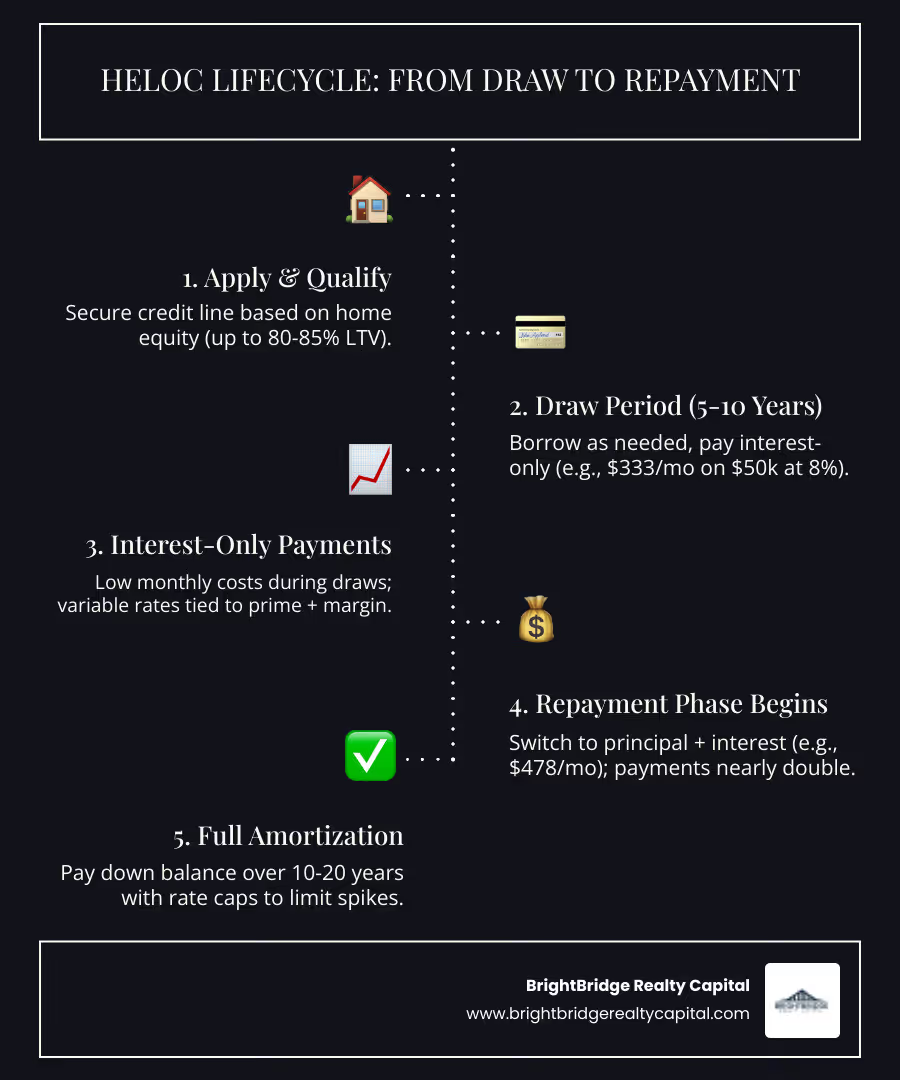
Heloc calculator terminology and related resources:
Understanding the Mechanics of a HELOC Calculator
When we sit down with a heloc calculator, we aren't just playing with random numbers. We are looking at the pulse of your financial health and the structural integrity of your investment strategy. A Home Equity Line of Credit (HELOC) is a revolving line of credit secured by your home, much like a credit card with a significantly higher limit and a much lower interest rate. But unlike a credit card, the "limit" isn't arbitrary; it's mathematically tied to your home's value and your existing debt obligations.

To get an accurate estimate, the calculator requires several specific inputs, each of which plays a vital role in the final output:
- Home Value: This is the current fair market value of your property. In New York, where property values can shift rapidly due to neighborhood gentrification or shifts in the luxury market, getting a fresh appraisal or a solid estimate is the first step. A heloc calculator is only as good as the data you feed it; if you overestimate your home's value, you'll be disappointed when the bank's appraisal comes back lower.
- Mortgage Balance: This is the total amount you currently owe on your primary mortgage and any other liens against the property. Since a HELOC is a "second mortgage" or junior lien, your first lender gets paid first in a worst-case scenario. The amount of equity you can tap is the difference between your home's value (multiplied by the lender's LTV limit) and this balance.
- Loan-to-Value (LTV) and Combined Loan-to-Value (CLTV): Lenders typically limit your total debt (first mortgage + HELOC) to 80% or 85% of your home's value. This is known as the CLTV. For example, if your home is worth $1,000,000, an 80% CLTV means your total debt cannot exceed $800,000. If your first mortgage is $500,000, your HELOC limit would be $300,000.
- Credit Score: Your FICO score heavily influences the "margin" a lender adds to the base interest rate. While some lenders accept scores as low as 620, a score of 720+ usually unlocks the best rates. A higher credit score signals to the lender that you are a lower-risk borrower, which translates directly into lower monthly interest payments in your calculator results.
One critical piece of the puzzle that often gets overlooked is the IRS guidance on home equity interest. According to IRS Publication 936, interest on a HELOC is generally only tax-deductible if the funds are used to buy, build, or substantially improve the home that secures the loan. This means if you use the money to consolidate credit cards or buy a boat, that tax benefit usually disappears, effectively increasing the "real" cost of the loan. When using a heloc calculator, you should consider whether the interest will be deductible, as this affects your after-tax cost of capital.
Estimating Draw Period Costs with a HELOC Calculator
The draw period is often referred to as the "honeymoon phase" of your HELOC. Usually lasting 5 to 10 years, this is the time when you can pull money out as needed, repay it, and pull it out again. It offers unparalleled flexibility for homeowners who have ongoing expenses, such as a multi-stage home renovation or a child's college tuition.
Most heloc calculator tools assume interest-only payments during this phase. Here is how that math works in a real-world scenario:
- The Index: Most HELOCs use the Prime Rate as their base. The Prime Rate is typically 3% higher than the Federal Funds Rate set by the Federal Reserve. As of early 2025, rates have hovered between 6% and 9% APR, depending on the economic climate and inflation targets.
- The Margin: This is the extra percentage the lender adds based on your creditworthiness (e.g., Prime + 1%). If the Prime Rate is 7.5% and your margin is 1%, your effective APR is 8.5%.
- The Calculation: If you have a $50,000 balance at an 8% APR, your monthly interest-only payment is calculated by multiplying the balance by the rate and dividing by 12. ($50,000 * 0.08) / 12 = $333.33.
The danger here is that because the rate is variable, your payment can fluctuate. If the Federal Reserve raises rates to combat inflation, your "interest-only" payment climbs immediately. We always recommend that clients learn how does a heloc work in detail so they aren't caught off guard by a sudden $50 or $100 increase in their monthly bill. A good heloc calculator will allow you to simulate a 1% or 2% rate hike to see how it impacts your budget.
Planning for the Repayment Phase Using a HELOC Calculator
Once the draw period ends, the "repayment period" begins—typically lasting 10 to 20 years. This is where the financial reality of the loan sets in. You can no longer withdraw money, and your monthly payment must now cover both the interest and the principal. This is known as fully amortized payments.
Using a heloc calculator to look at the amortization schedule is eye-opening. For that same $50,000 balance at 8% APR, a 20-year repayment schedule pushes your payment from $333.33 to $418.22. If your repayment term is shorter—say 10 years—that payment jumps to over $600. This is a 100% increase from the draw period payment.
Lenders do include "rate caps" to protect you from infinite increases (such as a lifetime cap of 18%), but the "payment spike" at the end of the draw period is the number one reason people find themselves in financial trouble or forced into a sub-optimal refinance. Understanding what is a home equity line of credit means recognizing it as a two-stage financial commitment. You must have a plan for the day the draw period ends, whether that is paying off the balance in full, refinancing into a fixed-rate loan, or ensuring your income can handle the higher amortized payments.
How Much Equity Can You Actually Access?
One of the most common questions we hear at our New York office is: "How much can I actually get?" It’s not just about the math; it’s about the lender’s appetite for risk and the current state of the real estate market. In a rising market, lenders may be more aggressive, but in a cooling market, they often pull back on LTV limits to protect themselves from falling home values.
Lenders use the CLTV (Combined Loan-to-Value) ratio to set your limit. This ratio takes into account all debt secured by the property. Here is a detailed breakdown of how that looks in practice for a typical homeowner:
The 80% vs. 85% LTV Comparison Table
Component80% LTV Limit85% LTV LimitHome Value$500,000$500,000Max Total Debt Allowed$400,000$425,000Current Mortgage Balance$210,000$210,000Max HELOC Limit$190,000$215,000
While the extra $25,000 at 85% LTV looks attractive, it often comes with a "risk premium." This means you might face a higher interest rate or stricter credit requirements. Furthermore, some lenders will only offer 85% LTV on primary residences, while capping investment properties at 70% or 75%. Beyond equity, lenders look at your Debt-to-Income (DTI) ratio. This is the percentage of your gross monthly income that goes toward paying debts. Most lenders prefer a DTI below 43%, though some flexible programs go up to 50% for high-net-worth individuals or those with significant cash reserves.
When using a heloc calculator, it is wise to run the numbers at both 80% and 85% LTV to see the difference in potential liquidity. However, you must also account for the appraisal process. A lender will not take your word for the home's value; they will hire a professional appraiser or use an Automated Valuation Model (AVM). If the appraisal comes in lower than expected, your available credit line will shrink accordingly. This is why we suggest being conservative with your home value estimate when first using a calculator.
For those looking at non-primary residences, the rules change significantly. Investment properties are viewed as higher risk because, in a financial crisis, people are more likely to default on a rental property than their own home. We’ve put together a comprehensive investment property equity line guide to help investors navigate the tighter equity requirements and different pricing structures often found in the rental market. Understanding these nuances is key to building a scalable real estate portfolio.
Comparing HELOCs to Other Financing Strategies
A HELOC isn't always the right tool for the job. Depending on your goals, a lump-sum loan or a full refinance might be more advantageous. A heloc calculator can help you compare the monthly costs, but you also need to consider the long-term interest expense and the flexibility of the funds.
- HELOC vs. Home Equity Loan: A home equity loan gives you all the cash upfront at a fixed interest rate. This is ideal for a one-time, fixed-cost project like a roof replacement or a specific debt consolidation amount. You know exactly what your payment will be for the life of the loan. A HELOC, conversely, is better for ongoing needs where you don't want to pay interest on money you haven't used yet. If you have a $100,000 line but only use $10,000, you only pay interest on that $10,000.
- HELOC vs. Cash-Out Refinance: A cash-out refinance replaces your existing mortgage with a new, larger one. This was a very popular strategy when interest rates were at historic lows. However, if your current mortgage has a very low interest rate (like the 2.5% or 3% rates seen in 2020-2021), a cash-out refinance would force you to give up that rate on your entire balance. In this scenario, a HELOC allows you to tap equity at a higher variable rate on just the new portion of debt, while keeping your low-rate primary loan intact.
Closing costs for a HELOC are generally lower than those for a full refinance. While a refinance might cost 3% to 6% of the total loan amount in closing fees, HELOC costs often range from 2% to 5% of the line amount, and some lenders even offer "no-closing-cost" promotions. However, you must stay aware of the IRS news on interest deductibility rules. The Tax Cuts and Jobs Act of 2017 changed the landscape; if you use a HELOC to pay off credit cards or medical bills, you lose the ability to deduct that interest. This can make the effective cost of a HELOC higher than a mortgage where the interest is fully deductible.
For those managing portfolios, home equity loans on investment properties can offer the stability of fixed payments, which is often preferred for long-term cash flow modeling. When you are calculating the ROI on a rental property, having a variable interest rate can introduce too much uncertainty into your monthly profit-and-loss statements. A fixed-rate home equity loan provides the predictability that many professional investors crave.
Strategic Uses for Your Home Equity Line
How you use the money matters as much as how you borrow it. Statistics show that 40% of HELOC users use the funds for debt consolidation, while 23% use them for home improvements. The remaining users often leverage the funds for emergency expenses, business ventures, or further real estate acquisitions. When you run your numbers through a heloc calculator, you should also be calculating the "return on investment" for how those funds will be deployed.
1. Home Improvements: This is widely considered the "gold standard" for HELOC usage. By modernizing a kitchen, adding a bathroom, or finishing a basement, you're potentially increasing the home's market value. This creates a virtuous cycle: you use equity to build more equity. Furthermore, because the funds are used to "substantially improve" the residence, the interest remains tax-deductible under current IRS rules. This makes the effective interest rate even lower than what the calculator shows.
2. Debt Consolidation: If you're carrying credit card debt at 20% or 24% APR, moving that balance to a HELOC at 8% or 9% can save you thousands of dollars in interest and significantly shorten your path to being debt-free. However, we always caution our clients: a HELOC is secured by your home. If you fail to pay, you could lose your house. Moving unsecured credit card debt into a secured HELOC increases your personal risk. Additionally, you must address the spending habits that led to the credit card debt in the first place, or you may find yourself with a maxed-out HELOC and new credit card balances.
3. Real Estate Investing: Many savvy investors use a home equity line of credit to buy rental property. In competitive markets like New York or New Jersey, having a HELOC provides the "dry powder" needed to make quick, all-cash offers. This can give you a significant advantage over other buyers who are waiting on traditional mortgage approvals. Once the new property is renovated and rented, investors often perform a "cash-out refinance" on that specific property to pay back the HELOC, thereby keeping the line open for the next deal. This is a core component of the BRRRR (Buy, Rehab, Rent, Refinance, Repeat) strategy.
4. Emergency Fund / Liquidity Buffer: Sometimes the best use of a HELOC is not using it at all. Having an open line of credit provides a safety net for unexpected life events, such as a job loss or a major medical expense. Since you only pay interest on what you draw, an unused HELOC costs you very little (perhaps just a small annual fee) while providing immense peace of mind. It is much easier to apply for a HELOC while you are employed and your finances are stable than it is when you are in the middle of a crisis.
Frequently Asked Questions about HELOCs
What is the difference between a HELOC and a home equity loan?
Think of a HELOC like a credit card: it’s a revolving line where you only pay for what you use, and the rate is usually variable, meaning it can go up or down with the market. A home equity loan is more like a traditional car loan: you get a lump sum of cash all at once, a fixed interest rate that never changes, and a set monthly payment from day one. A heloc calculator is essential for the former because of the variable nature of the payments.
How do variable interest rates affect my monthly payments?
Most HELOCs are tied to the Prime Rate, which is influenced by the Federal Reserve's monetary policy. If the Fed raises interest rates to fight inflation, the Prime Rate goes up, and your HELOC rate follows. A 1% increase in the rate on a $50,000 balance adds about $41.67 to your monthly interest-only payment. Over a year, that's an extra $500. Using a heloc calculator regularly to "stress test" your budget against potential 2% or 3% rate hikes is a hallmark of a responsible borrower.
What are the typical closing costs for a HELOC?
Closing costs usually run between 2% and 5% of the total credit line. This includes things like a professional appraisal fee (to determine the home's value), a title search (to ensure there are no hidden liens), and lender origination fees. Some lenders offer "no-closing-cost" HELOCs to attract borrowers, but be careful—these often come with slightly higher interest rates or "early closure fees" if you pay off and close the line within the first 24 to 36 months. Always read the fine print regarding these recapture fees.
Can the lender freeze or reduce my HELOC limit?
Yes. Because a HELOC is a revolving line of credit, lenders have the right to reduce or freeze your limit if the value of your home drops significantly or if your financial situation changes (such as a major drop in your credit score). This happened to many homeowners during the 2008 financial crisis. This is why it is important not to rely solely on a HELOC as your only source of emergency funds.
How does a HELOC impact my credit score?
Initially, applying for a HELOC will cause a small, temporary dip in your credit score due to the "hard inquiry." Once the account is open, it can actually help your score by increasing your total available credit and improving your credit utilization ratio—provided you don't max out the line. However, if you carry a high balance relative to the limit, it may be viewed similarly to a maxed-out credit card, which can negatively impact your score.
Conclusion
Navigating the world of home equity doesn't have to be a guessing game or a source of financial anxiety. By using a heloc calculator, you can move from a position of "I think I can afford this" to "I know exactly what my 10-year financial plan looks like." Whether you're looking to renovate your family home to create a better living space, consolidate high-interest debt to find financial freedom, or expand your investment portfolio to build generational wealth, the key is to understand the transition from the flexible draw period to the structured repayment phase.
At BrightBridge Realty Capital, we specialize in helping you unlock the hidden value of your real estate assets. Based in the heart of New York, we provide direct lending solutions with the speed, transparency, and flexibility that traditional big-box banks often lack. We understand that in the fast-paced world of real estate, timing is everything. A delay of even a few days can mean the difference between securing a lucrative investment property and losing it to a competitor. That is why we pride ourselves on our streamlined process and fast closings—often getting our clients the capital they need within a week.
Your home is more than just a place to live; it is a powerful financial engine. When managed correctly with the right tools and professional guidance, it can provide the liquidity you need to achieve your most ambitious goals. Ready to stop guessing and start growing your net worth? Secure your next investment with our Rental Loans and let our team of experts help you build a smarter, more resilient financial future.